Articles about
martech
Thoughts and field notes on MarTech, customer engagement, and solution architecture.
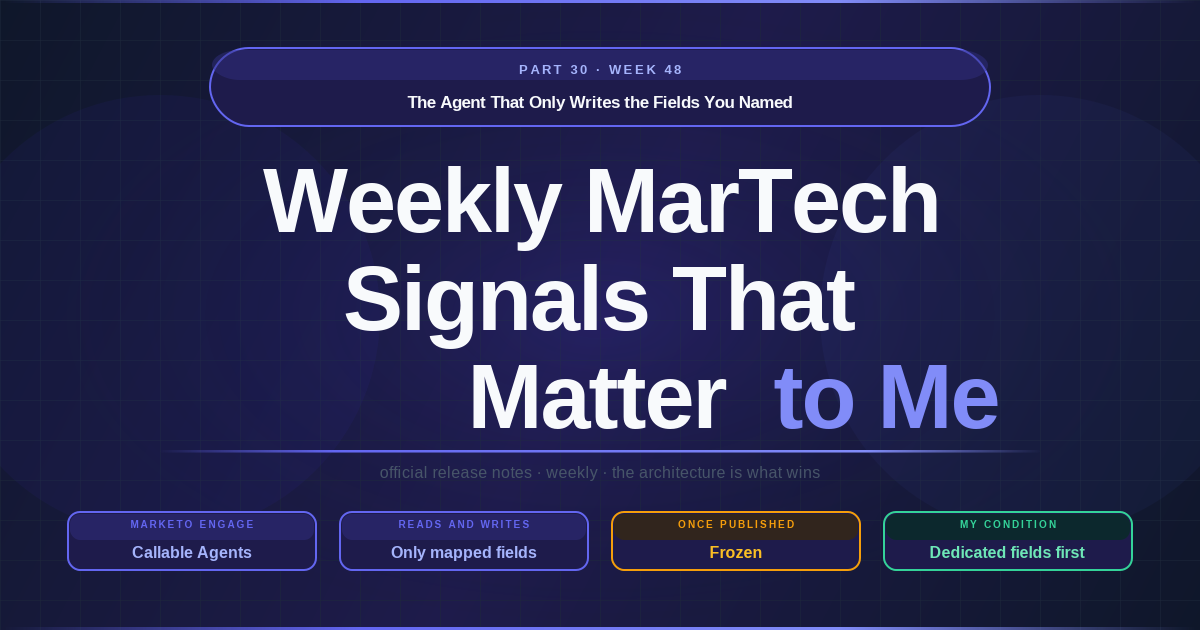
The Agent That Only Writes the Fields You Named: Signals W48
Marketo Engage now lists Callable Agents as Released: an AI agent that runs as a Smart Campaign flow step, reads and writes only the lead fields an administrator maps, and is frozen once published. My position: those limits are the reason to let it run unattended, on fields created for it.
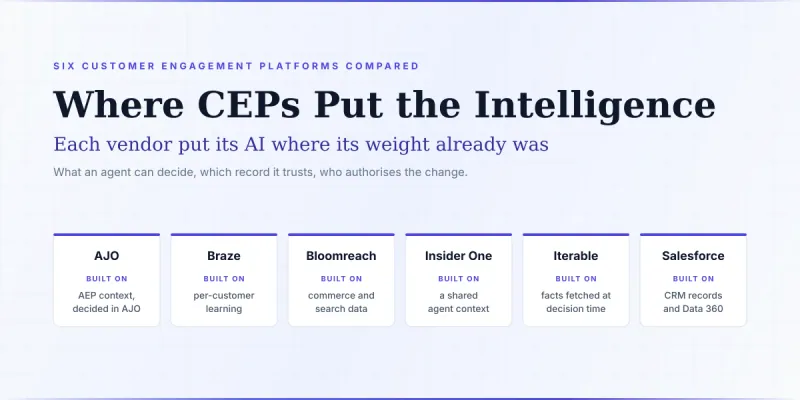
Where CEPs Put the Intelligence: Six Platforms Compared
AJO, Braze, Bloomreach, Insider One, Iterable and Salesforce all ship agents now. Each put its AI where its centre of gravity already was, and that decides what an agent can decide, which record it trusts and who authorises the change.
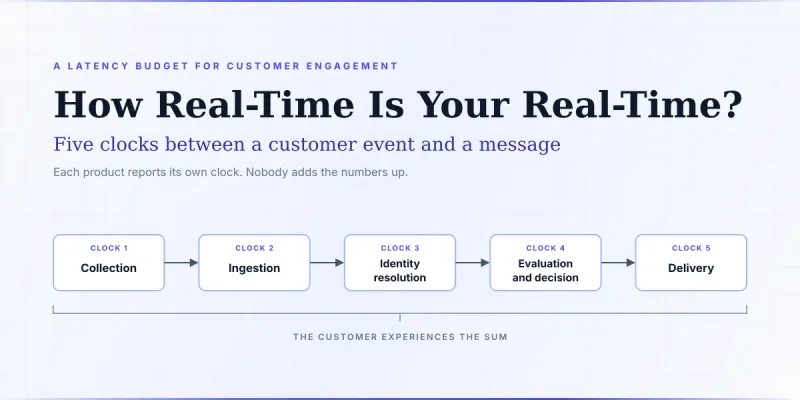
How Real-Time Is Your Real-Time? A Latency Budget for Customer Engagement
Every product between a customer's click and a marketing message can honestly claim to be real-time, and the message can still arrive forty minutes later. Real-time behaviour is a property of the whole chain, and the way to get it is a latency budget set per use case.
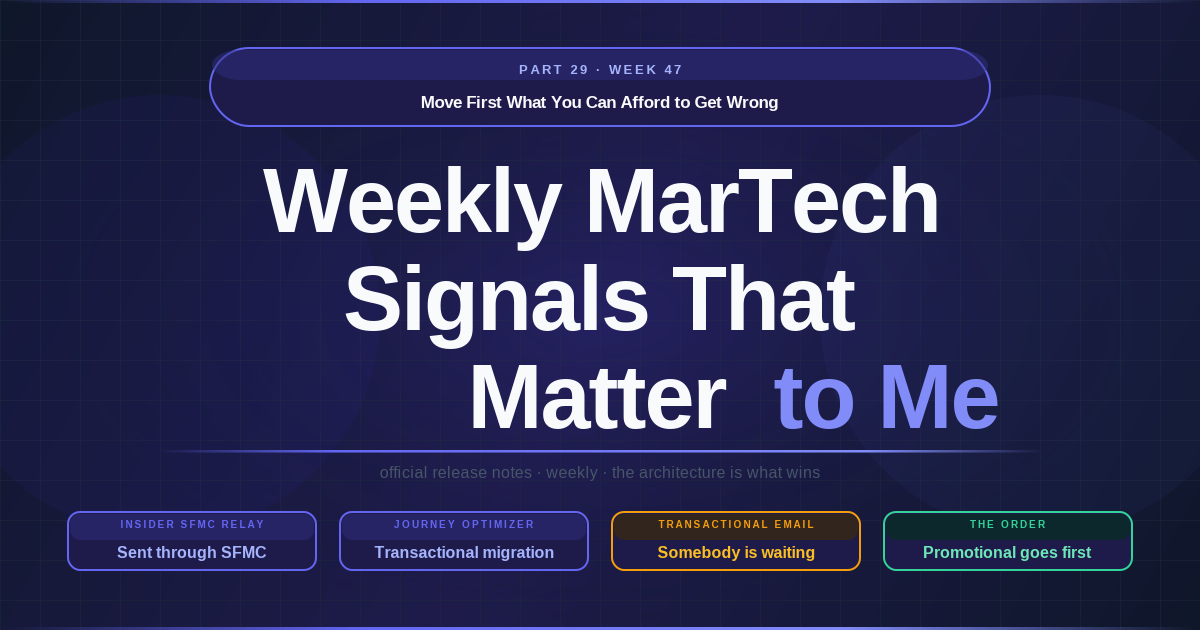
Move First What You Can Afford to Get Wrong: Signals W47
Insider documented a relay that sends promotional email through the customer's own Salesforce Marketing Cloud account, and Adobe Journey Optimizer extended its migration workspace to transactional email. I read them as tools for two different phases of the same plan, and I argue for an order: migrate promotional email first, transactional last.
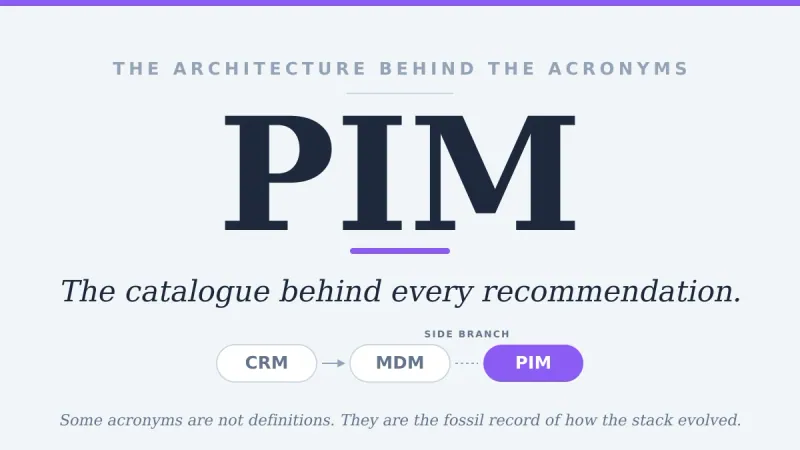
The Architecture Behind the Acronyms (PIM): The Catalogue Behind Every Recommendation
When a recommendation shows a sold-out item or the wrong size range, the engagement platform takes the blame. The failure usually sits in product data, and PIM is the acronym for the layer that marketing architecture rarely budgets for.
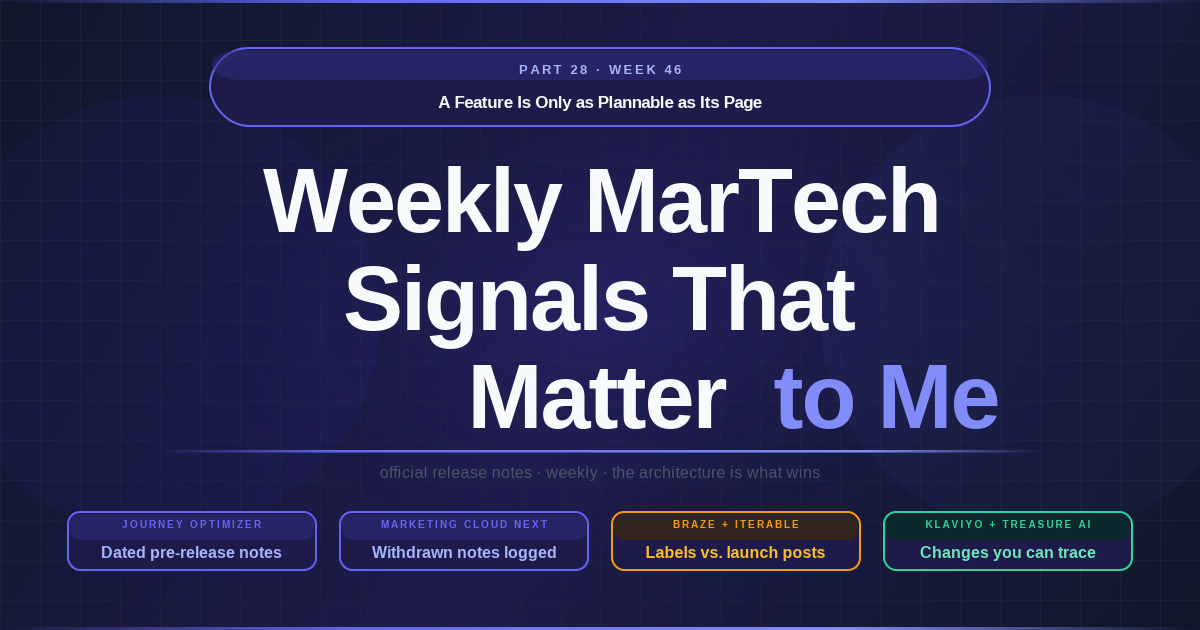
A Feature Is Only as Plannable as Its Page: Signals W46
Adobe Journey Optimizer now publishes what is coming a week before each monthly release, with a date. This week's record shows how differently vendors tell us what is planned, what is live, what is still in beta and what was withdrawn, and why that matters for anyone who plans tests and campaigns around a release.
The Architecture Behind the Acronyms (CMP): The Banner That Became a Layer
CMP started life as the name for a cookie banner inside an adtech framework. The job the category now has to do, holding a customer's permissions across every channel, is one the acronym was never built to describe.
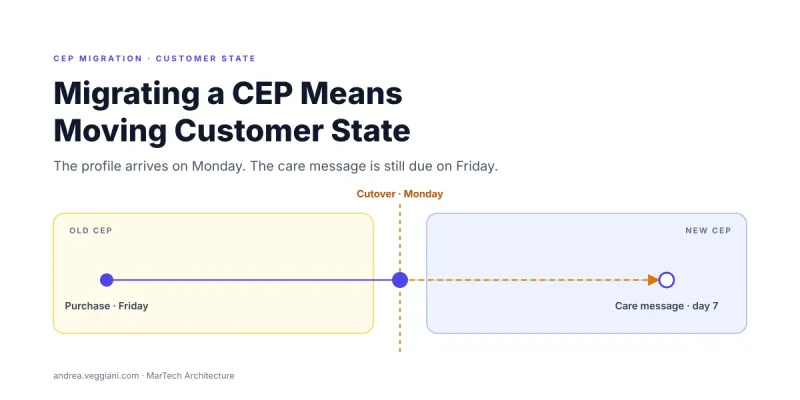
Migrating a CEP Means Moving Customer State
A CEP migration can reproduce every journey diagram and still change what happens to customers already inside it. The cutover depends on what state you preserve, reconstruct or deliberately end.
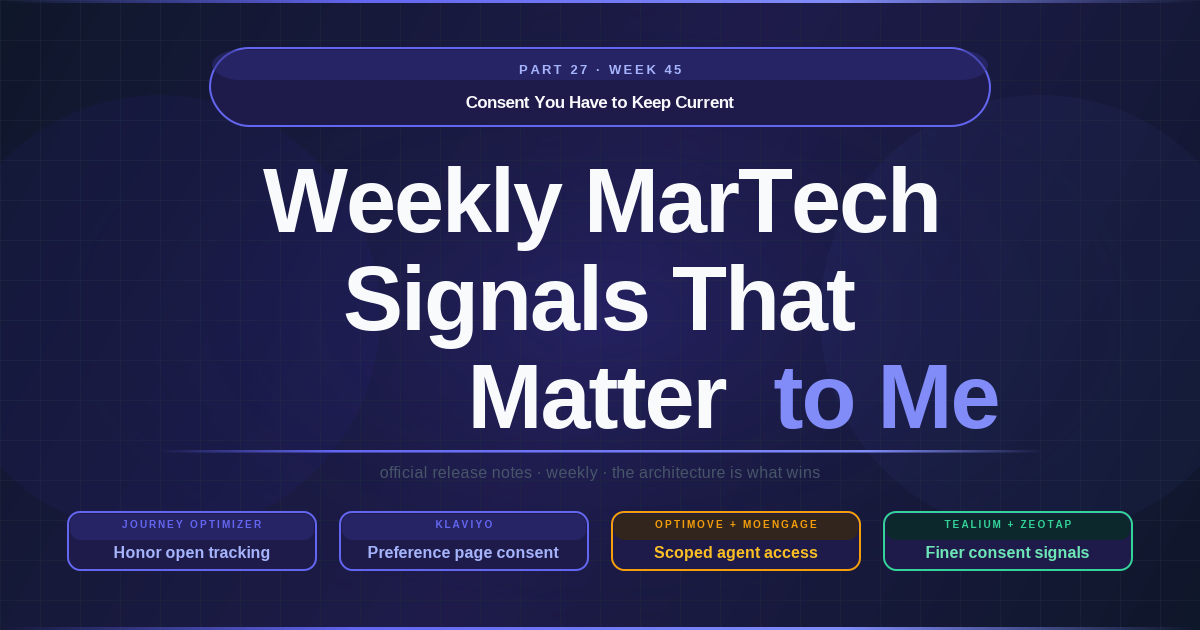
Consent You Have to Keep Current: Signals W45
Tracking consent is moving out of the moment of sending and into the preference centre, where recipients can change it whenever they like. This week's releases show what that asks of the platforms, the consent signals around them and the access model for the agents that now act on the same data.
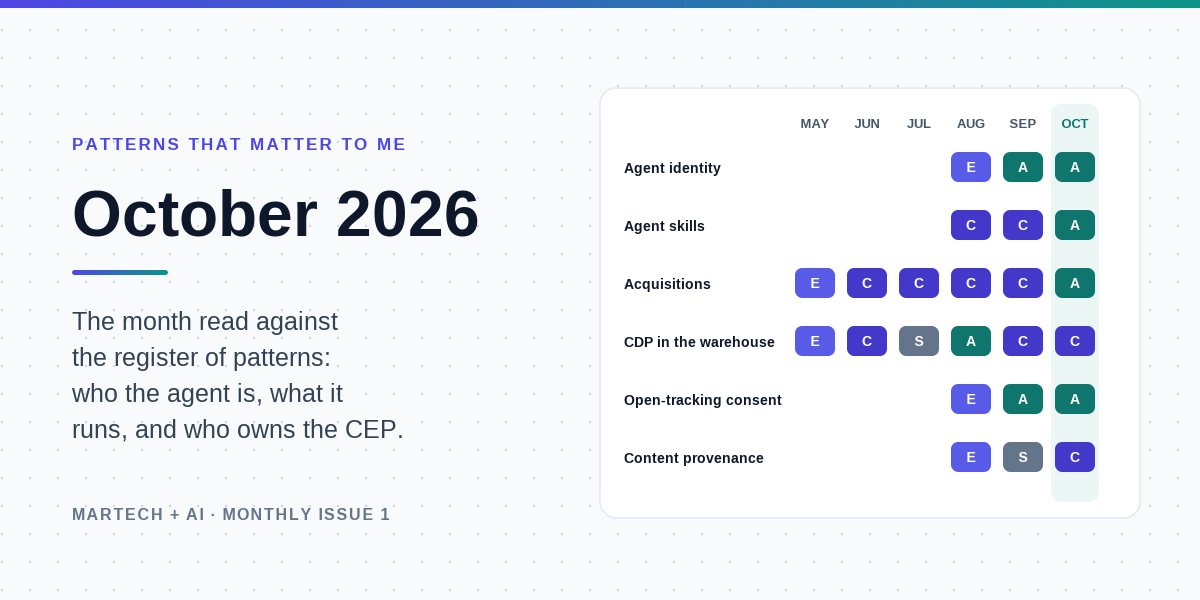
Patterns That Matter to Me: October 2026
The first monthly issue of Patterns That Matter to Me reads October's MarTech and AI Watch editions against a register of eighteen patterns. The agent's identity absorbed MCP as the question vendors answer first, skills became a shared format with a check before they run, and Salesforce agreed to buy Braze.
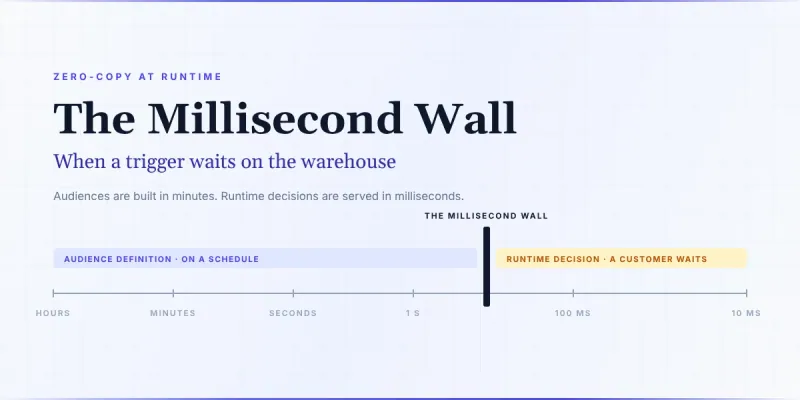
Zero-Copy at Runtime: The Millisecond Wall
Zero-copy activation works well for audiences built on a schedule. Asking an analytical warehouse to answer a single customer's question while an in-app trigger waits is a different workload, and it runs into latency, concurrency and cost long before it runs into governance.
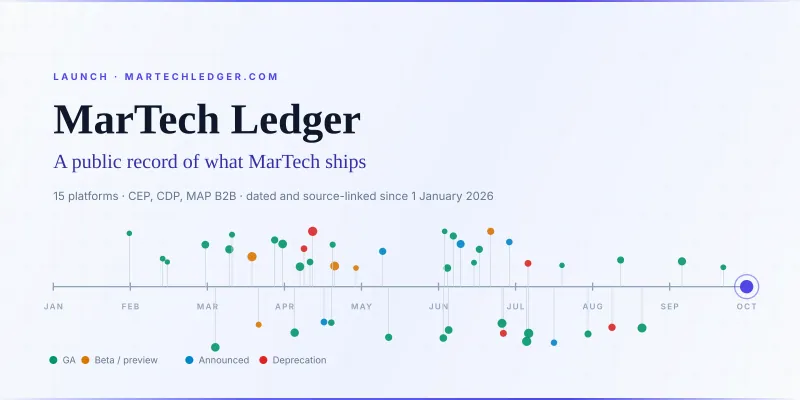
MarTech Ledger: A Public Record of What MarTech Ships
Why I built MarTech Ledger, a dated and source-linked record of what 15 CEP, CDP and B2B marketing automation platforms release, announce and retire, how its AI pipeline works, which tools run it and who it is for.
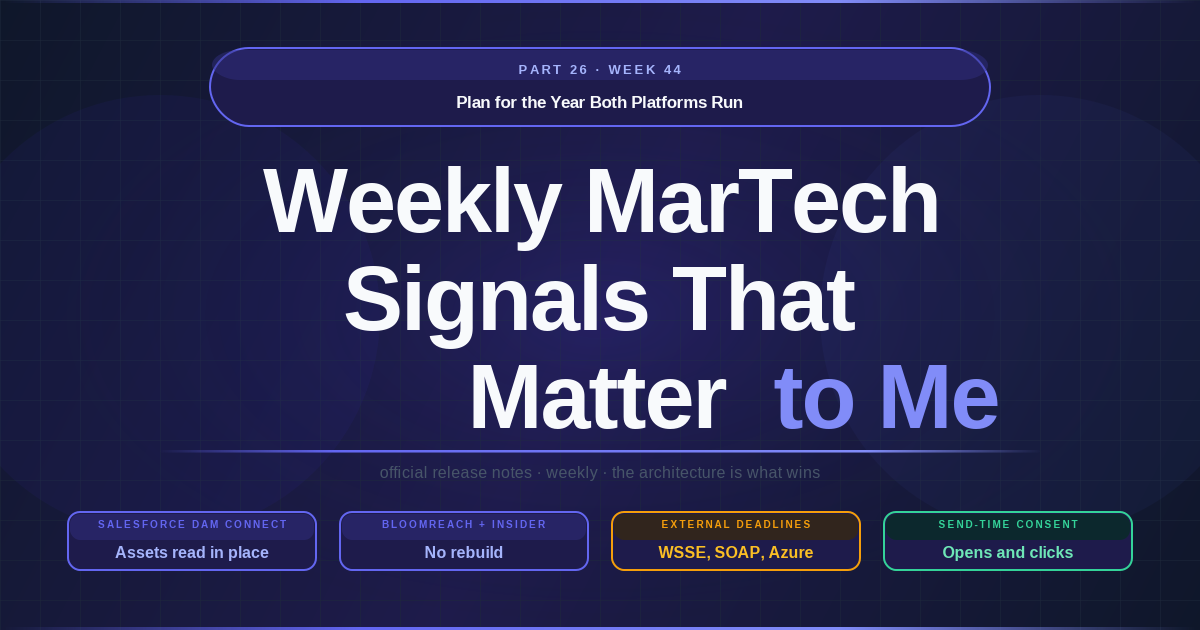
Weekly MarTech Signals That Matter to Me: Part 26, Week 44
Most platform changes are long periods in which the old and the new system run side by side. This week's releases show which features make that period manageable: assets that can be reused across platforms, audiences that arrive without being rebuilt, and consent that is checked at the moment of sending.
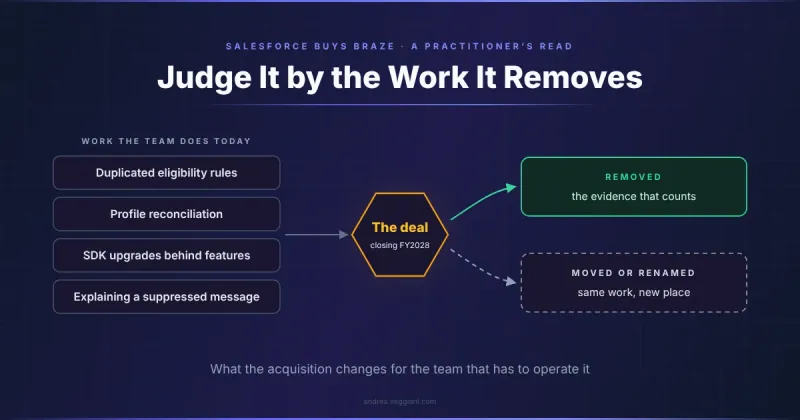
Salesforce Buys Braze: Judge It by the Work It Removes
The Salesforce–Braze deal through the eyes of someone who uses the platforms: strengths you rely on, flaws you hate, and compromises an acquisition still has to resolve.
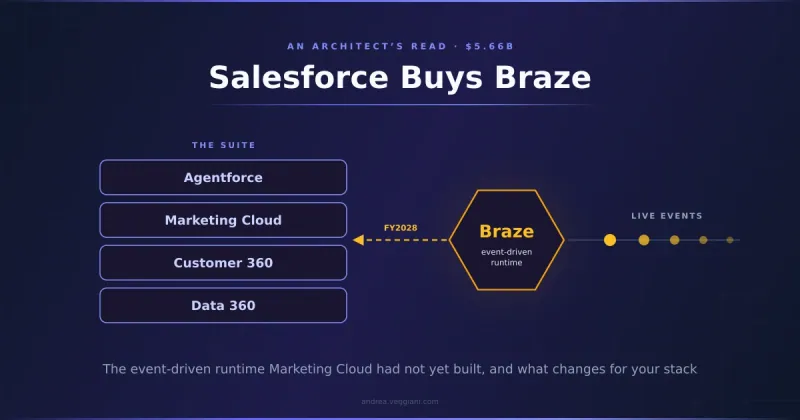
Salesforce Buys Braze: What It Means for Your Stack
Salesforce's $5.66 billion deal for Braze buys an event-driven engagement runtime and the decisioning on top of it, the part of the stack Marketing Cloud's native rebuild had not yet delivered for mobile-first B2C. What it means for Braze customers, Marketing Cloud customers and composable stacks.
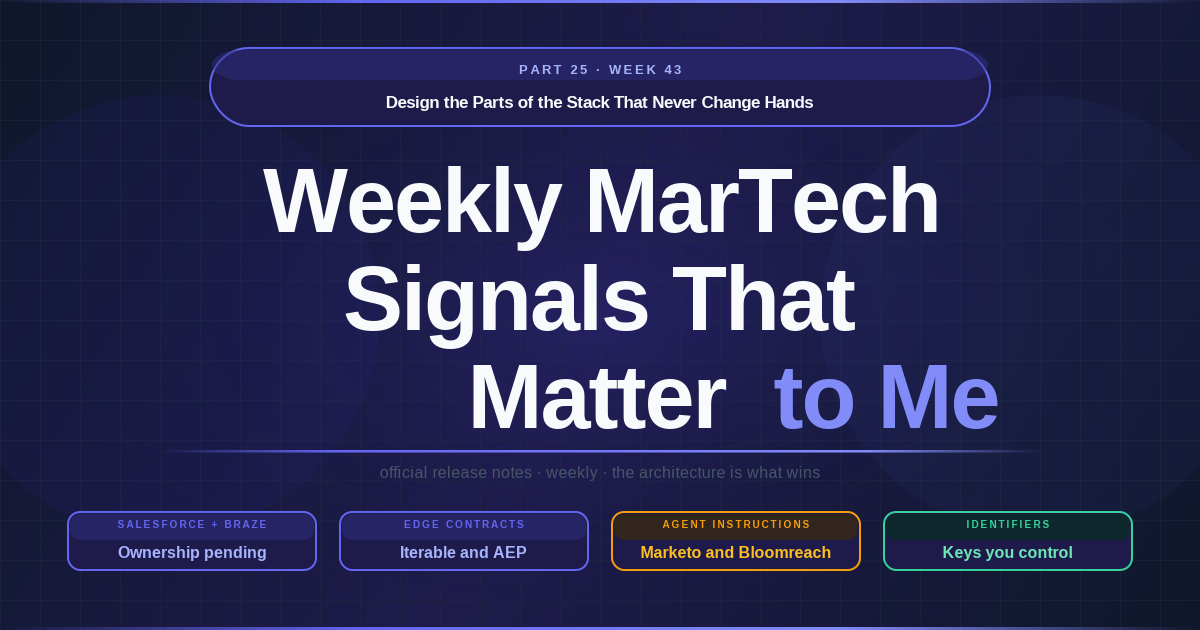
Weekly MarTech Signals That Matter to Me: Part 25, Week 43
Salesforce has agreed to acquire Braze, with the close expected in Salesforce's next fiscal year. For teams running or choosing either platform, the useful question is which parts of their own architecture stay theirs whoever owns the platform: the contracts at the edges, the identifiers that travel, and the instructions written for agents.
The Architecture Behind the Acronyms (iPaaS): Giving Up on One Record
iPaaS is named after the way it is delivered and says nothing about the job it does. Its rise marks the moment enterprises stopped chasing one customer record and started moving state between many.
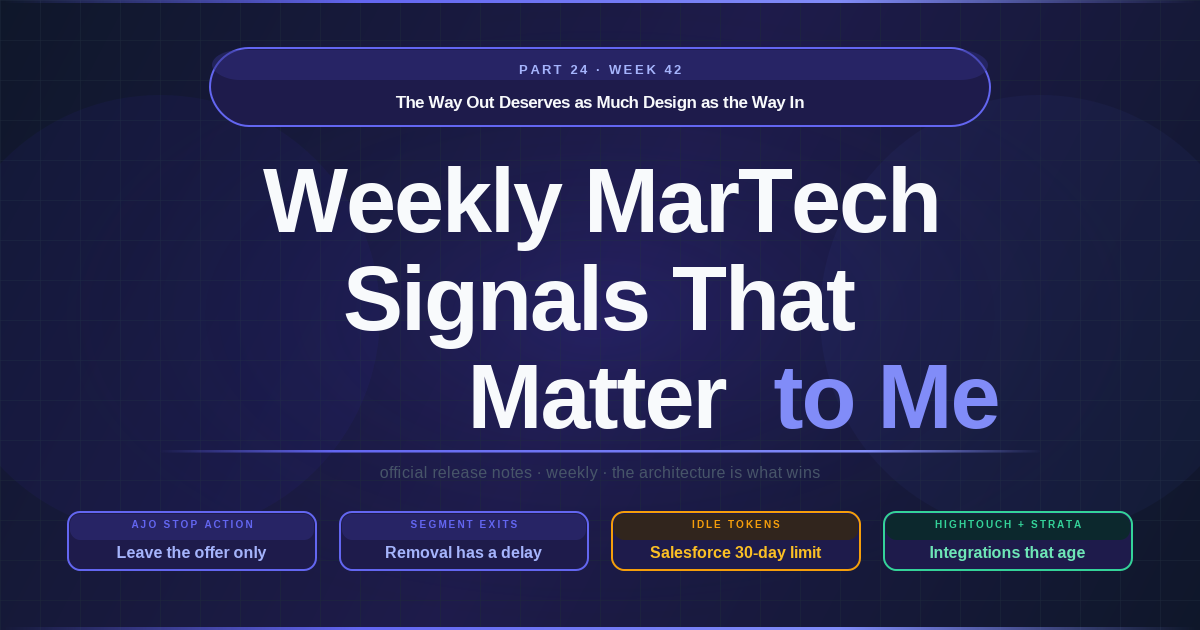
Weekly MarTech Signals That Matter to Me: Part 24, Week 42
Adobe Journey Optimizer can now take a profile out of inbound experiences without ending its journey, Insider removes people who leave a segment from a ChatGPT Ads audience, Salesforce will revoke integration tokens left idle for thirty days, and Hightouch bought an agent that keeps integrations running. The way out deserves as much design as the way in.
The Architecture Behind the Acronyms (MDM): The Referee the CRM Bought
Master data management was built to settle arguments between systems of record. In 2025 the largest system of record bought one of the category's leaders, and that tells you what MDM has become.
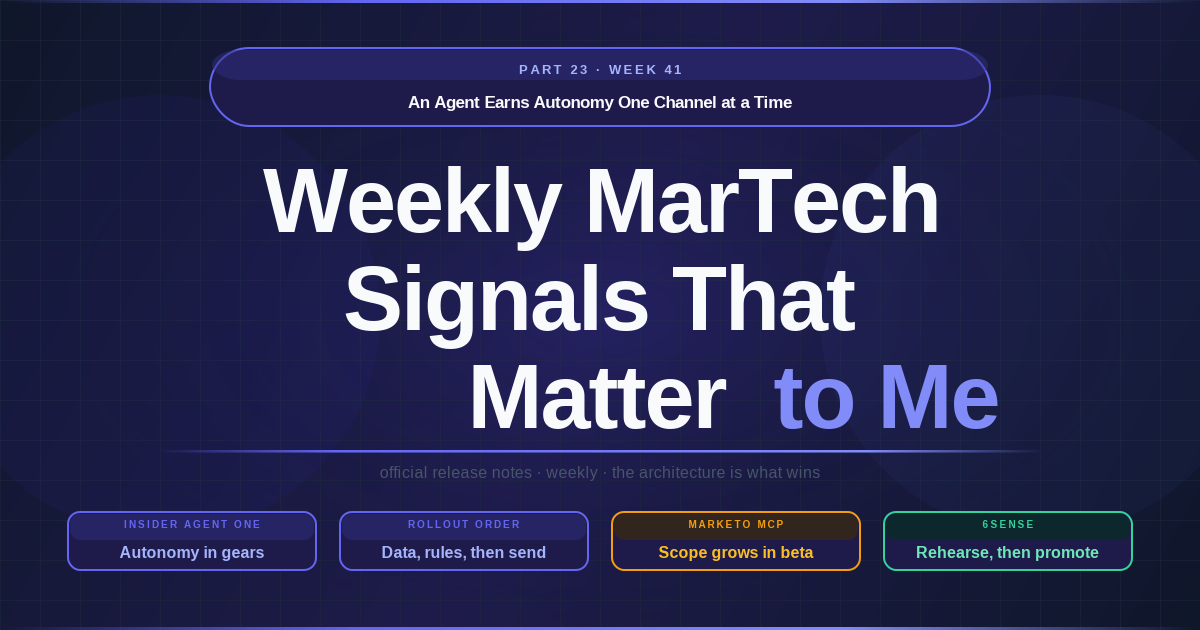
Weekly MarTech Signals That Matter to Me: Part 23, Week 41
Insider made agent autonomy a mode chosen per use case and channel, 6sense let workflows be rehearsed in a sandbox before promotion, Iterable spelled out the order in which a control must be switched on, and Marketo's MCP server gained smart list operations during its open beta. Rollout is becoming part of the product.
Weekly MarTech Signals That Matter to Me: Part 22, Week 40
Braze put its Operator inside Claude and ChatGPT under the individual user's identity, Marketo's MCP server runs as a dedicated API user, and OpenAI gave its specialist dots an identity of their own. Three answers to the first architecture question of agentic marketing.
Weekly MarTech Signals That Matter to Me: Part 21, Week 39
Iterable made the email tracking pixel a per-recipient consent value and Braze made its MCP server sign in as the person using it. The same design decision from two ends of the stack, and the history nobody has planned to keep.
Weekly MarTech Signals That Matter to Me: Part 20, Week 38
Salesforce and HubSpot both announced that their own screen is no longer where you use them, and both answered the governance question with inheritance. What that leaves unresolved for anyone who has to audit it.
The Architecture Behind the Acronyms (CRM): The Acronym That Was Never a Product
CRM is the largest software market in the enterprise, and the analysts who define it do not describe it as a product at all. They describe it as a business strategy.
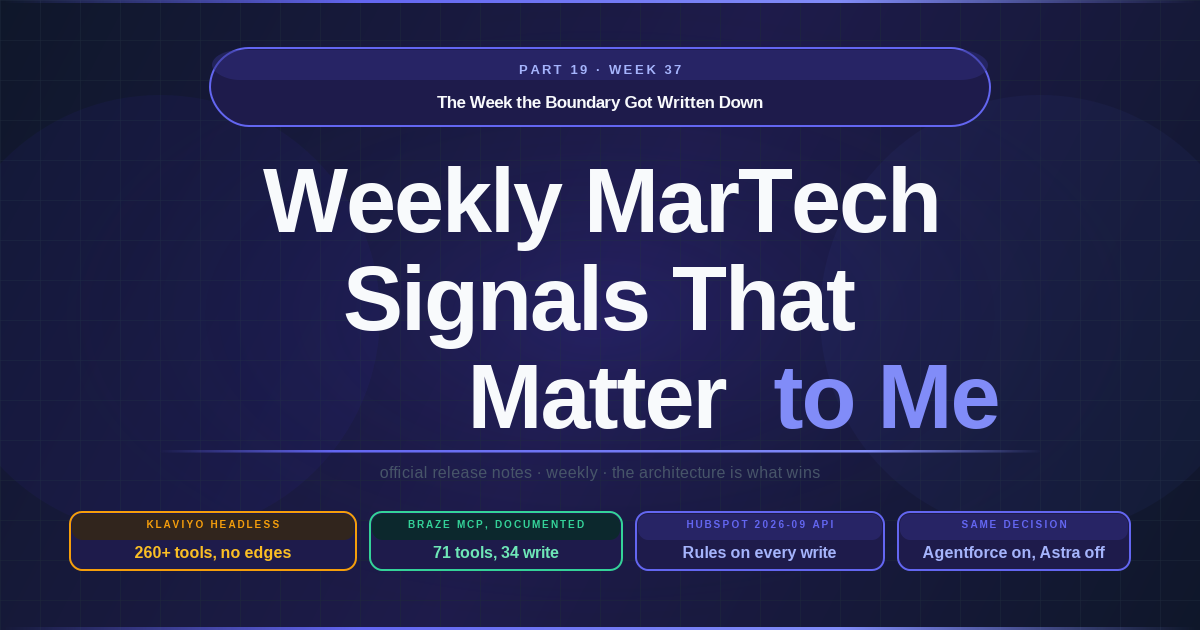
Weekly MarTech Signals That Matter to Me: Part 19, Week 37
Three customer engagement platforms published what their agent may actually do, and they put the answer in three different places: the launch copy, a reference table, and the API contract. The ones that write the boundary down are the ones you can buy from.
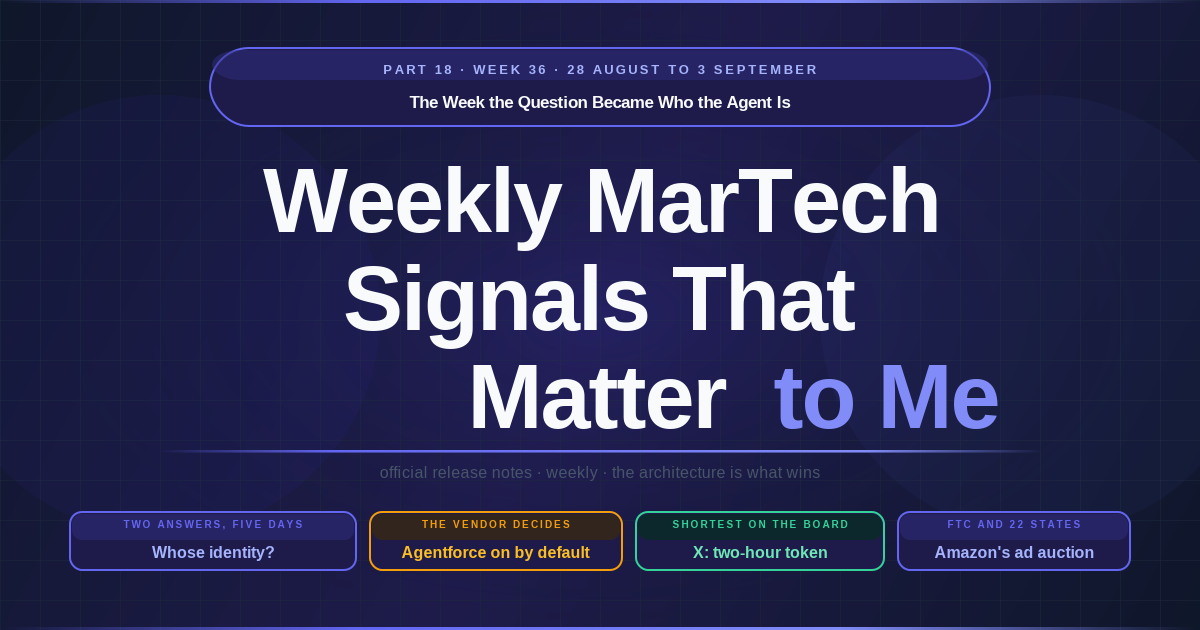
Weekly MarTech Signals That Matter to Me: Part 18, Week 36
Optimizely gave its agents their own identity. Salesforce and Anthropic gave theirs yours. Salesforce is also turning the agent platform on for you by default. Treasure AI published a read-only boundary, Salesforce retracted a write capability it had documented, and the FTC sued Amazon over an auction that was not the auction it described.
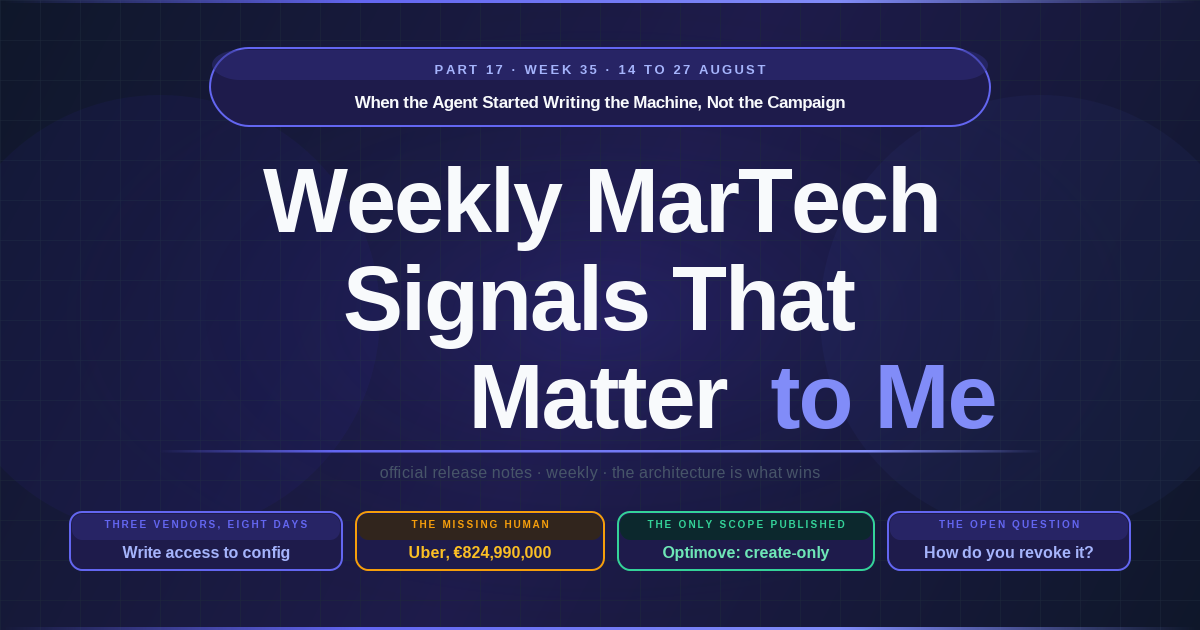
Weekly MarTech Signals That Matter to Me: Part 17, Week 35
In eight days three platforms gave an agent write access to configuration rather than to campaigns, and none of them published a session lifetime or a revocation path. In the same fortnight a regulator put 825 million euros on the absence of a human in an automated decision.
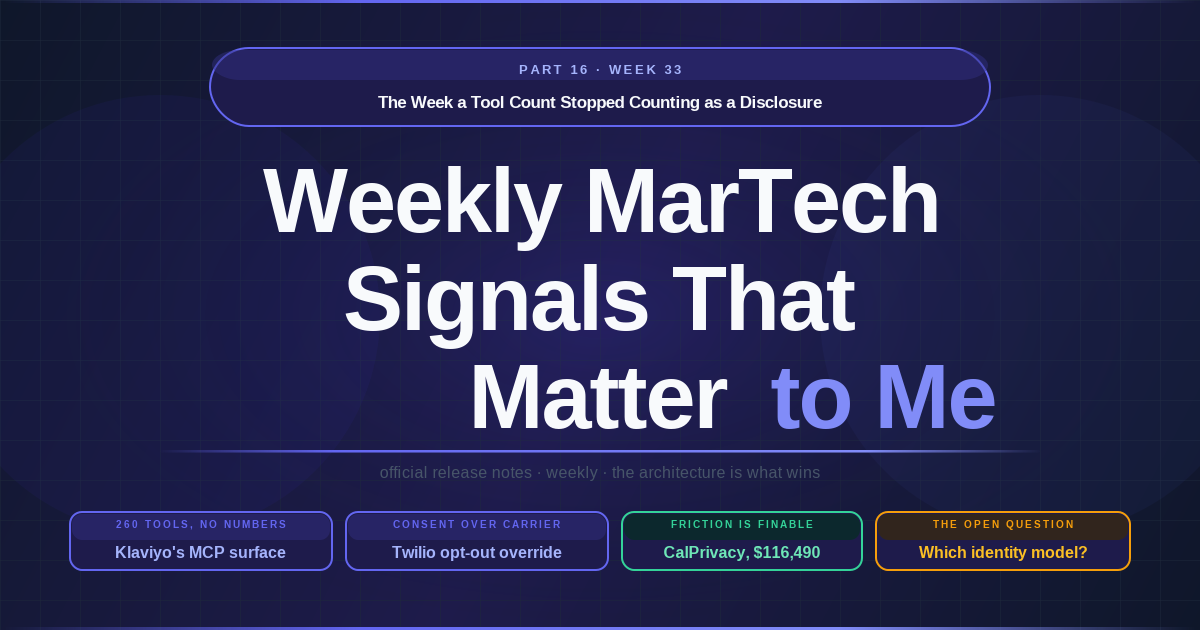
Weekly MarTech Signals That Matter to Me: Part 16, Week 33
Klaviyo published 260 MCP tools with write access in a single sentence, and published nothing about session lifetime or permissions. In the same four days, a regulator, a messaging provider and a standards body all turned the opt-out path into something with an API and an audit trail.
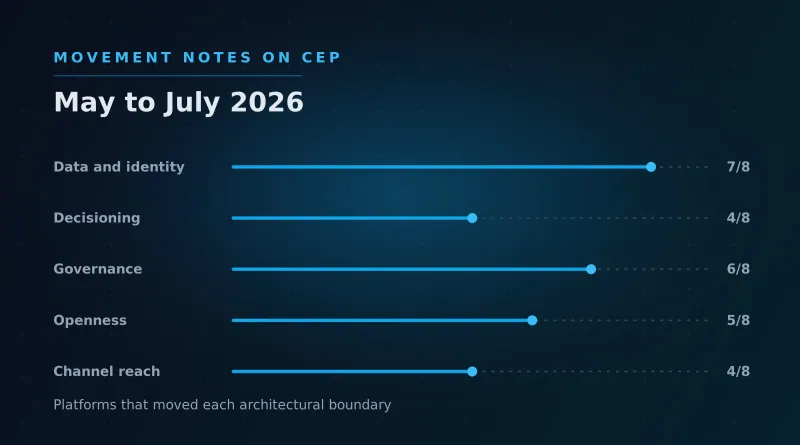
Movement Notes on CEP: May to July 2026
Which architectural boundaries eight customer engagement platforms moved between May and July 2026, across data, decisioning, governance, openness and channel reach.
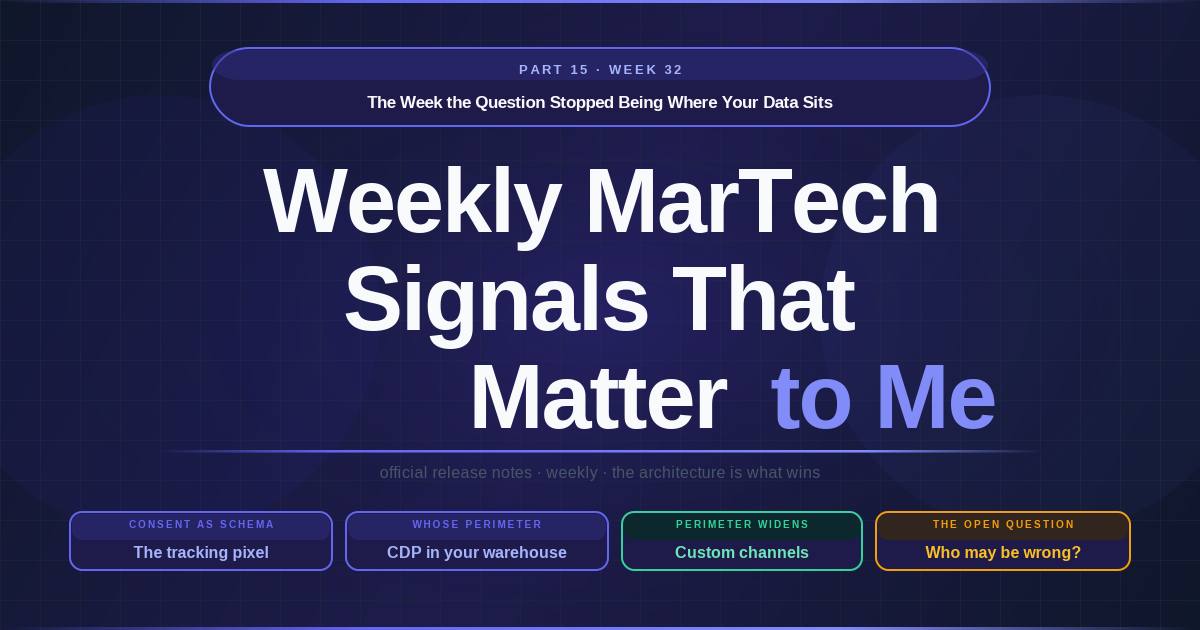
Weekly MarTech Signals That Matter to Me: Part 15, Week 32
The open-tracking pixel became a consent attribute, an entire CDP moved inside the customer's own Snowflake account, and any messaging channel became a no-code configuration. Three items, one week, and the same underlying move: the platform is where your logic runs, not where your state lives.
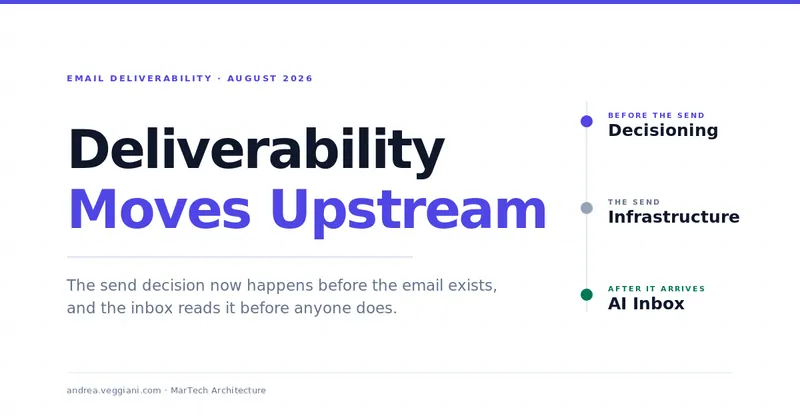
AI Email Deliverability Starts Before the Send
AI is moving email deliverability upstream into the decision of whether a message should exist, while AI inboxes make a second decision about whether it deserves attention.
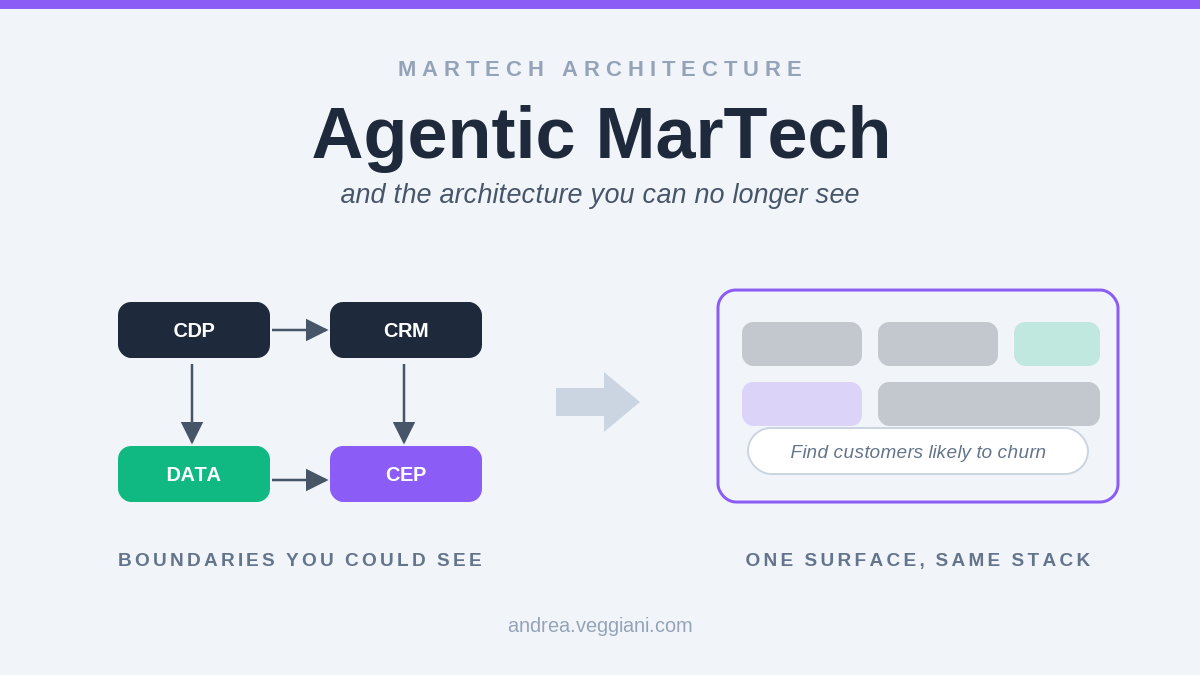
Agentic MarTech: The Architecture You Cannot See
Conversational MarTech interfaces hide system boundaries inside permissions, prompts, definitions, retrieval policies and traces. Five questions and an agent register make them inspectable again.
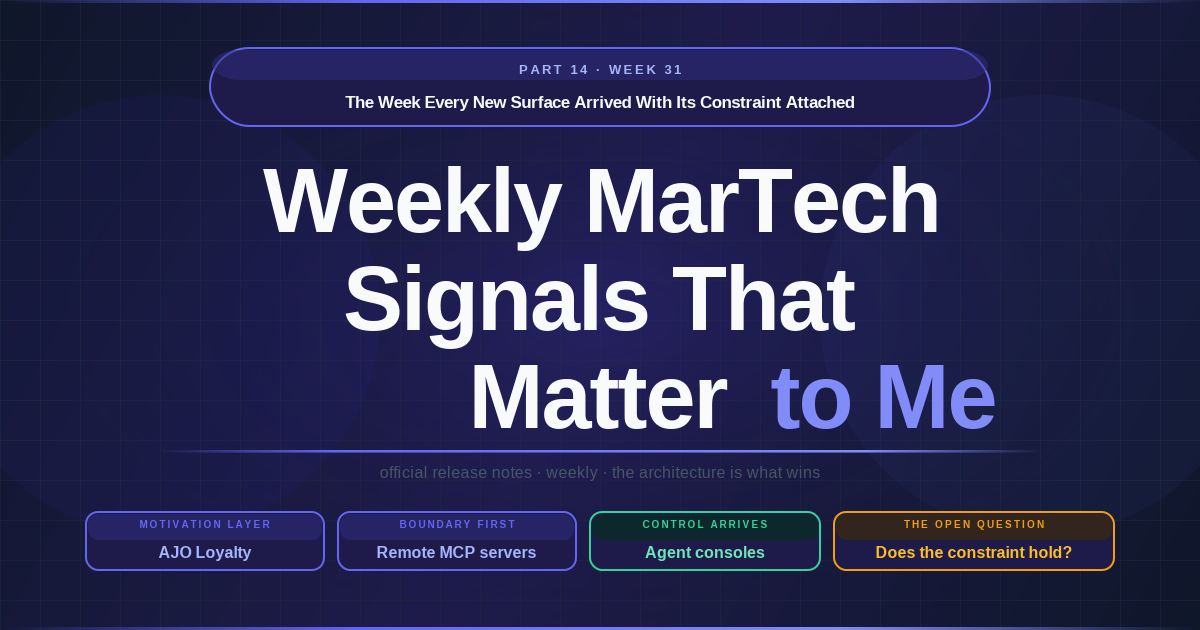
Weekly MarTech Signals That Matter to Me: Part 14, Week 31
Adobe took the motivation layer of loyalty into the CEP and left the points ledger behind. Two vendors shipped remote MCP servers and sold the boundary rather than the reach. A week where every new surface arrived with its constraint attached.
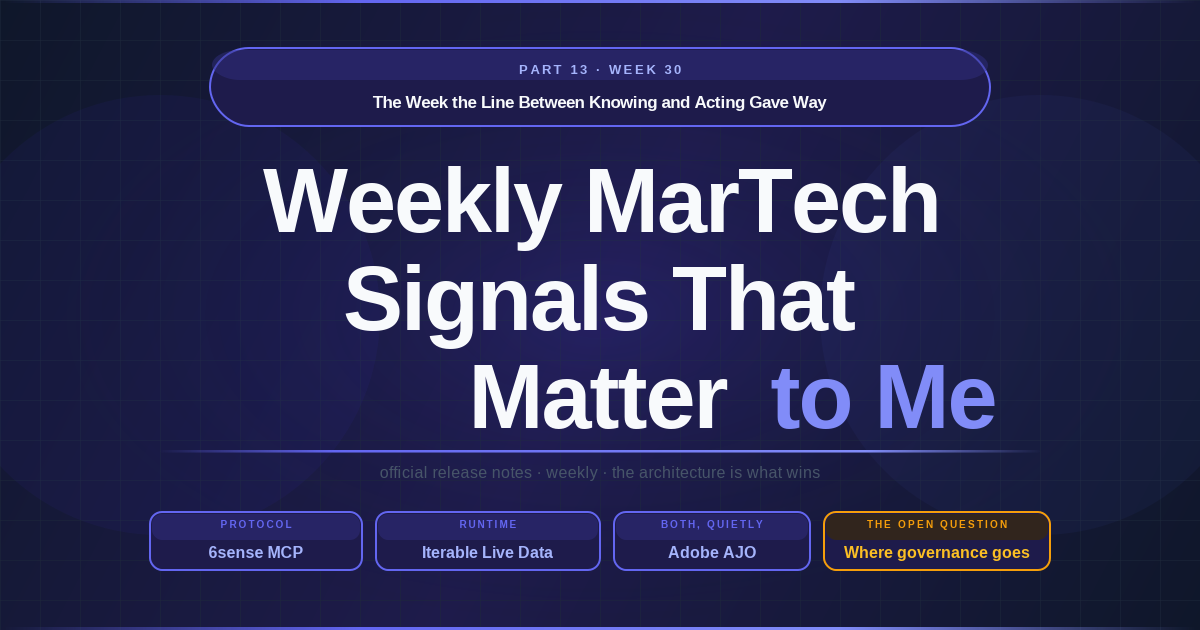
Weekly MarTech Signals That Matter to Me: Part 13, Week 30
In a single week, 6sense put its intelligence behind MCP, Iterable pulled live data into journeys, and Adobe Journey Optimizer shipped both. Three vendors, one move: the line between knowing the customer and acting on them is giving way.
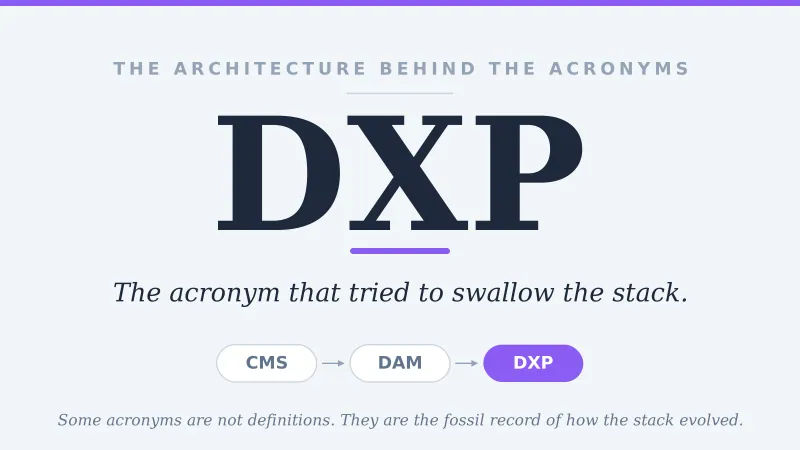
The Architecture Behind the Acronyms (DXP): The Acronym That Tried to Swallow the Stack
DXP emerged when websites became complex digital experiences and the CMS was no longer enough. Then the category expanded until it began to describe almost the entire stack.
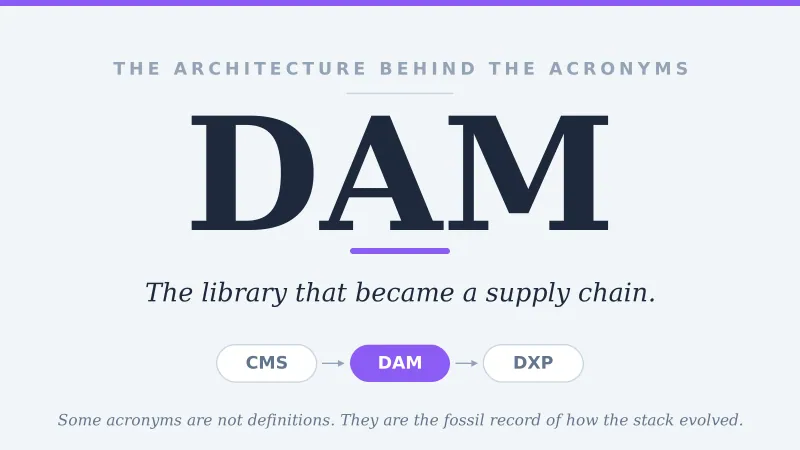
The Architecture Behind the Acronyms (DAM): The Library That Became a Supply Chain
DAM began as a searchable library for digital files. It became the governance and distribution layer for assets moving across brands, markets, channels and AI-assisted content operations.
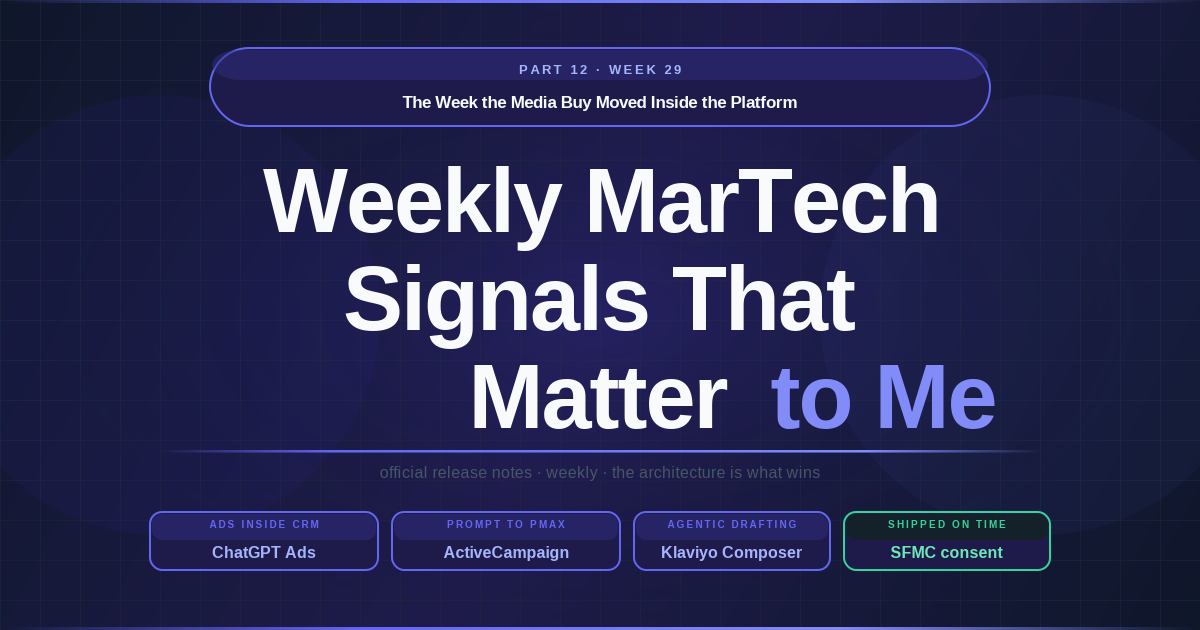
Weekly MarTech Signals That Matter to Me: Part 12, Week 29
A quiet product week still moved a boundary: paid-media execution is being pulled closer to engagement and automation platforms, while more of the campaign chain is being operated through agentic interfaces. Why that is an architecture question, not a feature one.
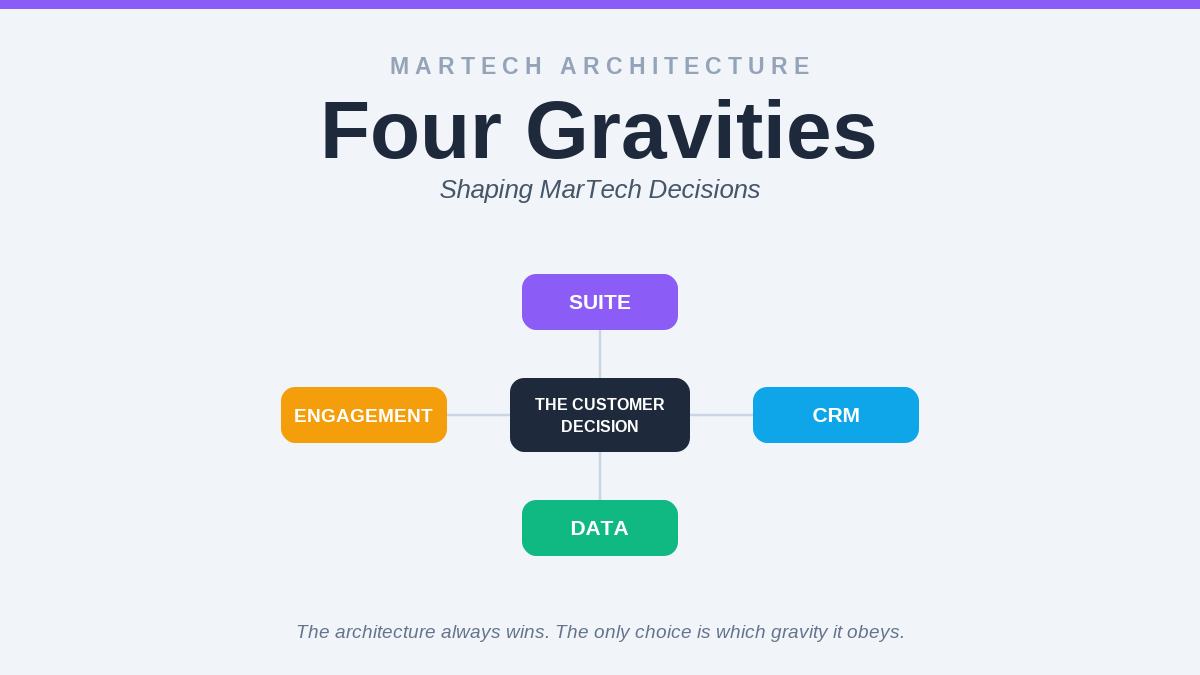
Four Gravities Shaping MarTech Decisions: Suite, CRM, Data and Engagement
MarTech platform decisions are shaped by four gravitational forces: the experience suite, the CRM, the enterprise data layer and the engagement runtime. Understanding which gravity should dominate is more useful than comparing feature lists.
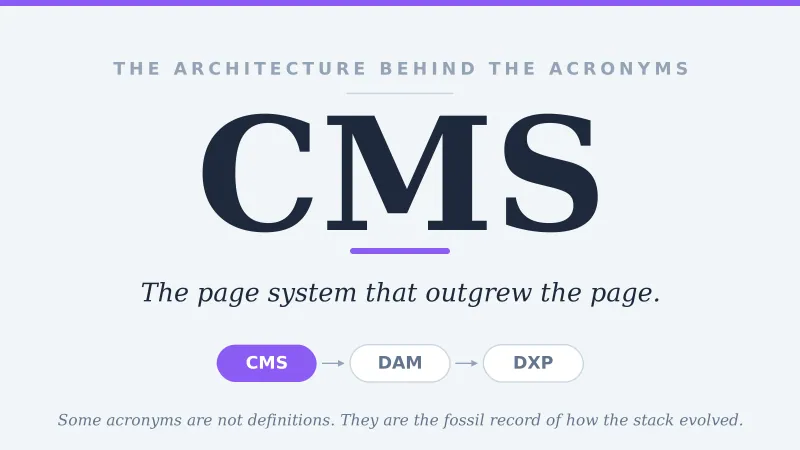
The Architecture Behind the Acronyms (CMS): The Page System That Outgrew the Page
CMS began as a way to publish web pages without editing HTML. It became the structured content layer behind websites, applications, channels and, increasingly, AI agents.
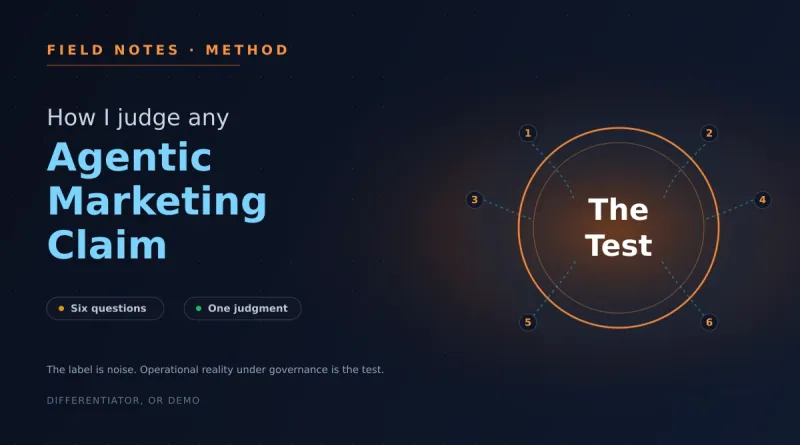
How I Judge Any Agentic Marketing Claim
One reusable test for any agentic or AI marketing claim: does it improve operational reality under governance, or is it a demo?
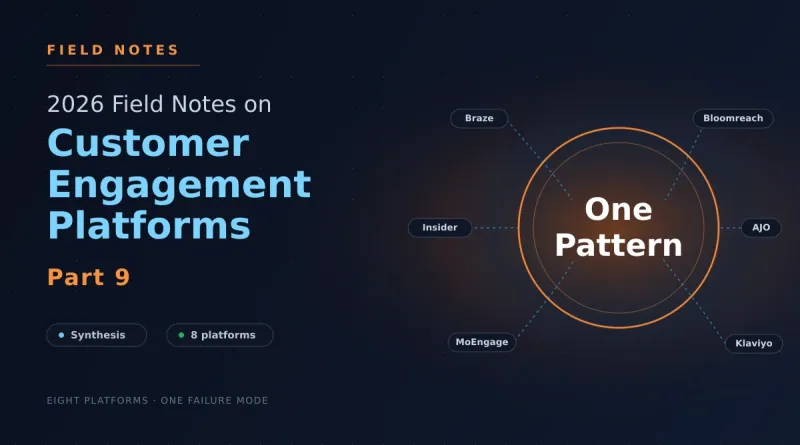
2026 Field Notes on Customer Engagement Platforms - Part 9: Eight Platforms, One Pattern
Eight platforms, one pattern: an interim synthesis where different CEP physics converge on the same governance-versus-activation failure mode.
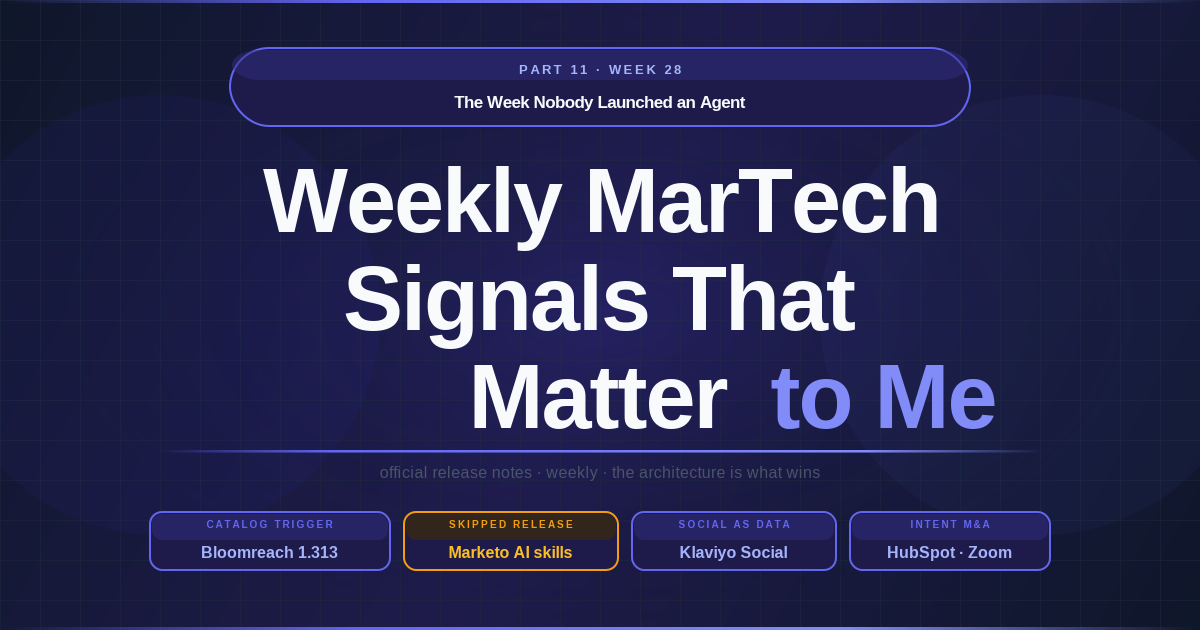
Weekly MarTech Signals That Matter to Me: Part 11, Week 28
A quiet holiday week with no agent launches, yet one of the quarter's most architecturally interesting: catalogs, channels and two intent-layer buys.
2026 Field Notes on Customer Engagement Platforms - Part 8: Klaviyo
Klaviyo as commerce-data proximity: field notes on the storefront as system of record, K:AI agents, and when it strains beyond DTC.
2026 Field Notes on Customer Engagement Platforms - Part 7: MoEngage
MoEngage as insight-led, app-first activation: field notes on Sherpa, Merlin and Aampe, and when analysing and acting in one seat wins.
The Architecture Behind the Acronyms (CDP): The Layer That Won
CDP beat every rival to become the default name for the customer data layer, then dissolved into packaged, warehouse-native and suite-embedded forms.
The Architecture Behind the Acronyms (DMP): The Layer That Lost
DMP ran a decade of digital advertising and then collapsed, even as the identity logic it pioneered survived everywhere else.
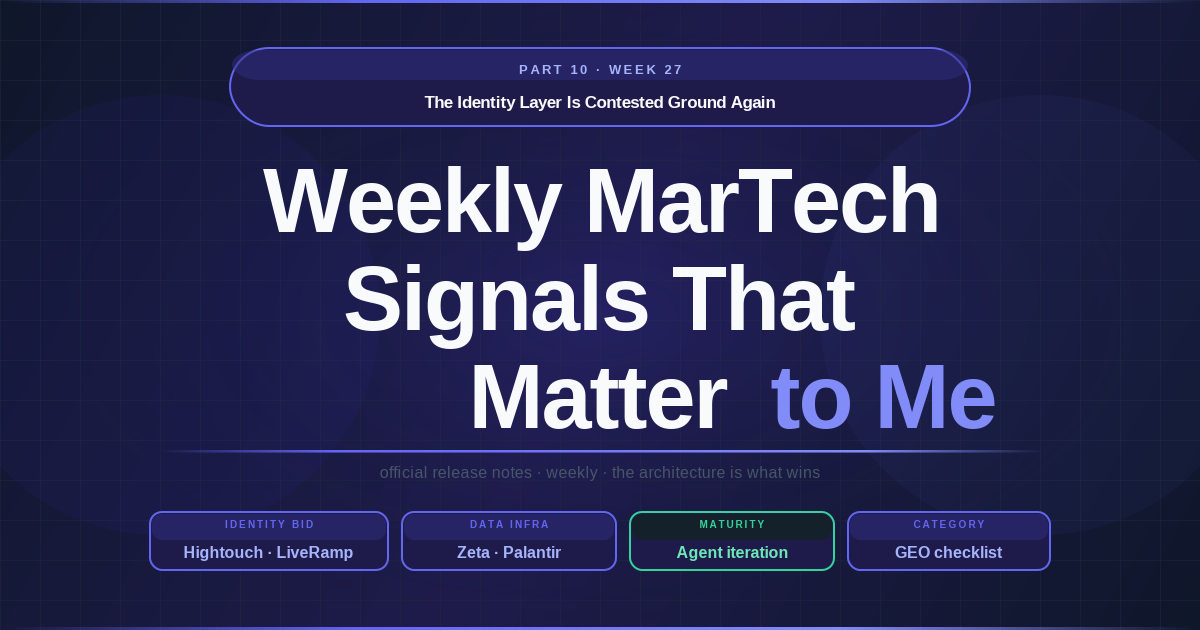
Weekly MarTech Signals That Matter to Me: Part 10, Week 27
Hightouch's LiveRamp bid, Zeta's Palantir partnership, Databricks CustomerLake and Tealium Context API all point to the same shift
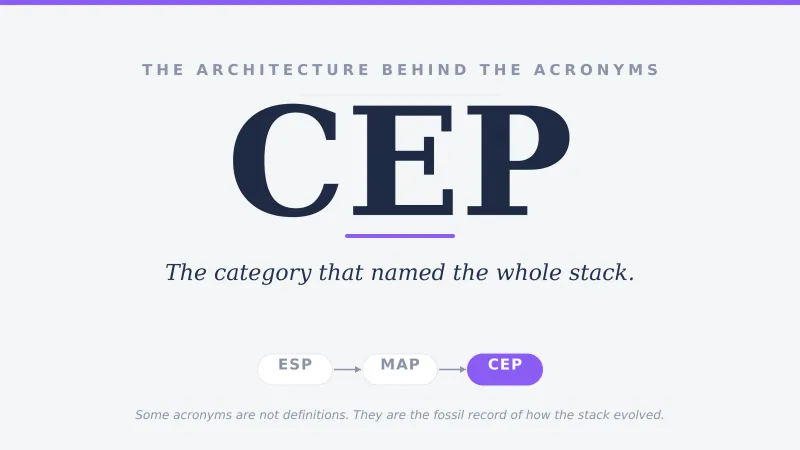
The Architecture Behind the Acronyms (CEP): The Category That Named the Whole Stack
Customer Engagement Platform absorbed ESP and MAP, then collided with CDP. That is why it is useful, vague, and dangerous to buy against.
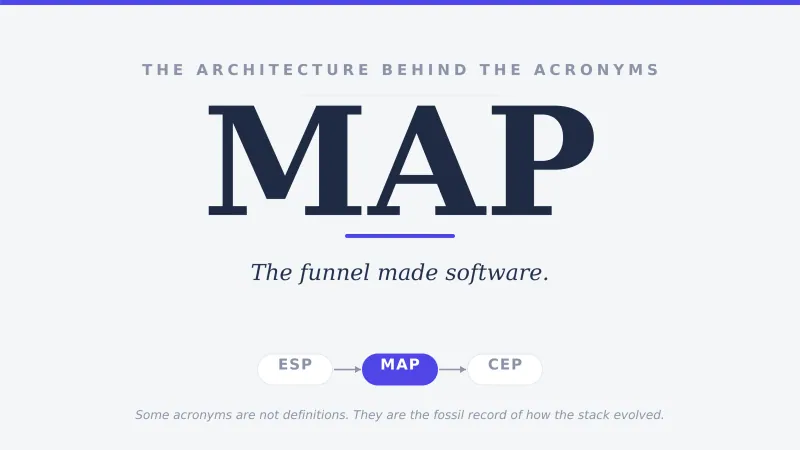
The Architecture Behind the Acronyms (MAP): The Funnel Made Software
Marketing Automation encoded the funnel into software. It still fits B2B well, but its campaign-tempo model explains why B2C moved toward event-driven
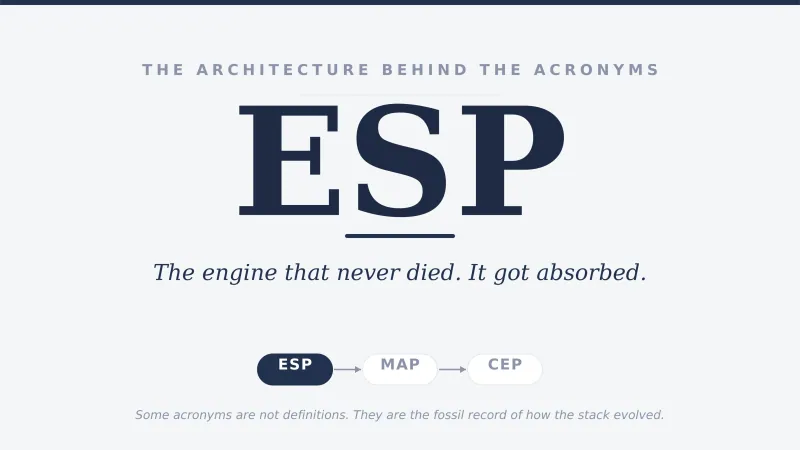
The Architecture Behind the Acronyms (ESP): The Engine That Never Died, It Got Absorbed
The Email Service Provider faded as a category, but its function still sits inside every modern engagement stack: delivery, reputation, consent
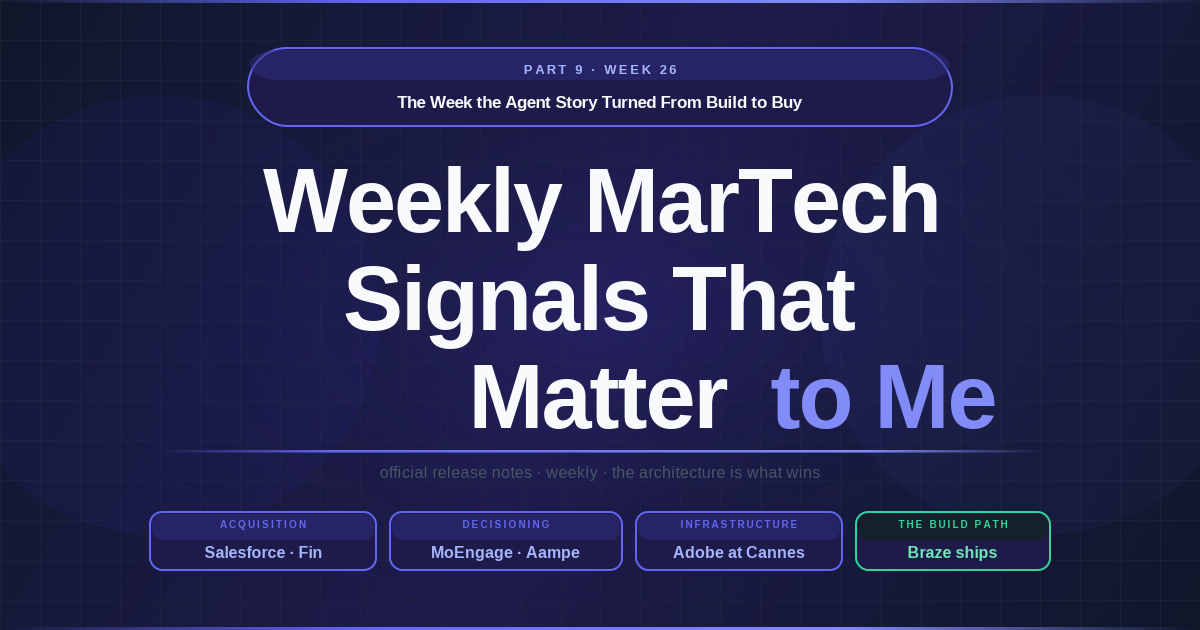
Weekly MarTech Signals That Matter to Me: Part 9, Week 26
Salesforce agreed to acquire Fin for $3.6B and MoEngage acquired Aampe's per-customer decisioning engine.
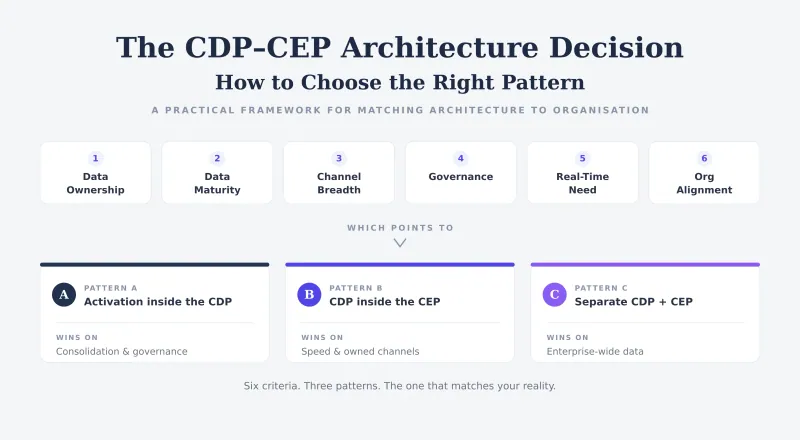
The CDP-CEP Architecture Decision: How to Choose the Right Pattern - Part 2
After mapping the three CDP-CEP wiring patterns, this is the practical framework for choosing which architecture fits your organisation.
Weekly MarTech Signals That Matter to Me: Part 8, Week 25
Databricks launched an agentic CDP inside the lakehouse, GEO became a buyable category almost overnight, and Salesforce shipped Summer '26.
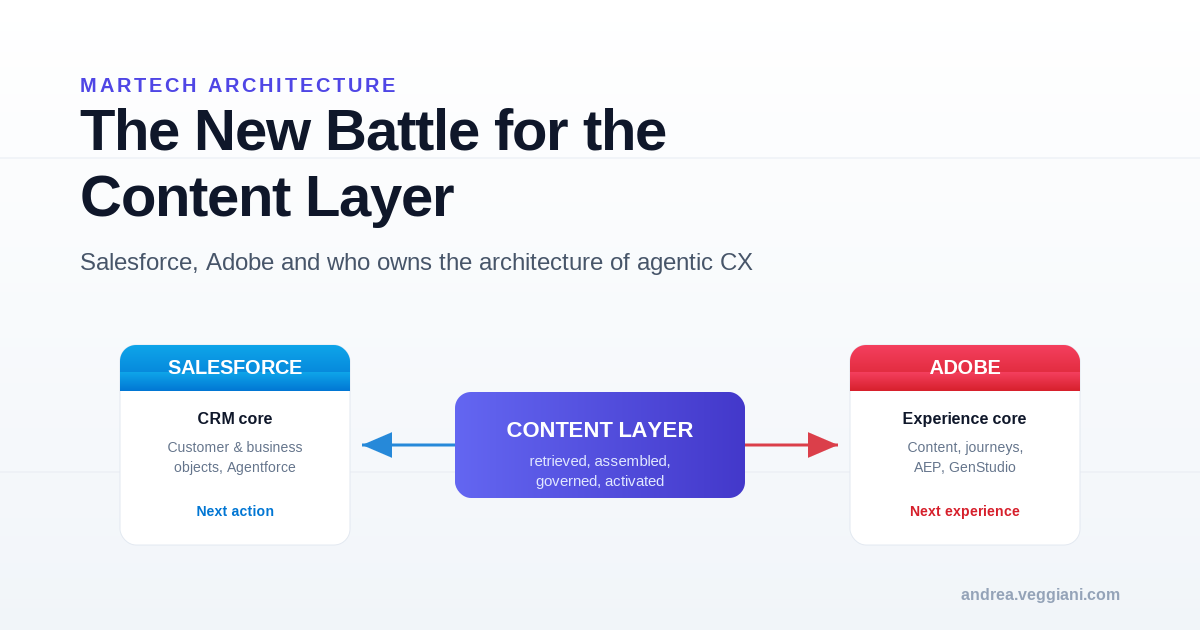
Salesforce, Adobe and the New Battle for the Content Layer
Salesforce's agreement to acquire Contentful is not just a CMS move. It is another chapter in its long-running content-layer battle with Adobe.
Weekly MarTech Signals That Matter to Me: Part 7, Week 24
Salesforce signs a definitive agreement to acquire Contentful, agentic marketing platforms converge on the same agent-plus-MCP pattern
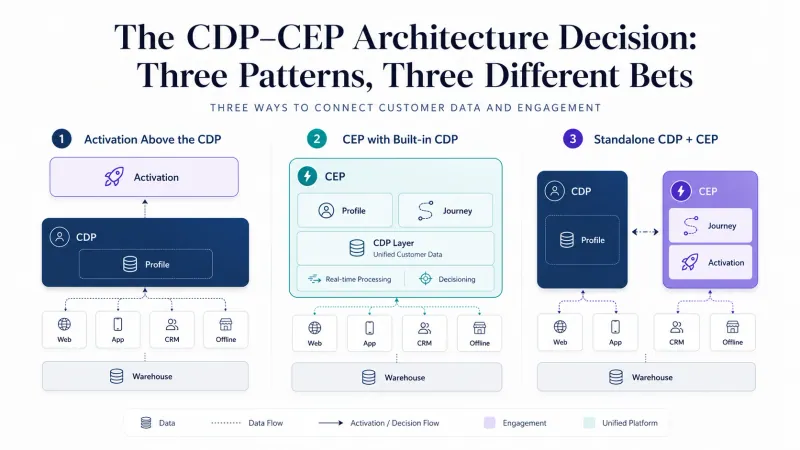
The CDP-CEP Architecture Decision: Three Patterns, Three Different Bets - Part 1
Activation inside the CDP, the CDP inside the CEP, or best-of-breed apart: three ways to wire customer data and engagement, and what each choice really implies.
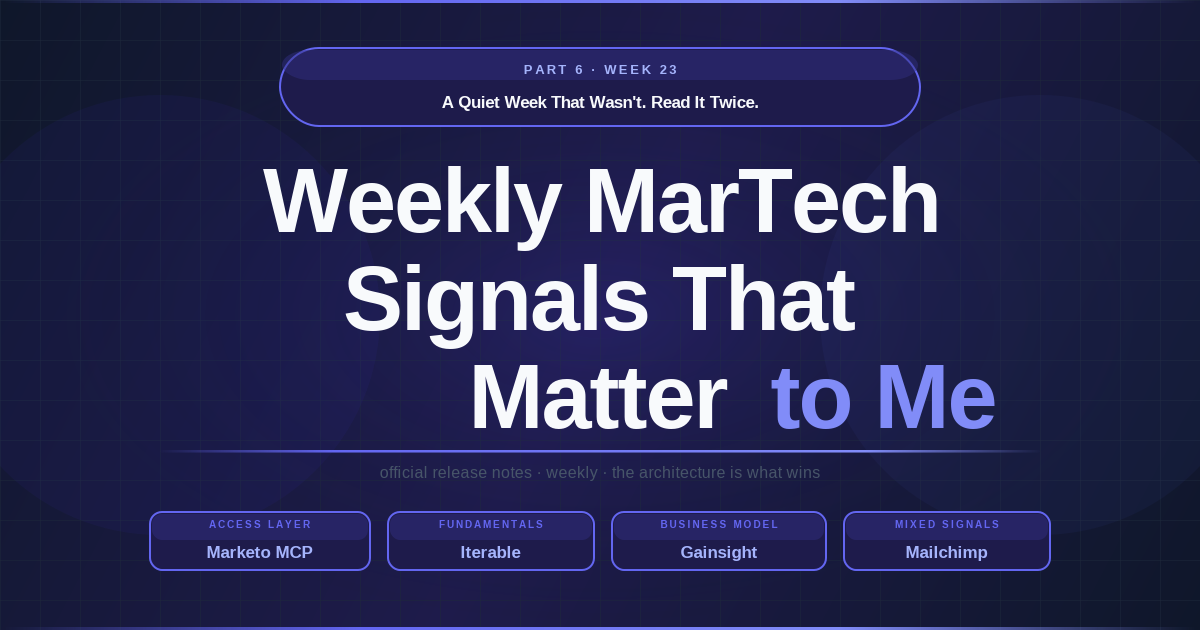
Weekly MarTech Signals That Matter to Me: Part 6, Week 23
Marketo brings MCP to the MAP layer, Iterable ships the unglamorous fundamentals, Mailchimp complicates its own strategic signal
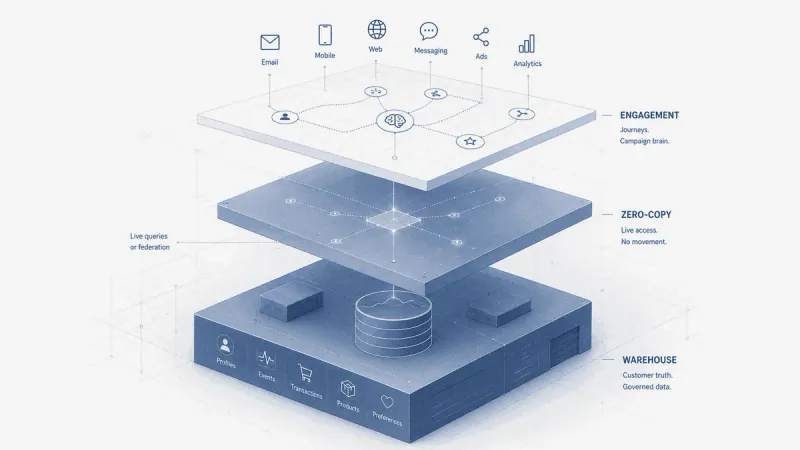
Zero-Copy Engagement: When the Warehouse Becomes the Campaign Brain
Zero-copy activation is not just a new integration pattern. It is a signal that customer engagement architecture is moving closer to the data warehouse
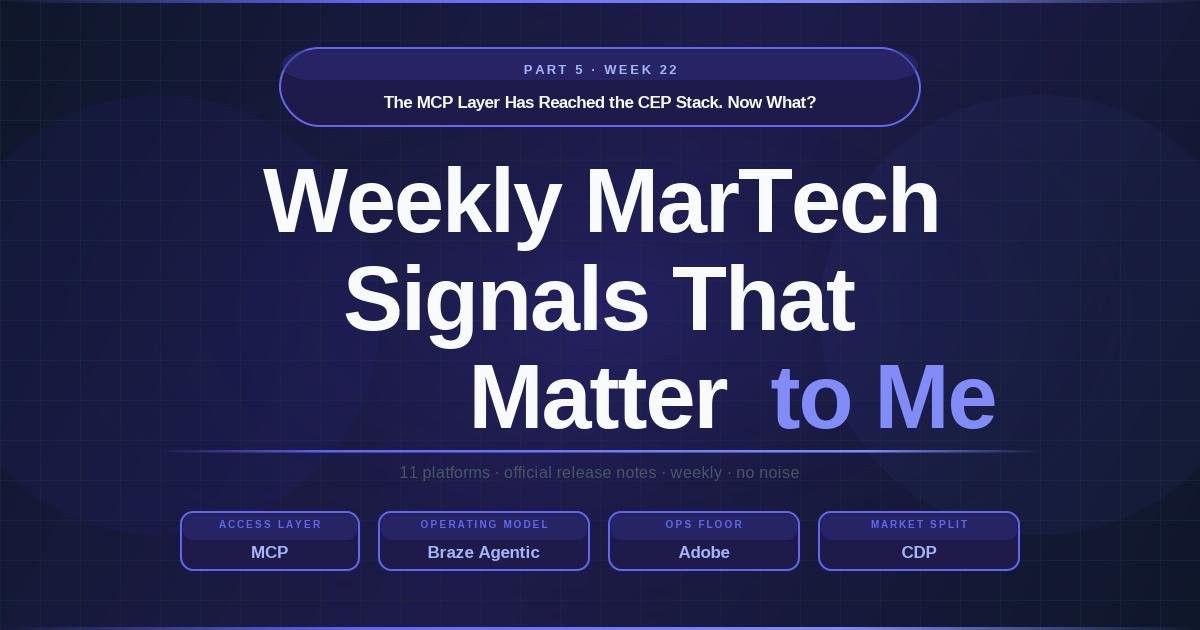
Weekly MarTech Signals That Matter to Me: Part 5, Week 22
MCP is moving from isolated platform news to a common access layer for customer engagement platforms.
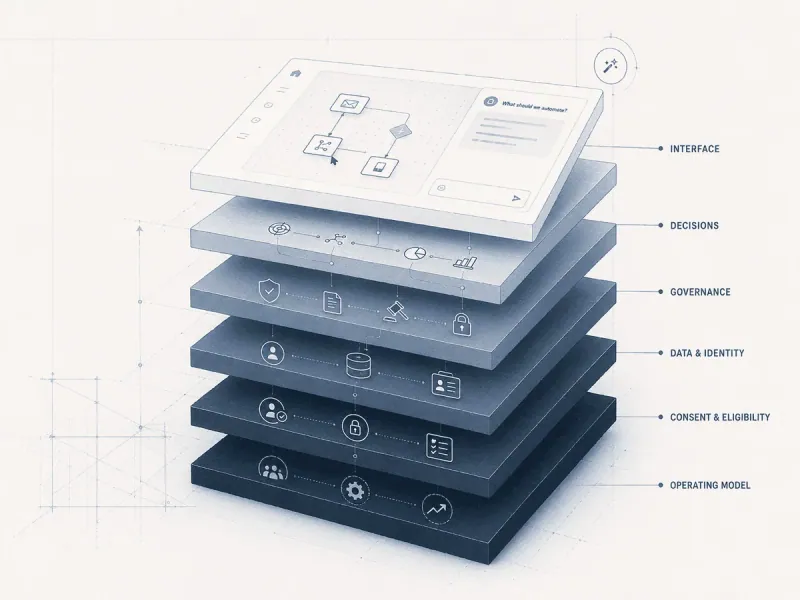
Business Autonomy Was Never Just a UI Problem
Agentic AI promises to make MarTech platforms easier to use, but without the right architecture and operating model it moves complexity rather than removing it.
Weekly MarTech Signals That Matter to Me: Part 4, Week 21
AJO's May release, Bloomreach's governance update, and Klaviyo's AWS Marketplace listing all point in the same direction

Email Isn't Dead. It's Being Rebuilt From the Inbox Up.
After 25 years, email is still the highest-ROI channel in the stack. But the platforms delivering it in 2026 are fundamentally different.
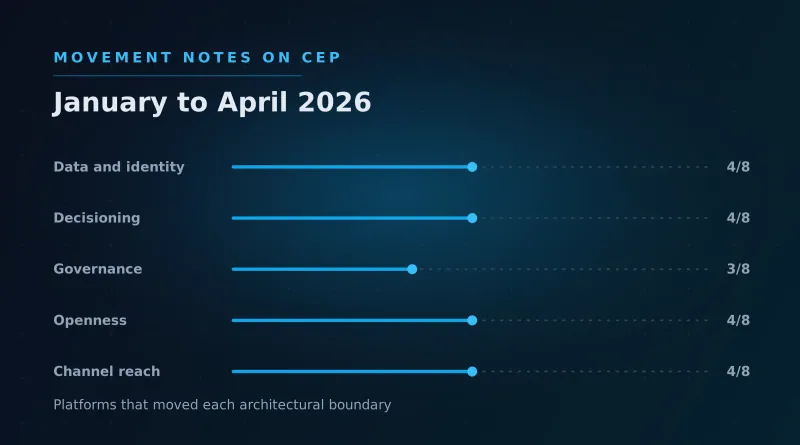
Movement Notes on CEP: January to April 2026
Which architectural boundaries eight customer engagement platforms moved between January and April 2026, across data, decisioning, governance, openness and channel reach.
Weekly MarTech Signals That Matter to Me: Part 3, Week 20
The Insider One/Bluecore acquisition reframes the CEP M&A logic, Klaviyo reveals the full scope of its B2C CRM ambition
Weekly MarTech Signals That Matter to Me: Part 2, Week 19
Hightouch at $2.75B, Canva buying Ortto, Braze's operational consolidation drop and AJO's march toward autonomous journey management.
Weekly MarTech Signals That Matter to Me: Part 1, Week 18
Agentic Marketing Is No Longer a Roadmap Item. A week of MarTech releases that belong together: AJO's orchestration intelligence layer
Weekly MarTech Signals That Matter to Me - Part 0
For 25+ years I tried to stay current in this industry through newsletters, bookmarks, RSS feeds and conference roadmaps. None of it worked as a system.
2026 Field Notes on Customer Engagement Platforms - Part 6: Iterable
Iterable as the moment engine: field notes on signal-to-moment velocity, Nova Agent, and the composable trade-off for lifecycle teams.
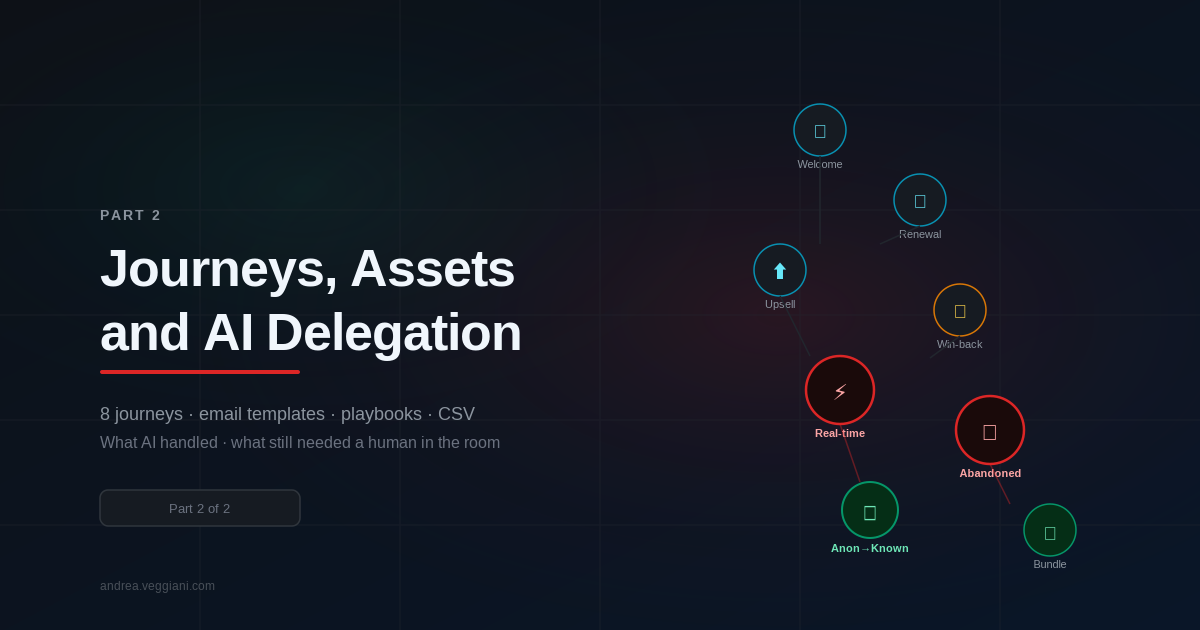
From Personal Site to Sales Tool: Building a Working Braze Demo with Claude Cowork - Part 2
Eight Canvas journeys, seven email templates, a 110-user CSV, and two Word documents, how the operational layer of a Braze sales demo gets built
From Personal Site to Sales Tool: Building a Working Braze Demo with Claude Cowork - Part 1
How I designed and built a working Braze sales demo for an enterprise prospect, why I chose a real site instead of a sandbox
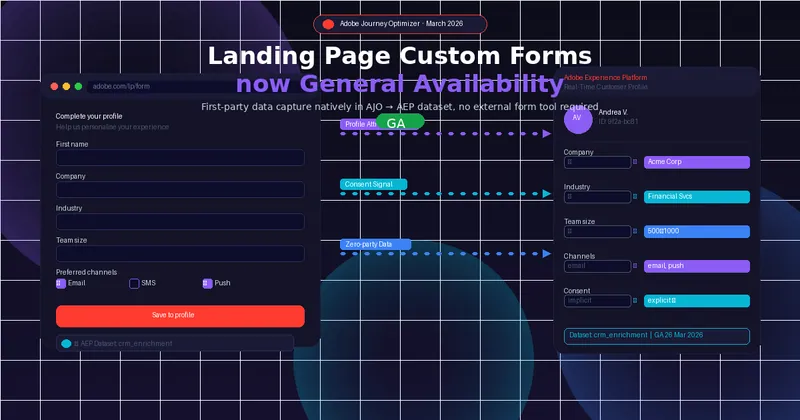
AJO March 2026 Release: Landing Page Custom Forms Reach GA and Why That Matters More Than It Sounds
Adobe Journey Optimizer's March 2026 release promotes Landing Page Custom Forms to General Availability.
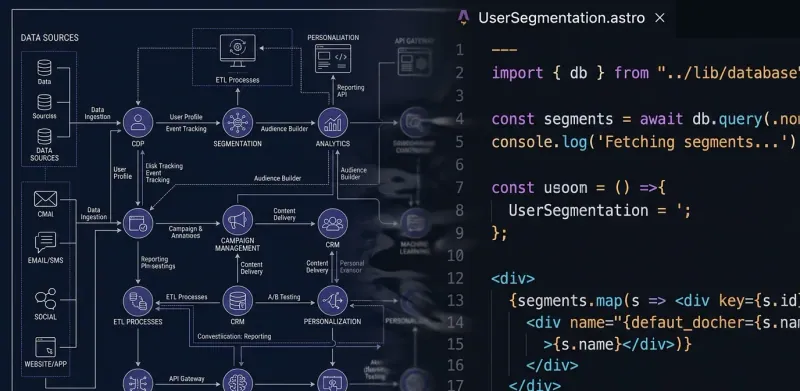
What a Weekend with Astro and Claude Cowork Taught Me About Building Again
A personal reflection on building a website with Astro, Vercel, and Claude Cowork and what AI-assisted development reveals about prototyping, authorship
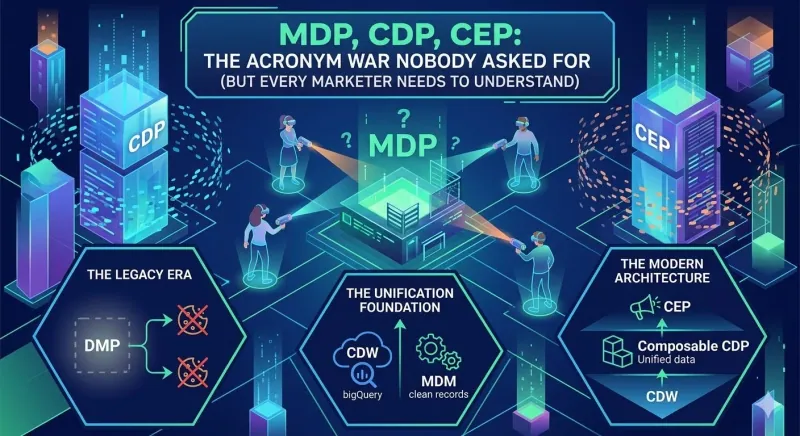
MDP, CDP, CEP: The Acronym War Nobody Asked For (But Every Marketer Needs to Understand)
Martech has a naming problem. Every few years a new (or rather, a resurrected one) acronym shows up promising to solve what the previous…
2026 Field Notes on Customer Engagement Platforms - Part 5: Salesforce Marketing Cloud (Agentforce Marketing)
Salesforce Marketing Cloud as CRM gravity: field notes on Agentforce, the Engagement and Next coexistence, and when the anchor helps or hurts.
2026 Field Notes on Customer Engagement Platforms - Part 4: Adobe Journey Optimizer
Adobe Journey Optimizer as suite gravity: field notes on when AEP foundations make it fly, and when they leave it stuck in traffic.
2026 Field Notes on Customer Engagement Platforms - Part 3: Insider One
Insider One as user-centric growth: field notes on the CEP that bridges engagement and experience optimization, and where it strains.
2026 Field Notes on Customer Engagement Platforms - Part 2: Bloomreach
Bloomreach as commerce and product intelligence: field notes on the commerce-first CEP and when its zero-latency loop actually pays off.
2026 Field Notes on Customer Engagement Platforms - Part 1: Braze
Braze as the event-driven runtime: field notes on where it wins, where it strains, and how its physics shapes real CEP delivery.
2026 Field Notes on Customer Engagement Platforms - Part 0
Why this CEP field-notes series exists: the operating model and data architecture decide outcomes, not features. One platform per article.
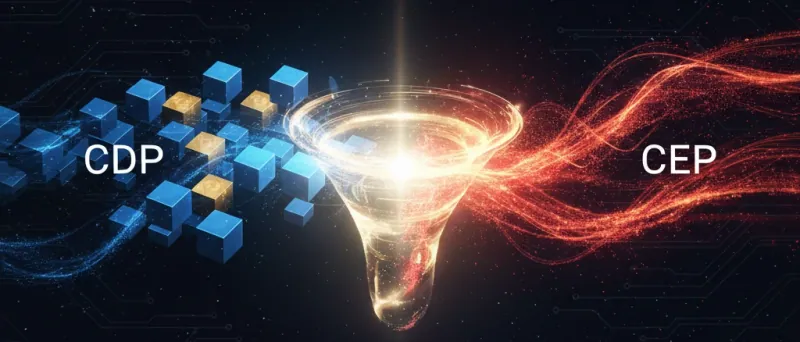
When CDP Meets CEP: The Convergence of Data and Activation in the Age of Algorithmic Empathy
The MarTech landscape is collapsing the distance between customer data and customer action.
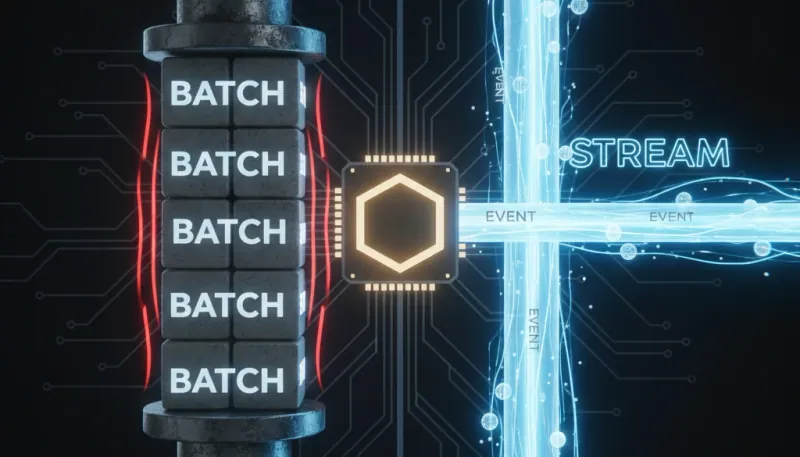
The End of Batch-and-Blast: From Marketing Automation to Agentic Engagement - Part 2
The architectural revolution that eliminated Latency Debt: the mandatory leap from slow batch processing to Real-Time Intelligence.

The End of Batch-and-Blast: From Marketing Automation to Agentic Engagement - Part 1
After 25 years in MarTech, I’ve watched “Marketing Automation” die a slow death. The modern customer demands a real-time system of intelligence.

Agentic Marketing: The Next Frontier Where AI and Human Creativity Meet - Part 3
The future of marketing isn’t automation: it’s collaboration between human imagination and machine intelligence.

The AI Imperative: How Intelligent Systems Are Transforming Customer Engagement - Part 2
Why rules-based automation breaks under if/then sprawl, maintenance debt and latency, and how predictive models replace static segments with real-time decisions.

The Day We Traded Empathy for Efficiency: Why Marketing Automation is Broken - Part 1
How the pursuit of scale led to the Algorithmic Apathy, and why the next years belong to real-time, event-driven Customer Engagement.