11 min read
Why Iterable is Part 6 (and why it is the “moment engine” archetype)
After Braze, Bloomreach, Insider One, Adobe Journey Optimizer and Salesforce Marketing Cloud, Iterable is the next platform I started working with in this series.
So Part 6 is not a ranking, just the next lens in the same serie.
But once you look at Iterable through the same lens used for the previous articles, it quickly earns its own archetype. I think of Iterable as a moment engine.
Not because it owns the entire customer data foundation. Not because it wants to become the enterprise CRM. Not because it is trying to pull the whole experience stack into a suite.
But because its strongest proposition is very specific:
turn customer signals into coordinated action quickly, across channels, with enough intelligence and control to make that speed useful.
Iterable sits in an interesting space. It is not commerce-first like Bloomreach. It is not experience-optimization-first like Insider One. It is not pulled by Adobe suite gravity. It is not anchored by Salesforce CRM gravity.
It is closer to the independent CEP model: a high-velocity activation and orchestration layer that works best when the enterprise already has, or is building, a reliable source of customer truth somewhere else.
In enterprise programs, that usually sounds like this:
- “We need real-time relevance.”
- “We cannot wait two quarters before activating anything.”
- “Marketing needs to own lifecycle orchestration without depending on every other team for every change.”
- “We have data. Now we need to make it useful.”
That does not mean foundations do not matter. It means Iterable optimizes for marketer velocity, while increasingly adding the governance, measurement, compliance and AI-assisted execution capabilities required to make that velocity safer at enterprise scale.
A useful way to frame it:
Your data platform defines truth.
Iterable defines action.
Your operating model decides whether action becomes a durable capability or another layer of campaign chaos.
A quick note on what I mean by “CEP”
My working definition has stayed consistent throughout this series. A Customer Engagement Platform is a system of action that:
- listens to customer signals
- evaluates decision logic
- orchestrates activation across channels
- measures outcomes and feeds learnings back into the loop
Iterable fits this definition clearly. But compared with data-native CEP models such as Adobe Journey Optimizer on AEP or Salesforce Marketing Cloud on Data Cloud, Iterable usually draws a cleaner boundary.
You bring the customer truth and Iterable turns that truth into action.
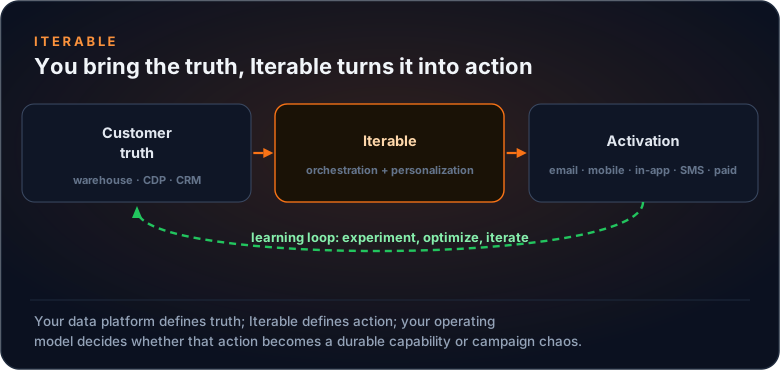
That truth may live in a warehouse, a CDP, a CRM, a product analytics layer, a commerce platform or, more commonly, a messy combination of several systems.
This boundary is not necessarily a limitation. In many enterprises, “customer truth” is already contested territory. Identity is fragmented. Consent is enforced differently by channel. Product, CRM, ecommerce and service systems all claim part of the customer picture.
A platform that tries to own both truth and action can become powerful, but also politically and operationally heavy. Iterable often works because it takes a more composable posture. It focuses on orchestration, personalization and activation, while letting the enterprise decide where identity, consent, modelling and governance should live.
The risk is obvious: if the upstream truth is weak, Iterable will not magically fix it. It will just help the organization act on weak truth faster.
Iterable in one sentence
Iterable is an AI-powered customer engagement platform that helps marketing teams turn real-time customer signals into cross-channel lifecycle action across email, mobile, in-app, SMS and paid audiences; its bias is toward speed, experimentation and moments-based personalization.
A shorter version:
Iterable is what you choose when you want activation velocity without committing the entire engagement operating model to a suite.
Its physics: the moment engine. Every platform in this series has a centre of gravity that predicts how it behaves under load, and I map all eight against each other in Part 9. Iterable’s is the moment engine: signal-to-moment velocity for lifecycle teams that can bring their own truth.
A short maturity signal
Iterable was founded in 2013 and grew in the same market window that produced a new generation of engagement platforms: more event-driven, more API-oriented, more comfortable with modern data stacks and less constrained by the batch campaign logic of older marketing automation systems.
A few public milestones are useful:
- June 2021: Iterable announced a $200M Series E at a $2B valuation.
- October 2021: Iterable surpassed $100M ARR.
- February 2024: Iterable surpassed $200M ARR.
- December 2025: Iterable announced it had surpassed one trillion cumulative customer interactions.
- July 2025: Iterable appointed Sam Allen as CEO, with founder Andrew Boni moving into the role of Chief Scientist.
I do not read these milestones as trophy numbers. In CEP evaluations, they matter because they point to a more important question:
is Iterable maturing beyond “fast and usable” into “fast, usable and governable”?
That is the key enterprise question. High-velocity platforms are attractive, but high velocity without governance eventually becomes journey sprawl.
The CEO transition is also a useful signal. Iterable is not positioning itself only as a fast-moving alternative for digital teams anymore. It is increasingly competing for larger enterprise programs, where the buying criteria are different: reliability, security, compliance, global operating models, proof of value and AI that can be controlled, not just demonstrated.
That is the phase shift I would watch.
As of July 2026, these remain the latest disclosed milestones, as Iterable is private and discloses selectively.
How Iterable is positioned today
As of Spring 2026, Iterable positions itself as an AI customer engagement platform. The core themes are:
- moments-based marketing
- real-time activation
- cross-channel orchestration
- AI-assisted execution
- goal-based optimization
- marketer speed with stronger governance
This is a meaningful sharpening from the older “cross-channel marketing platform” framing. The platform is no longer just saying:
build journeys and send messages.
It is increasingly saying:
define the business goal, connect the customer signals, and let the system help execute, test, optimize and govern the work.
That is the same category movement I have described across the series: from campaigns to control loops, from static journeys to adaptive systems, from automation as efficiency to engagement as continuous decisioning.
The Iterable mental model (how I explain it internally)
The way I explain Iterable internally is simple:
-
Signals
Events, attributes, behaviors, lifecycle states, anonymous and known activity. -
Audience logic
Segments, eligibility, suppression, timing, intent thresholds. -
Orchestration
Journeys, branching, delays, message steps, profile updates. -
Personalization
Templates, data, Catalog, dynamic logic, AI-generated variants. -
Pressure strategy
Frequency caps, priorities, cooldowns, conflict prevention. -
Learning loop
Performance insight, experimentation, optimization and iteration.
The Iterable-shaped part is not that these pieces exist. Most serious CEPs have some version of them. The Iterable-shaped part is the bias toward making these pieces usable by marketing teams without forcing every decision into a heavy suite governance model.
That is the strength. It is also the risk. Because when tools make it easy to ship, organizations need to become better at deciding what should not ship.
AI and governance: the 2026 shift
The most important Iterable product development to understand for 2026 is Nova Agent. Iterable introduced Nova at Activate Summit 2025 and expanded the idea through the Spring 2026 release.
The important point is not “Iterable has AI.” Everyone has AI now. The important point is what kind of AI it is trying to become.
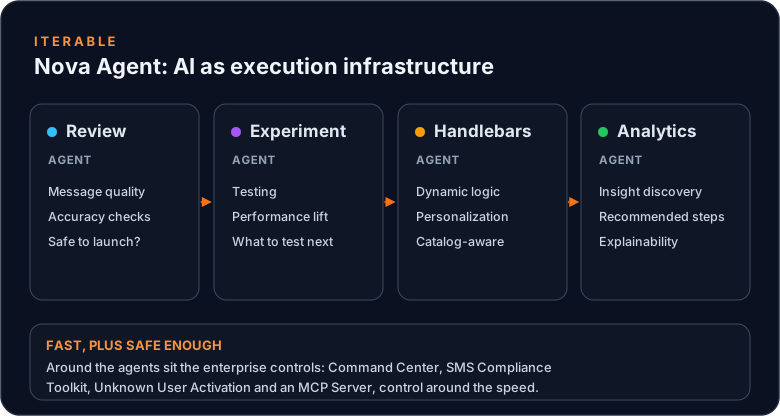
Nova Agent is framed as a goal-driven system of agents that can help marketers move from intent to execution: building campaigns, auditing messages, running experiments, generating personalization logic and surfacing performance insights.
The release describes specialized agents such as:
- Review Agent for message quality and accuracy checks
- Experimentation Agent for testing and performance improvement
- Handlebars Agent for dynamic personalization logic
- Analytics Agent for insight discovery and recommended next steps
That is more interesting than generic copy generation. In real CEP operations, the hardest problems are not usually “write me another subject line.” They are questions like: is this journey safe to launch? Who is eligible? Who should be suppressed? Which goal is this campaign optimizing for? What happens when two journeys conflict? Can we explain why this customer got this message, or why they did not?
This is where AI starts to matter: not as a creative shortcut, but as execution infrastructure.
The Spring 2026 release also added or expanded capabilities such as Command Center, Unknown User Activation, Google Ads integration, SMS Compliance Toolkit, Stored Messages and MCP Server. Individually, these are product features. Together, they tell a clearer story:
Iterable is moving from fast cross-channel execution toward fast cross-channel execution with more intelligence, measurement and control.
That is exactly where the CEP market is going. The open question is whether Iterable can keep the simplicity and speed that made it attractive while adding the enterprise controls that larger programs require. That balance is hard, and it is where many platforms lose their original advantage.
Where Iterable sits in the stack
In most modern stacks, I see Iterable fitting into two main patterns.
Pattern A: CDP or Warehouse as Truth, Iterable as Activation
Events, profiles, consent and calculated attributes are unified in a CDP, warehouse or customer data layer. Iterable receives the signals and owns orchestration, personalization and channel execution.
This pattern is common when the organization already has investments in Snowflake, BigQuery, Databricks, dbt, Tealium, Segment, mParticle, Salesforce or internal event streaming. In this model, Iterable does not need to become the data foundation. It needs clean data contracts.
Pattern B: Distributed Truth, Iterable as Signal-to-Action Layer
Truth comes from multiple systems: CRM, product analytics, ecommerce, app events, subscription systems and service platforms. Iterable becomes the place where those signals are turned into lifecycle action.
This can work well, but only if the organization is disciplined about semantics. If the same event means three different things in three different systems, Iterable will not solve that. It will scale the confusion.
A Third Emerging Pattern: Earlier Funnel Activation
Unknown User Activation adds a partial third pattern. Iterable can start acting on high-intent anonymous behavior before identity is fully resolved.
That is strategically interesting, especially for high-traffic digital businesses. But it also expands the design surface: anonymous identity, profile creation rules, consent by region, channel eligibility, data retention and what “intent” means before authentication.
This is not only a feature. It is an architecture and governance question.
Personalization at scale: why catalog still matters
Catalog remains one of Iterable’s important platform primitives. It helps teams avoid a common anti-pattern:
cloning journeys because personalization was not designed properly.
If every region, brand, segment or product line needs its own flow, journey architecture becomes unmanageable. Catalog supports a better pattern:
one lifecycle structure, many contextual variations.
That is where personalization becomes scalable.
The interesting 2026 development is the connection between Catalog and Nova Agent. If structured content and product data live in Catalog, and Nova can help generate or apply dynamic Handlebars logic, Iterable can reduce the technical barrier to more sophisticated personalization.
That is useful, but it still depends on the same old foundation: good data, good content structure, good naming, good ownership. AI can generate logic. It cannot invent a reliable operating model.
Competitive set (how it shows up in real programs)
Iterable commonly competes with independent CEP and lifecycle platforms such as Braze, Insider One, Bloomreach Engagement, MoEngage, CleverTap, Optimove, Customer.io, Klaviyo in some mid-market contexts, and Zeta when the conversation includes data, identity and activation.
The comparison is usually not:
which one has email, SMS and push?
That is too basic. The real differentiators are speed of execution, mobile and in-app depth, data integration posture, journey governance, experimentation model, personalization primitives, AI explainability, pressure strategy, paid/owned coordination and enterprise controls.
Iterable also competes against Adobe, Salesforce, Oracle and SAP/Emarsys when the enterprise is deciding whether to consolidate engagement into a broader suite.
Iterable tends to win when time-to-value matters, the enterprise has customer truth elsewhere, marketing wants more autonomy, lifecycle marketing is a competitive capability and the organization does not want every engagement decision to depend on a suite roadmap.
Iterable tends to lose when suite consolidation is the strategic priority, procurement favors fewer strategic platforms, governance is designed around CRM or experience-cloud operating models, or the enterprise wants identity, decisioning, analytics, content and engagement under one vendor.
This is not a weakness. It is the natural trade-off of being an independent CEP.
Where Iterable is strongest (my delivery-centric view)
From a delivery-centric view, Iterable is strongest in five areas.
1. Marketer Velocity
Iterable is designed for teams that need to build, test and iterate quickly. This is not just UX. It is an operating philosophy.
2. Lifecycle Depth
Iterable fits organizations where lifecycle marketing is not a side function, but a growth engine: activation, onboarding, retention, winback, reactivation, loyalty and subscription engagement.
3. Composable Activation
Iterable works well when customer truth lives somewhere else and the organization wants a dedicated activation layer to turn that truth into coordinated action.
4. Personalization at Scale
Catalog, dynamic content, Handlebars logic and Nova Agent create a useful path toward scalable personalization, especially when teams avoid journey cloning.
5. Enterprise Maturity Direction
Command Center, SMS Compliance Toolkit, Stored Messages, MCP Server and Nova Agent all point toward the same direction: more control around the speed.
That direction matters because independent CEPs do not win enterprise programs only by being faster. They win when they are faster and safe enough.
Final read
Iterable’s role in the CEP market is clearer to me now than it was a few years ago.
It is not trying to win by becoming the deepest enterprise data platform. It is not trying to win by surrounding the buyer with a full experience cloud. It is not trying to win by being CRM-native.
Iterable is trying to win a different argument:
if the enterprise can bring reliable signals, Iterable can help marketing convert those signals into relevant moments faster, across channels, with an increasingly serious layer of AI, measurement and governance.
That is a strong position, especially for organizations that want customer engagement to behave less like campaign production and more like an adaptive operating system.
But the same rule applies here as in every article of this series: the platform is only half the story. The architecture always wins.
And with Iterable, the architecture question is very specific:
Do you know where truth lives, and can you turn it into action without letting speed become another source of chaos?
What’s next
Part 7 turns to MoEngage, the insight-led, app-first platform where analysis and activation share a seat.
Sources
Iterable
- Company page
- The $100M ARR milestone
- Series E funding announcement
- Activate Summit 2025 and the introduction of Nova
- Open-source Model Context Protocol server announcement
- Spring 2026 product release
- Nova product page
- What’s New
- Catalog overview
- A deep dive into Iterable’s Catalog
- Support, Unknown User Activation overview
- Support, 2026 release notes
Press coverage
- Business Wire, Series E funding at a $2B valuation
- Business Wire, Surpassing $200M ARR
- Business Wire, Sam Allen appointed CEO
- Business Wire, Surpassing one trillion customer interactions
- Business Wire, Nova Agent and the Spring 2026 AI innovations
Analysts
- Forrester, Cross-Channel Marketing Hubs market framing
- Gartner Peer Insights, Iterable product listing