Articles about
cep
Thoughts and field notes on MarTech, customer engagement, and solution architecture.
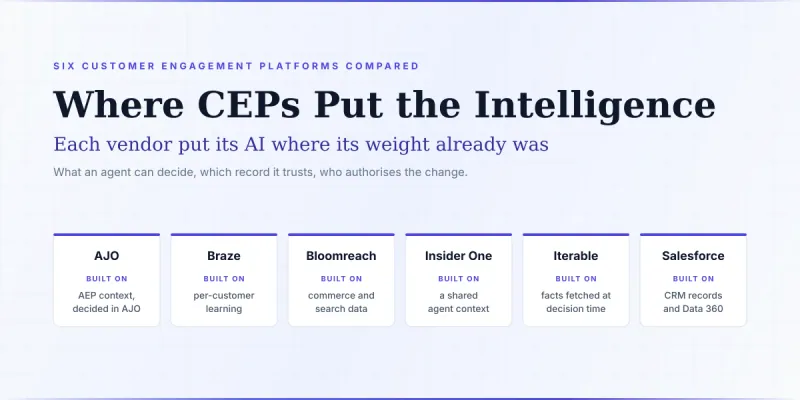
Where CEPs Put the Intelligence: Six Platforms Compared
AJO, Braze, Bloomreach, Insider One, Iterable and Salesforce all ship agents now. Each put its AI where its centre of gravity already was, and that decides what an agent can decide, which record it trusts and who authorises the change.
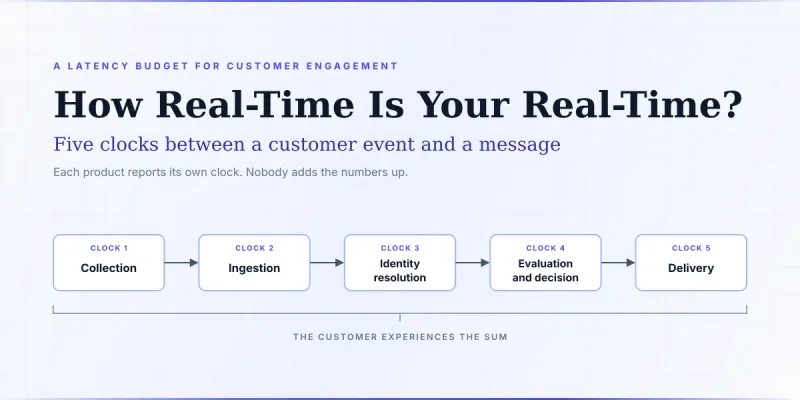
How Real-Time Is Your Real-Time? A Latency Budget for Customer Engagement
Every product between a customer's click and a marketing message can honestly claim to be real-time, and the message can still arrive forty minutes later. Real-time behaviour is a property of the whole chain, and the way to get it is a latency budget set per use case.
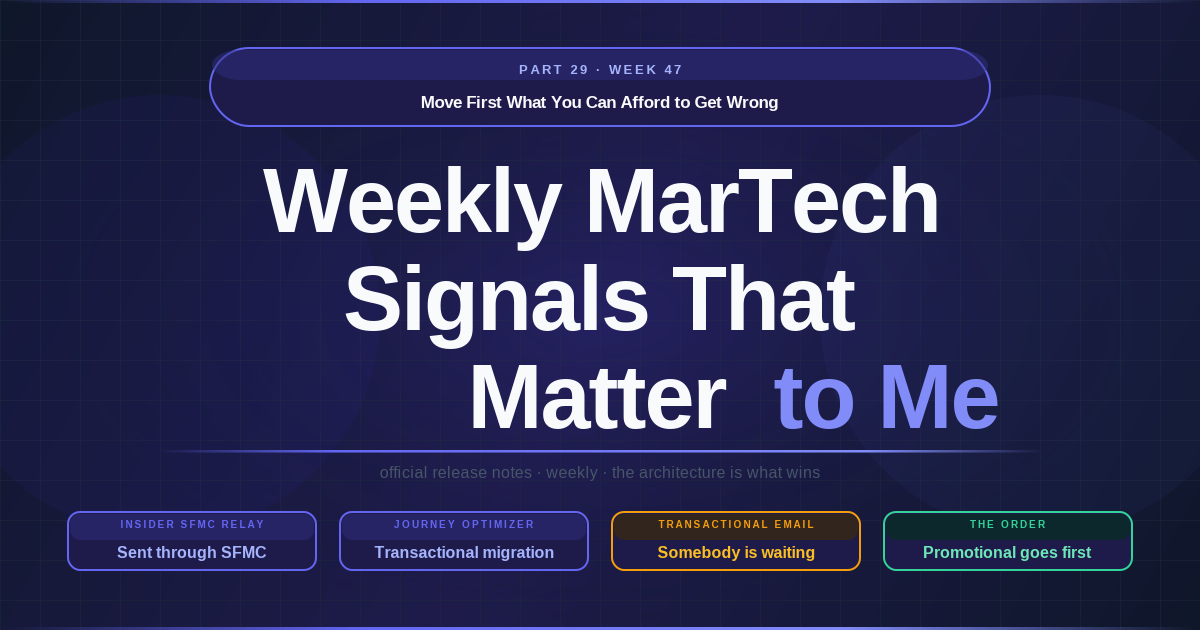
Move First What You Can Afford to Get Wrong: Signals W47
Insider documented a relay that sends promotional email through the customer's own Salesforce Marketing Cloud account, and Adobe Journey Optimizer extended its migration workspace to transactional email. I read them as tools for two different phases of the same plan, and I argue for an order: migrate promotional email first, transactional last.
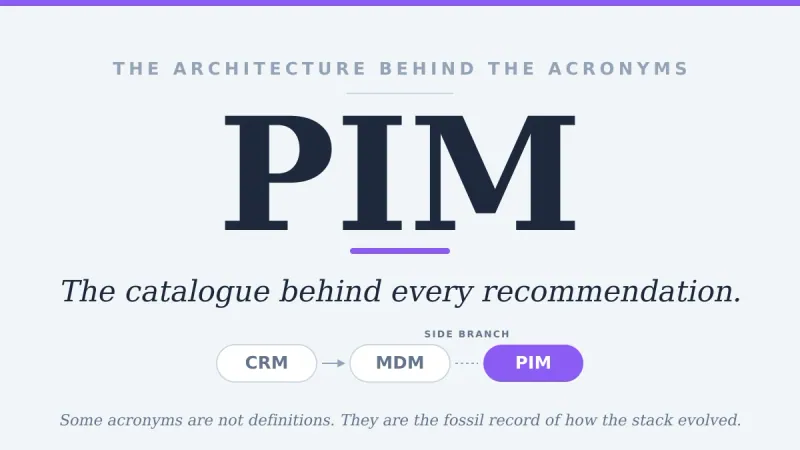
The Architecture Behind the Acronyms (PIM): The Catalogue Behind Every Recommendation
When a recommendation shows a sold-out item or the wrong size range, the engagement platform takes the blame. The failure usually sits in product data, and PIM is the acronym for the layer that marketing architecture rarely budgets for.
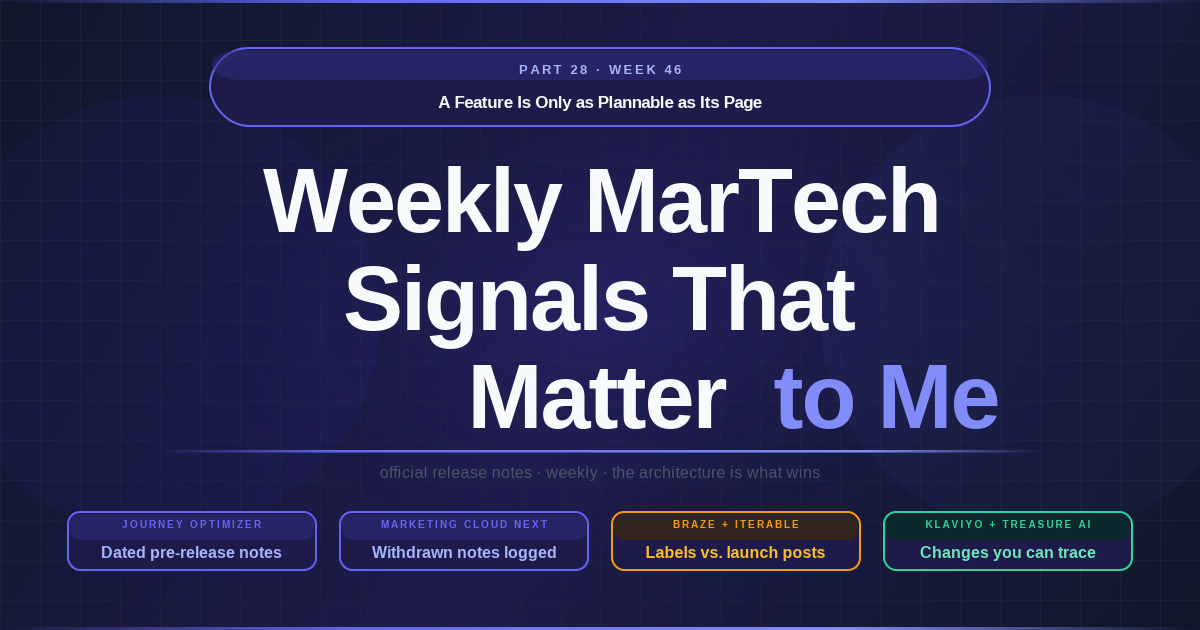
A Feature Is Only as Plannable as Its Page: Signals W46
Adobe Journey Optimizer now publishes what is coming a week before each monthly release, with a date. This week's record shows how differently vendors tell us what is planned, what is live, what is still in beta and what was withdrawn, and why that matters for anyone who plans tests and campaigns around a release.
The Architecture Behind the Acronyms (CMP): The Banner That Became a Layer
CMP started life as the name for a cookie banner inside an adtech framework. The job the category now has to do, holding a customer's permissions across every channel, is one the acronym was never built to describe.
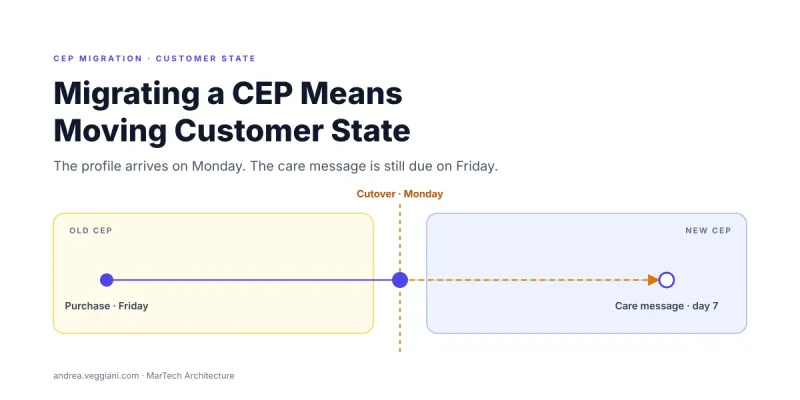
Migrating a CEP Means Moving Customer State
A CEP migration can reproduce every journey diagram and still change what happens to customers already inside it. The cutover depends on what state you preserve, reconstruct or deliberately end.
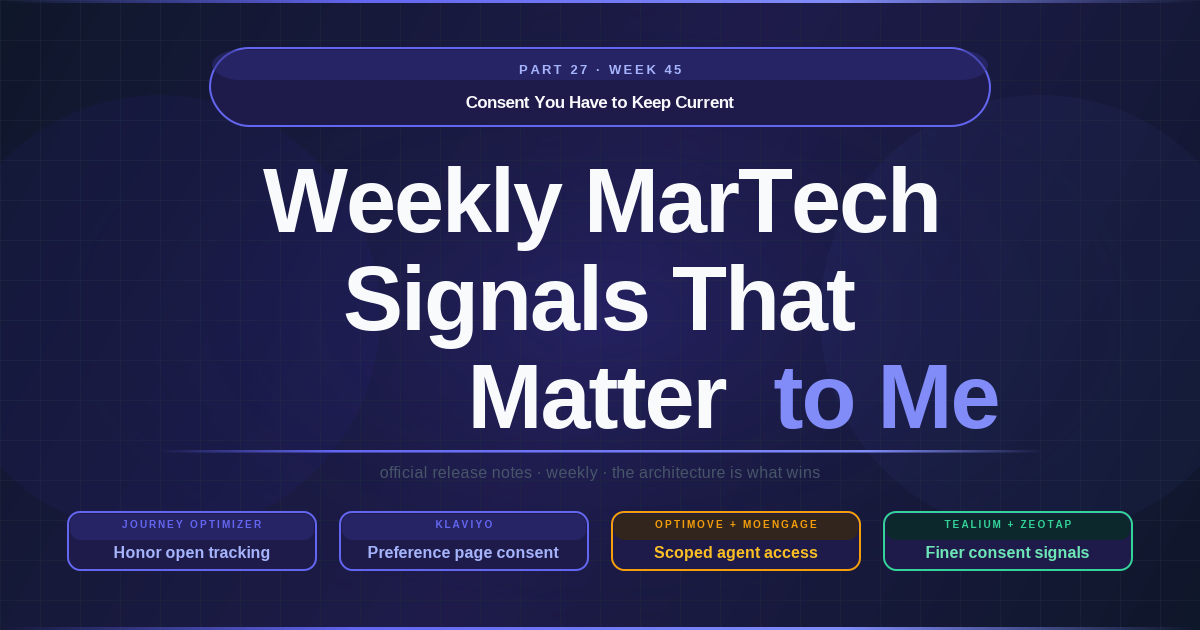
Consent You Have to Keep Current: Signals W45
Tracking consent is moving out of the moment of sending and into the preference centre, where recipients can change it whenever they like. This week's releases show what that asks of the platforms, the consent signals around them and the access model for the agents that now act on the same data.
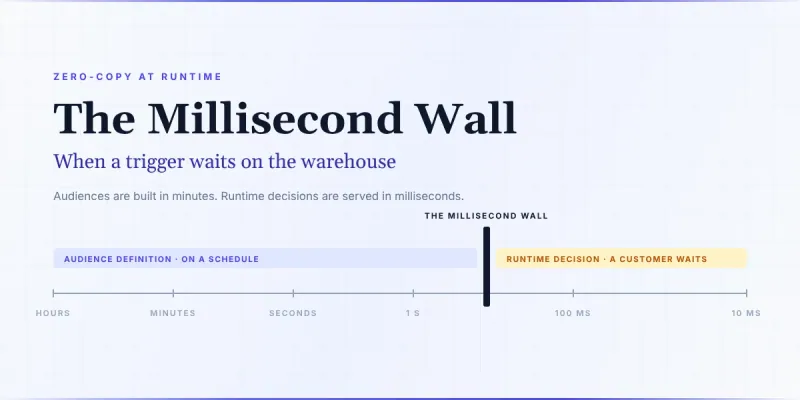
Zero-Copy at Runtime: The Millisecond Wall
Zero-copy activation works well for audiences built on a schedule. Asking an analytical warehouse to answer a single customer's question while an in-app trigger waits is a different workload, and it runs into latency, concurrency and cost long before it runs into governance.
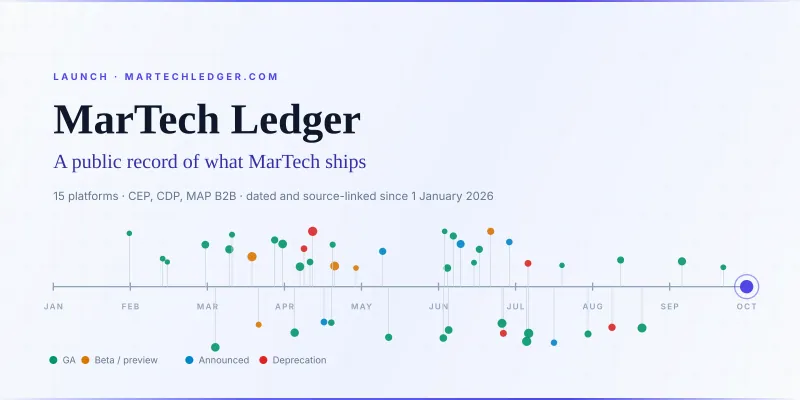
MarTech Ledger: A Public Record of What MarTech Ships
Why I built MarTech Ledger, a dated and source-linked record of what 15 CEP, CDP and B2B marketing automation platforms release, announce and retire, how its AI pipeline works, which tools run it and who it is for.
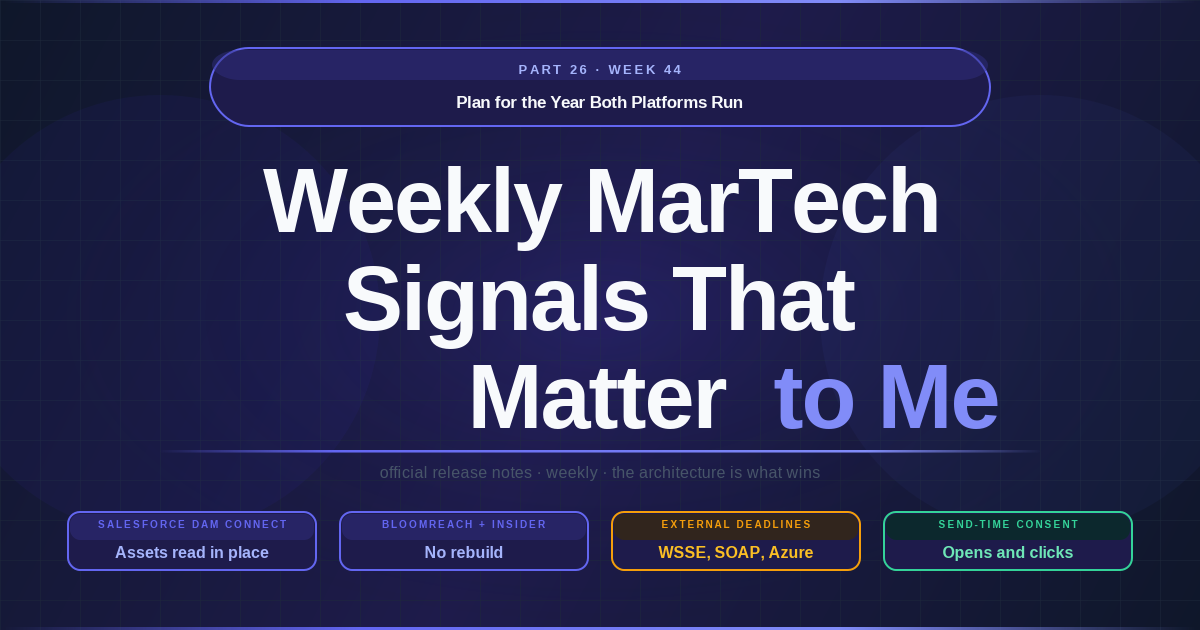
Weekly MarTech Signals That Matter to Me: Part 26, Week 44
Most platform changes are long periods in which the old and the new system run side by side. This week's releases show which features make that period manageable: assets that can be reused across platforms, audiences that arrive without being rebuilt, and consent that is checked at the moment of sending.
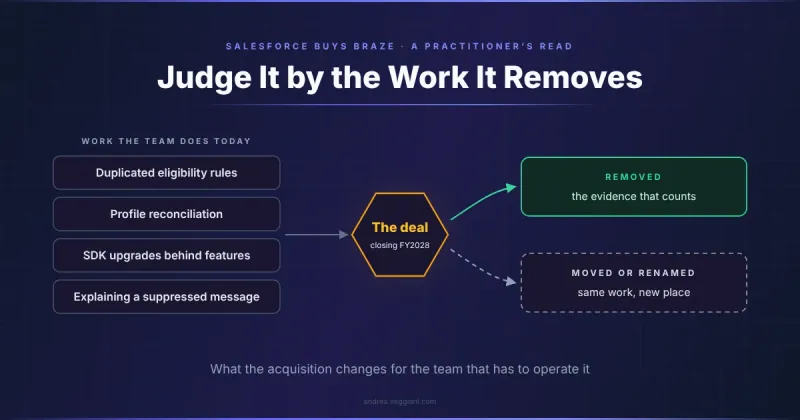
Salesforce Buys Braze: Judge It by the Work It Removes
The Salesforce–Braze deal through the eyes of someone who uses the platforms: strengths you rely on, flaws you hate, and compromises an acquisition still has to resolve.
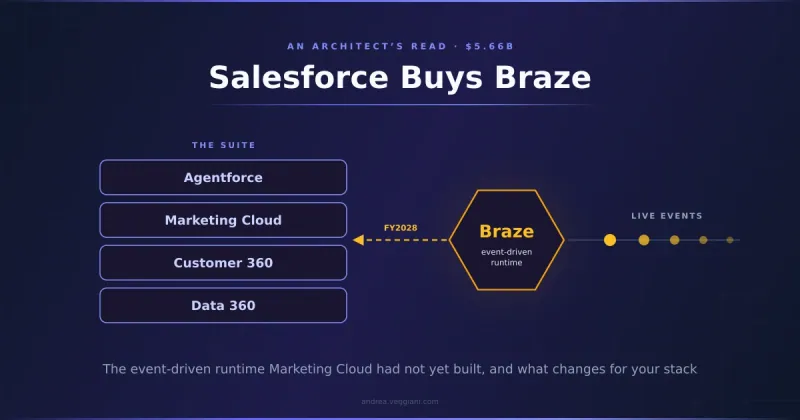
Salesforce Buys Braze: What It Means for Your Stack
Salesforce's $5.66 billion deal for Braze buys an event-driven engagement runtime and the decisioning on top of it, the part of the stack Marketing Cloud's native rebuild had not yet delivered for mobile-first B2C. What it means for Braze customers, Marketing Cloud customers and composable stacks.
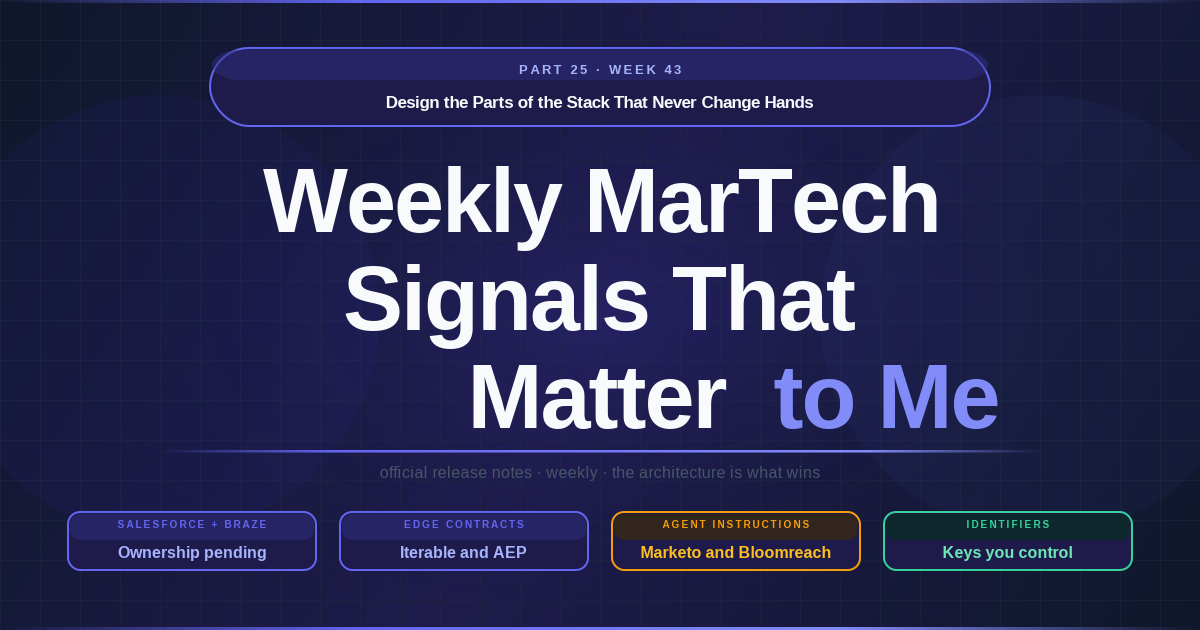
Weekly MarTech Signals That Matter to Me: Part 25, Week 43
Salesforce has agreed to acquire Braze, with the close expected in Salesforce's next fiscal year. For teams running or choosing either platform, the useful question is which parts of their own architecture stay theirs whoever owns the platform: the contracts at the edges, the identifiers that travel, and the instructions written for agents.
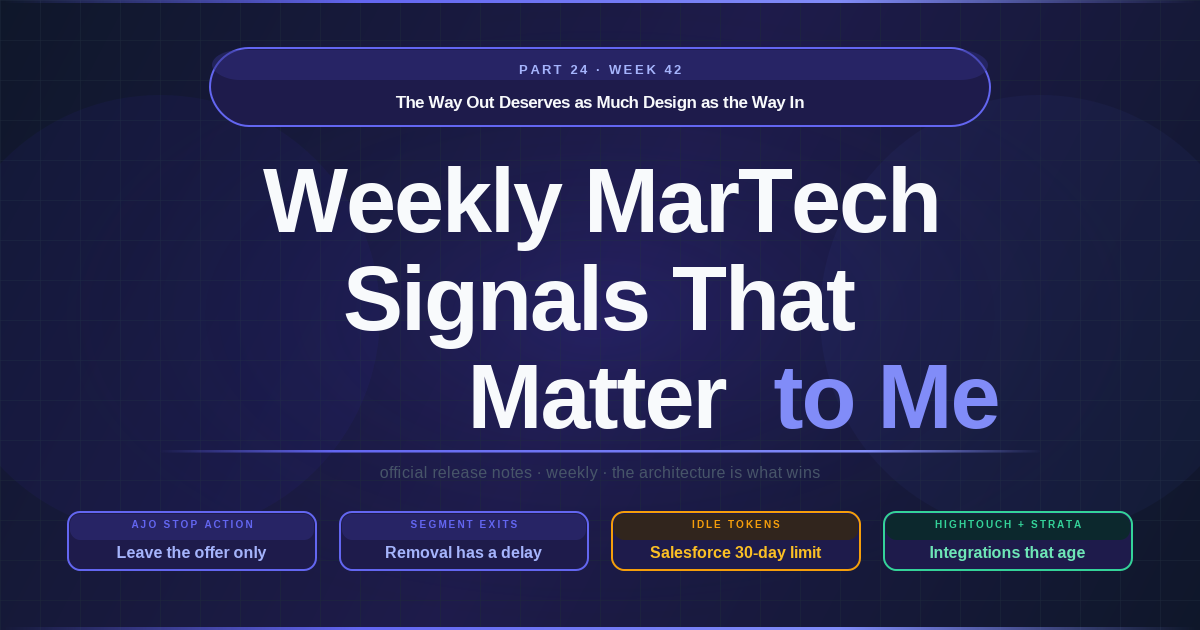
Weekly MarTech Signals That Matter to Me: Part 24, Week 42
Adobe Journey Optimizer can now take a profile out of inbound experiences without ending its journey, Insider removes people who leave a segment from a ChatGPT Ads audience, Salesforce will revoke integration tokens left idle for thirty days, and Hightouch bought an agent that keeps integrations running. The way out deserves as much design as the way in.
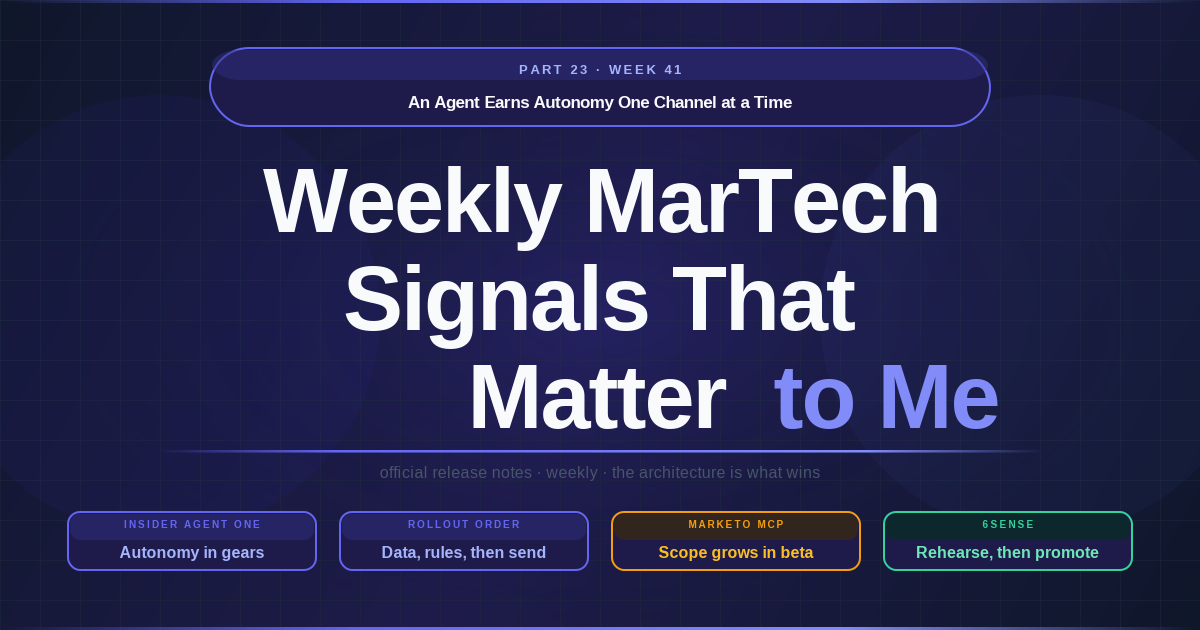
Weekly MarTech Signals That Matter to Me: Part 23, Week 41
Insider made agent autonomy a mode chosen per use case and channel, 6sense let workflows be rehearsed in a sandbox before promotion, Iterable spelled out the order in which a control must be switched on, and Marketo's MCP server gained smart list operations during its open beta. Rollout is becoming part of the product.
Weekly MarTech Signals That Matter to Me: Part 22, Week 40
Braze put its Operator inside Claude and ChatGPT under the individual user's identity, Marketo's MCP server runs as a dedicated API user, and OpenAI gave its specialist dots an identity of their own. Three answers to the first architecture question of agentic marketing.
Weekly MarTech Signals That Matter to Me: Part 21, Week 39
Iterable made the email tracking pixel a per-recipient consent value and Braze made its MCP server sign in as the person using it. The same design decision from two ends of the stack, and the history nobody has planned to keep.
Weekly MarTech Signals That Matter to Me: Part 20, Week 38
Salesforce and HubSpot both announced that their own screen is no longer where you use them, and both answered the governance question with inheritance. What that leaves unresolved for anyone who has to audit it.
Weekly MarTech Signals That Matter to Me: Part 19, Week 37
Three customer engagement platforms published what their agent may actually do, and they put the answer in three different places: the launch copy, a reference table, and the API contract. The ones that write the boundary down are the ones you can buy from.
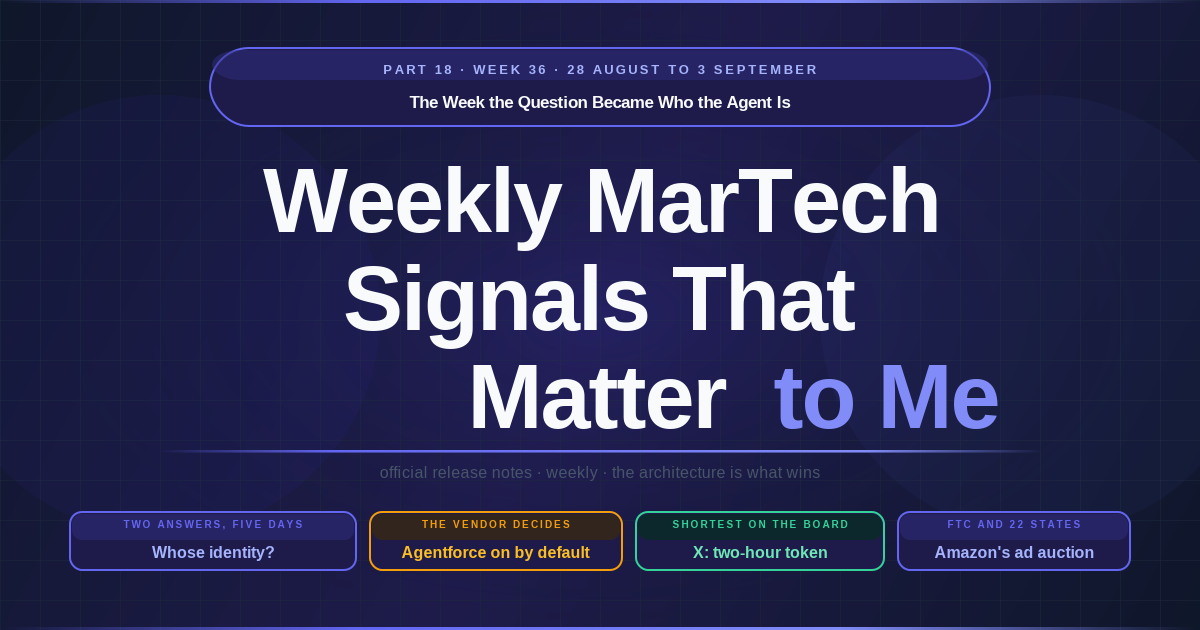
Weekly MarTech Signals That Matter to Me: Part 18, Week 36
Optimizely gave its agents their own identity. Salesforce and Anthropic gave theirs yours. Salesforce is also turning the agent platform on for you by default. Treasure AI published a read-only boundary, Salesforce retracted a write capability it had documented, and the FTC sued Amazon over an auction that was not the auction it described.
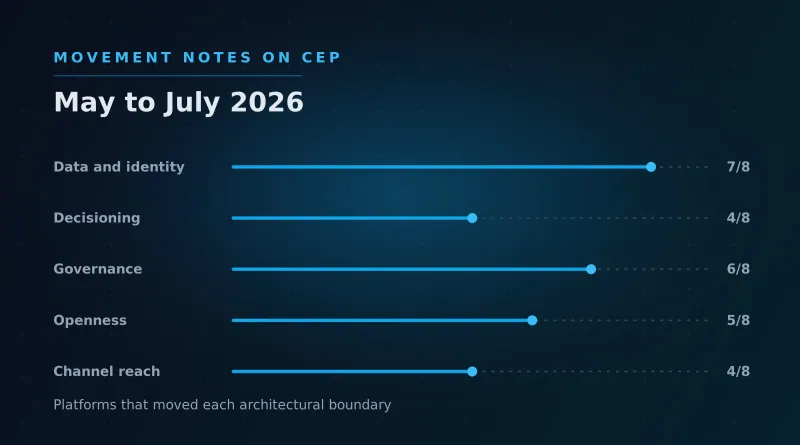
Movement Notes on CEP: May to July 2026
Which architectural boundaries eight customer engagement platforms moved between May and July 2026, across data, decisioning, governance, openness and channel reach.
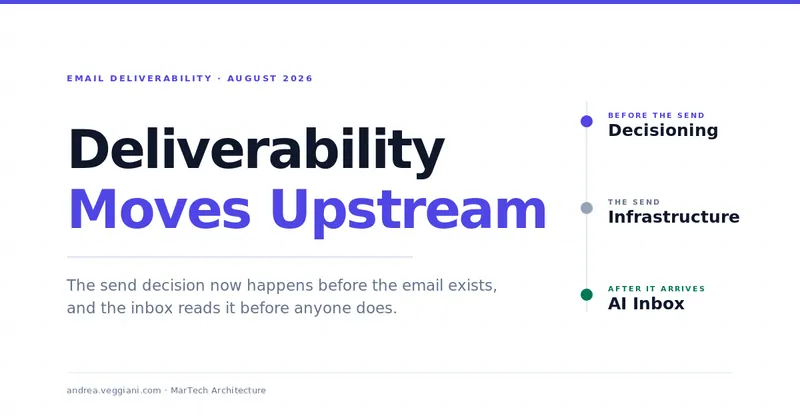
AI Email Deliverability Starts Before the Send
AI is moving email deliverability upstream into the decision of whether a message should exist, while AI inboxes make a second decision about whether it deserves attention.
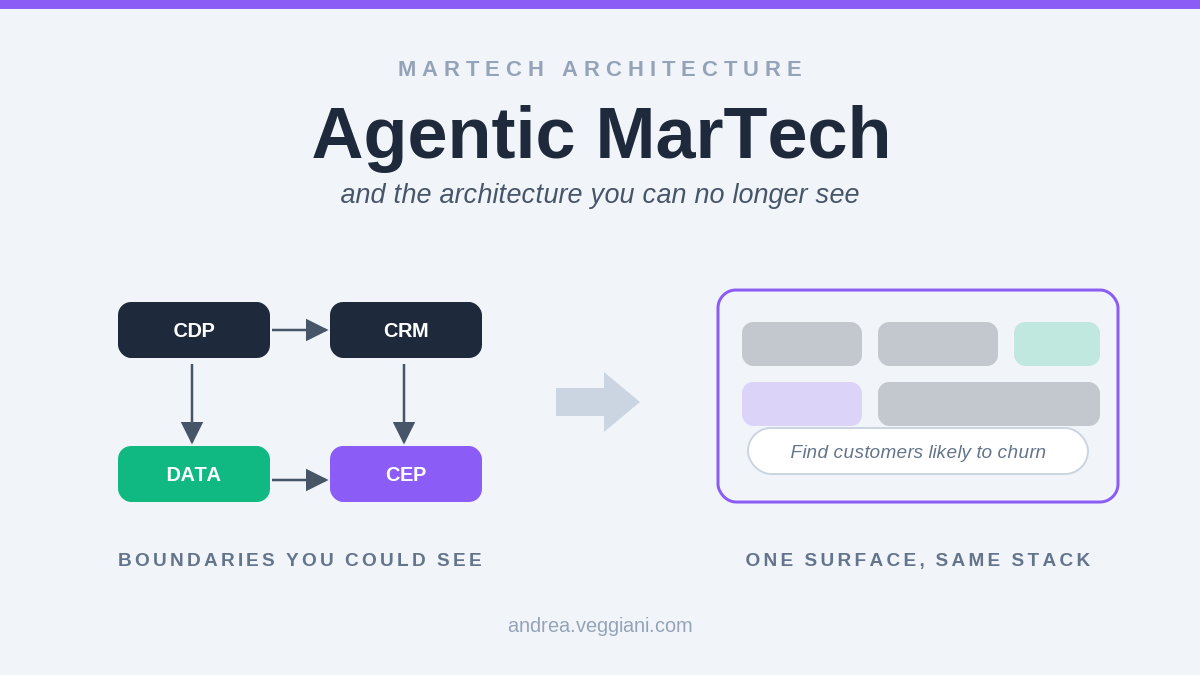
Agentic MarTech: The Architecture You Cannot See
Conversational MarTech interfaces hide system boundaries inside permissions, prompts, definitions, retrieval policies and traces. Five questions and an agent register make them inspectable again.
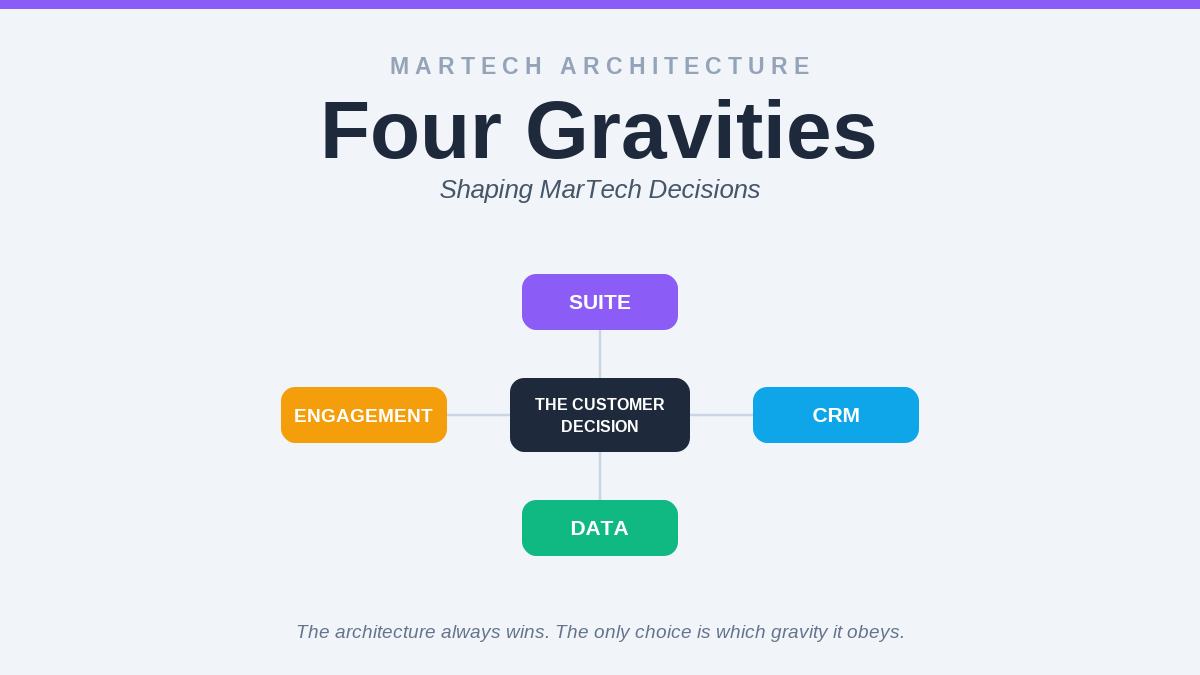
Four Gravities Shaping MarTech Decisions: Suite, CRM, Data and Engagement
MarTech platform decisions are shaped by four gravitational forces: the experience suite, the CRM, the enterprise data layer and the engagement runtime. Understanding which gravity should dominate is more useful than comparing feature lists.
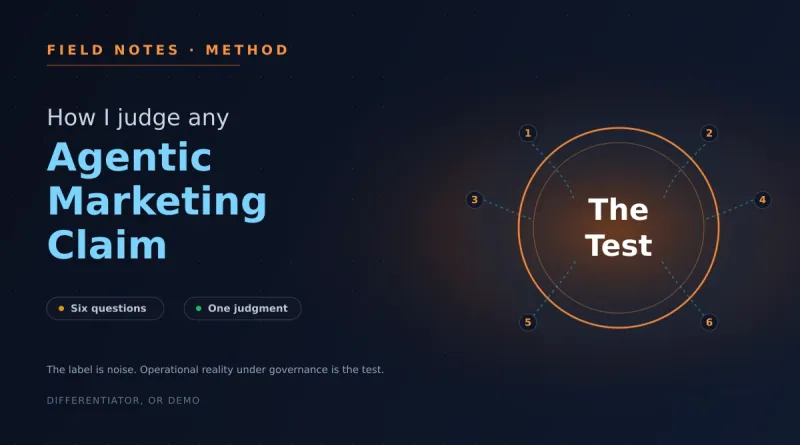
How I Judge Any Agentic Marketing Claim
One reusable test for any agentic or AI marketing claim: does it improve operational reality under governance, or is it a demo?
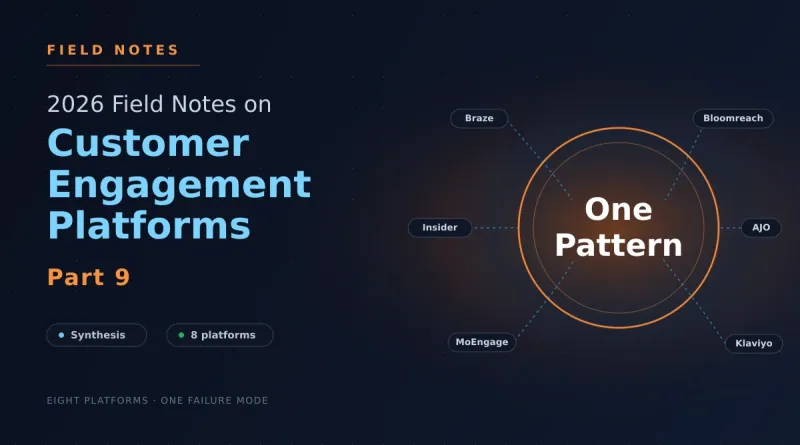
2026 Field Notes on Customer Engagement Platforms - Part 9: Eight Platforms, One Pattern
Eight platforms, one pattern: an interim synthesis where different CEP physics converge on the same governance-versus-activation failure mode.
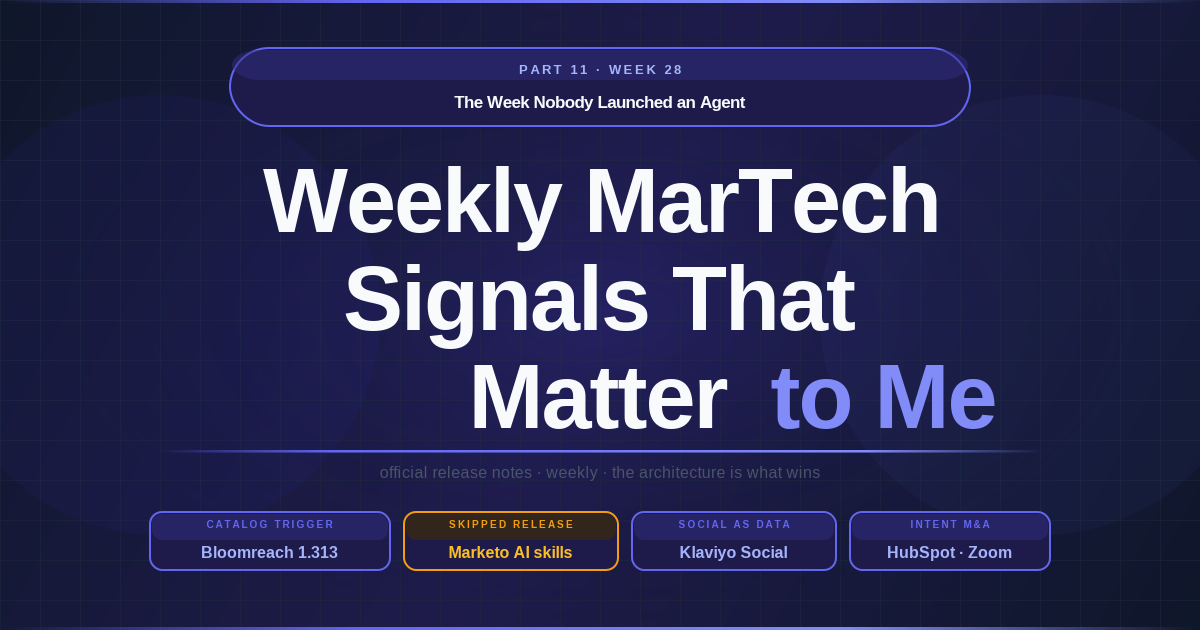
Weekly MarTech Signals That Matter to Me: Part 11, Week 28
A quiet holiday week with no agent launches, yet one of the quarter's most architecturally interesting: catalogs, channels and two intent-layer buys.
2026 Field Notes on Customer Engagement Platforms - Part 8: Klaviyo
Klaviyo as commerce-data proximity: field notes on the storefront as system of record, K:AI agents, and when it strains beyond DTC.
2026 Field Notes on Customer Engagement Platforms - Part 7: MoEngage
MoEngage as insight-led, app-first activation: field notes on Sherpa, Merlin and Aampe, and when analysing and acting in one seat wins.
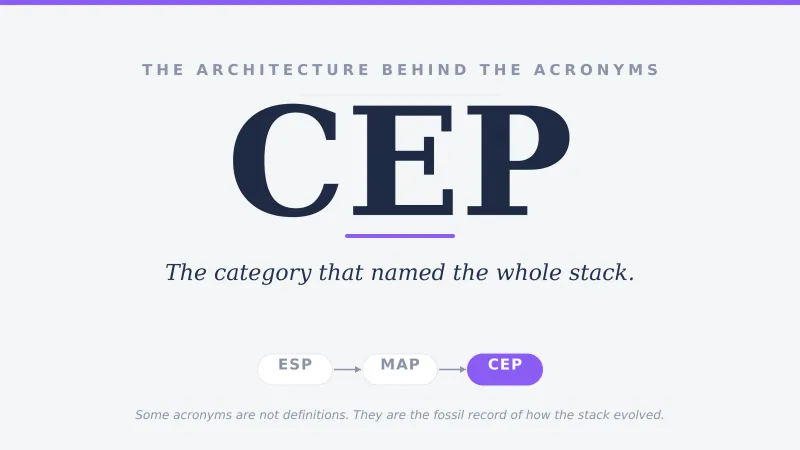
The Architecture Behind the Acronyms (CEP): The Category That Named the Whole Stack
Customer Engagement Platform absorbed ESP and MAP, then collided with CDP. That is why it is useful, vague, and dangerous to buy against.
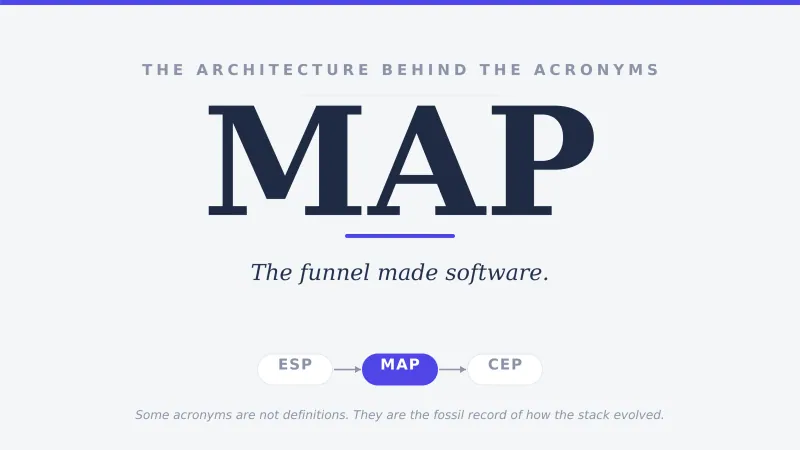
The Architecture Behind the Acronyms (MAP): The Funnel Made Software
Marketing Automation encoded the funnel into software. It still fits B2B well, but its campaign-tempo model explains why B2C moved toward event-driven
The Architecture Behind the Acronyms (ESP): The Engine That Never Died, It Got Absorbed
The Email Service Provider faded as a category, but its function still sits inside every modern engagement stack: delivery, reputation, consent
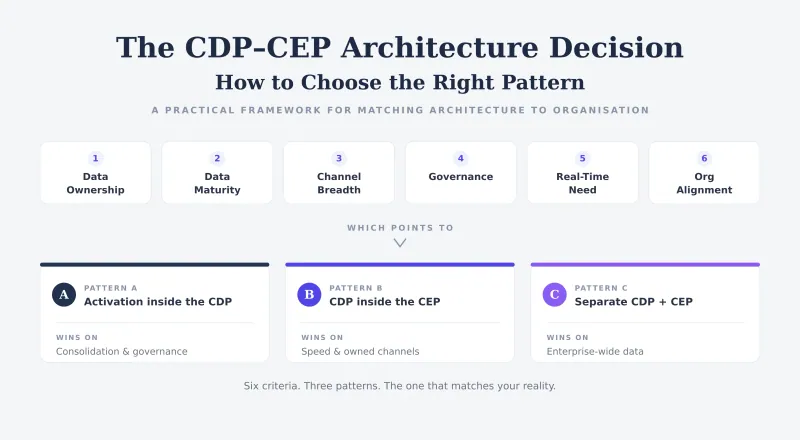
The CDP-CEP Architecture Decision: How to Choose the Right Pattern - Part 2
After mapping the three CDP-CEP wiring patterns, this is the practical framework for choosing which architecture fits your organisation.
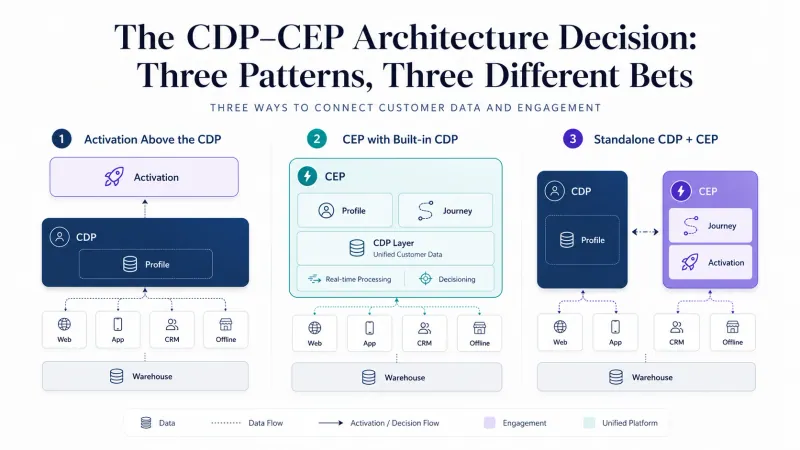
The CDP-CEP Architecture Decision: Three Patterns, Three Different Bets - Part 1
Activation inside the CDP, the CDP inside the CEP, or best-of-breed apart: three ways to wire customer data and engagement, and what each choice really implies.
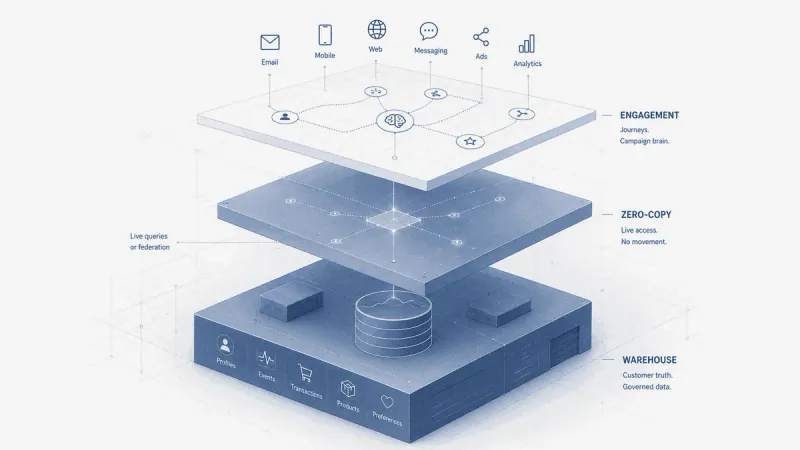
Zero-Copy Engagement: When the Warehouse Becomes the Campaign Brain
Zero-copy activation is not just a new integration pattern. It is a signal that customer engagement architecture is moving closer to the data warehouse
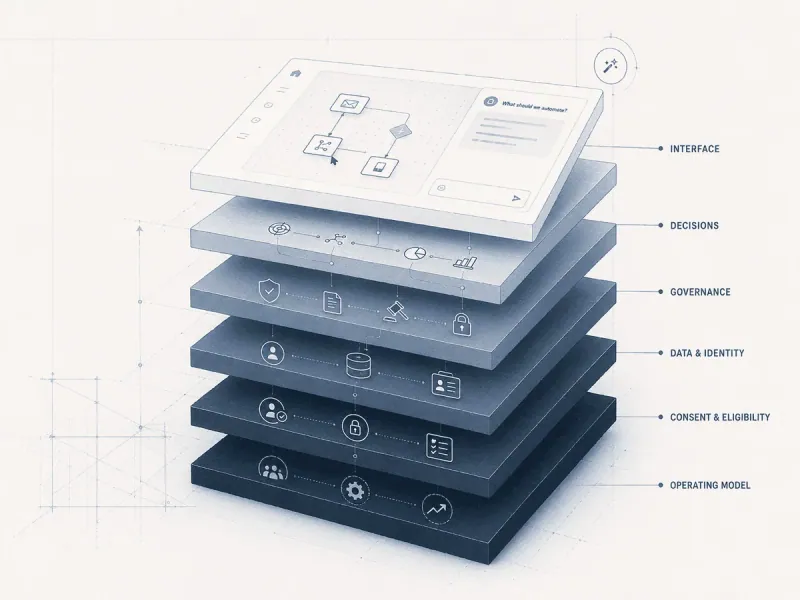
Business Autonomy Was Never Just a UI Problem
Agentic AI promises to make MarTech platforms easier to use, but without the right architecture and operating model it moves complexity rather than removing it.
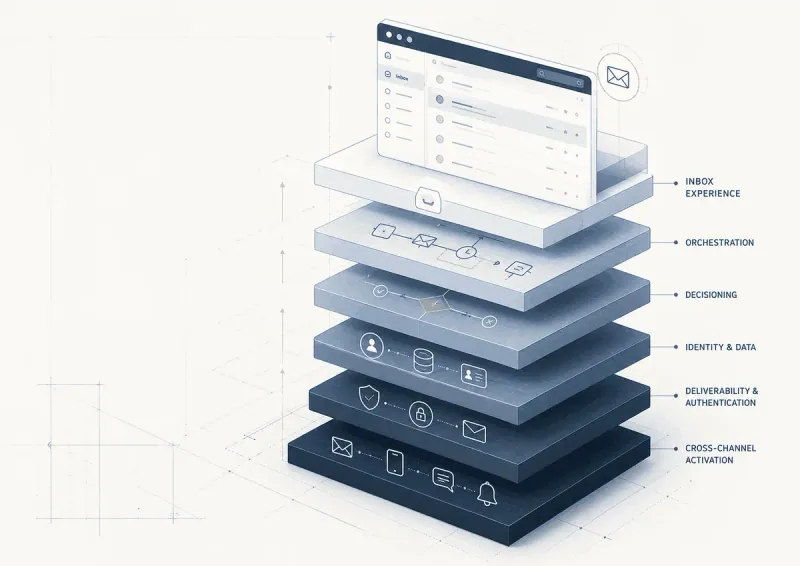
Email Isn't Dead. It's Being Rebuilt From the Inbox Up.
After 25 years, email is still the highest-ROI channel in the stack. But the platforms delivering it in 2026 are fundamentally different.
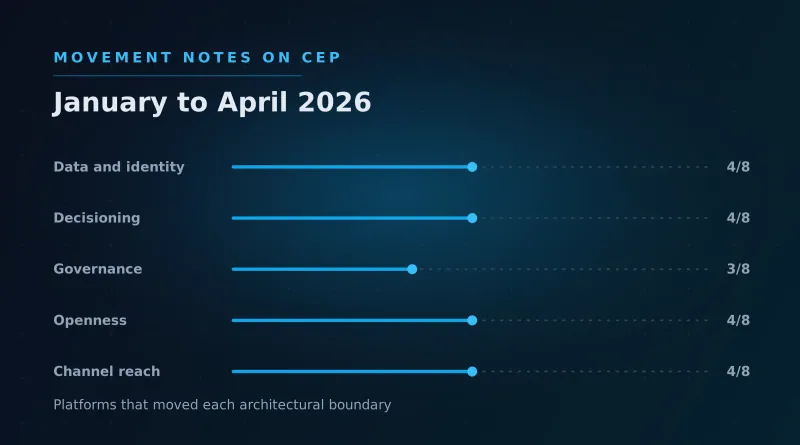
Movement Notes on CEP: January to April 2026
Which architectural boundaries eight customer engagement platforms moved between January and April 2026, across data, decisioning, governance, openness and channel reach.
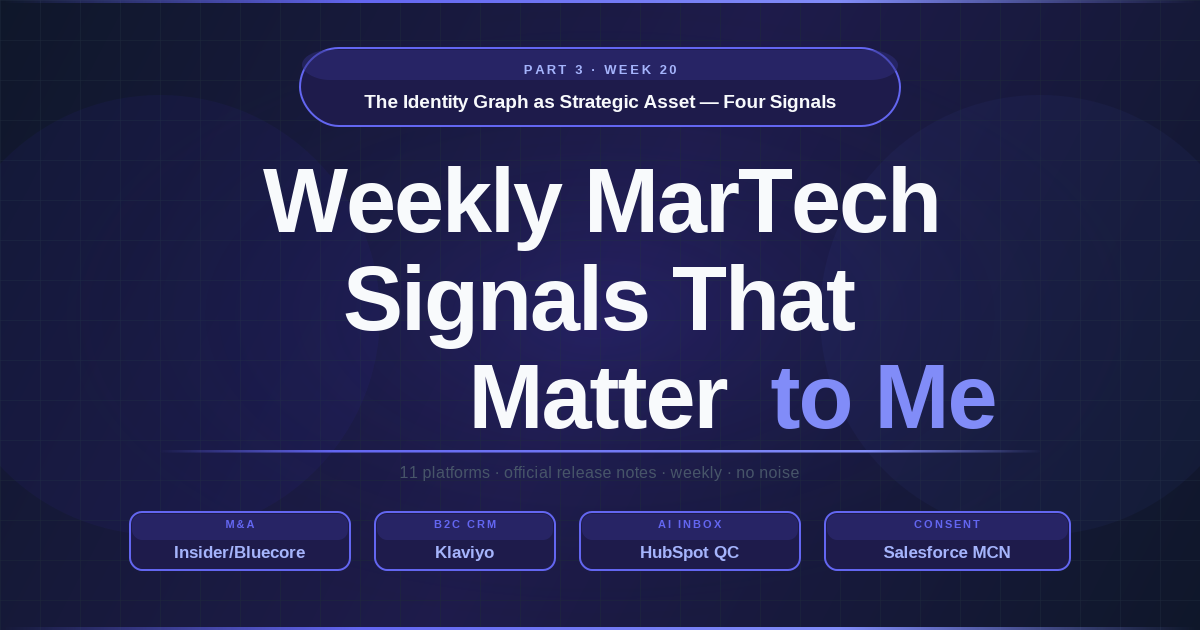
Weekly MarTech Signals That Matter to Me: Part 3, Week 20
The Insider One/Bluecore acquisition reframes the CEP M&A logic, Klaviyo reveals the full scope of its B2C CRM ambition
Weekly MarTech Signals That Matter to Me: Part 2, Week 19
Hightouch at $2.75B, Canva buying Ortto, Braze's operational consolidation drop and AJO's march toward autonomous journey management.
2026 Field Notes on Customer Engagement Platforms - Part 6: Iterable
Iterable as the moment engine: field notes on signal-to-moment velocity, Nova Agent, and the composable trade-off for lifecycle teams.
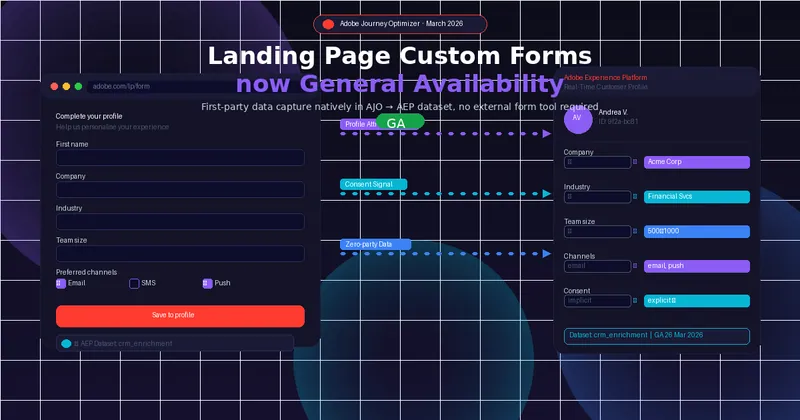
AJO March 2026 Release: Landing Page Custom Forms Reach GA and Why That Matters More Than It Sounds
Adobe Journey Optimizer's March 2026 release promotes Landing Page Custom Forms to General Availability.
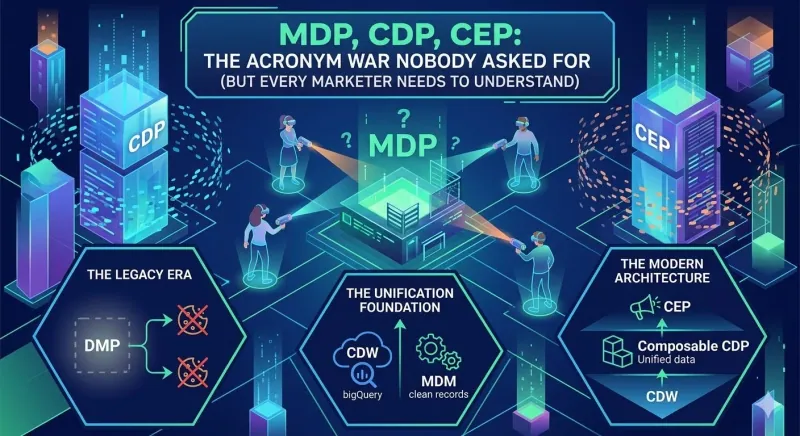
MDP, CDP, CEP: The Acronym War Nobody Asked For (But Every Marketer Needs to Understand)
Martech has a naming problem. Every few years a new (or rather, a resurrected one) acronym shows up promising to solve what the previous…
2026 Field Notes on Customer Engagement Platforms - Part 5: Salesforce Marketing Cloud (Agentforce Marketing)
Salesforce Marketing Cloud as CRM gravity: field notes on Agentforce, the Engagement and Next coexistence, and when the anchor helps or hurts.
2026 Field Notes on Customer Engagement Platforms - Part 4: Adobe Journey Optimizer
Adobe Journey Optimizer as suite gravity: field notes on when AEP foundations make it fly, and when they leave it stuck in traffic.
2026 Field Notes on Customer Engagement Platforms - Part 3: Insider One
Insider One as user-centric growth: field notes on the CEP that bridges engagement and experience optimization, and where it strains.
2026 Field Notes on Customer Engagement Platforms - Part 2: Bloomreach
Bloomreach as commerce and product intelligence: field notes on the commerce-first CEP and when its zero-latency loop actually pays off.
2026 Field Notes on Customer Engagement Platforms - Part 1: Braze
Braze as the event-driven runtime: field notes on where it wins, where it strains, and how its physics shapes real CEP delivery.
2026 Field Notes on Customer Engagement Platforms - Part 0
Why this CEP field-notes series exists: the operating model and data architecture decide outcomes, not features. One platform per article.
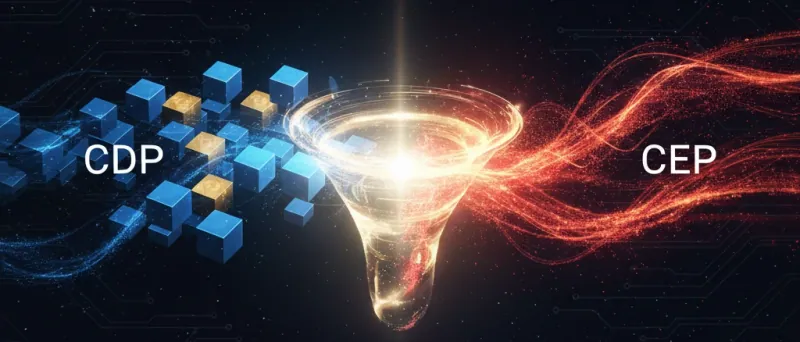
When CDP Meets CEP: The Convergence of Data and Activation in the Age of Algorithmic Empathy
The MarTech landscape is collapsing the distance between customer data and customer action.
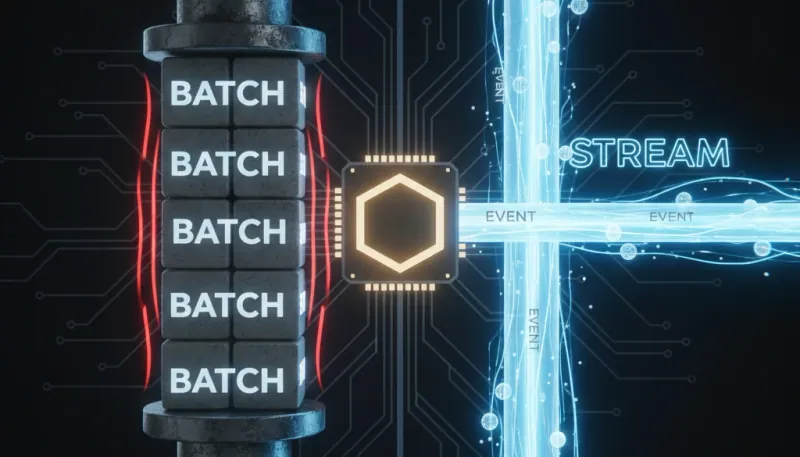
The End of Batch-and-Blast: From Marketing Automation to Agentic Engagement - Part 2
The architectural revolution that eliminated Latency Debt: the mandatory leap from slow batch processing to Real-Time Intelligence.