8 min read
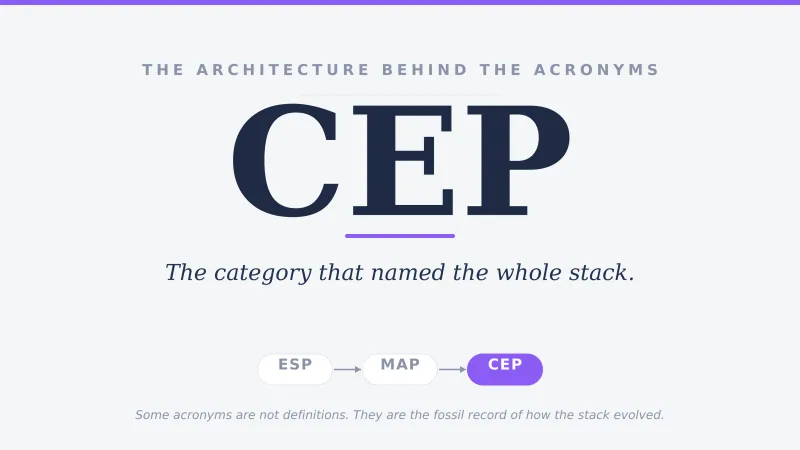
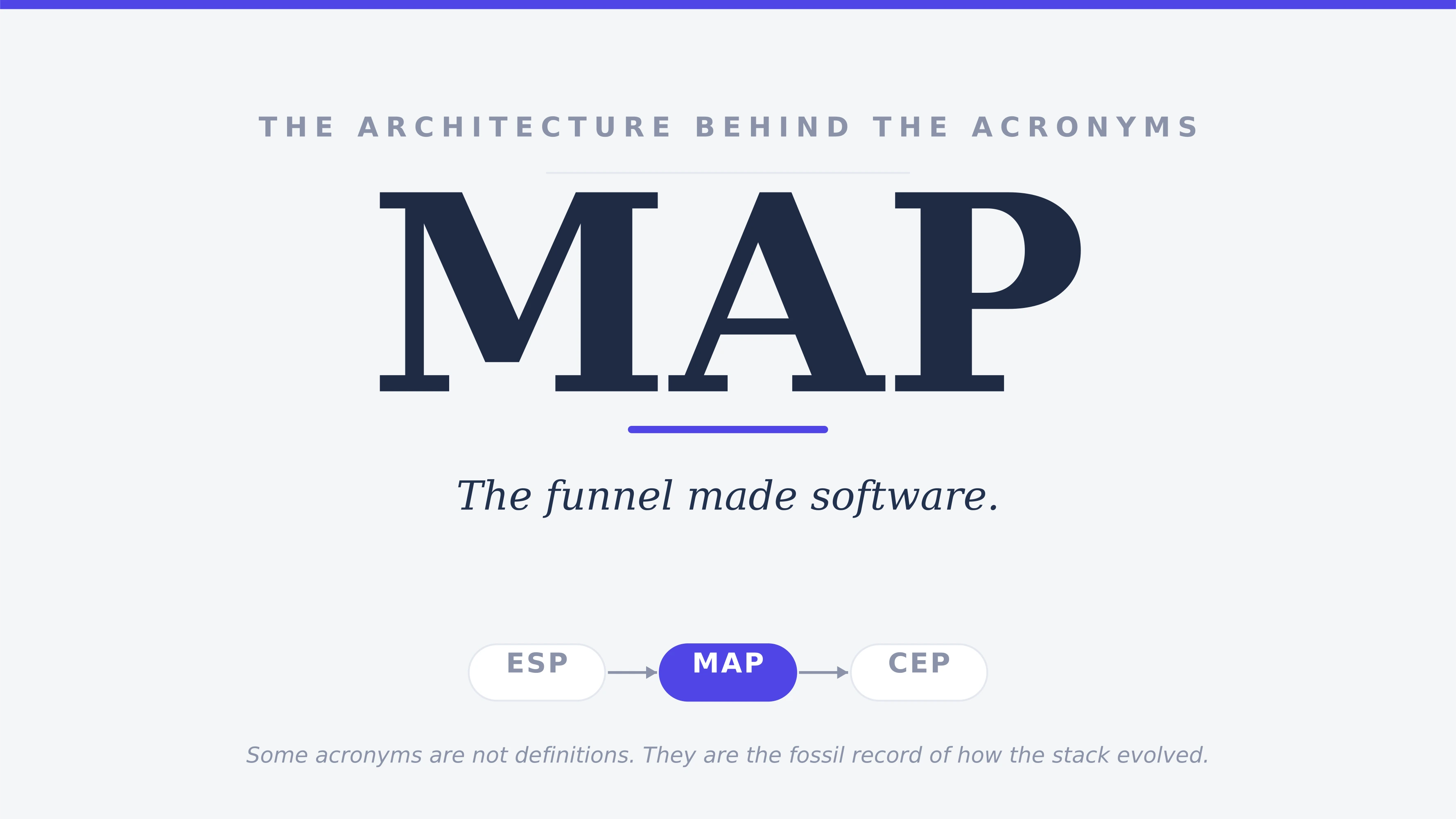
Second in a lineage that runs ESP to MAP to CEP. ESP owned the send. MAP added the brain that decided who got sent what, and built it around a model of the funnel that the next decade would quietly dismantle.
If the ESP was a send engine, Marketing Automation was the first acronym to claim it could think. A MAP did not just deliver your email. It decided who should receive it, when, and what should happen next based on how they responded. For a while in the late 2000s and 2010s, that felt like the future of marketing arriving on schedule.
It was a genuine leap. It was also, in hindsight, a very specific bet on what a customer is and how they move. That bet is encoded in the MAP data model, and understanding it explains both why Marketing Automation conquered B2B and why it has spent the last several years being reshaped by event-driven engagement.
What it actually solved
The problem the MAP solved was repetition. By the late 2000s marketers had ESPs and could send at scale, but every send was a manual act: pull a list, build the email, schedule it. If you wanted to follow up with people who opened, or chase people who did not, you did it by hand, next week, with another list pull. The work was linear and it did not scale with the number of customers or the number of follow-ups.
Marketing Automation turned that linear work into a standing program. Build the logic once, as a flow, and let it run: if someone downloads the whitepaper, wait two days, send the case study; if they open it, notify sales; if they go quiet, drop them into a re-engagement track. The marketer moved from executing sends to designing systems that executed sends. That was the real unlock, and it was worth every bit of the enthusiasm it generated.
To make that work, the MAP needed something the ESP never had: a persistent record of each person and what they had done. Not a list for one campaign, but a profile that accumulated behaviour over time. This is the quiet architectural milestone in the lineage. The ESP thought in lists and sends. The MAP introduced a durable contact record with a history. That idea, once it existed, never went away. It just kept getting more ambitious, through the CDP and beyond.
The market that shaped it
Marketing Automation did not grow up evenly. It found its perfect host in B2B, and that shaped the entire category. The defining platforms all emerged in a tight window in the mid-2000s: Eloqua first, then Marketo (founded 2006) and Pardot (founded 2007). They built their data model around a specific motion: a prospect fills in a form, becomes a lead, accumulates a score based on behaviour, crosses a threshold, and gets handed to sales. The whole architecture assumes a long, considered, form-driven funnel with a human salesperson waiting at the end.
That assumption is everything. Lead scoring, nurture tracks, the marketing-qualified to sales-qualified handoff, the tight integration with the CRM as the system of record for the deal: all of it makes sense if you accept that the customer journey is a funnel measured in weeks and the goal is to feed a sales team. For B2B, that was and largely still is a fair description of reality, which is why Marketing Automation remains genuinely healthy there.
The trouble started when the same software and the same vocabulary were sold into B2C, where the model fits badly. A retail customer does not fill in a form to become a lead and wait to be scored. They browse, buy, return, browse again, open an app at midnight, abandon a cart, and respond to a price drop, all in real time, with no salesperson at the end. Forcing that behaviour into a lead-and-funnel data model meant a constant fight against the architecture. The “marketing automation is broken” complaint that became common in B2C was, underneath, a complaint about a B2B data model wearing a B2C costume. In B2C, the term did not disappear from everyday language, but the architecture underneath it changed: what many teams still call automation is now closer to event-triggered, cross-channel engagement than to classic lead nurture. I traced that failure in The End of Batch-and-Blast.
How vendors changed the meaning
“Marketing Automation” became one of the most overloaded phrases in the stack, and vendors did the overloading. In B2B it kept its precise meaning: lead lifecycle management. In B2C it loosened into “anything that sends a message without a human clicking go”, which could mean a triggered email, a drip series, or a scheduled blast with a fancier name. The same two words described a rigorous lead-scoring engine and a glorified autoresponder, and buyers were left to guess which one a vendor meant.
Then the platforms climbed, exactly as the ESPs had, and the acquisition history reads like a map of the climb. Oracle bought Eloqua in 2012 for around 871 million dollars and made it the cornerstone of Oracle Marketing Cloud. Salesforce acquired Pardot as part of its 2.5 billion dollar ExactTarget deal in 2013, then in 2022 rebranded it Marketing Cloud Account Engagement, dropping the word “Pardot” entirely. Adobe bought Marketo in 2018 for 4.75 billion dollars, at the time its largest SaaS acquisition, and folded it into a much larger experience stack. In every case the standalone MAP became a component inside a bigger suite that wanted to be called something more ambitious. The MAP, like the ESP before it, started dissolving upward into something bigger.
The honest version of what happened is this: the MAP added the decision layer to email, and then the decision layer turned out to be the valuable part. Once you have a system that decides who gets what and when, the question becomes why it should be limited to email, or to a weekly cadence, or to a funnel. Answering “it should not” is the move that produces the CEP, which is the next article in this series.
What it means architecturally today
Strip the branding and a MAP is the lifecycle-logic layer of the stack, built on a particular assumption about time. Its native tempo is the campaign and the nurture track: stages, waits measured in days, scores that accumulate, a handoff at the end. That is not a flaw. It is a precise fit for journeys that genuinely are slow and considered, which is most of B2B and a meaningful slice of high-consideration B2C like finance, insurance, and automotive.
Seeing it as a tempo, rather than a product, is what makes the architecture decision clear. The question is not “do we need marketing automation” but “what is the actual tempo of our customer”. If your customer moves in weeks through a funnel toward a salesperson, the MAP model is the right shape and trying to replace it with pure real-time decisioning is over-engineering. If your customer moves in seconds across channels with no salesperson, the MAP model is a constant source of friction and you need the engagement layer the CEP provides. Many real businesses have both tempos in different segments, which is why so many stacks end up running a MAP and a CEP side by side rather than one replacing the other.
The common failure mode here is the mirror of the ESP one. With the ESP, organisations buy a decisioning platform and use it as a send engine. With the MAP, they buy lead-funnel software and try to run real-time, high-frequency B2C engagement on top of it, then blame the tool when it cannot keep up. The acronym is not broken. It is being asked to keep a tempo it was never built for.
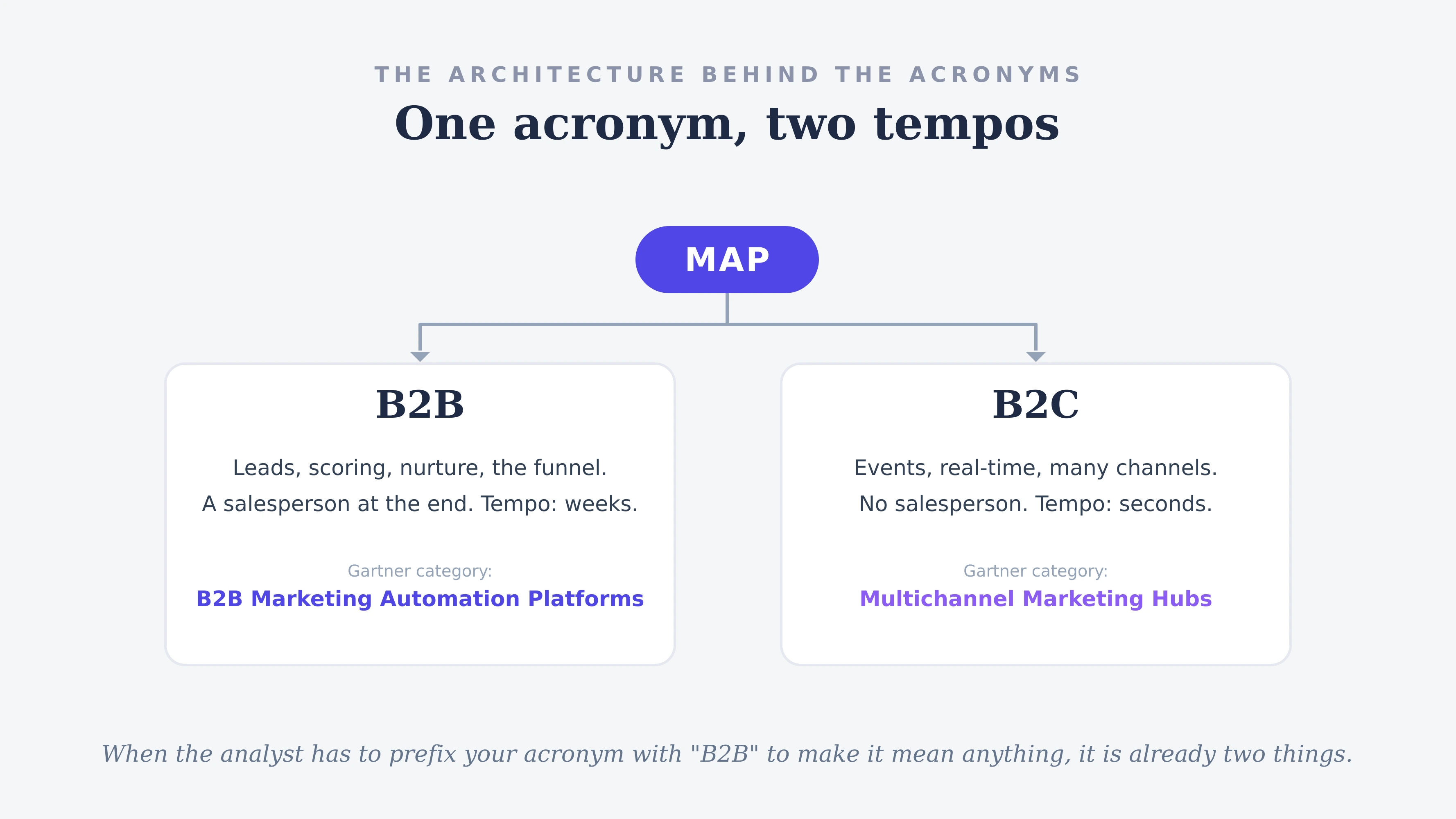
The analysts confirm the split, and they do it in the most concrete way possible: by what they put in the title. Gartner’s quadrant for this market is not called “Marketing Automation Platforms.” It is the Magic Quadrant for B2B Marketing Automation Platforms, and Gartner defines the category around demand generation at scale, capturing and qualifying leads and accounts, orchestrating engagement across the customer journey, and scoring leads to evaluate quality. The “B2B” is not decoration. It is a signal that the funnel-and-lead data model only describes one half of the market. There is no equivalent B2C MAP category with the same public prominence, because in the consumer world that execution has largely been absorbed into the Multichannel Marketing Hub, which is the CEP territory of the next article. When one of the industry’s most cited analysts has to qualify your acronym with “B2B” to make it precise, the acronym has already told you it is really two things.
What it gets confused with
MAP gets confused with the ESP beneath it and the CEP above it, and the confusion is directional. Against the ESP, the distinction is the decision layer: an ESP sends, a MAP decides who to send to and sequences it. Against the CEP, the distinction is tempo and breadth: a MAP runs lifecycle logic at the pace of a funnel, mostly around email and forms; a CEP runs decisioning in real time across many channels. Each acronym in the lineage is the previous one plus a layer, which is exactly why the boundaries feel blurry. They are blurry by inheritance.
The more consequential confusion is between MAP and CDP, because both keep a persistent profile and people assume that makes them interchangeable. They are not. A MAP keeps a profile in order to act on it within marketing’s own channels. A CDP keeps a profile in order to unify identity and serve it to everything, including the MAP. Treating your MAP’s contact database as your single customer profile is one of the most common and most expensive architectural mistakes I see, and it is a direct consequence of the acronym confusion. The MDP, CDP, CEP question I unpacked in The Acronym War starts right here.
Does it still matter
The acronym matters more than ESP and less than it used to, and the split is along the B2B and B2C line. In B2B, Marketing Automation is still a live, meaningful category. People buy MAPs on purpose, evaluate them as MAPs, and run their lead lifecycle on them, and they are right to. The funnel model the MAP encodes is a fair description of how B2B buying actually works.
In B2C, the acronym is fading architecturally into “engagement” for a good reason: the funnel-shaped, form-driven, weekly-cadence assumptions baked into the MAP do not match how consumers behave. What persists everywhere, in both worlds, is the thing the MAP actually contributed to the lineage: the idea that a marketing system should hold a durable profile and decide, not just send. That idea outgrew the acronym and became the foundation of everything after it.
MAP is not one acronym but two: in B2B it is a live category you should still buy on purpose, and in B2C it is a tempo you have probably outgrown, so the only real question is which one describes your customer.
Sources
Gartner
- Magic Quadrant for B2B Marketing Automation Platforms
- Multichannel Marketing Hubs (where B2C execution sits)
Knak
Forrester
SaaStr