8 min read
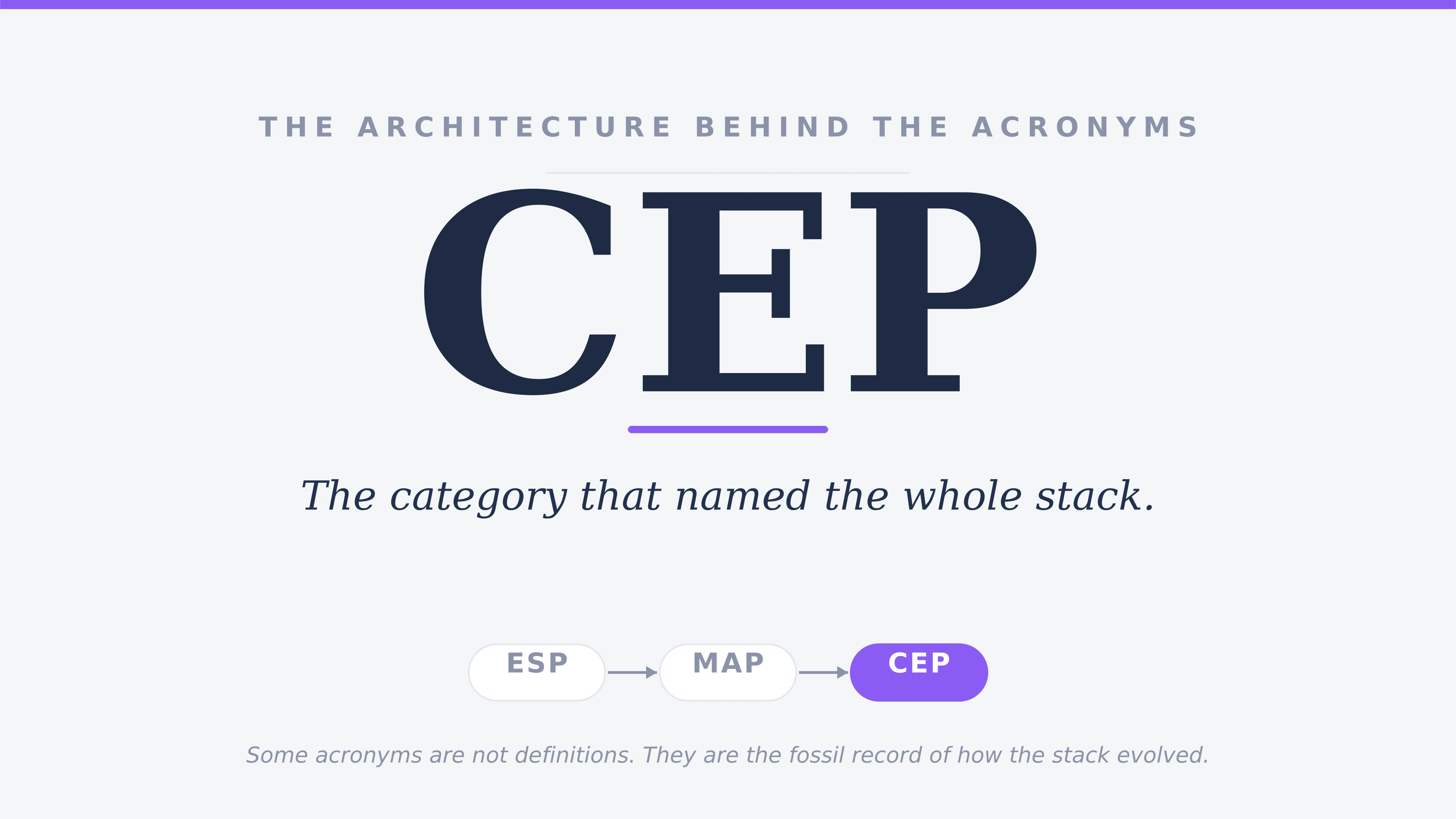
Third and last in a lineage that runs ESP to MAP to CEP. This one absorbed both of the others, then quietly claimed to be the whole stack, which is why it is the hardest of the three to define cleanly.
Of the three acronyms in this trilogy, CEP is the youngest and the slipperiest. ESP and MAP at least had reasonably settled meanings before vendors stretched them. Customer Engagement Platform arrived already stretched. It is more a vendor and market coinage than a precise technical category, and you can watch its definition shift depending on which vendor’s slide you are looking at.
That is not a reason to dismiss it. It is the most useful lens we have on the current state of the engagement stack, precisely because its vagueness is informative. The CEP is what you get when the send engine and the funnel logic merge and then expand to claim the entire customer relationship. Understanding why the term is so hard to pin down is the same as understanding why the whole category collided.
What it actually solved
The CEP solved a problem the MAP created by succeeding. Once marketers had a system that could decide who got what and when, two limits became obvious and intolerable. The decisioning was tied to email, and it ran at the tempo of a campaign. But customers had scattered across web, app, push, in-app, SMS, and service, and they were moving in real time, not in weekly cycles. The MAP model, built on a funnel and a calendar, could not keep up.
The CEP is the answer to “what if the decision layer were not limited to email, and not limited to a schedule”. Its founding promise is real-time, cross-channel decisioning: signals arrive continuously as streams from every touchpoint, the platform decides continuously what the best next action is, and it executes across whatever channel fits, with email reduced to one output among many. That is a real and meaningful shift, the shift from journeys as flowcharts you draw once to journeys as control systems that run and adjust. I have written about what that shift demands in practice across the Field Notes on CEP series; this article is about the acronym and where it sits, not the platforms.
The architectural milestone the CEP contributes to the lineage is the demotion of the channel. In the ESP, email was the product. In the MAP, email was the primary channel with others bolted on. In the CEP, the channel is just an output, and the valuable, defensible part is the decisioning in the middle. That inversion is the whole point of the category, and it is also the source of all the confusion.
The market that shaped it
The CEP did not emerge from a clean technical definition. It emerged from a market need for a word. By the late 2010s, several different kinds of vendor were converging on the same territory from different starting points. ESPs that had climbed the value chain, MAPs that wanted to escape the slowing B2B funnel, mobile-first messaging platforms born in the app era, and broad marketing clouds were all selling versions of “we orchestrate engagement across channels in real time”. They needed a banner, and “Customer Engagement Platform” became it.
Because the term was a convergence point rather than a specification, every vendor poured its own heritage into it. A platform that grew up in mobile push meant something different by CEP than one that grew up in B2B email, even when both used the same three words.
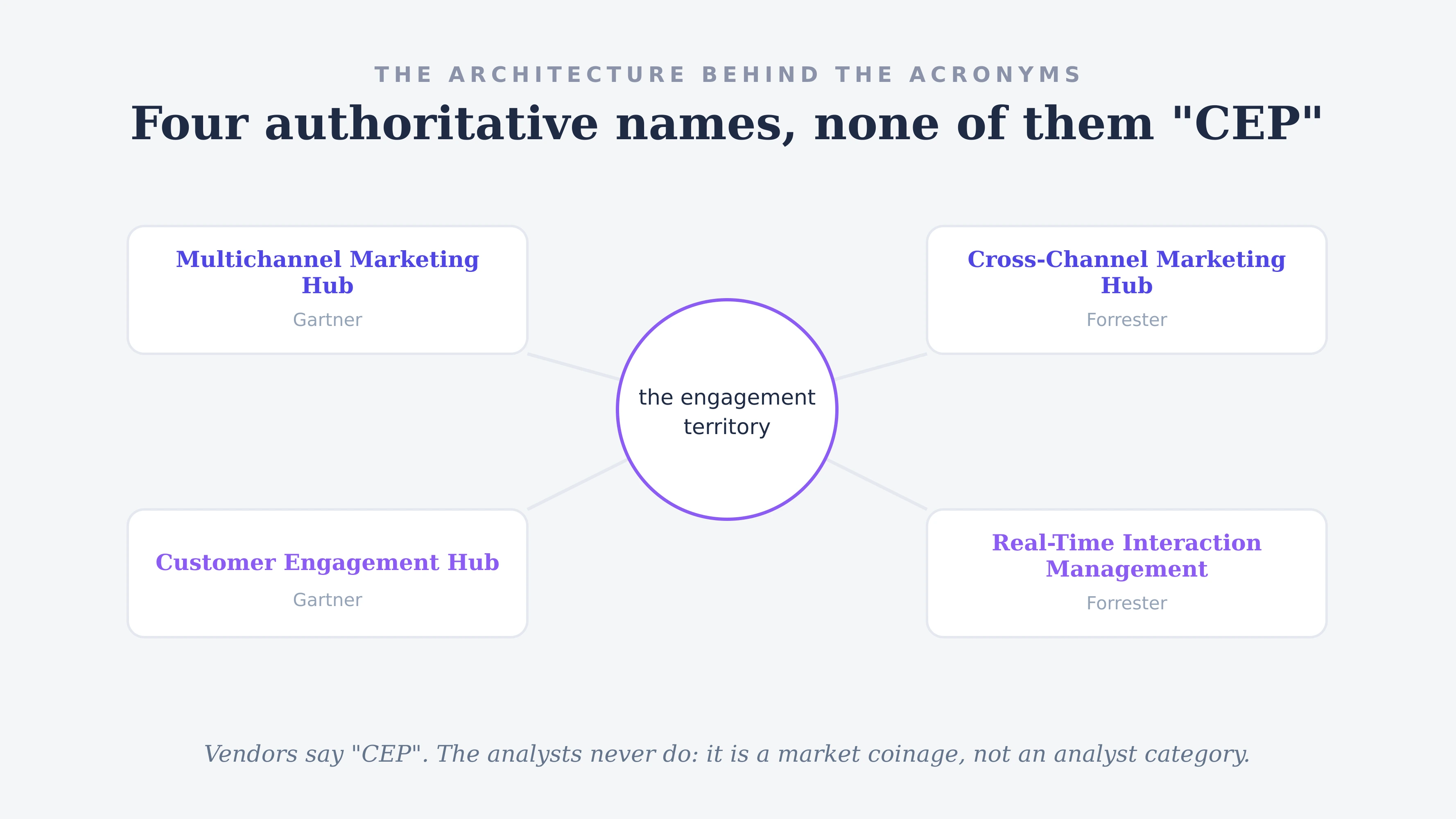
The most telling evidence is that analysts do not appear to treat “Customer Engagement Platform” as the primary public category label for this territory. Neither Gartner nor Forrester runs a widely recognised “Customer Engagement Platform” report, and between them they have produced at least four different names for the surrounding space. Gartner tracks the execution market as Multichannel Marketing Hubs, defined as applications that “orchestrate personalized campaigns and event-driven customer journeys across marketing channels, leveraging customer data, predictive models and real-time insights,” and separately defines a Customer Engagement Hub as a broader architectural framework spanning marketing, sales, and service. Forrester covers adjacent ground as Cross-Channel Marketing Hubs, spanning customer data and profile management, segmentation, analytics, and outbound and inbound cross-channel marketing, and treats the real-time, decisioning dimension as a separate discipline it calls Real-Time Interaction Management. Multichannel Marketing Hub, Customer Engagement Hub, Cross-Channel Marketing Hub, Real-Time Interaction Management: four authoritative lenses on the same engagement territory, none of which use “CEP” as the primary public category label. The label is a vendor and market coinage more than an analyst category. The result is a term that is genuinely useful as a direction of travel and genuinely useless as a precise spec, which is an unusual and important combination to hold in your head.
This is also where the CEP’s relationship with the CDP gets tense, because both categories were expanding at the same time and both wanted to own the customer profile. That collision is worth its own treatment, and I gave it one in When CDP Meets CEP and The Acronym War. For this article the point is narrower: the CEP grew up as a category defined by ambition rather than precision, and that origin explains its present-day fuzziness.
How vendors changed the meaning
With ESP and MAP, vendors changed the meaning by climbing out of the category. With CEP, there was no higher category to climb into, so vendors changed the meaning by competing over what it should include. The fight is about scope, and it runs in two directions.
Downward, most CEP vendors claim some combination of channels, decisioning, and orchestration. That part is broadly agreed. The contested ground is whether the CEP also owns the customer profile and identity, which is CDP territory, and whether it owns the data foundation beneath that. Some vendors say the CEP should be the profile and the brain and the hands, a single platform for everything. Others say the CEP should be the brain and the hands but read its profile from a separate CDP or warehouse. This is not a detail. It is the central architecture decision of the modern stack, and the acronym leaves it unresolved because many vendors resolve it in whatever way favours their own product.
So “CEP” on a vendor slide can mean a self-contained engagement suite that also stores and resolves your customer data, or a focused decisioning-and-orchestration layer that sits on top of your data platform. Those are very different architectures with very different implications for ownership, lock-in, and where your single customer profile actually lives. The word hides the difference. The buyer who does not force the question ends up with whichever answer the vendor preferred.
What it means architecturally today
The most useful way to hold the CEP today is as the decisioning and orchestration layer of the engagement stack, explicitly separated in your mind from the data layer beneath it, even when a single vendor sells you both. The CEP’s job is to take a unified profile and a stream of real-time signals and decide, continuously, what the next best action is, then execute it across channels. Whether it also owns the profile is a choice you make, not a property of the acronym.
Framing it this way turns the vague category into a sharp set of questions. Where does the unified profile live, inside the CEP or in a CDP or warehouse it reads from. Is the decisioning genuinely real-time and signal-driven, or is it campaign tempo with a faster coat of paint. Are all channels truly outputs of one decision layer, or is email still a separate silo running the old way inside the same login. Can the platform act on a stream, or does it still fundamentally think in segments and schedules. Those questions cut straight through vendor positioning, and they only become askable once you stop treating CEP as a single defined thing and start treating it as a layer with a contested boundary.
The failure mode that ties this trilogy together appears here in its fullest form. Organisations buy a CEP, the most capable engagement platform they have ever owned, and then run an ESP inside it: list pulls, scheduled blasts, a campaign calendar, email as a silo. They bought a real-time decisioning layer and operate it at batch tempo. The acronyms changed three times. The operating model never did.
What it gets confused with
By the time you reach the CEP, the confusion is total, and that is the honest punchline of the whole series. The CEP gets confused with the MAP because both run decisioning logic; the difference is tempo and breadth, real-time and cross-channel versus funnel and mostly email. It gets confused with the ESP because both send email; the difference is that for the CEP, email is one output of a decision layer, not the product. And it gets confused with the CDP because both want to own the customer profile; the difference is that the CDP’s job is to unify and serve identity to everything, while the CEP’s job is to decide and act, and whether one platform should do both is the open question of the decade.
If you have read the ESP and MAP articles, you can now see why these terms are so hard to separate cleanly. They are not four distinct categories that happen to overlap. They are one evolving function, photographed at four moments, each absorbing the last. The blurred boundaries are not sloppy thinking. They are the fossil record of the absorption, which is the thesis of this entire series.
Does it still matter
The acronym matters, but not as a category to shop for, and this is the trap. You should absolutely care about the capabilities the CEP describes: real-time, cross-channel, signal-driven decisioning is the genuine frontier of engagement and it is where the value is moving. But “we need a CEP” is not a specification, because the word resolves to at least two different architectures depending on who owns the profile. Buying on the acronym means letting the vendor make your central architecture decision for you.
So the CEP matters in exactly the way the whole series argues acronyms matter: as a signal of where the stack is heading, not as a label you can buy against. The discipline is to translate “CEP” into the specific questions about tempo, channels, and profile ownership that the word is busy hiding. Do that, and the vagueness stops being a problem and becomes a useful map of where the real decisions are.
CEP is not a product category you can buy, it is the name we gave the moment the send engine, the funnel, and the customer profile all collided, so treat it as a direction of travel and a set of architecture questions, never as a line item.
Sources
Gartner
- Multichannel Marketing Hubs market (definition and reviews)
- Customer Engagement Hub (glossary definition)
- Improve Multichannel Marketing With Customer Data Platforms
Forrester