10 min read
Martech has a naming problem. Every few years a new (or rather, a resurrected one) acronym shows up promising to solve what the previous one couldn’t. The latest is MDP, Marketing Data Platform.
While the letters have floated around for years (sometimes used by IT to mean Master Data Platform, or briefly tested by vendors before ‘CDP’ took over), as of early 2026, its modern reincarnation has no consensus definition…
The confusion is not just semantic. These labels influence budget ownership, operating models, vendor selection, and ultimately how customer experience gets delivered. Before adopting the label, it helps to place it in the bigger architecture.
The global martech market hit $131 billion in 2023 and is still growing at 13.3% annually. Yet Gartner’s 2023 CMO Survey found that organisations are only tapping into about a third of their martech stack’s actual capabilities. The tools aren’t usually the problem. The architecture is.
Why Martech Categories Keep Colliding
If you’ve worked in martech long enough, you’ve seen this before: a new acronym appears, vendors rally around it, and buyers are left trying to understand whether it reflects a real capability shift or just a new label.
These aren’t just buzzwords, though. Each category was born from a genuine, specific problem that the previous generation of tools couldn’t solve. The trouble is that two decades of martech evolution have piled these categories on top of each other, and the definitions are blurring faster than vendors can update their datasheets.
McKinsey’s 2025 Rewiring Martech report found that 47% of martech decision-makers name stack complexity and data integration as their main blockers to getting real value from their tools. Not one of the 50+ Fortune 500 CMOs interviewed for that report could clearly explain the ROI of their martech stack. Adding another tool rarely solves this. A better architectural model usually does.
So here’s the practical model:
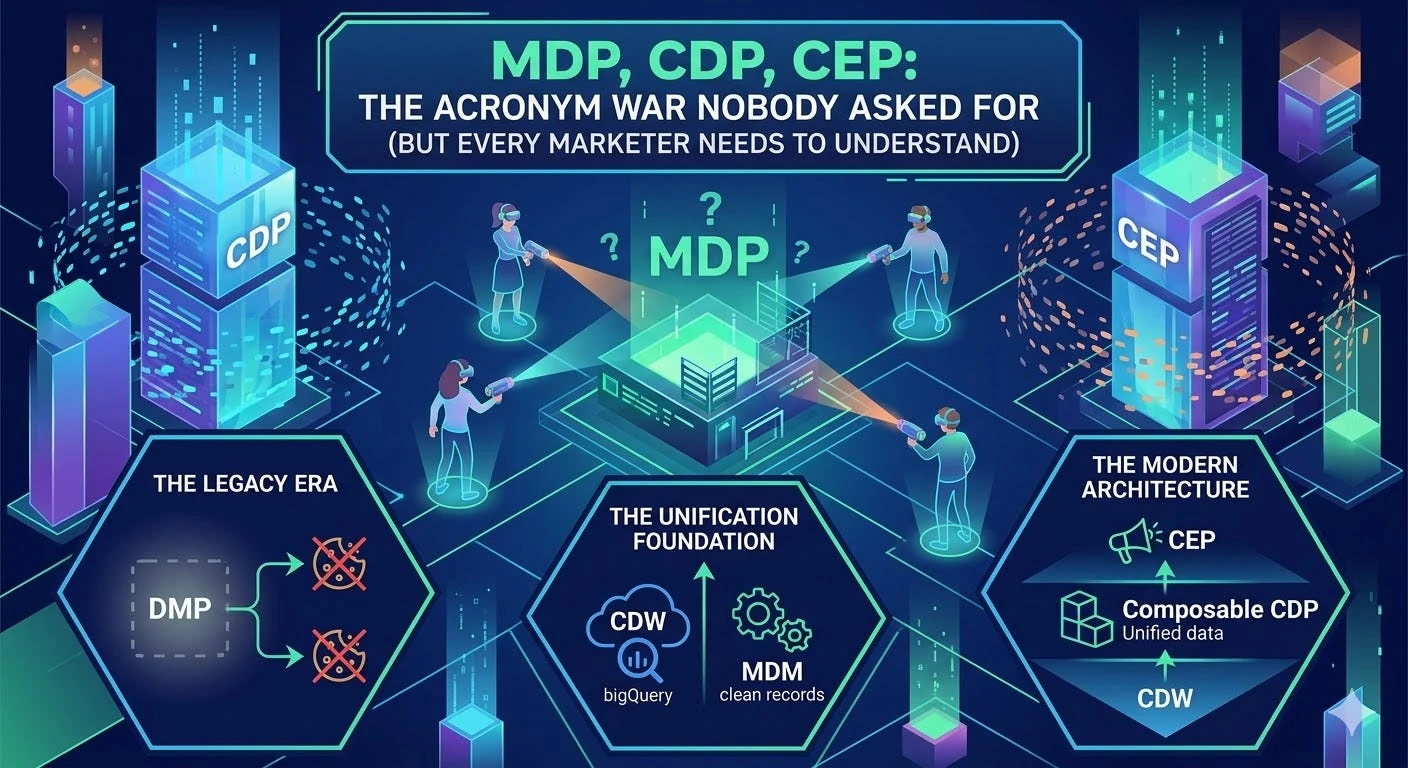
- the CDW stores and governs data
- the CDP unifies customer identity and audiences
- the CEP executes journeys and interactions
- the MDP is increasingly the architectural frame connecting those layers
The foundation you can’t skip: CDW and MDM
Before we even get into marketing tools, there’s an infrastructure layer worth acknowledging.
The Cloud Data Warehouse, think Snowflake or Google BigQuery, is the gravitational centre of the modern data stack. It holds everything: transactional data, behavioural events, product data, CRM exports and web clickstreams. It’s not a marketing tool per se, but increasingly it’s the source of truth that marketing tools both read from and write back to.
MDM, or Master Data Management, sits alongside it. This is the IT-led discipline of building clean, deduplicated, authoritative “golden records” across an enterprise. MDM is about governance and consistency at scale. Marketing rarely owns it, but smart martech architects know it exists because a weak MDM foundation will quietly corrupt every downstream marketing application.
These two form the bedrock. Everything else builds on top of them.
The acquisition era: the DMP
The DMP, or Data Management Platform, was actually the first category to brand itself a “marketing data platform.” It grew out of the programmatic advertising world, where it aggregated anonymous third-party audience data, browsing behaviour, demographic clusters, interest segments and made it actionable for media buying and ad targeting.
For one specific job, acquisition at scale, the DMP was powerful. But it had a structural flaw baked in from the start. Its data was anonymous (no persistent identities), short-lived (profiles would expire around 90 days), and entirely dependent on third-party cookies.
You know where this goes. GDPR in 2018. CCPA in 2020. Chrome’s cookie deprecation. The DMP’s data supply chain effectively collapsed.
The DMP is no longer at the centre of customer architecture. It can still matter in acquisition-heavy media use cases, but for most enterprise customer-engagement programs, its strategic role has diminished significantly.
Key vendors: Adobe Audience Manager, Lotame, Oracle Data Cloud.
The unification revolution: the CDP
The CDP, or Customer Data Platform, emerged as the answer to the identity problems the DMP couldn’t solve. David Raab coined the term in 2013, and the category exploded through 2017 to 2022.
The CDP’s core promise: pull together all your first-party customer data, resolve identities across every touchpoint, and build a persistent, unified Customer 360 profile that any marketing system can tap into.
What a CDP actually does: four functional types
A useful way to understand CDPs is as a capability ladder: some platforms mainly unify data, others add analytics, decisioning, and finally delivery.
A Data CDP is the minimum viable version; it ingests data from source systems, resolves customer identities, and stores unified profiles in a persistent database accessible to external tools. Some vendors started here and remain strongest at this layer.
An Analytics CDP adds analytical applications on top: customer segmentation, machine learning, predictive modelling, revenue attribution, and journey mapping. It often automates how processed data gets distributed downstream.
A Campaign CDP (sometimes called an engagement CDP) layers in a decisioning capability, specifying different actions for different individuals within a segment. This is where personalised messages, outbound campaigns, real-time interactions, and product recommendations come in. Data, analytics, and decisioning in one system.
A Delivery CDP is the most complete form, adding message delivery across channels: email, web, mobile, CRM and advertising. Products in this tier often started as marketing clouds or delivery platforms and layered CDP capabilities on afterwards. They tend to be stronger on activation than on raw data capture.
The practical lesson is simple: if identity, profile quality, and data access are weak, every downstream capability, segmentation, journey logic, personalisation and reporting becomes less reliable.
How CDPs are built: three architectural types
Separately from what a CDP does, the CDP Institute also classifies them by how they’re built, a distinction that became critical as composable architecture took hold.
A Packaged CDP is a self-contained SaaS platform where the vendor handles all the data infrastructure. It deploys fastest and works well for teams without deep data engineering resources.
A Composable CDP operates as a modular layer on top of your existing Cloud Data Warehouse, adding identity resolution, segmentation, and Reverse ETL without duplicating the underlying data. It requires more technical maturity, but eliminates vendor lock-in and replication costs.
A Hybrid CDP splits responsibility between vendor and business, some data management handled by the CDP vendor, some by the organisation’s own CDW. This is increasingly common as enterprises migrate toward warehouse-native architectures in stages rather than all at once.
Composable and hybrid models are gaining ground, especially in enterprises that already have a mature warehouse. The core logic is straightforward: why replicate data into another expensive black box if segmentation and activation can run closer to the source of truth?
The execution layer: the CEP
The CEP, or Customer Engagement Platform, is the execution layer: the system that turns profiles, signals, and business rules into real customer interactions.
If the CDP is the brain that knows everything about your customer, the CEP is the voice that speaks to them across email, push notifications, SMS, in-app messages, WhatsApp, and whatever comes next. It handles journey orchestration, campaign automation, behavioural triggers, A/B testing, and channel-level personalisation.
CEPs do not need to be the system of record. They need timely access to good data, reliable orchestration logic, and fast execution. In practice, many program failures happen when teams expect the CEP to compensate for weak upstream data.
Gartner tracks CEPs primarily under the Multichannel Marketing Hub Magic Quadrant. In the 2025 edition, Salesforce, Adobe Journey Optimizer, and Braze were the three co-Leaders.
By segment: at the enterprise end, Adobe Journey Optimizer and Salesforce Marketing Cloud dominate. For API-first teams, Braze, Iterable, InsiderOne and MoEngage are the names you’ll hear most. In the mid-market, Klaviyo, Customer.io, Actito, and Brevo have carved out strong positions.
The emerging concept: the MDP
This is where the market gets less clear, and more interesting.
The MDP, or Marketing Data Platform, is the newest acronym in the room, and as of early 2026, it has no consensus definition, no dominant vendor, and no Gartner Magic Quadrant of its own. But it’s showing up in enterprise conversations at an accelerating pace.
Two interpretations are currently competing for ownership of the term.
Interpretation A treats the MDP as a product category: a single platform combining customer-data unification, segmentation, decisioning, and execution. This is essentially a CDP and CEP fused into one product. Vendors positioning in this space, even if they haven’t adopted the MDP label yet, include Bloomreach and InsiderOne.
Interpretation B is the more useful one: MDP as architecture. In this view, the warehouse holds and processes data, a CDP adds identity and audience logic and a CEP handles execution. The platform is not a box; it is the operating model.
The CDP Institute frames this well through a dual-zone model: Zone One is the data ecosystem (data assembly, identity resolution, CDW, enrichment and insights), and Zone Two is the marketing ecosystem (CDP, journey orchestration, personalisation and experimentation). Under Interpretation B, the MDP is the sum of both zones working coherently together.
If you accept Interpretation A too quickly, you risk recreating the same problem in a new form: centralising too much in a single vendor layer and reducing architectural flexibility.
Interpretation B forces harder questions: who owns the data layer, where identity resolution lives, and how execution stays connected to governed data.
One more acronym worth knowing: the CDEP
Before we land on architecture, one more label deserves a mention: the CDEP, or Customer Data & Engagement Platform. This is the term some vendors, and increasingly some analysts, use to describe platforms that deliberately blur the CDP/CEP boundary in a single product. MoEngage, for example, positions itself as a warehouse-native CDEP.
In CDP Institute functional terms, a CDEP maps onto the Delivery CDP tier, the most complete functional level, with an explicit emphasis on real-time engagement and journey orchestration rather than pure data management.
If MDP is the architectural idea, CDEP is the product expression of that idea: a platform that tries to combine customer data and engagement in one environment.
The architecture that actually works in 2026
The most useful way to think about this in 2026 is not by vendor category, but by architectural layer.
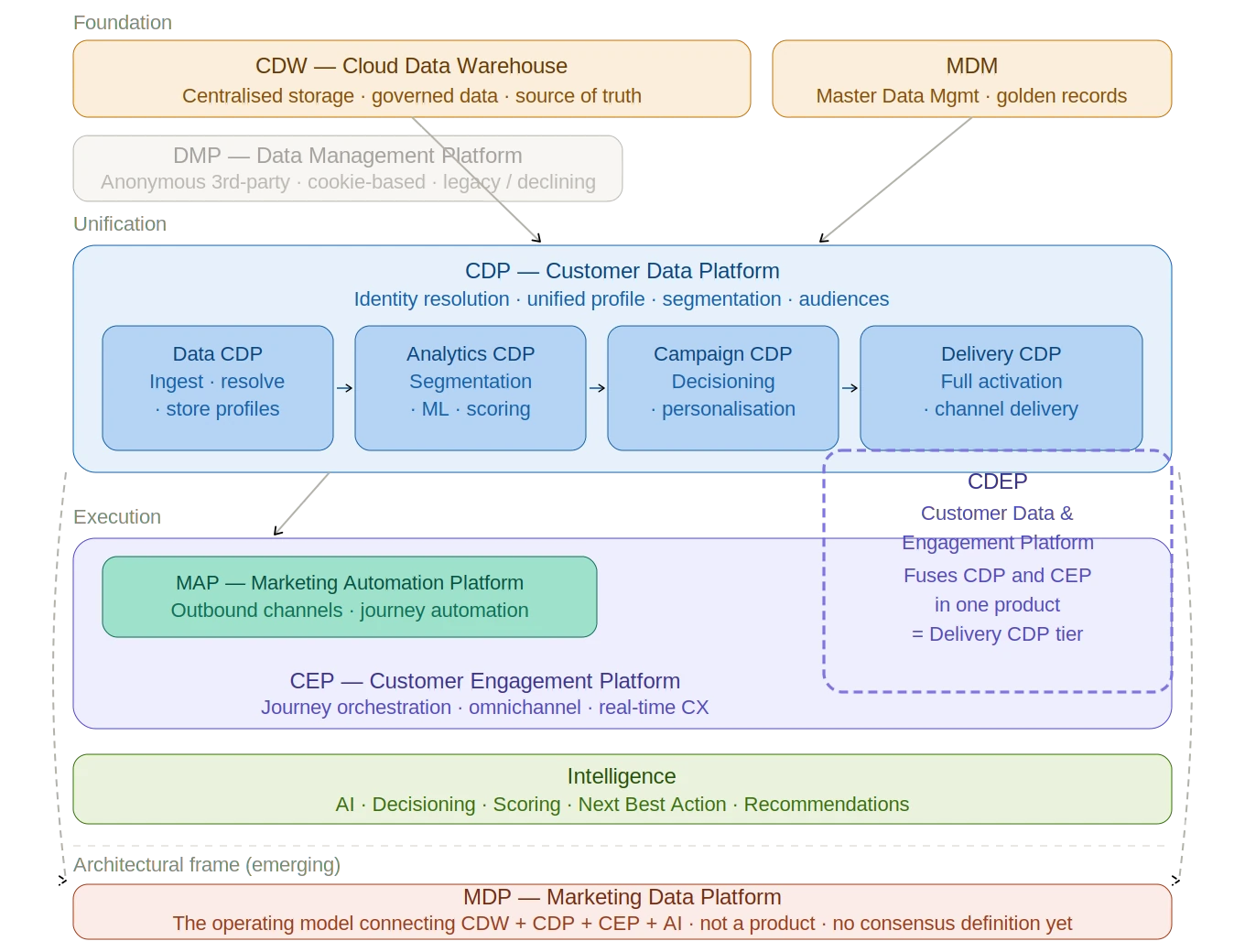
- Foundation: CDW + MDM for governed data and enterprise consistency
- Unification: CDP for identity resolution, customer profiles, and segmentation
- Execution: CEP for journeys, activation, and channel orchestration
- Intelligence: AI and decisioning for scoring, recommendations, and next best action
The key architectural principle is zero-copy data activation: the CDP or MDP layer operates directly on CDW data without duplicating it, maintaining a single source of truth, cutting costs, and eliminating the data freshness lag that plagued first-generation CDPs.
The DMP sits apart as a legacy data-only category. The four functional CDP types form a progressive capability ladder. Packaged, composable, and hybrid CDPs are different paths to the same destination. The CEP handles execution. The CDEP blurs the CDP/CEP line at the Delivery tier. And the MDP is the architectural frame that holds all of it together.
So do you actually need an MDP?
In many cases, yes, but not as a new product category to buy. More often, the question is whether you already have the right components and whether they work together coherently.
Ask yourself three questions:
- Do you have a CDW with clean, unified customer data?
- Do you have a composable CDP or a packaged CDP connected to your warehouse?
- Do you have a CEP or MAP for execution?
If all three are yes, you’re already running an MDP. You just haven’t called it that yet.
The real value of the MDP concept isn’t a new product to buy. It’s a strategic frame that forces your organisation to ask the questions that actually matter: who owns the data layer, how does it connect to execution, and is there a single source of truth or ten competing ones?
The takeaway
The acronym war won’t stop here. AI Decisioning Platforms, Real-Time Interaction Management, Composable Martech, Agentic Marketing Platforms, and other labels are already appearing in 2025/2026 analyst reports.
But underneath every new label is the same fundamental tension: the closer you bring data and execution together, the better your marketing performs. MDP, CDEP, and composable CDP are all different roads to the same destination.
The winners in this space will not be the teams that choose the most fashionable acronym. They will be the teams that design the clearest architecture between data, identity, execution, and decisioning.
Sources
Gartner
- 2023 CMO Spend and Strategy Survey, 2023.
- Foo Kune, L. et al., Magic Quadrant for Customer Data Platforms, January 2026.
- Brosnan, A. et al., Magic Quadrant for Multichannel Marketing Hubs, September 2025.
Forrester
McKinsey & Company
- Rewiring martech: From cost center to growth engine, McKinsey Growth, Marketing & Sales, October 2025.
CDP Institute
- Raab, D., The Customer Data Platform Concept, 2013.
- Round Table Notes: Composable CDPs vs Packaged CDPs, March 2025.
- Round Table Notes: Practical Experiences Building Composable CDPs, May 2025.
Trade press and vendors
- Fisher, R., Gartner Magic Quadrant for Customer Data Platforms 2026: The Rundown, CX Today, 8 February 2026.
- Braze, Named a Leader in the 2025 Gartner Magic Quadrant for Multichannel Marketing Hubs, third consecutive year, BusinessWire, September 2025.
- Celebrus, The Four Types of CDP Vendors Explained, Celebrus Technologies, 2022.