12 min read
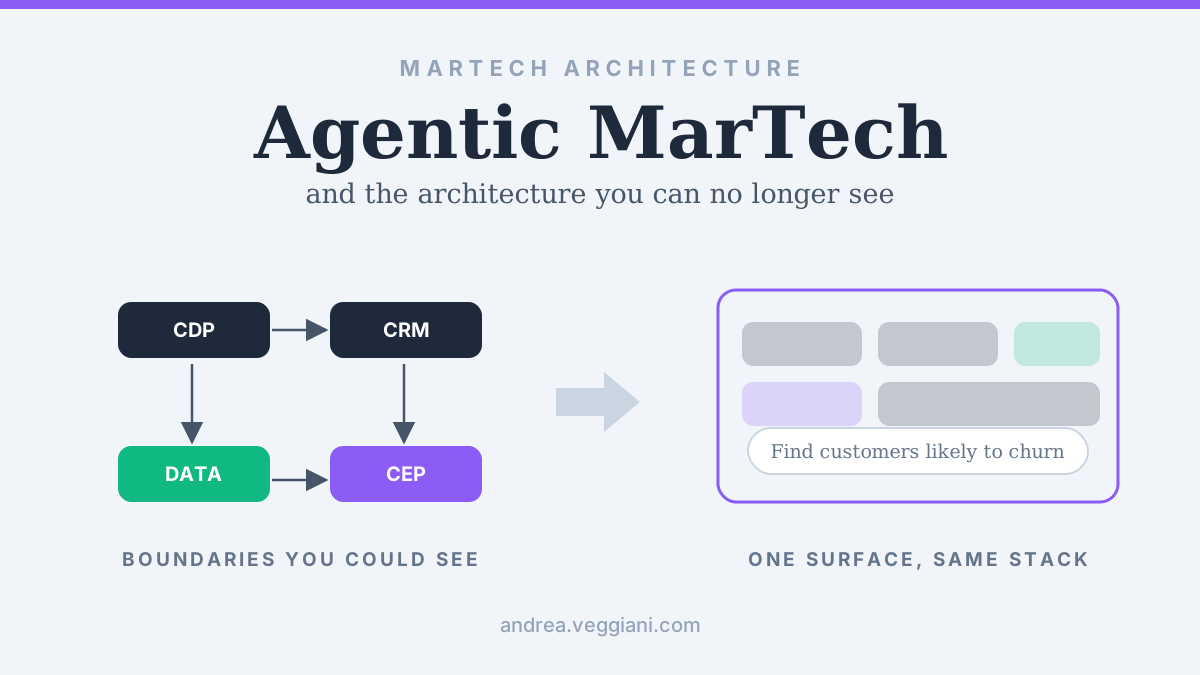
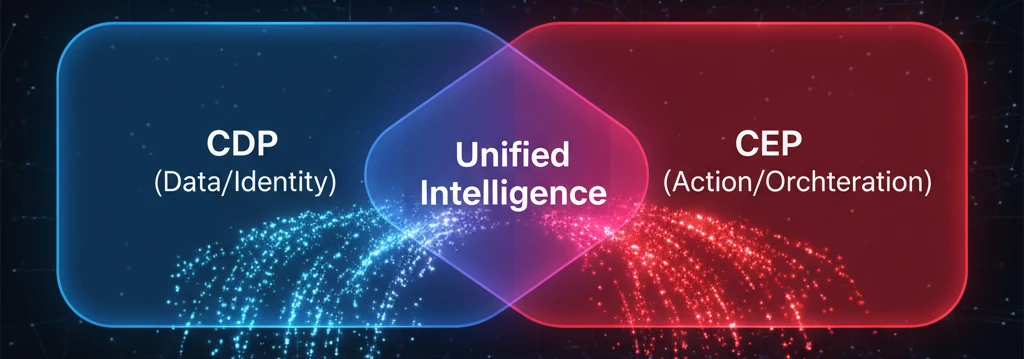
The MarTech landscape is collapsing the distance between customer data and customer action. It’s no longer CDP collects → CEP activates. It’s a single, real-time intelligence loop.
Introduction: The Age of Unified Intelligence
Modern customer engagement is no longer about channels, but about micro-moments. Moments happen in real time — and so must the systems that interpret, decide, and act on them. A customer browsing shoes on a mobile app must instantly see the relevant loyalty offer in their email inbox. That offer must be suppressed if they click the unsubscribe button within one minute.
Over the past decade, enterprises have invested in Customer Data Platforms (CDPs) to unify fragmented data and create a single view of the customer. Simultaneously, they’ve deployed Customer Engagement Platforms (CEPs) — systems designed to orchestrate personalized journeys and deliver cross-channel experiences.
For years, the two operated in a strict, sequential architecture: CDP collects and prepares data → CEP consumes, decides, and activates.
But in practice, this model has failed due to API friction and latency. Every time data had to be moved, mapped, or synchronized between the CDP’s unified identity graph and the CEP’s execution engine, valuable milliseconds were lost. A five-minute delay is enough to turn a relevant, helpful message into a frustrating, irrelevant piece of spam.
The Latency Problem wasn’t just technical; it was strategic. It prevented true Algorithmic Empathy — the ability to adapt communication instantly based on the customer’s live state. As a result, the line between CDP and CEP has blurred to the point of extinction. Vendors once specializing in one area are now converging, merging data management, decisioning, and activation into a single intelligent engagement layer.
This is the rise of the unified platforms where data, intelligence, and action live in the same real-time environment, making algorithmic empathy operational at scale.
1. The Data Foundation: From Warehouses to Real-Time Identity Graphs
At its core, the CDP was created to solve a simple but critical problem: identity fragmentation. A single customer can appear under dozens of identifiers like cookies, device IDs, CRM records, email addresses, and loyalty numbers. The CDP’s purpose is to reconcile all these fragments into a Golden Record: a unified, persistent, and real-time customer profile. The complexity lies not just in stitching the data, but in ensuring that the identity is resolved deterministically (based on unique identifiers like email) and probabilistically (using machine learning to infer links based on behavioral patterns).
From Data Warehouses to Lakehouses: The Need for Speed
Traditional data warehouses relied on fixed schemas and nightly batch processing — a model that cannot support modern engagement speeds. This “sleep cycle” of data processing meant that any action taken in the morning was based on data from yesterday afternoon.
Today’s architectures have evolved toward Data Lakehouses, which combine the flexibility of a data lake (schema-on-read) with the reliability of a warehouse. This shift enables the storage of raw, unstructured event data (like website clicks or video consumption) alongside structured transactional data (purchases, returns).
Platforms like Adobe Experience Platform (AEP) and Salesforce Data Cloud exemplify this evolution. They are built on event-driven architectures that don’t just store data but process it in motion — continuously calculating derived fields like “recent purchase score” or “channel affinity.” This continuous processing is essential for low-latency activation.
Event Sourcing and Real-Time Identity Resolution
The modern CDP doesn’t just store data — it listens. Through event sourcing, every customer interaction (an app swipe, a chat transcript, a store purchase) becomes a real-time event that updates the Golden Record in milliseconds. This is not simply about uploading a file; it’s about the customer’s interaction triggering an instantaneous profile update across the entire unified platform.
This capability eliminates what analysts call the Latency Penalty — the lost relevance that occurs when engagement systems act on stale data. Adobe’s Real-Time Customer Profile in AEP, for instance, promises to update profiles and activate segments in under 100 milliseconds, enabling truly instantaneous personalization that bypasses traditional batch cycles. Furthermore, the integration of consent and privacy flags is now a fundamental, real-time attribute of the Golden Record, ensuring that activation adheres to regulatory requirements (like GDPR or CCPA) in the precise moment of engagement.
2. Intelligence in the Data Layer: AI for Hygiene, Governance, and Discovery
AI is no longer confined to predictive marketing models — it now operates at the data infrastructure level, directly inside the CDP. This means intelligence is applied before activation, ensuring the quality and integrity of the data being used for decisioning.
Operational AI (Diagnostic & Prescriptive): Tools like the AI Assistant within AEP help engineers and marketers automate operational tasks like audience cleanup, schema validation, or complex segment creation through natural language commands. Similarly, Salesforce Data Cloud’s integration with Einstein automatically detects anomalies (e.g., a massive spike in unsubscribes from a single IP address) and suggests data unifications, reducing time-to-insight and improving data health. This is diagnostic AI — it tells you what is wrong.
Predictive Activation and Feature Stores: Platforms like Tealium Predict ML use real-time behavioral data to generate propensity scores (e.g., likelihood to convert, churn risk) that can be instantly activated within the same data interface, directly informing the CEP. Crucially, modern CDPs are incorporating Feature Stores, which standardize and manage the features (like “days since last purchase” or “average cart size”) used by multiple predictive models. This ensures consistency and dramatically accelerates the deployment of new AI-driven decisioning capabilities.
More importantly, AI supports Audience Discovery, surfacing micro-segments that human analysts would overlook — such as “users who watched a product video but didn’t visit the pricing page within five minutes.” Once AI models start to inform segmentation and next-best-action decisions directly in the data layer, the distinction between “data layer” and “activation layer” becomes semantic rather than architectural.
3. The Activation Engine: CEPs Redefined
Traditionally, the Customer Engagement Platform was the layer responsible for orchestration — applying business rules and predictive logic to determine what message to send, when, and through which channel. Platforms such as Braze, Adobe Journey Optimizer (AJO), Insider, Bloomreach Engagement, and Salesforce Marketing Cloud (SFMC) are leaders.
Yet, their capabilities now extend far beyond simple message delivery. Modern CEPs are moving from campaign orchestration (batch, scheduled sends) to stream orchestration (listening to and reacting to continuous behavioral signals).
They no longer rely on external systems for foundational data tasks. Modern CEPs:
- Handle real-time audience segmentation natively, often calculating segment membership at the time of the event trigger.
- Integrate behavioral data streaming and enrichment through embedded collectors (SDKs and APIs).
- Expose open APIs for external data ingestion, allowing them to pull in non-standard or bespoke data attributes instantly.
- Leverage built-in AI decisioning engines (Braze Predictive Suite, Adobe Sensei GenAI) to perform Next Best Action (NBA) decisions across multiple concurrent journeys.
- Incorporate Generative AI (GenAI) to personalize content variants dynamically, not just selecting from a static library, but creating copy and image adaptations in real-time based on the user’s profile and the immediate context.
This evolution means many CEPs now perform robust CDP-like functions, just as many CDPs are expanding into activation and decisioning.
4. The Convergence: When Data and Activation Become One
The market no longer tolerates latency between “data unified” and “action taken.” A customer who abandons a cart and receives an email three hours later is already gone. Before convergence, organizations often had dual systems: a high-fidelity CDP maintaining the Golden Record and a CEP using a low-fidelity, synchronized copy. This setup led to operational nightmares: duplicate segment definitions, differing profile decay policies, and inconsistent personalization.
This is why vendors are converging: the operational cost of not unifying the two layers is now too high (2).
CDP Vendors Moving into Activation (Upward)
- Adobe RTCDP + Journey Optimizer: This combination is the quintessential example of this unified approach, merging identity, real-time segmentation, and orchestration in one environment, enabling marketers to act on live behavioral events instantly. The value is that the same profile used for identity resolution is used for journey decisioning.
- Salesforce Data Cloud + Marketing Cloud: Data Cloud now serves as the central Real-Time Identity Graph that feeds all Marketing Cloud journeys, ensuring that orchestration is based on the single source of truth, not siloed legacy databases. The key benefit here is the ability to connect vast amounts of interaction data from Customer 360 directly into personalized journeys without ETL overhead.
- Treasure Data: Long a leader in enterprise CDP, Treasure Data has moved decisively into activation with its “AI Marketing Cloud” (10). This unifies its trusted data foundation with native tools like the “Engagement AI Suite,” enabling marketers to design and orchestrate cross-channel journeys directly on top of the CDP.
- Twilio Segment + Engage: Segment, historically a pure-play CDP focused on data plumbing, added Engage to layer native campaign orchestration directly onto its data infrastructure, enabling rapid campaign delivery and removing the need for a separate email vendor for basic use cases.
CEP Vendors Moving into Data (Downward)
- Braze: Braze has deepened its data capabilities by enabling direct ingestion of large, streaming data sets and by leveraging partnerships, such as Snowflake Data Sharing, to consume live customer profiles without cumbersome ETL processes. This allows Braze to enrich its engagement decisions with the vast, governed data sets living in the modern data warehouse.
- Insider and Bloomreach Engagement: Both platforms ingest and unify first-party data streams, positioning themselves as “marketing CDPs” that eliminate the need for a separate platform just to prepare data for personalization within their own ecosystems. Their strength lies in combining identity resolution and AI decisioning specifically for highly optimized, low-latency execution in owned channels (web, app, email).
5. Strategic Implications: From Automation to Intelligence
The convergence of CDP and CEP marks a definitive shift from workflow automation to strategic intelligence (1). Legacy Marketing Automation systems were built around static rules and batch campaigns — they followed instructions. If the rule was wrong, the execution was still perfect.
The new paradigm is algorithmic decisioning: the system no longer waits for the marketer to tell it exactly what to do; it evaluates context and acts autonomously within predefined ethical and business constraints (2). This eliminates the Feedback Loop Failure common in MA, where campaign results took days to calculate and feed back into the system.
- Moving from rules to intelligence: We shift from “send email if abandoned cart” to “evaluate best next action across all channels (email, push, in-app), considering CLV, intent, and recency, then execute the optimal content variation (GenAI powered) in the optimal channel.” The system uses an optimization goal, not a fixed instruction.
- Moving from campaigns to continuous decision loops: Marketing no longer runs on scheduled blasts, but on signals and continuous experimentation (2). This allows for constant A/B/n testing and predictive optimization that traditional automation simply couldn’t handle.
6. Operationalizing Empathy: The Agentic Enterprise
The ultimate goal of this convergence is operational empathy — the ability for an enterprise to understand and respond to human signals in real time, not just in marketing, but across the entire organization (3). This requires the unified platform to be the central nervous system for customer interactions.

Cross-Functional Empathy Triage — A Unified Scenario
Imagine a high-CLV customer attempting checkout but encountering three consecutive payment failures. The system, leveraging the Real-Time Identity Graph and a dynamically calculated Reputation Score (high CLV + recent engagement), identifies this sequence pattern as a critical frustration signal and triggers a coordinated enterprise response:
- Marketing Triage (CEP Layer): The system determines the best next action (NBA) is silence — suppressing all promotional emails and push notifications for 48 hours to avoid adding noise (a proactive empathy move) — while delivering a subtle, context-aware in-app message: “We noticed you had an issue checking out — can we help?” with a one-click link to chat support.
- Service Triage (CRM Integration): The CEP sends a command via API to the Service Cloud, automatically opening a P1 ticket tagged High CLV Risk / Payment Failure. The chat window is pre-filled with payment details and the customer’s high-value status is flagged for routing to a senior agent, reducing average handling time and ensuring white-glove service.
- Inventory Triage (ERP Integration): The system automatically places a temporary, soft-lock hold on the cart items within the ERP for 30 minutes. This ensures product availability while the customer engages with support, preventing a negative experience upon return.
This real-time, cross-functional orchestration — spanning marketing, service, and operations — is the realization of algorithmic empathy, and it is only achievable when data, decisioning, and activation layers operate as one unified intelligence.
7. Market Outlook: The Rise of Unified Engagement Platforms
Analysts increasingly recognize that CDP and CEP are not separate markets, but stages of a single continuum of customer intelligence (7). The legacy distinction based on data movement is obsolete.
Gartner’s recent reports on Multichannel Marketing Hubs (MMHs) note the rapid inclusion of real-time identity resolution and data ingestion features, blurring the lines with the CDP category (4). They recognize that an effective marketing execution tool must have a unified, real-time data foundation. Similarly, Gartner’s 2025 Magic Quadrant for CDPs highlights that the market is rapidly shifting, with a new emphasis on real-time activation and AI enablement as core functions (5).
Forrester’s research into both CDPs and Cross-Channel Marketing Hubs (CCMHs) reflects this, showing that vendors’ primary differentiation is now shifting from functional features to architectural philosophy (6). The market is also addressing the challenge of data sprawl: the unified platform must be designed to read data from existing cloud data warehouses (like Snowflake or Databricks) rather than forcing companies to copy all data into the vendor’s proprietary cloud.
This concept of a composable platform allows enterprises to maintain governance over their core data assets while allowing the activation layer to execute decisions instantly.
In this unified landscape, differentiation is philosophical:
- Enterprise vendors (Adobe, Salesforce, Oracle) prioritize governance, scalability, and deep integration with massive, established enterprise ecosystems (ERP, HCM, Service). They offer a full-suite, single-vendor solution.
- Challenger vendors (Braze, Insider, Bloomreach) focus on agility, time-to-value, and marketer usability in owned channels (mobile, web). Their primary value proposition is speed and a cleaner, more focused user experience.
But all are converging toward a single mission — to operationalize empathy through unified, intelligent engagement.

Conclusion: Beyond Architecture, Toward Alignment
The separation between CDP and CEP was a necessary stage in Martech’s evolution — a way to bring order to complexity. But as the pace of interaction accelerates and customer expectations rise, that separation has become artificial and detrimental to the customer experience.
Today, engagement happens at the intersection of data and action, where every signal is both input and output in a continuous feedback loop. In that sense, CDP and CEP are not two platforms — they are two essential functions of the same real-time intelligence.
The future of customer engagement will belong to those who embrace this convergence — not as a product category, but as a mindset: Data and Activation Unified. Algorithmic Empathy at Scale.
Sources
Consultancy and analyst research
- BCG, From Campaigns to Business Value: How AI Will Transform Marketing, November 2025.
- McKinsey & Company, Next best experience: How AI can power every customer interaction, October 2025.
- CX Today, Gartner Magic Quadrant for Customer Data Platforms (CDPs) 2025: The Rundown, May 2025.
Vendor and market coverage
- Bloomreach, The Forrester Wave: Cross-Channel Marketing Hubs, Q4 2024, November 2025.
- Solutions Review, How Big Tech Is Turning Empathetic AI Policy Into Practice: 5 Examples, November 2025.
- Business Wire, Treasure Data Introduces AI Marketing Cloud to Power Agentic Customer Engagement, October 2025.