13 min read
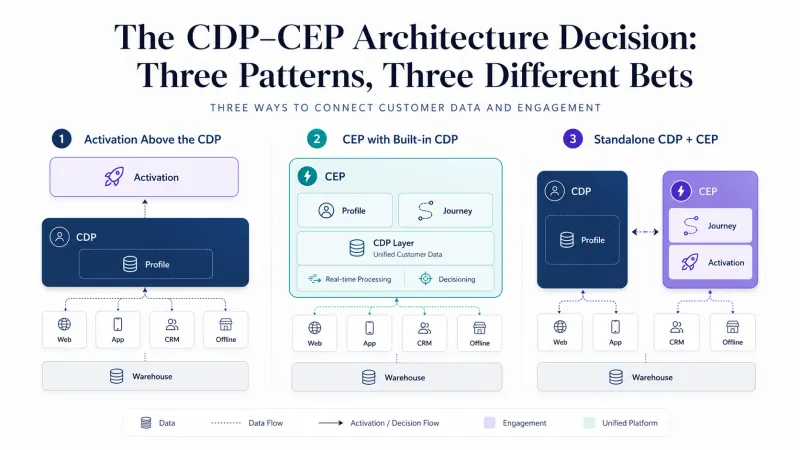
In Part 1, I mapped the three main ways to wire a CDP and a CEP together:
- Pattern A: activation inside the CDP
- Pattern B: CDP capabilities inside the CEP
- Pattern C: standalone CDP with a separate CEP
The question now is: how do you choose?
The answer is not vendor-dependent.
You cannot solve this by comparing Magic Quadrant positions, feature matrices or demo scores. Those inputs matter, but they are not enough. The pattern that survives in production is determined by the organisation around it: its data maturity, ownership model, channel breadth, technical capacity, governance requirements and operational discipline.
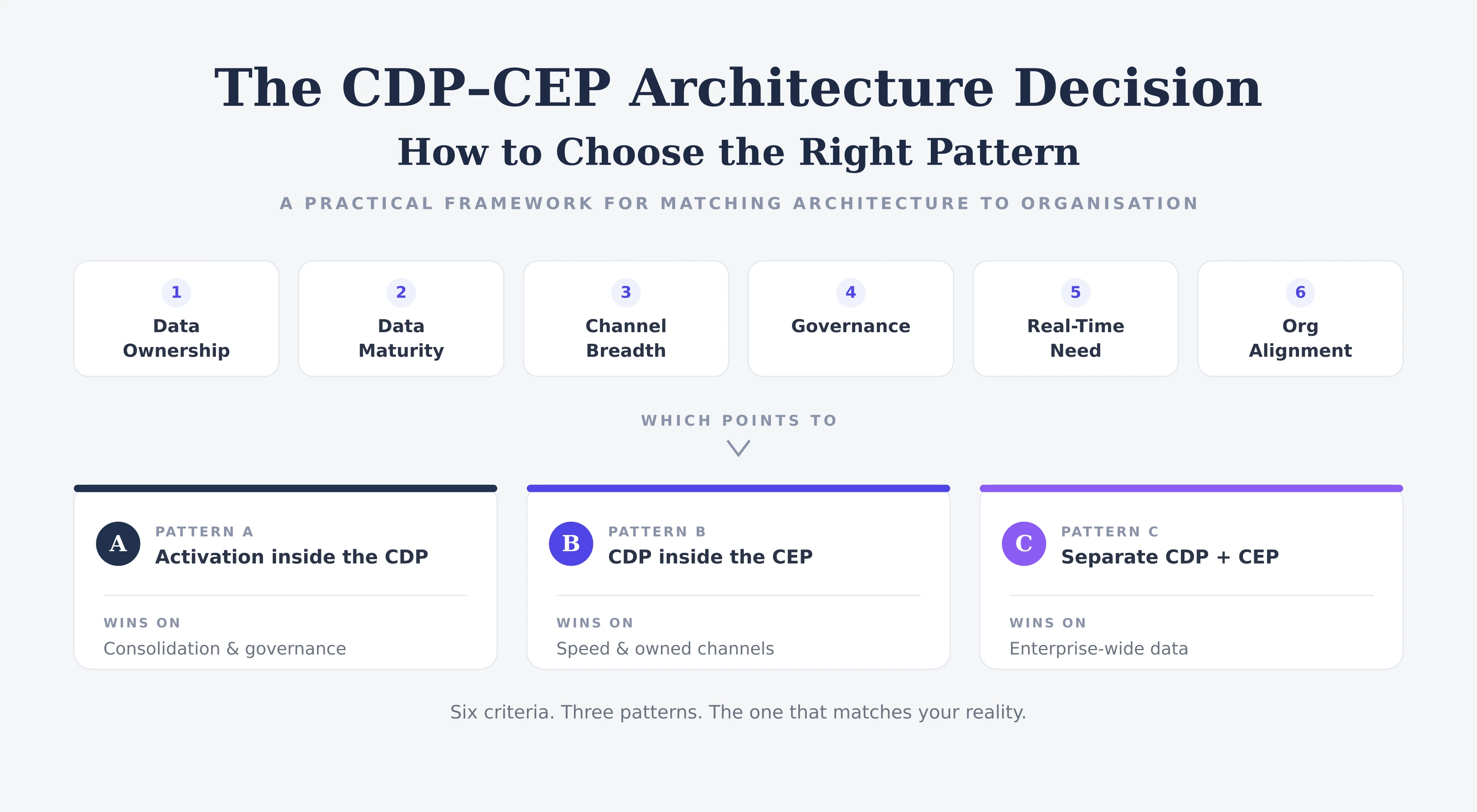
I use six criteria when evaluating this decision.
They are not perfect rules. Real organisations sit in the overlaps. But they are good predictors of whether an architecture will survive contact with reality.
The Six Decision Criteria
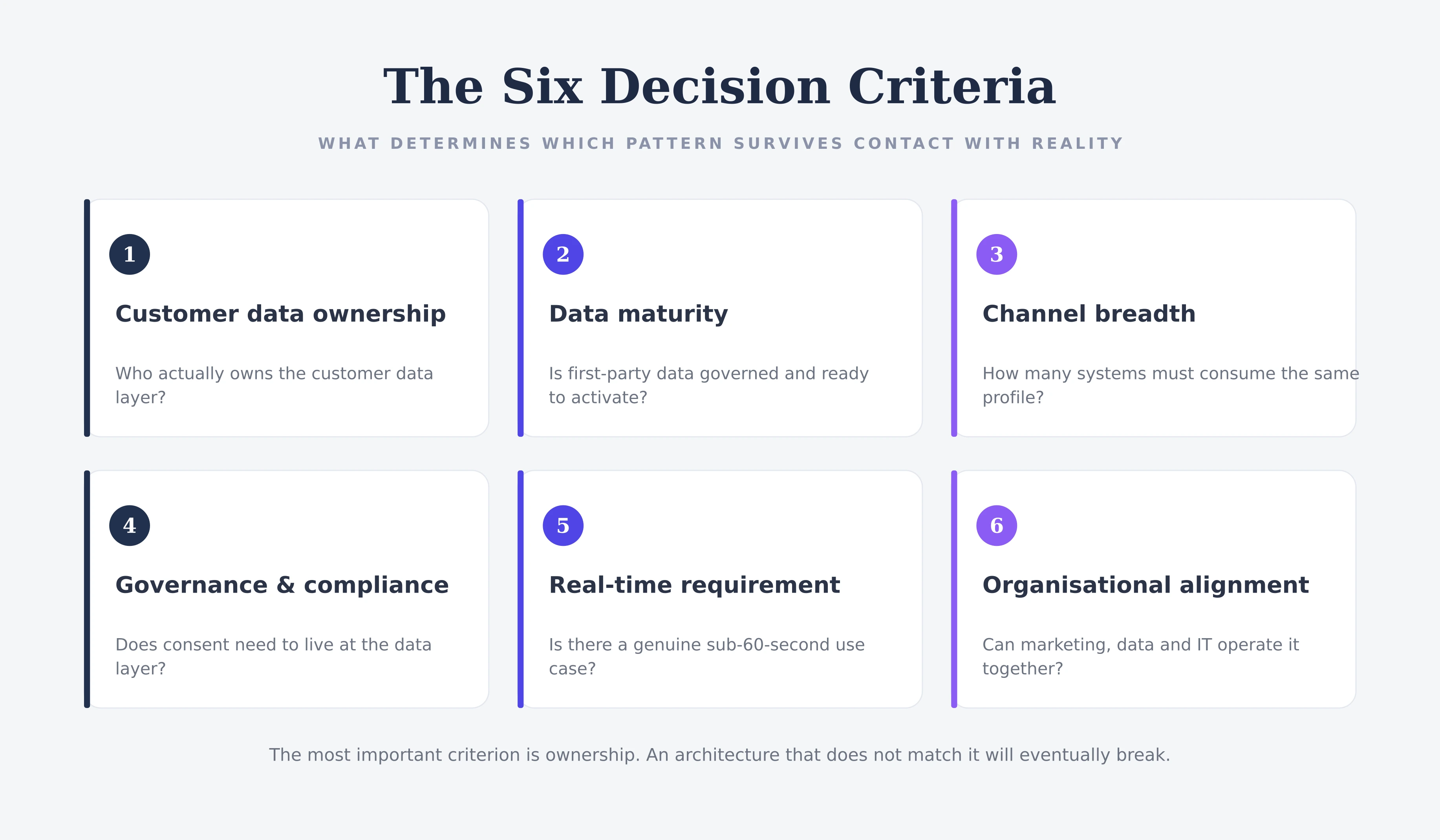
1. Who owns the customer data layer?
This is the most important question, and the one most often skipped.
In many organisations, the honest answer is uncomfortable: nobody owns the customer data layer clearly, or three different teams each believe they do.
If the CDO, data platform team or IT organisation owns a governed cloud data warehouse and treats it as the central source of truth for customer data, Pattern C is architecturally natural. The CDP becomes a modelling, identity and activation layer sitting on top of infrastructure that already exists and is already governed.
If marketing owns the customer data, builds the segments and is accountable for activation quality, Pattern B can be coherent. Marketing’s customer data layer lives directly inside the engagement platform marketing operates every day.
Pattern A works when ownership is shared and mature: data, IT and marketing all align around a common enterprise platform, a shared governance framework and a single profile model.
If nobody owns the customer data layer, organisations often drift toward Pattern B by default. The CEP vendor absorbs the problem because the business needs to activate quickly. That may be pragmatic, but it is important to be honest about what happened: the governance problem was deferred, not solved.
2. What is your data maturity?
The practical question is simple:
Do you have reliable, governed first-party customer data in a cloud data platform, and do you have the data engineering capacity to maintain it?
If yes, the composable variant of Pattern C deserves serious consideration. Identity resolution, segmentation and audience logic can live close to the data, with Reverse ETL or warehouse-native activation tools syncing the right signals to CEPs and other destinations.
If no, Pattern B or a packaged form of Pattern A may get you to value faster. A packaged CDP or a CEP with built-in CDP capabilities provides structure that organisations without mature data infrastructure genuinely need.
This is where many CDP programmes fail. The issue is not that the selected platform cannot activate data. The issue is that the data was not ready to be activated.
Data quality, identity consistency, consent availability, event taxonomy and source system reliability are not secondary details. They define the ceiling of what any CDP–CEP architecture can deliver.
Pattern C assumes the organisation can own those foundations. Pattern A can provide strong governance scaffolding, but still requires disciplined configuration and data stewardship. Pattern B can move faster, but only within the limits of the data model the CEP is able to manage.
3. How broad are your activation requirements?
A programme focused mainly on email and push has very different architectural needs from a true omnichannel stack.
If your activation surface is narrow, Pattern B can be sufficient. A modern CEP can manage profiles, segments and journeys across two or three owned channels very effectively. The operational simplicity is real, and the additional complexity of a separate CDP may not produce enough value.
If your activation surface is broad, Pattern C becomes more defensible.
Email, push, in-app, SMS, WhatsApp, web personalisation, paid media, direct mail, call centre, commerce, loyalty and customer service do not always belong inside one engagement platform. When many systems need to consume customer context, the CDP has a broader architectural role: it becomes the shared customer data layer for multiple activation endpoints.
Pattern A can also support broad activation when the organisation has standardised heavily on one suite. But this depends on whether the suite realistically covers the channels and use cases that matter most, not only whether it has a product in each category.
The question is not “how many channels does the vendor support?”
The better question is:
How many independent systems need to consume the same governed customer profile?
If the answer is one primary CEP, Pattern B may be enough. If the answer is many activation surfaces across the enterprise, Pattern C is usually easier to justify.
4. How strong are your governance and compliance requirements?
This is where enterprise scale changes the decision.
If the organisation operates across multiple geographies, brands or regulated sectors, consent and data usage cannot be managed only as suppression logic inside each execution tool. Governance needs to sit at the data layer.
Pattern A can be strong here because data governance and activation share the same broader platform model. Frameworks such as Adobe Experience Platform’s data usage labelling and enforcement capabilities, or Salesforce Data Cloud’s consent and unified profile model, can help enforce customer data usage more consistently when configured correctly.
Pattern C can also work well when the CDP or warehouse-native customer layer is governed properly and serves all downstream systems from a common policy framework.
Pattern B has a lower governance ceiling.
The consent management inside CEPs can be perfectly adequate for marketing operations: channel preferences, unsubscribes, suppression rules, message eligibility and communication frequency. But that is not the same as enterprise data governance.
If legal, compliance or data teams need to answer which systems consumed a specific customer attribute, under which legal basis, from which source, and for which purpose, a CEP-centric customer profile may not be enough.
Pattern B is not weak. It is simply optimised for activation first. That distinction should be explicit in the decision.
5. What is the real real-time requirement?
“Real-time” is one of the most overused words in MarTech.
Many requirements described as real-time are actually “within the hour”, “before the next campaign”, or “by the next business day”. Those are valid requirements, but they should not drive the architecture in the same way as sub-minute decisioning.
For most lifecycle marketing, Pattern C’s integration latency is not visible to the customer. Abandoned cart within two hours, reactivation after seven days, post-purchase education, loyalty milestones, birthday campaigns and win-back journeys do not usually require sub-second profile propagation.
For genuine real-time use cases, Pattern B has a structural advantage. Data ingestion and journey triggering happen inside the same platform, so there is no external synchronisation boundary to cross.
Pattern A can also perform well when the CDP and activation layer are part of the same eventing and profile infrastructure. But even inside large suites, the practical latency depends on the specific products, data flows and configuration.
Pattern C can support real-time use cases, but it requires stronger engineering: event streaming, reliable identity resolution, low-latency sync, monitoring, replay logic and clear ownership of the integration layer.
Before letting real-time requirements decide the architecture, stress-test the actual use cases.
If the honest answer is “we want the capability, but we do not have a live sub-60-second use case today”, then governance, flexibility and operational fit may matter more than optimising for theoretical speed.
6. How aligned is the organisation?
This criterion rarely appears in vendor evaluations, but it often explains implementation failure after the fact.
CDP and CEP architectures sit between teams: marketing, CRM, data, IT, analytics, legal, commerce and sometimes customer service. If those teams are not aligned on ownership, data definitions and operating model, the platform will expose the problem rather than solve it.
Pattern A requires the highest alignment. It depends on a shared enterprise platform, a common data model, joint governance and a level of collaboration between CDO, CIO and CMO that not every organisation has at the start of the programme.
Pattern B requires the least alignment at the beginning. Marketing can move quickly and own the platform more independently. That is its strength. It is also its ceiling if the long-term ambition is enterprise-wide customer data sharing.
Pattern C requires alignment at the integration layer. Someone must own the pipeline between CDP and CEP as core infrastructure, not as a support task. When Pattern C fails, it often fails here: the architecture is correct on paper, but no team truly owns the boundary where customer data becomes activation.
The lesson is simple.
Do not choose the architecture you wish the organisation could operate.
Choose the one it is actually ready to operate, or explicitly fund the changes needed to make the target architecture realistic.
The Decision Matrix
This is how the six criteria tend to map to the three patterns. Treat it as a guide, not a rule.
| Criterion | Pattern A · Activation in CDP | Pattern B · CDP in CEP | Pattern C · Separate CDP + CEP |
|---|---|---|---|
| Customer data ownership | Shared between data, IT and marketing | Mostly marketing | Shared between data and marketing |
| Data maturity required | Medium to high | Low to medium | Medium to high; high for composable |
| Channel breadth | Medium to wide | Narrow to medium | Wide |
| Governance requirements | High | Low to medium | Medium to high |
| Real-time activation | Medium to high | High | Low to medium unless engineered carefully |
| Organisational alignment required | High | Low to medium | Medium to high |
| Time to value | Medium | Fast | Slow to medium |
| Vendor lock-in | High | Medium to high | Low to medium |
| Operational complexity | Medium to high | Low | High |
The most important row is not time to value. It is ownership.
An architecture that does not match ownership will eventually break. Either the wrong team controls the data, the wrong team owns the activation, or nobody owns the integration between the two.
Three Scenarios Where Each Pattern Wins
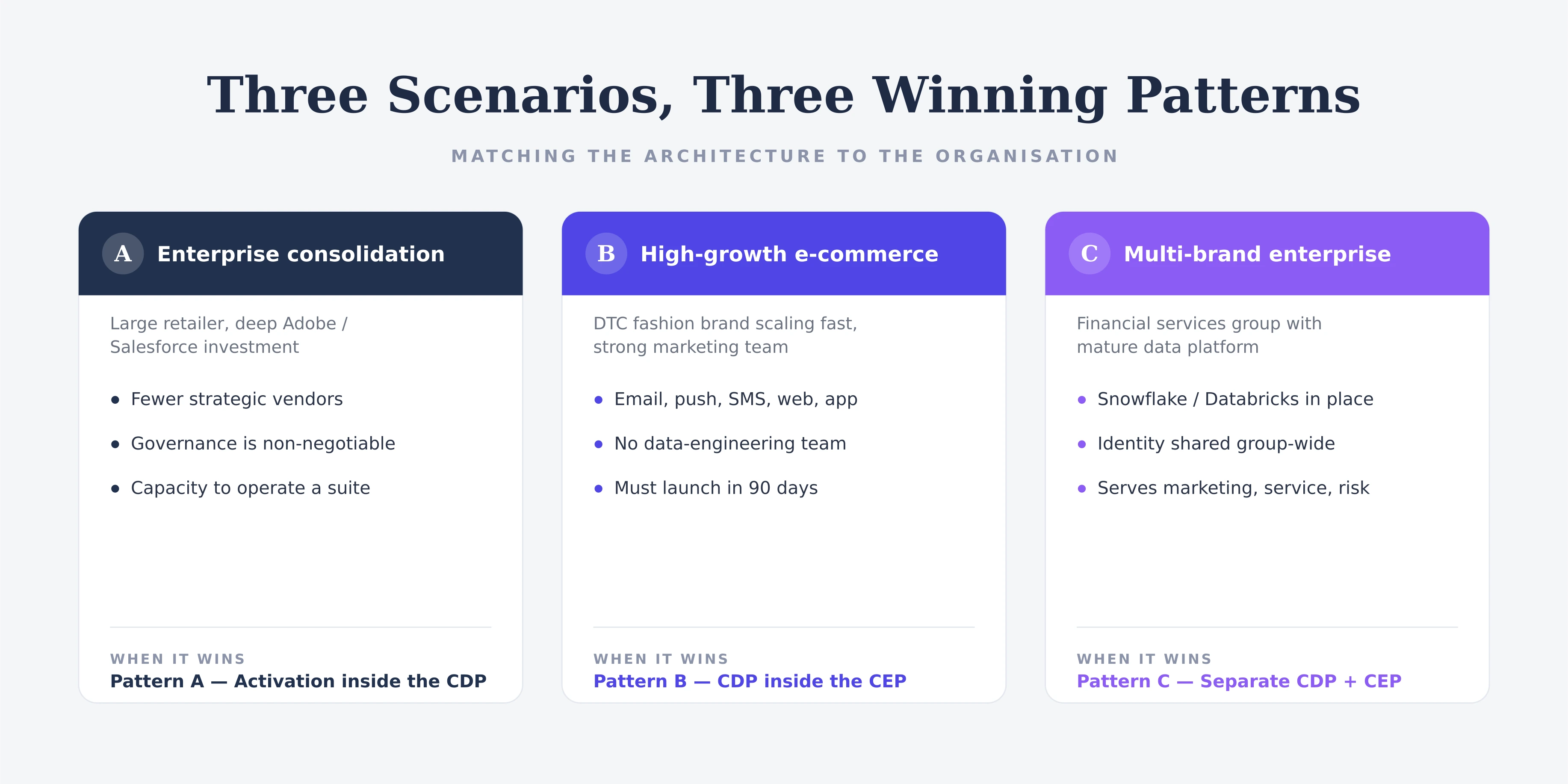
Pattern A wins: enterprise platform consolidation
A large retailer is already deeply invested in Adobe Experience Cloud. Adobe Analytics is mature. Adobe Experience Platform is part of the roadmap. The CIO wants fewer strategic vendors. The CDO needs a governed customer profile. Marketing wants real-time orchestration, but within a platform model IT can govern.
Adobe Real-Time CDP with Adobe Journey Optimizer becomes a natural direction.
The point is not that Adobe is always the right answer. The point is that the organisational and architectural conditions match Pattern A: enterprise platform consolidation, governance needs, existing suite investment and enough technical capability to operate the environment.
The same logic can apply in a Salesforce-centred organisation using Data Cloud as the customer data foundation and Salesforce Marketing Cloud as the activation layer.
Pattern B wins: high-growth e-commerce
A direct-to-consumer fashion brand is growing quickly. The marketing team is strong. The data model is relatively straightforward. The main channels are email, push, SMS, web and app. There is no dedicated data engineering team, and the business needs to launch in 90 days.
Bloomreach Engagement, Insider or another CEP with strong built-in data capabilities can be a coherent choice.
The built-in customer profile is sufficient for the activation model. The marketing team can operate the platform. Time to value matters more than enterprise-grade data portability. A separate CDP procurement and integration project would add months without necessarily producing proportional value.
Pattern B wins when speed, simplicity and owned-channel activation are the dominant requirements.
Pattern C wins: multi-brand enterprise with mature data infrastructure
A financial services group operates multiple brands, each with different channels and engagement tools. The data team maintains Snowflake or Databricks as the enterprise data platform. Customer identity needs to be resolved at group level and shared across marketing, service, analytics and risk.
A standalone or composable CDP layer on top of the warehouse, syncing to multiple downstream CEPs and activation systems, is the more defensible architecture.
No single CEP should own the enterprise identity graph. The customer data layer needs to serve more than marketing execution. The integration complexity is real, but the organisation has the data engineering capability to operate it.
Pattern C wins when customer data is an enterprise asset, not only a marketing asset.
The Composable CDP Wrinkle
Composable CDPs do not create a completely separate fourth pattern. They change the economics and implementation model of Pattern C.
In a traditional standalone CDP architecture, data is often copied into a CDP, modelled there and then pushed downstream to activation tools.
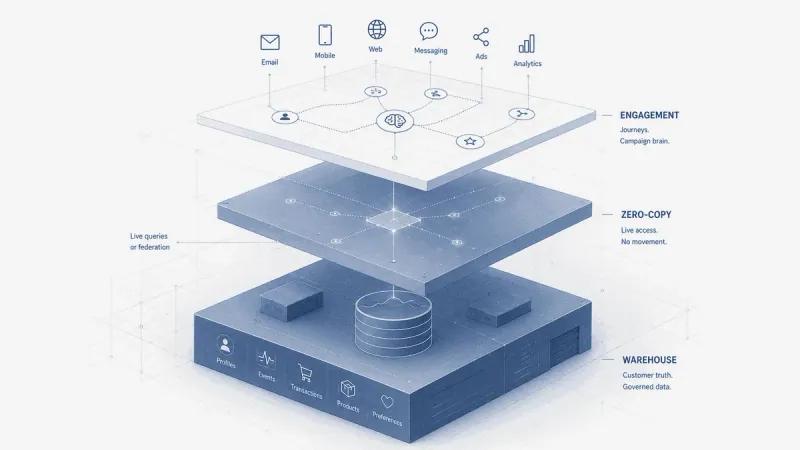
In a composable architecture, the data remains in the cloud data warehouse. The CDP or Reverse ETL layer defines audiences, traits and activation logic on top of the warehouse, then syncs the necessary data to downstream platforms.
This reduces one of the historical criticisms of CDPs: creating another customer data silo.
For organisations with mature warehouse infrastructure, the composable route is often preferable to deploying a packaged CDP alongside the warehouse. Otherwise, the packaged CDP risks becoming a second source of truth for customer identity, which is exactly the problem a CDP is supposed to solve.
But composable does not remove complexity. It shifts it.
The organisation still needs strong data modelling, identity rules, consent logic, schema discipline, observability and integration ownership. A composable CDP is not a shortcut around data maturity. It is a way to take advantage of data maturity that already exists.
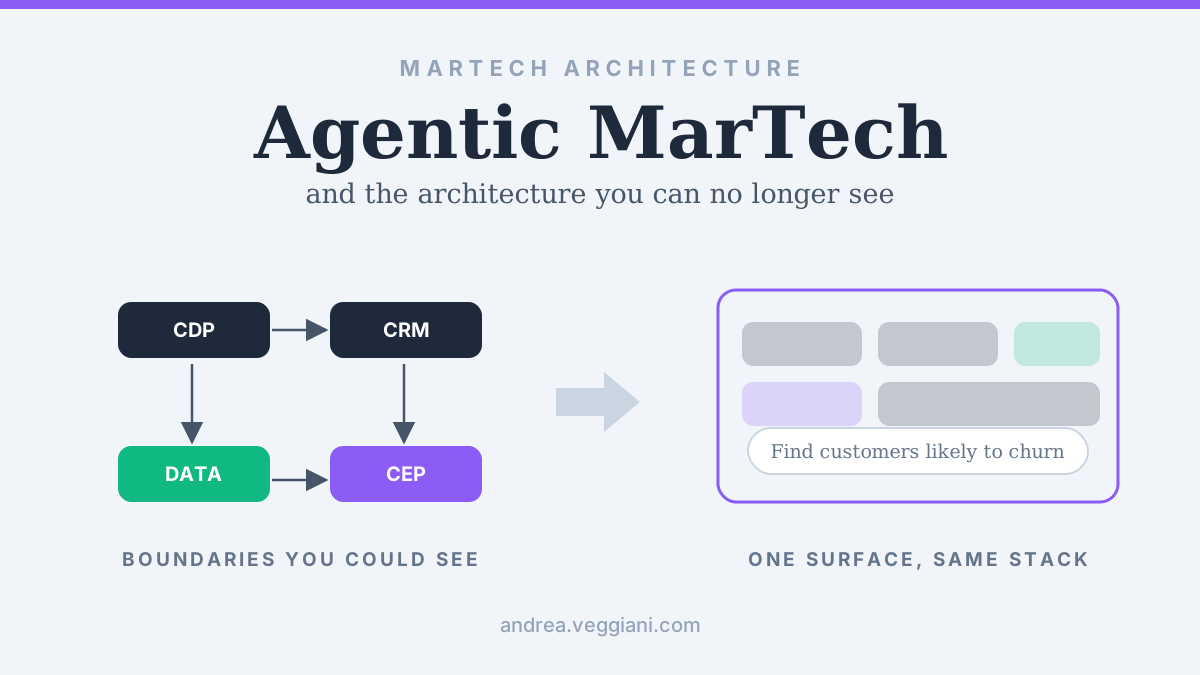
This is also where agentic marketing architectures will become more relevant. As AI agents begin to generate audiences, propose journeys, create variants or optimise decisions, the quality and governance of the customer data layer becomes even more important.
Pattern A and Pattern C have an advantage here because they can expose a more governed customer profile to decisioning systems. Pattern B can still support agentic activation, but the underlying profile is usually more marketing-grade than enterprise-grade.
That distinction may not matter for every organisation today. It will matter more as autonomous decisioning becomes part of the operating model.
Red Flags in Each Pattern
Red flags in Pattern A
Be careful if the activation layer is significantly weaker than the specialist CEPs your use cases require.
A suite can provide a strong data foundation but still lag in the day-to-day capabilities marketers need: journey flexibility, mobile engagement, experimentation, content workflows, reporting usability or operational speed.
Also pressure-test the pricing model. If activation volume is high, CDP-style pricing applied to large-scale campaign execution can become expensive quickly.
The warning sign is this: the architecture is clean, but the marketing team cannot operate it effectively or affordably.
Red flags in Pattern B
Ask two questions before committing:
Does the CEP’s built-in CDP meet enterprise identity and governance requirements, or only marketing activation requirements?
Will the customer profile be accessible to other systems that need it?
If the answer is “good enough for now”, that can be acceptable. But “good enough” needs a definition.
If the answer is “we will figure out profile portability later”, that is not a solved problem. It is a deferred architecture decision.
Pattern B is strong when chosen deliberately. It is risky when chosen because nobody wanted to confront customer data ownership.
Red flags in Pattern C
The critical question is whether the organisation has the engineering and operating capacity to own the integration layer.
A poorly maintained Reverse ETL pipeline, a fragile API integration, an undocumented transformation rule or an unmonitored sync failure can destroy trust in the whole architecture.
Pattern C creates flexibility, but only if the boundary between CDP and CEP is treated as core infrastructure.
If ownership of that boundary is unclear, Pattern C can produce the worst of both worlds: more complexity without better data quality.
The Question Underneath the Decision
The real question is not which pattern is architecturally superior.
The real question is which pattern your organisation is able to operate, govern and evolve.
Pattern A is powerful when enterprise platform consolidation, data governance and organisational alignment are real.
Pattern B is powerful when marketing needs speed, simplicity and strong owned-channel activation without a large data engineering dependency.
Pattern C is powerful when customer data is an enterprise asset that must serve multiple systems, teams and activation surfaces.
Every time I have seen organisations get this wrong, the reason was similar: they chose a platform based on capability, but they chose an architecture that did not match their operating reality.
The platform looked right in the evaluation.
The architecture failed in production.
Start with the six criteria. Be honest about where the organisation really sits on each. Then choose the pattern that matches reality, not aspiration.
Because the architecture always wins.
The platform only matters once the architecture is right.
This is Part 2 of a two-part series. Part 1 — The CDP–CEP Architecture Decision: Three Patterns, Three Different Bets covers how each architecture works, who implements it and what it actually costs.
Sources
CDP Institute / Customer Data Alliance
- CDP Industry Update: February 2026
- Customer Data Alliance and CDP Institute release new CDP Industry Update
CDP.com
- Do You Need a CDP with an Engagement Platform?
- Packaged vs Composable CDP: An Outdated Framing
- CDP Industry Statistics 2026: Market Size & Trends
Customer.io
Blueshift
MarTech.org
Dinmo
CX Today