13 min read
Everyone in this industry argues about platforms.
Which CDP is best. Whether CEPs still need a separate data layer. Whether the composable model is finally mature enough. Whether a suite is safer than best-of-breed.
These are real questions, but they are downstream of a more important one that is often skipped:
How are you wiring the CDP and the CEP together, and have you thought through what that architectural choice implies?
The integration pattern matters more than the individual platforms.
You can buy a strong CDP and a strong CEP and still end up with stale personalisation, inconsistent audiences, duplicated segment logic and governance problems. Not because the platforms are bad, but because the architecture between them creates constraints that no vendor feature list can fully remove.
After years designing and implementing cross-channel customer engagement stacks, I have seen this play out repeatedly. Teams spend months evaluating platforms and very little time evaluating the integration model. Then the problems appear six months after launch, when the architecture starts operating under real pressure.
This is Part 1 of a two-part series.
Here I will map the three main architectural patterns: what they are, how they work, who implements them, and what each one costs you.
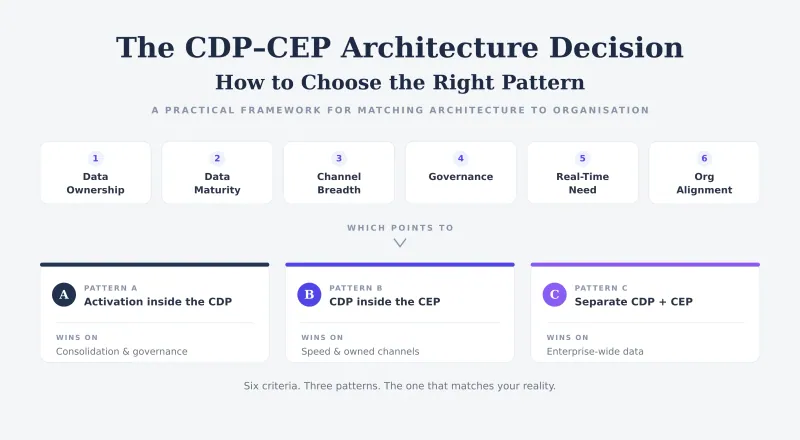
In Part 2, I will move from mapping to decision-making: the criteria that should guide which pattern makes sense for your organisation, and the red flags to watch before committing.
The Three Patterns
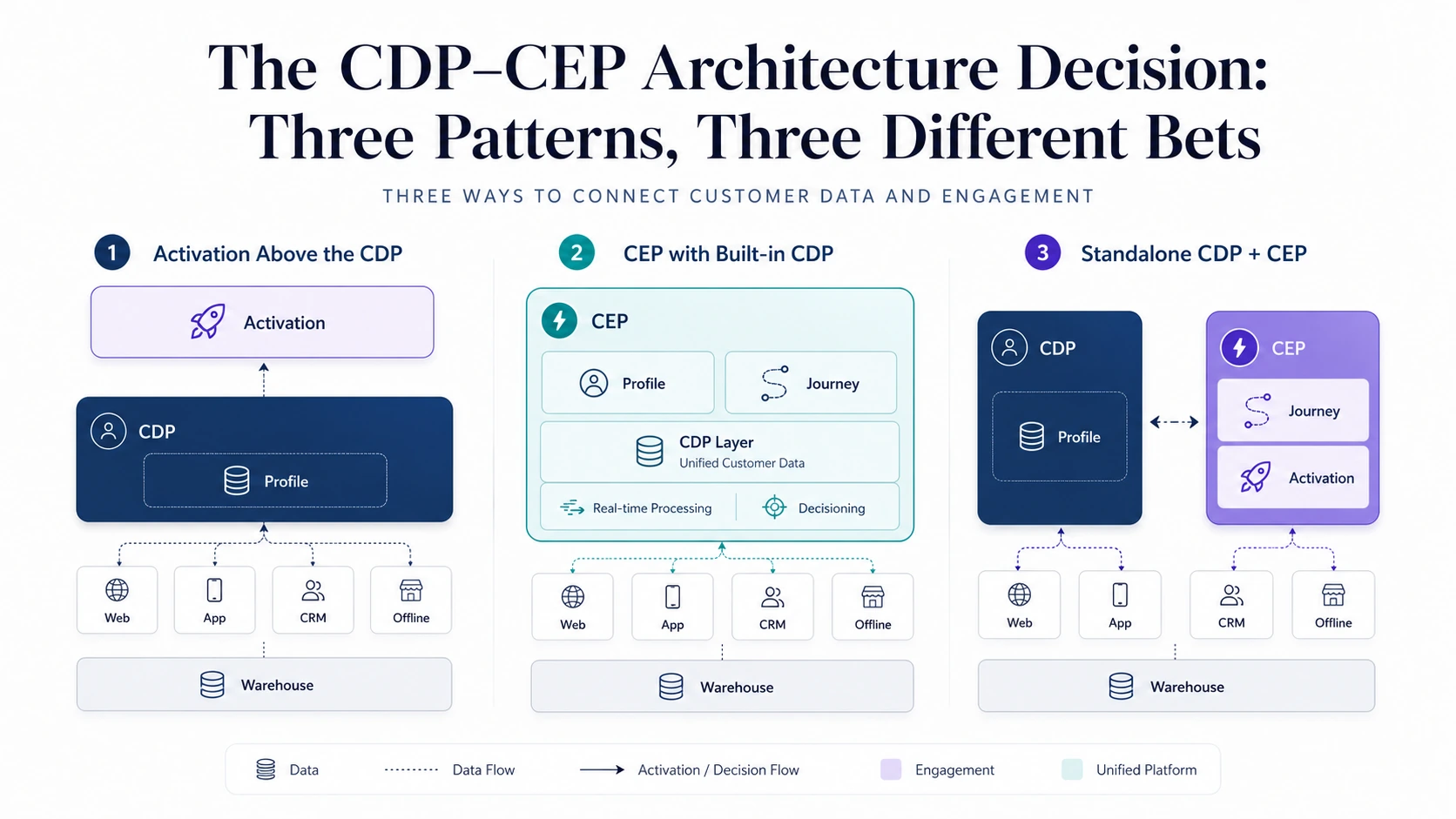
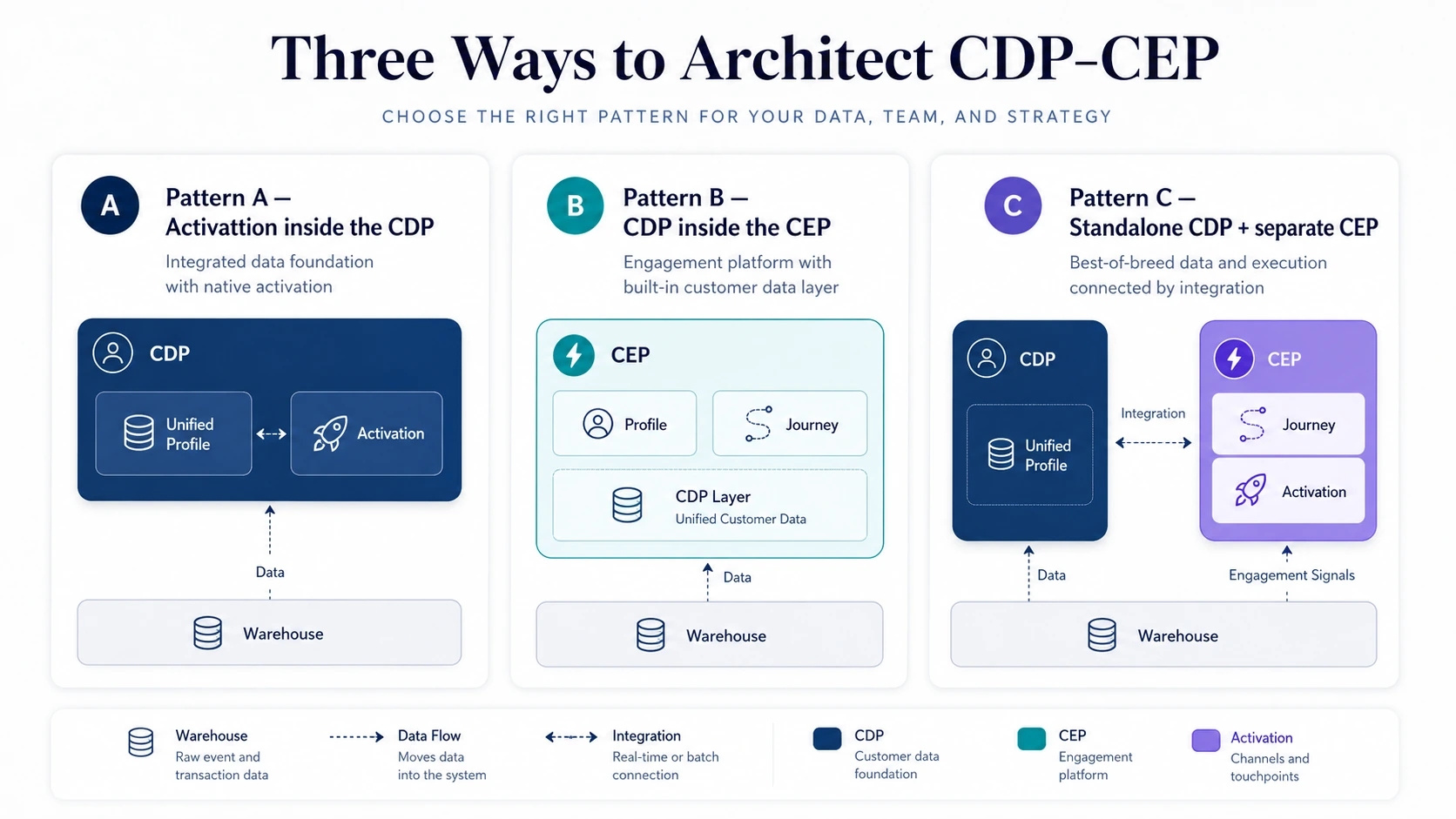
There are many implementation variants, but most CDP–CEP architectures fall into three patterns.
Pattern A: Activation inside the CDP.
The CDP vendor expands upward, adding journey orchestration, campaign execution and channel activation on top of the data foundation. The CDP remains the primary system of record, while activation becomes a native capability of the same broader platform.
Pattern B: CDP inside the CEP.
The CEP vendor expands downward, building identity resolution, profile unification, event ingestion and segmentation directly into the engagement platform. The CEP becomes the combined system for both data and execution.
Pattern C: Standalone CDP with a separate CEP.
Classic best-of-breed. A dedicated CDP manages identity, profiles, consent and audiences. A dedicated CEP handles journey orchestration and channel delivery. The two are connected through APIs, streaming, Reverse ETL, file-based synchronisation or a shared cloud data warehouse layer.
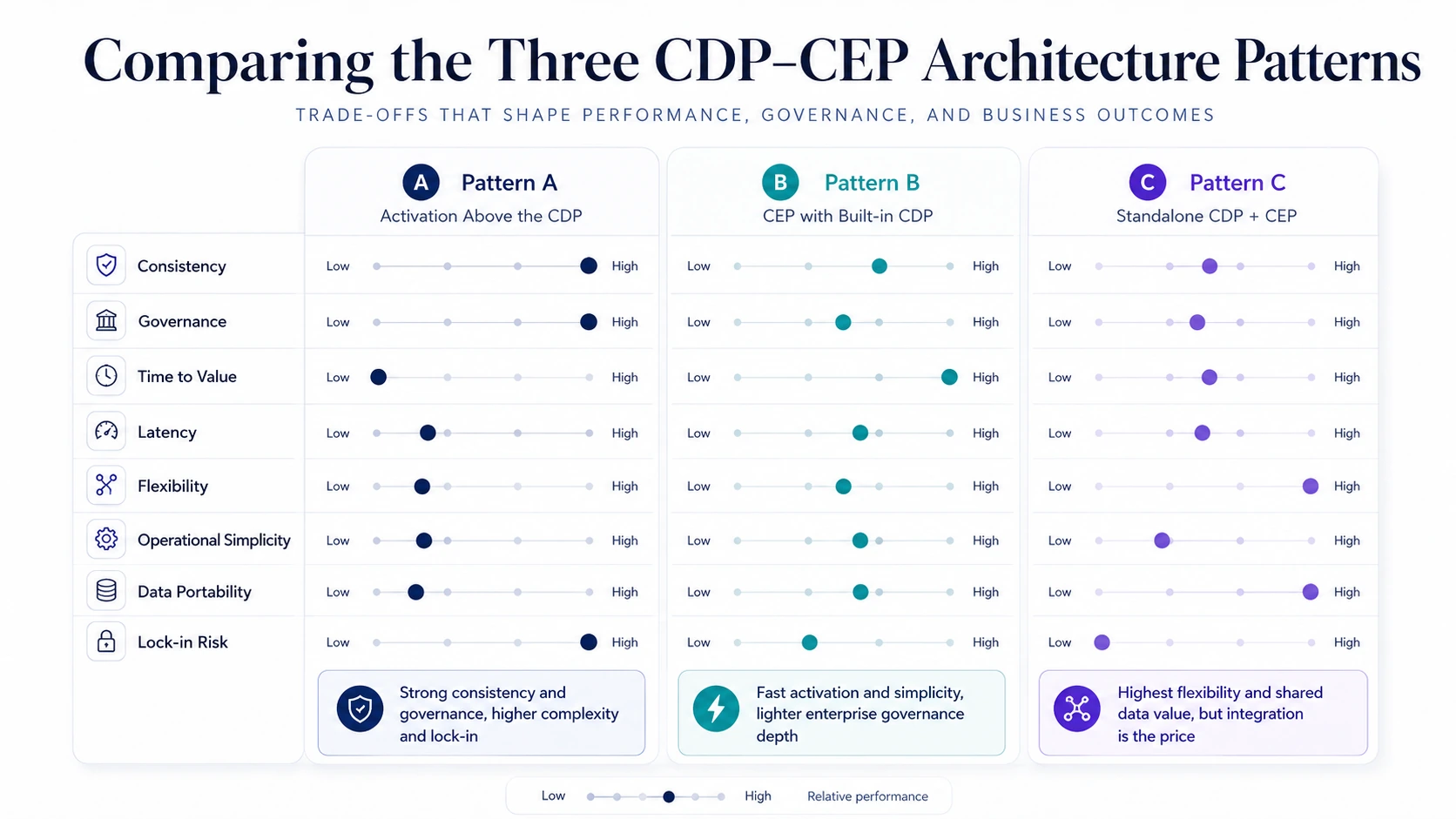
None of these patterns is inherently right or wrong. All three are live in production environments. All three can work. All three can fail.
The difference is not abstract architectural elegance. The difference is in the trade-offs each pattern creates around data quality, latency, governance, cost, operational complexity and organisational ownership.
The current CDP market makes more sense when read through this lens. What is changing is not whether customer data matters. It is where responsibility for customer context sits: inside a suite, inside the engagement platform, or closer to the enterprise data infrastructure.
Pattern A: Activation Inside the CDP
How it works
In this pattern, the CDP is the foundation. On top of it, the same vendor provides journey orchestration, decisioning, campaign tooling and channel activation.
The data layer and execution layer share the same identity graph, profile model and governance framework. There is no separate audience synchronisation step between the CDP and the CEP because, architecturally, they are part of the same platform family.
Typical examples include Adobe Real-Time CDP with Adobe Journey Optimizer on Adobe Experience Platform, Salesforce Data Cloud as the identity and profile foundation for Salesforce Marketing Cloud, and Treasure Data’s AI Marketing Cloud, which extends its CDP heritage into orchestration and activation. Twilio Segment with Engage is a lighter version of the same direction. The common idea is simple: keep customer context and customer activation inside one governed environment.
The genuine strengths
The main advantage is consistency.
The profile used for identity resolution is the same profile used for segmentation, decisioning and activation. There is no separate copy of the customer profile pushed into another tool, and no second system trying to reinterpret the same customer state. That matters more than it sounds.
In a decoupled architecture, you often end up maintaining two definitions of the same thing: a segment in the CDP and a corresponding audience or entry condition in the CEP. Every time one changes and the other does not, the organisation creates drift. Pattern A reduces that class of problem because the activation logic sits closer to the governed profile. Governance is the second major strength. Consent, data usage policies and suppression rules can be enforced more consistently when the data and activation layers share the same governance model. In platforms like Adobe Experience Platform or Salesforce Data Cloud, this still depends on correct configuration, data labelling, policy design and operational discipline. But the architecture gives you a stronger foundation than a chain of disconnected suppression jobs between systems. The third strength is strategic alignment with enterprise platform consolidation. Large vendors are investing heavily in integrated data and activation layers. The Salesforce acquisition of Informatica, completed in November 2025, is a clear signal of where enterprise capital is moving: deeper integration between data infrastructure, customer context and activation. The CDP Institute’s February 2026 Industry Update also points to continued concentration in large integrated vendors, with a small group accounting for a dominant share of employment and funding in the CDP category. Finally, AI and decisioning benefit from a more complete governed profile. Predictive scores, propensity models and next-best-action logic are more valuable when they can operate on the same customer context that activation uses. Pattern A makes this easier than architectures where models operate on one profile while campaigns execute against another projection of that profile.
The real costs
The first cost is usability.
CDP-led platforms are often designed from a data architecture and governance perspective first. Activation capabilities such as journey builders, campaign workflows, experimentation and content operations are added on top. They have improved significantly, but they do not always feel as natural for day-to-day marketers as platforms born specifically for engagement execution. Adobe Journey Optimizer has become more capable, but it remains a complex environment. Salesforce Marketing Cloud is powerful, but it carries legacy architectural layers that require skill and discipline to operate well. In Pattern A, the organisation often gains data consistency but accepts a higher operating burden for marketers and platform teams. The second cost is commercial.
CDP pricing often follows data infrastructure logic: profiles, rows, events, API calls, data volume. That model makes sense when the CDP is primarily a data layer. It can become more difficult when the same environment is also used for high-volume activation. Before choosing Pattern A, the commercial model needs to be stress-tested against real campaign volume, not only against profile counts. The third cost is lock-in.
Your identity graph, audience definitions, consent logic, journey orchestration, decisioning rules and channel history increasingly live inside one vendor ecosystem. That can be coherent. It can also become difficult to unwind. Migrating away from Pattern A is not just replacing a tool. It means rethinking the central nervous system of the marketing stack.
Who it fits
Pattern A fits organisations already committed to a major enterprise ecosystem such as Adobe Experience Cloud or Salesforce Customer 360.
It also fits enterprises where governance and compliance are non-negotiable, and where customer data usage needs to be enforced at the infrastructure level rather than through process alone.
It is best suited to organisations with the technical maturity to operate complex platforms, and with enough organisational alignment between marketing, data and IT to make a shared platform model work.
Pattern A is not the easiest route. But when the organisation is ready for it, it can provide the cleanest connection between governed customer data and activation.
Pattern B: CDP Inside the CEP
How it works
In this pattern, the engagement platform absorbs many CDP capabilities.
The CEP ingests events, stores user attributes, builds profiles, resolves identities for marketing purposes, creates segments and activates journeys from the same environment. Instead of a CDP feeding the CEP, the CEP becomes the data and execution system for marketing.
Bloomreach Engagement has positioned itself explicitly in this direction, using the idea of a Customer Data and Engagement Platform. Insider One follows a similar logic, combining data collection, segmentation, personalisation and orchestration inside one platform. Braze is more nuanced. It has strong behavioural event ingestion, user attributes, segmentation and real-time activation, but it does not generally position itself as a full enterprise CDP. Its answer to the data architecture question increasingly includes direct connections to cloud data warehouses, including Snowflake Data Sharing, rather than trying to replace every upstream data layer. The common idea in Pattern B is operational simplicity: marketing can work in one environment where data and activation are tightly connected.
The genuine strengths
Time to value is the clearest advantage.
There is no separate CDP procurement, no large integration project, and no additional data layer to implement before marketing can start activating. The team connects data sources, configures profiles and events, builds segments, and launches campaigns from the same platform. For many organisations, that is not a minor benefit. It is the difference between launching in weeks and launching in quarters.
Latency is another real advantage. When ingestion, segmentation and journey triggering happen in the same system, the path from event to action can be very short. For use cases such as cart abandonment, in-session personalisation, behavioural triggers or mobile engagement, Pattern B can be extremely effective because there is no external synchronisation step between profile update and activation. Operational simplicity also matters. One vendor. One interface. One place to debug. One operating model for the marketing team. For organisations without strong data engineering support, this can be a decisive advantage. This is one reason delivery-oriented CDPs and engagement platforms with built-in data capabilities have grown in relevance. Rokt’s US$300M investment and merger with mParticle, announced in January 2025, reflected a similar market logic: combining a real‑time CDP with ecommerce decisioning to unlock more relevant experiences at transaction time.
The real costs
The central limitation is governance depth.
The CDP capabilities inside a CEP are usually optimised for marketing activation, not enterprise data management. They are very good at answering questions such as: who should receive this message, who did this event, who belongs to this journey, and who should be suppressed from this channel? They are less suited to enterprise questions such as: which systems consumed this customer attribute, under which legal basis, from which source, and with which retention policy? That distinction matters.
Marketing-grade identity resolution is not the same thing as enterprise-grade master data management. Matching users by email, device ID or customer ID may be sufficient for activation. It may not be sufficient for cross-departmental customer identity across service, commerce, analytics, risk and finance. The second limitation is data portability.
When the unified profile lives inside the CEP, other systems do not naturally consume it. Analytics platforms, data science tools, paid media destinations, customer service applications or enterprise reporting may all need access to customer context. Exporting profiles out of the CEP reintroduces the integration complexity Pattern B initially helped you avoid. The third limitation is uneven depth across vendors.
Some CEPs have invested heavily in built-in CDP capabilities. Others provide profile enrichment and segmentation that should not be confused with a full customer data platform. Before assuming a CEP can replace a CDP, the organisation should test the hard questions: anonymous-to-known stitching, multiple identifiers, duplicate profiles, consent inheritance, cross-device behaviour, historical events, calculated attributes, schema governance and profile exportability.
Who it fits
Pattern B fits organisations where marketing is the primary owner of customer activation and where cross-departmental data sharing is not yet a major requirement.
It is especially strong for e-commerce, retail and direct-to-consumer brands with a relatively straightforward data model and a strong need for fast activation across owned channels such as email, push, SMS, in-app, web and WhatsApp. It also fits teams that need to move quickly and do not have the data engineering capacity to design, build and maintain a separate CDP–CEP integration layer.
Pattern B is often the most pragmatic choice. But it should be chosen with a clear understanding of its ceiling: it solves marketing activation faster than it solves enterprise customer data governance.
Pattern C: Standalone CDP with a Separate CEP
How it works
In this pattern, the CDP and the CEP remain independent platforms connected by an integration layer.
The CDP manages identity resolution, profile storage, consent logic, audience modelling and customer data governance. The CEP consumes audiences, attributes, events or calculated signals from the CDP to orchestrate journeys and deliver messages. The connection can take several forms: streaming events, APIs, webhooks, Kafka, Reverse ETL, file synchronisation, API polling or direct reading from a shared cloud data warehouse. In composable architectures, the cloud data warehouse becomes the foundation. Snowflake, BigQuery or Databricks holds the governed customer data. A composable CDP or Reverse ETL layer models audiences and syncs them to downstream engagement platforms. Common examples include Tealium or mParticle feeding Braze or Salesforce Marketing Cloud; Segment or Amperity acting as the customer data layer for multiple execution tools; or Hightouch, Census and similar warehouse-native tools syncing customer data from the warehouse to CEPs and media destinations. The common idea is separation of concerns: the customer data layer serves more than one activation platform.
The genuine strengths
Flexibility is the defining advantage.
You can replace either layer independently. If the organisation chooses a better CEP in two years, the CDP and identity model can remain. If the data strategy changes because of a merger, new warehouse architecture or governance programme, the CEP does not necessarily need to be replaced. Pattern C also makes the CDP a shared service layer.
In Pattern A and Pattern B, customer profiles often primarily serve one execution environment. In Pattern C, the CDP can feed engagement platforms, analytics, paid media, experimentation tools, customer service, direct mail, call centre systems and data science use cases. That broader return surface is the real reason Pattern C exists.
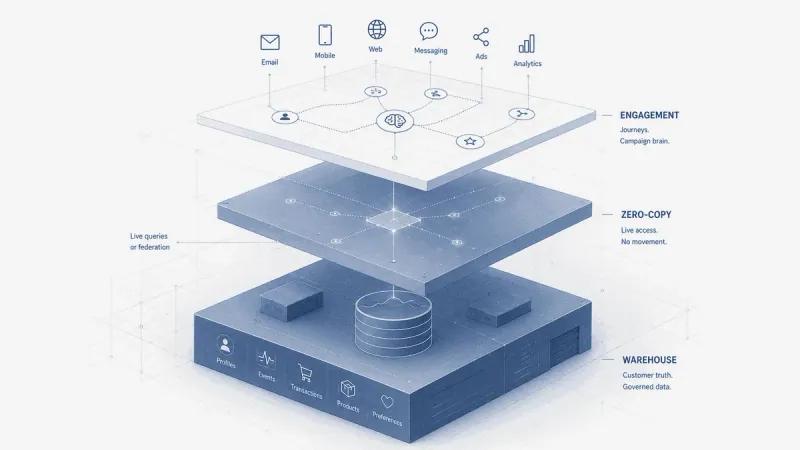
Data portability is stronger too. In the composable variant, data remains in the governed infrastructure the organisation already controls. The activation tools consume the necessary attributes, segments or signals, but the customer data foundation does not move into a vendor silo. This is why warehouse-native and composable CDP models have gained momentum. For organisations with mature cloud data platforms, it is increasingly natural to keep customer data close to the warehouse and use activation tools as consumers of that data, rather than making every tool another partial source of truth.
The real costs
Integration complexity is the unavoidable cost.
Two platforms mean two data models, two sets of identifiers, two operational teams, two contracts, two monitoring surfaces and one critical boundary between data and activation.
That boundary is where Pattern C succeeds or fails.
The audience built in the CDP is not automatically the audience used in the CEP. Unless the integration is carefully designed, monitored and governed, drift appears. The CDP says a customer belongs to a segment. The CEP disagrees because its local copy is delayed, incomplete or transformed differently. Latency is the second structural cost.
For most lifecycle use cases, this does not matter. Daily campaigns, post-purchase sequences, reactivation journeys, loyalty communications and standard abandoned cart flows can tolerate minutes or hours of latency without customer-visible impact. For genuinely real-time use cases, the integration layer becomes more demanding. Sub-minute triggers, live session interventions and immediate suppression logic require event streaming, careful state management and strong observability. Pattern C can support this, but it does not get it for free. The third cost is operational ownership.
When a trigger does not fire, the debugging path crosses systems. Was the event captured? Was the identity resolved? Did the audience update? Did the sync run? Did the CEP ingest the update? Did the journey evaluate the customer correctly?
In a poorly instrumented stack, that question can consume days.
Who it fits
Pattern C fits enterprises with genuine cross-departmental customer data requirements.
It is the natural pattern when the CDP serves marketing, service, commerce, analytics, paid media and data science, not only the engagement platform.
It also fits organisations with a mature cloud data warehouse and data engineering team that can own the integration layer as core infrastructure.
Pattern C is not the simplest architecture. It is not usually the fastest. But when the customer data layer needs to serve the whole enterprise, it is often the most defensible.
What This Choice Is Not About
This architectural decision is not primarily a platform evaluation question.
You cannot answer “which pattern is right for us?” by reading Magic Quadrants, comparing vendor demos or scoring feature checklists.
Those things matter, but only after the architectural fit is clear. The real questions are organisational:
- Who owns the customer data layer?
- How mature is the data infrastructure?
- How much governance is required?
- How many activation surfaces need to consume the customer profile?
- How real is the real-time requirement?
- Who will operate the integration boundary when something breaks?
Patterns A, B and C can all work. The difference is not which one is best in general. The difference is which one matches the organisation’s actual ability to operate, govern and evolve the architecture. That is where Part 2 begins.
Sources
CDP Institute / Customer Data Alliance
- CDP Industry Update: February 2026
- Customer Data Alliance and CDP Institute release new CDP Industry Update
CDP.com
- Do You Need a CDP with an Engagement Platform?
- Packaged vs Composable CDP: An Outdated Framing
- CDP Industry Statistics 2026: Market Size & Trends
Customer.io
Blueshift
MarTech.org
Dinmo
Salesforce
Rokt / mParticle