13 min read
TL;DR: Email’s ROI is higher than ever, but the real shift is architectural. The question is no longer “which ESP?” but “which platform owns email in your stack?”
Every few years, someone declares email dead.
It hasn’t happened yet. It won’t happen this year. And if the 2026 market data is any guide, email is entering a period of genuine reinvention, not decline.
The 2026 MarTech Intelligence Report on Email Marketing Platforms is direct about where the category is going [2]. The email marketing software market is projected to grow from roughly $1.7B in 2025 to $4.27B by 2034 — about a 10.6% CAGR — according to Fortune Business Insights, cited in MarTech’s accompanying coverage [1][2].
Meanwhile, email continues to deliver the highest ROI of any digital marketing channel: the UK DMA’s 2025 Marketer Email Tracker pegs it at roughly £38 returned for every £1 spent (up from £30 five years ago) [3], and Litmus/Validity research finds that 65% of email programmes generate between 10x and 50x ROI [2][4].
But here’s what I think practitioners miss when they cite that ROI number: the email of 2026 is not the same product as the email of 2016. The platforms, the architecture, the capabilities, and, critically, the failure modes are all different. If you’re still running email like it’s 2016, you’re getting worse results and you probably know it.
What Has Actually Changed
I started working with email as a channel when Neolane was still the frontier of what “cross-channel campaign management” could mean, back when it was a French independent, before Adobe acquired it in 2013 and rebadged it as Adobe Campaign [5].
Since then, I’ve worked across several generations of the category: Neolane and Adobe Campaign, ExactTarget and Salesforce Marketing Cloud, Marketo, Braze, Adobe Journey Optimizer, and more recently the broader CEP layer where tools like Bloomreach, Iterable and Insider One sit closer to customer engagement infrastructure than to traditional email delivery.
That evolution matters.
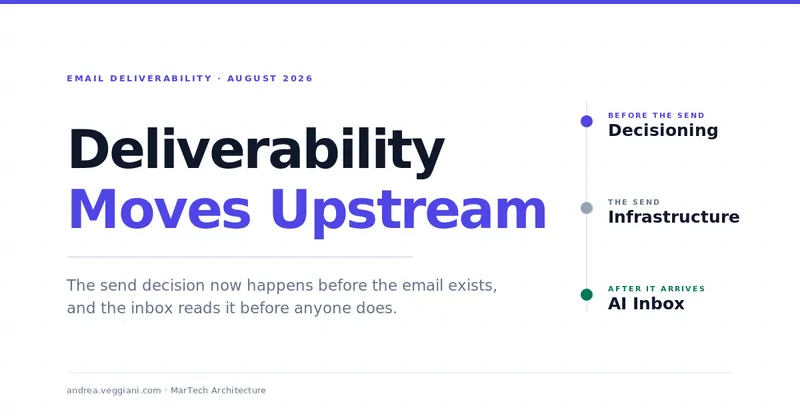
Because what used to be an email platform decision is increasingly becoming an architecture decision. The question behind most RFPs is no longer “which tool sends email?” but “where does email actually live in our stack?”
The MarTech report and its surrounding 2026 coverage identify a set of forces reshaping the email platform market.
Scale and inbox competition. Roughly 4.73 billion email users now generate around 392.5 billion messages per day worldwide, according to the Radicati Group’s Email Statistics Report, 2024–2028 [2][6]. When everyone’s platform can send at scale, scale is no longer a differentiator. What differentiates is signal quality: understanding which customers should receive which message at which moment. The platforms that have built this capability, and the teams that know how to use it, are pulling away from those still operating on batch logic.
AI and automation. The most useful framing here separates three different things in the email workflow: generative AI handles content and variant production; predictive AI handles send-time optimisation, subject line testing, and propensity scoring; and agentic AI, the emerging capability, handles journey logic autonomously, adjusting flows based on engagement signals without manual intervention [7].
The distinction matters because each requires different organisational readiness. Most teams are experimenting with GenAI. Far fewer have the data infrastructure to use predictive models properly. Almost none are operationally ready for genuine agentic email orchestration.
A simple example: an agentic system might pause a win-back email flow when it detects a high-value support ticket opened in the last 24 hours, without anyone explicitly defining that rule. It learns from cross-channel signals and adjusts journeys in real time, rather than waiting for humans to add another decision step.
And this is also why some of the most interesting vendor moves are no longer about email features alone. Insider One’s acquisition of Bluecore, for example, is not just another consolidation story in the email market. It is a signal that retail identity, behavioural data, product signals and autonomous engagement are converging into the same activation layer [13]. In that world, email is one output of a larger decisioning system.
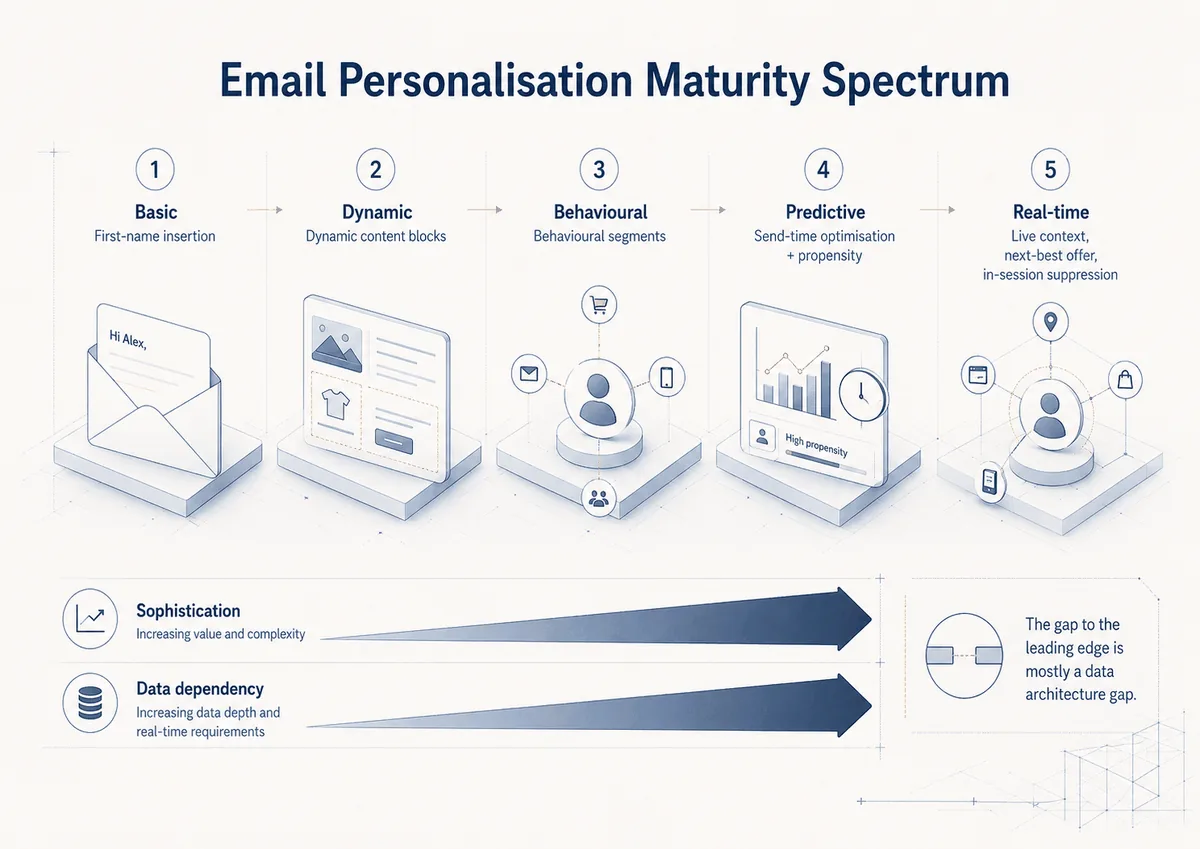
Personalisation and segmentation. Picture a maturity spectrum. At one end: first-name insertion in the subject line. At the other: real-time content assembly based on live customer context, next-best-offer decisioning, and channel-level suppression triggered by in-session behaviour.
Most organisations are somewhere in the middle, using dynamic content blocks, building behavioural segments, running A/B tests. The gap between the middle and the leading edge is widening, and it’s almost entirely a data architecture gap, not a platform gap.
This is where the vendor categories start to blur.
The more mature the programme becomes, the less useful it is to ask whether a platform is “an ESP”, “a CEP”, “a CDP”, or “a commerce personalisation engine”.
Those labels still matter for procurement and analyst reports.
But in the architecture, the more important question is different:
Where does the customer signal become a decision, and where does that decision become an action?
That is why the most interesting vendor comparison is no longer feature-by-feature email capability. It is the architectural role each platform wants to own.
Deliverability, authentication, and compliance. This is the one that deserves more attention than it usually gets.
Ecommerce capabilities and cross-channel integration. Email platforms are no longer standalone tools. The question isn’t “which ESP”, it’s “how does email fit into the orchestration layer?” I’ll come back to this.
On Deliverability: The Strategic Variable Nobody Manages Strategically
Deliverability has always mattered. What’s changed is the complexity and the stakes.
The data shows a striking gap. On one hand, authentication adoption has surged: global DMARC adoption among top domains climbed from 29.1% to 47.7% between 2023 and 2025 (95.8% in the US), per EasyDMARC’s 2025 adoption report [8]. On the other hand, the average inbox placement rate sits at roughly 83%, meaning about one in six marketing emails never reach the intended recipient, and 48% of email marketers say avoiding the spam folder is their single biggest challenge, per Mailgun’s 2025 State of Email Deliverability [2][9].
In other words, organisations are implementing the technical requirements correctly and still ending up in spam folders or failing to reach their intended audiences.
Why?
Because deliverability in 2026 is a reputation signal, and reputation is built on engagement, not just authentication.
If your email programme has a high unsubscribe rate, a low click-to-open rate, frequent spam complaints, or sends to invalid addresses, the mailbox providers know, and they act on it. No amount of DMARC compliance fixes a poor engagement signal. Google’s and Yahoo’s bulk sender requirements from February 2024, tightened again by Gmail in November 2025, made this explicit: authentication is necessary, but it’s the floor, not the ceiling [2].
This has architectural implications.
Deliverability is now a data quality problem.
The programmes with the best deliverability are the ones with the cleanest lists, the most accurate segmentation, and the tightest suppression logic. They’re not sending to everyone who can technically receive. They’re sending to the right people at the right frequency, which requires knowing who those people are and what their engagement history looks like.
That knowledge lives in your data infrastructure.
Which means deliverability is, at root, a CDP and identity resolution problem as much as it’s an email platform problem.
The End of the Standalone ESP
Here’s the shift that, in my view, has the most structural significance for how teams should think about their email investment.
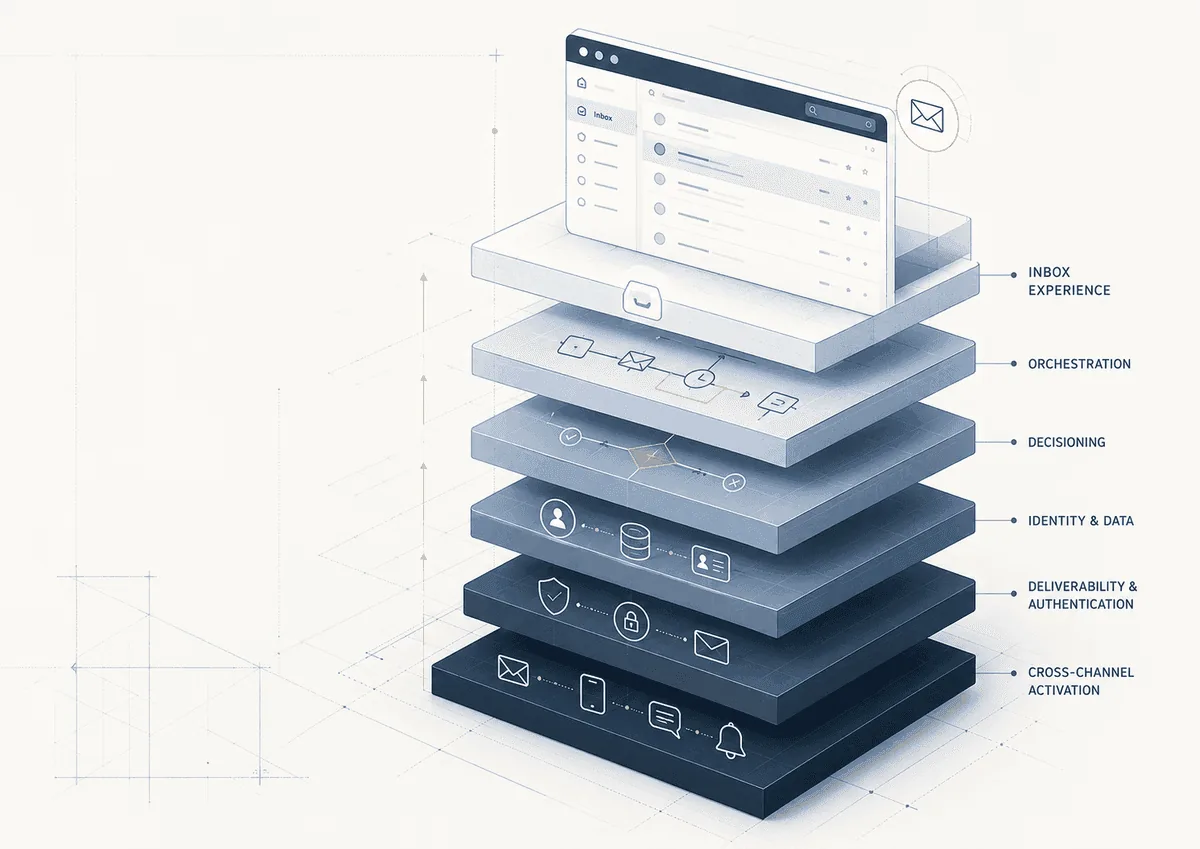
MarTech still classifies these vendors as “email marketing platforms,” but in practice, the most capable platforms in this category are no longer primarily email tools. They’re cross-channel orchestration engines where email is one delivery mechanism among several.
Braze, Adobe Journey Optimizer and Salesforce Marketing Cloud all sit in the Leaders quadrant of Gartner’s 2025 Magic Quadrant for Multichannel Marketing Hubs [10][11][12][16]. That matters because it tells us the category boundary has moved.
But the market is not simply “enterprise suites at the top and everyone else below.”
That would be too simplistic.
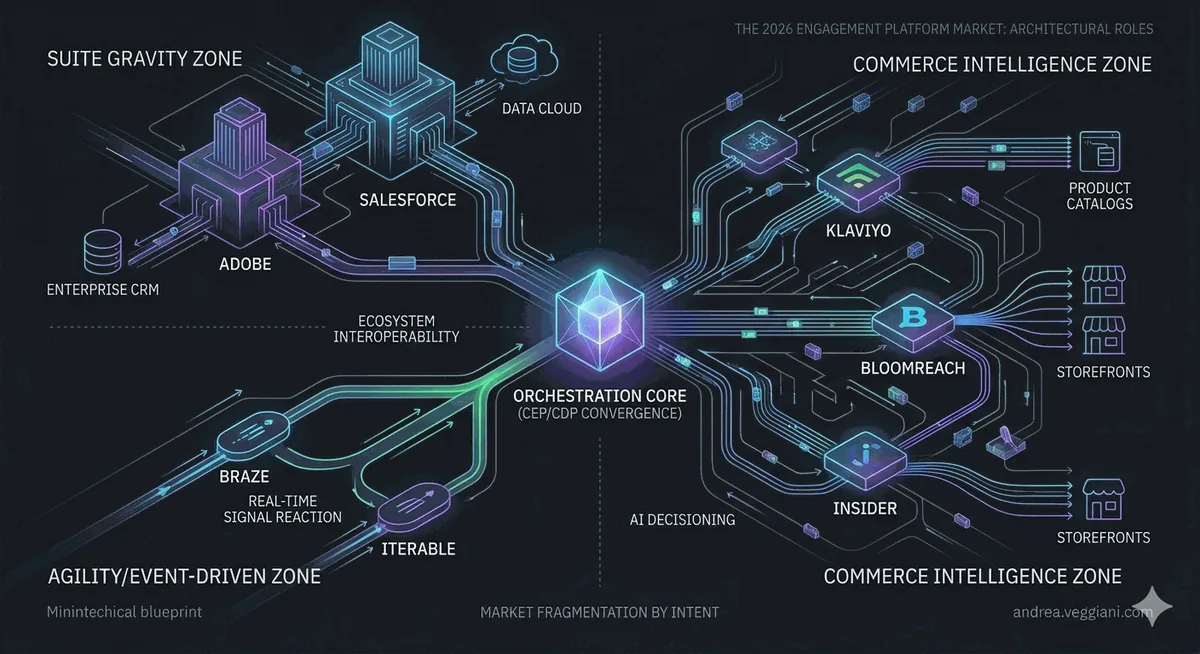
The more useful reading is that the market is fragmenting into architectural roles.
Braze is often described as a customer engagement platform, but its real strength is the way it turns customer events into cross-channel action. It is less useful to read Braze as “an email platform with other channels attached” and more useful to read it as an engagement runtime: event-driven, mobile-strong, channel-native and designed for teams that need to react quickly to customer behaviour.
Adobe Journey Optimizer approaches the same problem from inside Adobe’s broader experience architecture. Its strength is not email in isolation, but the way journeys, decisioning, profiles and offer logic can sit on top of Adobe Experience Platform. It is less useful to read AJO as a classic campaign management tool and more useful to read it as Adobe’s real-time orchestration layer: powerful when the surrounding Adobe data architecture is coherent, but heavily shaped by that suite context.
Salesforce Marketing Cloud comes from a different centre of gravity: CRM. Its strength is not only campaign execution, but the ability to connect marketing activation with sales, service, customer records, Data Cloud and, increasingly, Agentforce. It is less useful to read Salesforce Marketing Cloud as a single email platform and more useful to read it as a family of marketing execution capabilities that becomes strongest when Salesforce is already a core customer operating system.
Around these large orchestration platforms sit tools that approach the engagement problem from different directions.
Iterable sits closer to the lifecycle orchestration layer. Less suite-heavy than Adobe or Salesforce, but more cross-channel and journey-oriented than a classic ESP. Its strength is not that it replaces every enterprise platform category, but that it gives teams a high-velocity system for acting on customer moments.
Bloomreach approaches the same problem from a commerce-intelligence angle, combining customer data, product intelligence, search, web, app and email into a commerce-personalisation engine. It is less useful to read Bloomreach as “an ESP” and more useful to read it as part of the convergence between CDP, commerce intelligence and engagement execution [15].
Insider One belongs in the same blurred category, but with a different emphasis. It is less useful to read it as an ESP and more useful to read it as a customer engagement and experience-optimisation platform: cross-channel journeys, onsite and app personalisation, experimentation, product-triggered activation and, after the Bluecore acquisition, a stronger retail identity and behavioural data layer [13]. In that model, email is one output of a broader decisioning system.
Klaviyo is still often discussed as an email marketing platform, but its real strength is commerce-native lifecycle execution: product events, storefront integrations, behavioural segmentation and fast marketer-controlled flows [14]. It does not need to be read as “less enterprise” in a generic sense. It is better read as optimised for a different operating model: commerce speed, ease of use and marketer autonomy.
None of this makes the email platform less important.
It makes the ownership question more important.
Because these roles are not clean boxes.
Every vendor has its own positioning, heritage and strongest use cases. But in real evaluations, they often compete for the same budget, the same roadmap and sometimes the same operational responsibility.
That is where the work stops being a feature comparison and becomes architecture.
The question is not simply: which platform has email?
At this level of the market, most of them do.
The better question is: which platform should own email in this specific architecture?
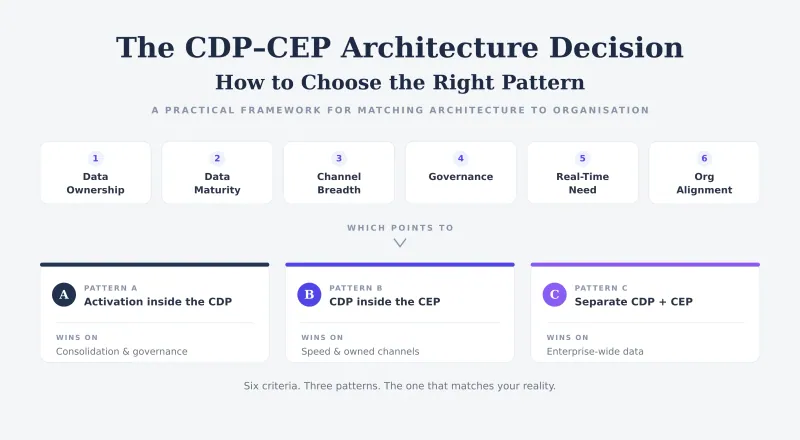
Should email be mainly a commerce-native lifecycle channel? A CRM-connected execution layer? A real-time journey channel inside a broader experience suite? A mobile-first engagement runtime? Or a commerce-intelligence activation surface?
That is the point where platform comparison stops being a feature checklist and becomes architecture work.
And it is also where my work usually starts: understanding the organisation’s data model, channel mix, governance constraints, customer journeys, operational maturity and email-specific requirements — deliverability, personalisation, consent, preference management, template operations, testing, frequency control and measurement — to determine which platform role actually fits.
The 2026 vendor landscape supports this reading. Forrester’s Q1 2026 Email Marketing Service Providers evaluation includes Adobe, Bloomreach, Bluecore, Braze, Cordial, Iterable, Klaviyo, Salesforce, SAP, Zeta and others among the significant providers it assessed [17]. MarTech’s 2026 Email Marketing Platforms guide profiles another mix of vendors, including Adobe, Braze, Klaviyo, Oracle, Salesforce, Twilio and Zeta [2].
The boundaries are no longer clean because the category itself is moving.
Email, CEP, CDP, commerce personalisation, identity resolution, and AI decisioning are starting to overlap.
The implications of this are significant. If you accept that the boundaries are blurring, three practical consequences follow.
First, email platform selection and CEP platform selection are increasingly the same decision. If you’re choosing an email platform that will sit alongside a separate journey orchestration tool, you’re building integration overhead and creating a latency problem.
Platforms with email natively embedded in their orchestration layer are operationally stronger, because a journey step, suppression rule or personalisation decision can apply consistently whether the next message goes via email, push, SMS, WhatsApp, app or web.
Second, the email-specific capabilities that matter most, deliverability management, advanced personalisation, ecommerce integrations, are increasingly table stakes among serious platforms. The differentiation has moved up the stack: into journey logic, AI decisioning and the data layer underneath.
Third, the platform role you need is not a matter of vendor size. It depends on your data complexity, channel mix, segmentation sophistication, governance needs, commerce model, and how much of your programme you want embedded in an owned-channel execution layer versus an orchestration platform that coordinates across all channels.
What 2026 Email Actually Looks Like
The teams running leading-edge email programmes in 2026 share some common characteristics that I’d put less charitably as “things most teams aren’t doing yet”:
They treat the send decision as a real-time query, not a scheduled export. Segment membership is evaluated at send time against a live profile, not a list generated twelve hours ago. A customer who purchased ten minutes before the campaign batch runs is excluded, not because someone built a suppression rule that caught it, but because the profile is current.
They have a channel preference and fatigue model. Not a static cap (“no more than three emails per week”) but a dynamic model that accounts for engagement decay, channel response rates by segment, and the cost of over-messaging versus the cost of silence. The model is explicit, documented, and enforced by the platform — not managed manually.
Deliverability is owned. Someone is accountable for inbox placement rates, sender reputation scores and list hygiene. This is a discipline, not a task. It’s connected to the data infrastructure team, not siloed inside the email tool.
AI is being used where it adds value, not everywhere. Send-time optimisation: yes, measurably effective. Subject line generation for variant testing: yes, useful when governed properly. Fully autonomous agentic journey logic: not yet, at least not for most organisations, because the data foundation is not mature enough to trust it.
The platform boundary is explicit. This is the part I would always look for in a real architecture review. Where does identity live? Where does consent live? Where does product data live? Where is fatigue calculated? Where is decisioning executed? Where is the message assembled? Where is the final send decision made?
If those answers are not explicit, the platform selection discussion is premature.
The Question I’d Ask
If I were auditing an email programme today, I’d ask one question before looking at the platform:
What does your system know about a customer, and how current is that knowledge when the send decision is made?
If the answer is “we export a segment from the CRM every morning,” the platform doesn’t matter yet.
If the answer is closer to “we evaluate live events against a unified profile at decision time, across email, push and onsite,” then the platform choice becomes a genuine leverage point.
The architectural work comes first.
Email isn’t dead. But the programmes treating it as a batch-and-blast channel are dying slowly, and they’ll blame the channel for what is actually an architectural failure.
The inbox is still there.
The question is whether you’re sending something worth receiving.
Sources
Cited sources
- [1] Fortune Business Insights, Email Marketing Software Market Size, Share & Growth Report, 2034.
- [2] MarTech (Third Door Media), Pamela Parker, Why email is now identity and deliverability infrastructure, 19 March 2026. Companion analysis to the 2026 MarTech Intelligence Report on Email Marketing Platforms.
- [3] UK Data & Marketing Association, Marketer Email Tracker 2025. ROI of email at about £38 per £1 spent, up from about £30 five years prior. The DMA has since withdrawn the page for this edition, so the citation is left unlinked.
- [4] Litmus, State of Email Reports 2025-2026.
- [5] Adobe, Press release on the Neolane acquisition, 27 June 2013.
- [6] Radicati Group, Email Statistics Report, 2024-2028.
- [7] Adobe Experience League, Agentic marketing: intelligent personalization with AI-led CX; Braze, Real-World Agentic AI Examples in Marketing; Bloomreach, How AI Is Transforming Marketing Workflows. The three-way split between generative, predictive and agentic AI is now broadly aligned across these vendor perspectives.
- [8] EasyDMARC, Global DMARC Adoption Report 2025. Global adoption among top domains grew from 29.1% in 2023 to 47.7% in 2025; US adoption at 95.8%.
- [9] Mailgun (Sinch), 2025 State of Email Deliverability. 48% of senders cite avoiding the spam folder as their biggest challenge.
- [10] Gartner, 2025 Magic Quadrant for Multichannel Marketing Hubs. Original document, paywalled.
- [11] Braze, Named a Leader in the 2025 Gartner Magic Quadrant for Multichannel Marketing Hubs.
- [12] Adobe, Adobe recognized by Gartner for Multichannel Marketing Hubs, 2025.
- [13] Bluecore, Insider One Acquires Bluecore, 13 May 2026.
- [14] Klaviyo, Best Email Marketing Platforms.
- [15] Bloomreach, Gartner Magic Quadrant for Multichannel Marketing Hubs, 2025.
- [16] Salesforce, 2025 Gartner Magic Quadrant for Multichannel Marketing Hubs.
- [17] Forrester, Email Service Providers Use AI To Inspire An Email Functionality Leap, covering the Q1 2026 Email Marketing Service Providers evaluation.