8 min read
Why this series exists
Most platform conversations still sound like a feature tour.
“Does it do email?”
“Does it do journeys?”
“Does it have AI?”
Those questions aren’t wrong, just incomplete.
Because in the real world, platforms don’t succeed or fail on feature checklists. They succeed or fail on something far less glamorous:
the operating system you build around them: identity, consent, governance, semantics, and the discipline to run engagement as a repeatable system.
I’ve seen the same movie many times.
A company buys a powerful platform, runs a handful of campaigns, and for a while, everything looks great. Then growth arrives: more products, more regions, more teams, more channels, more “urgent” requests. Suddenly, the platform isn’t a tool anymore.
It’s a battleground.
This series is my attempt to write about these platforms the way they’re actually used in enterprise and upper‑midmarket programs: as systems of action, not as product brochures.
Expect opinions. But practitioner opinions: delivery scars, architecture patterns, and lessons you only learn when a “simple nurture” becomes 300 workflows across 12 teams.
I’m also writing this as a way to make one point gently, but repeatedly:
In customer engagement, your constraints are the strategy.
If you don’t define constraints (who you can message, when, why, and with what rules), the platform will happily let you build chaos at scale.
Why I’m calling them CEPs
I’m using CEP (Customer Engagement Platform) as a practical umbrella term.
Not because MarTech taxonomy is ever perfect (it isn’t), but because the buyer’s need is converging.
A CEP, in my working definition, is a system that:
- listens to customer signals (events, attributes, context)
- decides what should happen (rules, policies, models)
- orchestrates experiences across channels (journeys, triggers, offers)
- measures outcomes and feeds learning back into the loop
Different vendors label themselves differently: cross‑channel marketing hub, customer communication platform, marketing automation, growth platform, journey orchestration.
In practice, the intent is the same:
“Take my customer truth and turn it into coordinated, measurable engagement.”
That’s what this series is really about.
And when I say “customer truth,” I’m not only talking about “data.”
I’m talking about meaning.
A purchase event isn’t useful unless everyone agrees on what “purchase” means.
A consent flag isn’t useful unless everyone agrees on which systems enforce it.
A “high intent” segment isn’t useful unless everyone agrees which behaviors qualify as intent, and which are just curiosity.
CEPs turn meaning into action.
Two clarifications (so we don’t get stuck on labels)
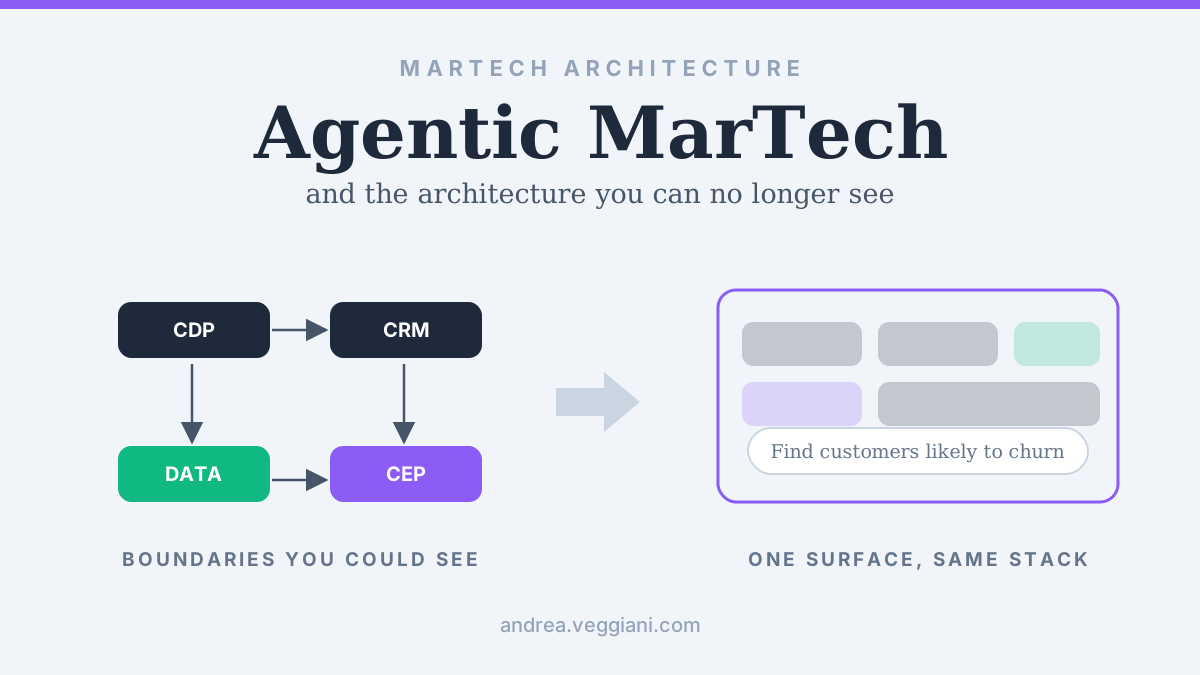
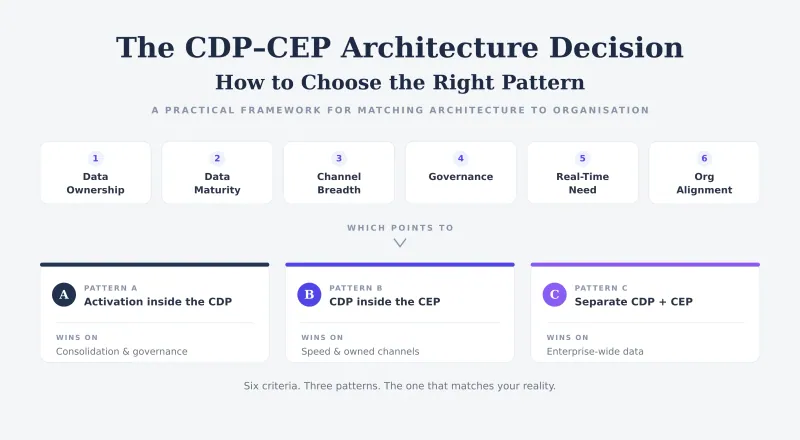
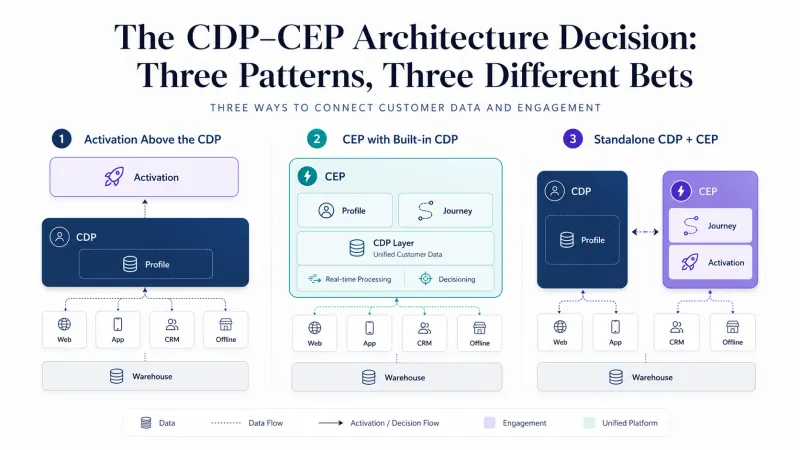
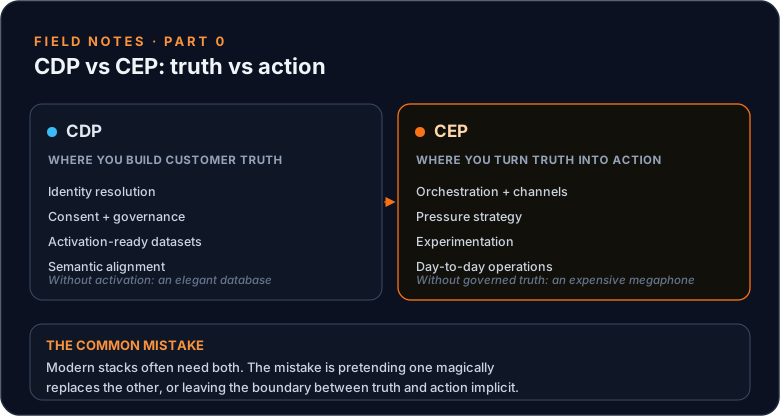
CEP is not the same thing as CDP
A CDP is usually where you build and govern customer truth: identity resolution, consent, activation‑ready datasets.
A CEP is usually where you turn that truth into action: orchestration, channel execution, pressure strategy, experimentation and day‑to‑day operations.
Modern stacks often need both.
The common mistake is pretending one magically replaces the other.
A CDP without activation becomes an elegant database.
A CEP without governed truth becomes a very expensive megaphone.
“All‑in‑one” vs “best‑of‑breed” is an operating model choice
Some organizations want suite gravity: fewer vendors, one procurement narrative, a single governance model.
Others want composability: faster channel innovation, specialized capabilities, and the freedom to swap components.
Both approaches can work. Both can fail.
The problem is not the philosophy.
The problem is when the philosophy is implicit.
When you don’t decide it, you end up with something like this:
- the CRM team thinks the CRM is the source of truth
- the data team thinks the warehouse is the source of truth
- marketing thinks the CEP is the source of truth
- compliance thinks nothing is the source of truth
And across this whole series, I’ll keep coming back to one question:
What system are we actually building, and who owns it?
The things you’ll see me obsess over (because they decide whether the platform works)
To keep this series honest, I’m going to talk about the boring parts.
The parts that decide success.
Semantics
Not “data quality” in the abstract. Semantics.
Do we all agree on what a customer is?
What’s a lead vs a contact vs an account?
What does “active” mean?
What does “high intent” mean?
CEPs don’t fix semantics. They amplify them.
Consent and suppression
Consent isn’t a checkbox. It’s a system.
Where does it live? How is it enforced? What happens when systems disagree?
If consent enforcement is ambiguous, your engagement strategy becomes a legal risk.
Pressure strategy
This is the CEO‑friendly way to say: “How do we avoid annoying customers while still hitting targets?”
Who gets what, how often, and why?
If your pressure strategy is “we’ll figure it out later,” later will be painful.
Experimentation discipline
Most engagement programs are optimized for correlation (opens, clicks).
The mature ones are optimized on impact (incrementality).
That requires holdouts, measurement discipline, and a willingness to learn things you may not like.
Governance that doesn’t kill speed
Governance is not the opposite of agility.
Good governance is what allows you to move fast safely.
You’ll see this theme repeated across every vendor:
speed is easy; scaled speed is hard.
How each article is structured
To make comparisons useful, every vendor‑specific piece follows the same spine. I’ll keep it consistent so you can skim sections across vendors.
You’ll always find:
- how the vendor got here (history + evolution)
- where it’s positioned today (what it’s optimized for)
- scale signals (public financials or credible milestones)
- who it really competes with in real programs
- where it fits in a modern architecture
- operating model implications (governance, lifecycle discipline, pressure strategy)
- the AI direction (what’s operational vs what’s theater)
- watch‑outs (how it hurts when misused)
Think of it as a field manual: less “wow demo,” more “how does this behave at scale?”
And yes, I will talk about tradeoffs.
Every platform is a set of tradeoffs.
The only unacceptable tradeoff is the one you discover after go‑live.
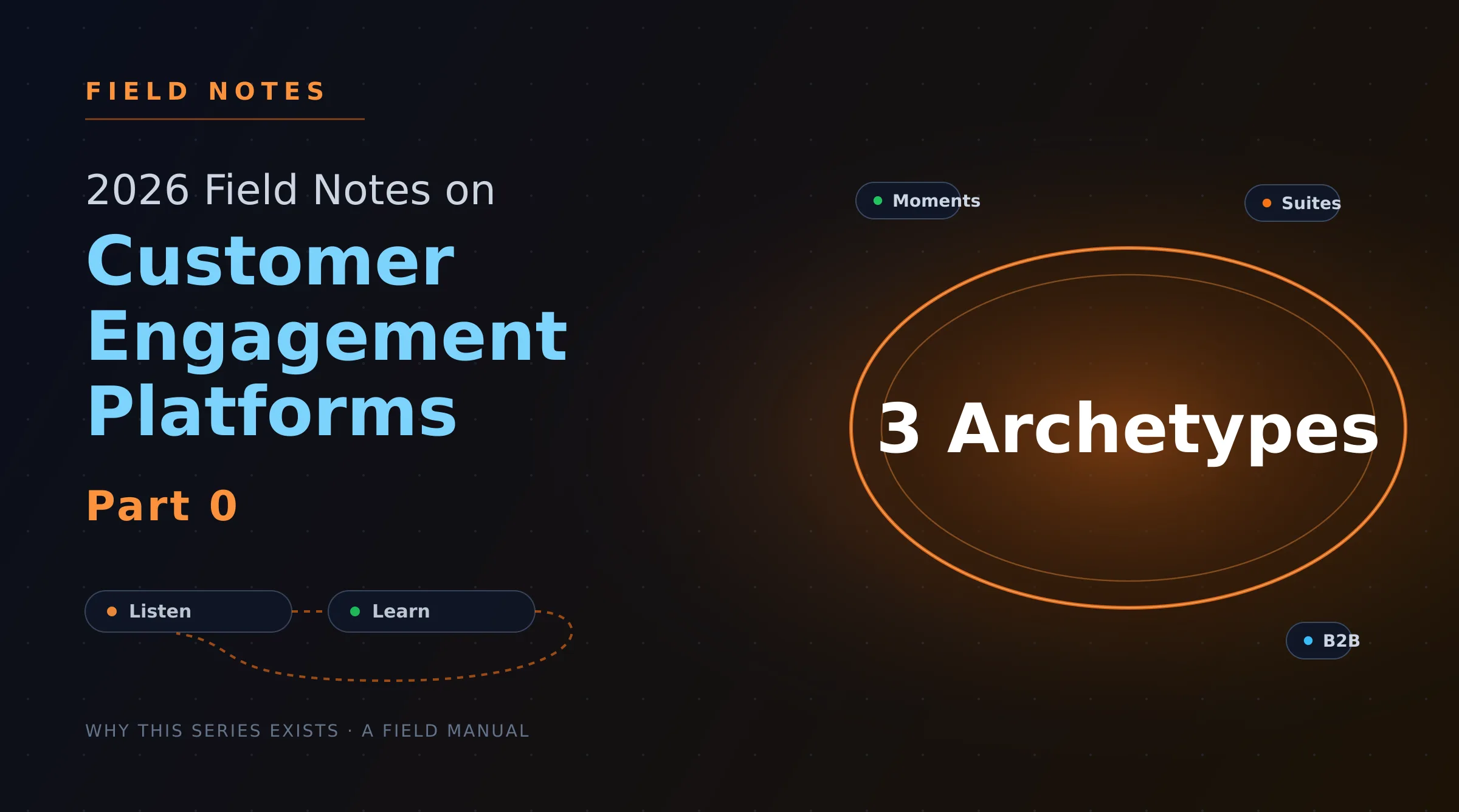
Eleven platforms, three archetypes
I selected these platforms based on my hands-on experience; grouped into three archetypes, they represent the most common patterns I see in the field.
The moment engines (fast activation, cross-channel orchestration)
These platforms are optimized for turning real-time intent into engagement with high marketer velocity.
In this series you’ll find Bloomreach, Braze, Insider, Iterable, MoEngage, and Klaviyo as clear examples.
The recurring risk in this category is simple: velocity without governance becomes journey sprawl.
And journey sprawl is not just messy.
It’s how you end up messaging the same customer from five different “best ideas” in the same week.
The suite-native orchestrators (enterprise gravity, governance, ecosystem)
Adobe Journey Optimizer and Salesforce Marketing sit here.
These platforms are strongest when engagement is part of a broader enterprise architecture: data, governance, analytics, identity.
Suite value appears when you embrace the architecture.
Partial adoption can create dependency friction, especially if “truth” and “action” aren’t clearly bounded.
In other words: you don’t buy a suite for a feature.
You buy it for an operating model.
The B2B revenue automation layer (lead-to-revenue discipline)
B2B requires a different lens: lifecycle semantics, scoring, routing, SLA enforcement, and CRM truth.
HubSpot, Adobe Marketo Engage, and Salesforce Marketing Cloud Account Engagement live in this part of the market.
These platforms don’t forgive fuzzy definitions.
Without RevOps discipline, they don’t automate revenue. They automate chaos.
And when they automate chaos, the symptoms look familiar:
- a flood of “leads” nobody follows up
- sales distrust of scoring
- marketing celebrating volume while pipeline quality declines
A simple way to position them (without pretending it’s a ranking)
I don’t use feature matrices as my first tool. I use a map.
The first axis is suite gravity vs best‑of‑breed activation.
Adobe and Salesforce sit closer to suite gravity.
Braze, Iterable, and Insider sit closer to best‑of‑breed activation.
HubSpot, Marketo, and Bloomreach often behave like bridges: strong platforms in their lane, frequently integrated into broader stacks.
The second axis is B2C moments vs B2B revenue process.
Braze / Iterable / Insider (and often Bloomreach in commerce) skew toward B2C/product/lifecycle moments.
HubSpot / Marketo / Account Engagement skew toward B2B lead‑to‑revenue.
Adobe AJO and Salesforce can support both, but the design choices matter a lot.
The point of this map is not to “rank vendors.”
It’s to prevent the most common failure mode:
buying a platform optimized for one motion, then forcing it into another.
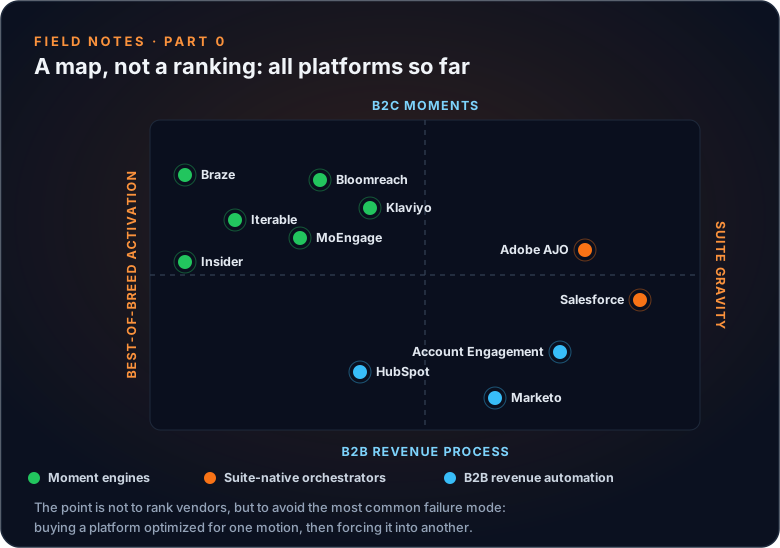
If you do that, you can still succeed, but you’ll pay for it in custom workarounds, governance debt, and endless alignment meetings.
The practical conclusion up front
A CEP is rarely the answer by itself.
It’s usually the execution layer of a broader engagement system.
And the real differentiators, regardless of vendor, are still the same:
- event semantics (what does “intent” mean in your business?)
- identity and consent enforcement
- pressure strategy (who gets what, how often, and why)
- experimentation discipline (holdouts, incrementality, learning loops)
- governance (who can ship what, and how you keep it coherent)
Platforms matter.
But your operating model matters more.
And to be clear: “operating model” doesn’t mean bureaucracy.
It means deciding who owns what, what rules are non-negotiable, and how you keep engagement coherent while the business changes.
How to use this series
If you’re in a platform evaluation cycle, treat the “questions I ask early” sections as discovery checklists.
If you’re already implemented, use the watch‑outs as a reality check.
And if you’re building a multi‑platform architecture, focus on boundaries: system of record, system of truth, system of action.
One practical tip: while reading, ask yourself whether a vendor is trying to be truth, action, or both.
Neither is automatically better.
But mixing them accidentally is one of the fastest ways to build an engagement stack nobody understands.
What’s next
Part 1 starts with Braze, because it’s one of the clearest examples of the “moment engine” archetype, and because it forces the most important CEP discipline early:
You can’t scale speed without governance.
Sources
For broader market framing, and not vendor marketing pages, these are good starting points:
Gartner
- Peer Insights, Multichannel Marketing Hubs. A useful voice-of-customer lens on the category.