9 min read
Why this series exists (and why I’m starting with Braze)
The CEP market is entering its most interesting phase.
Not because we got another “journey builder.” But because the whole category is shifting from campaign automation to continuous, real-time decisioning.
In plain terms: the old model assumed you could plan, segment, schedule, and measure in relatively stable cycles. The new model assumes customers behave like streams always moving, always signaling and always switching context.
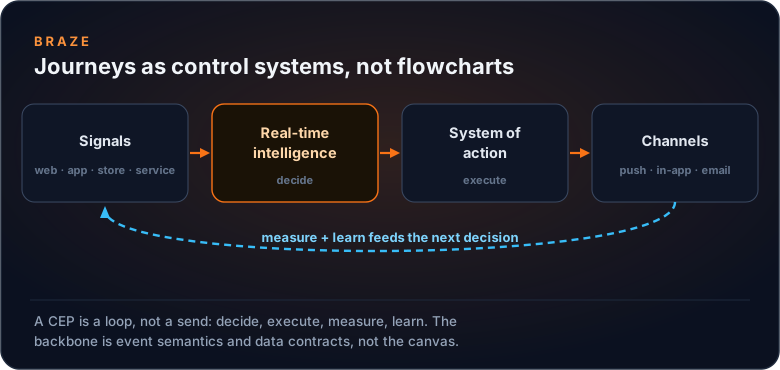
That forces a new baseline. Signals now arrive as continuous streams from web, app, store and service; the business needs both a real-time system of intelligence to decide and a real-time system of action to execute; and personalization is being redefined as optimization at the individual level rather than as templating.
And in 2025–2026, one more thing is becoming unavoidable: the shift from “journeys as flowcharts” to “journeys as control systems.” The platform that wins isn’t the one that draws the nicest canvas; it’s the one that can continuously decide and improve, safely.
So I’m starting a practical series: one platform per article, grounded in what happens when you actually deliver and operate CEPs in enterprise contexts.
The promise of this series
I’m not aiming to write a vendor brochure, nor a generic “feature comparison.” The goal is to capture the stuff you only learn when you:
- integrate the platform into real data ecosystems
- run it with real operating models (agile, approval-heavy, federated, multi-brand)
- face the messy realities (identity fragmentation, consent, conflicting triggers, channel constraints)
My lens will stay consistent across vendors:
- Architecture & data flow (identity, latency, eventing, contracts)
- Orchestration depth (state, triggers, conflict resolution, governance)
- Channel execution (especially mobile + owned channels)
- Experimentation & optimization (at scale, with guardrails)
- AI (decisioning + optimization, not only copy)
Part 1 is Braze because, in many programs I’ve seen, it’s the closest thing to a “high-velocity engagement engine” when mobile is strategic and time-to-value matters.
A quick note on what I mean by “CEP”
I set out the full working definition in Part 0, so here I will keep it short. A Customer Engagement Platform, in my usage, is not an ESP with more channels. It is a system of action that listens to customer signals, evaluates decision logic, orchestrates timing and messaging across channels, and feeds outcomes back into the next decision. The key difference is the loop: if a platform is only good at sending, you are doing multichannel publishing, and if it is good at deciding, sending and learning, you are doing engagement. That loop is the lens I carry into Braze.
Braze in one sentence
Braze is a customer engagement platform with a strong mobile-first DNA, now accelerating its evolution toward agentic / decisioning-driven orchestration as the market moves from “journeys” to “always-on optimization loops.”
Its physics: event-driven. Every platform in this series has a centre of gravity that predicts how it behaves under load, and I map all eight against each other in Part 9. Braze’s is event-driven: it reacts to streams of behaviour and treats engagement as a product runtime rather than a campaign calendar.
A brief history: from Appboy to Braze (and why that still matters)
Braze was founded in 2011, originally under the name Appboy, with an early conviction that mobile adoption would change how brands build customer relationships.
In September 2017, Appboy announced the plan to rename to Braze (a brand statement about bonding/unifying). The rename became official in November 2017.
Why this matters is that platforms tend to keep their original physics, and almost everything that follows about Braze traces back to that event-driven origin.
That tends to show up as strengths in:
- SDK + event capture mindset
- Speed and operational cadence
- Mobile channel excellence (push / in-app patterns)
And it also shapes the trade-offs you must design around when you integrate it into broader enterprise stacks.
If you come from suite-heavy environments, this difference is noticeable: Braze often feels engineered for teams who ship frequently and optimize continuously, rather than for teams who run quarterly “big launches.”
How Braze is positioned today
In the CEP market, Braze is typically positioned among the independent CEP / multichannel engagement vendors: it competes with suites, but often gets adopted because it can deliver execution velocity, especially in digital-first contexts.
Braze also highlights that it has been named a Leader in the 2025 Gartner® Magic Quadrant™ for Multichannel Marketing Hubs. I note that as a signal rather than a verdict, since a single Magic Quadrant placement reflects an analyst read of vision and execution more than how the platform behaves in your own delivery.
When Braze tends to win (from a practitioner perspective)
From a practitioner’s point of view, I see Braze winning (or sticking) when:
- Mobile apps are core to the business (not an “extra channel”)
- Teams need fast iteration cycles (test → learn → ship)
- Real-time triggers must be more than marketing language (low tolerance for “latency debt”)
- The business values operational autonomy (product + marketing + CRM teams shipping improvements weekly)
- Data Gravity sits in the Warehouse: Organizations leveraging Snowflake, BigQuery, or Databricks find Braze’s “Cloud Data Sharing” minimizes the latency usually found in legacy sync-heavy suites.
In other words, Braze often fits best when the organization wants engagement to behave like a product, continuously improved, measured, and refined.
When Braze can struggle (or at least require a clearer design)
And it tends to struggle when:
- The buyer expects the CEP to also be the enterprise data foundation (MDM/complex identity governance as primary mission)
- The operating model is heavily centralized, slow-moving, and release-heavy
- Stakeholders underestimate how much success depends on event semantics and data contracts
In those environments, Braze can still work, but it needs a more explicit architecture: who owns identity, who owns consent, who owns “truth,” and what Braze should (and should not) be responsible for.
The Braze mental model (how I explain it internally)
A useful way to think about Braze is as a high-performance engagement runtime. Where legacy suites are built to be a library of records, Braze is the engine of action: it does not just store intent, it resolves it. It thrives when you feed it clean, meaningful signals, and it delivers its value when you design journeys as a decision system rather than only a sequence.
This is why “event design” is not a technical detail. It’s the backbone of how your organization expresses customer reality.
If your event taxonomy is ambiguous (“click”, “click2”, “click_final”), your personalization will always be fragile.
If your events encode intent and context (what happened, why it matters, what state the customer is in), your engagement system becomes stable and scalable.
Recent financial results (and what they suggest)
On Dec 9, 2025, Braze reported results for its fiscal third quarter 2026 (quarter ended Oct 31, 2025):
- Revenue: $190.8M (+25.5% YoY)
- Total customers: 2,528
- Customers with ARR ≥ $500k: 303
- Non-GAAP operating income: $5.1M (improved vs. the prior-year quarter)
I don’t read these as “finance trivia.” In the CEP category they typically indicate:
- Braze is still growing meaningfully, but the story increasingly includes operating leverage.
- The platform is expanding within larger customers (ARR ≥ $500k cohort growth is a key adoption signal).
And from a buyer perspective, these dynamics often correlate with something practical: vendors in this stage typically invest heavily in enterprise features (security, governance, scale), while maintaining product velocity.
Update, as of July 2026: Braze has reported two quarters since this article first published. Full-year fiscal 2026 (ended January 31, 2026) closed at 24% revenue growth, and first-quarter fiscal 2027 (ended April 30, 2026) revenue reached $211.0M, up 30.2% year over year, with dollar-based net retention at 110%. The read does not change, it sharpens: the growth story now pairs accelerating organic revenue with the operating-leverage improvement I flagged above.
The OfferFit move: why it’s strategically loud
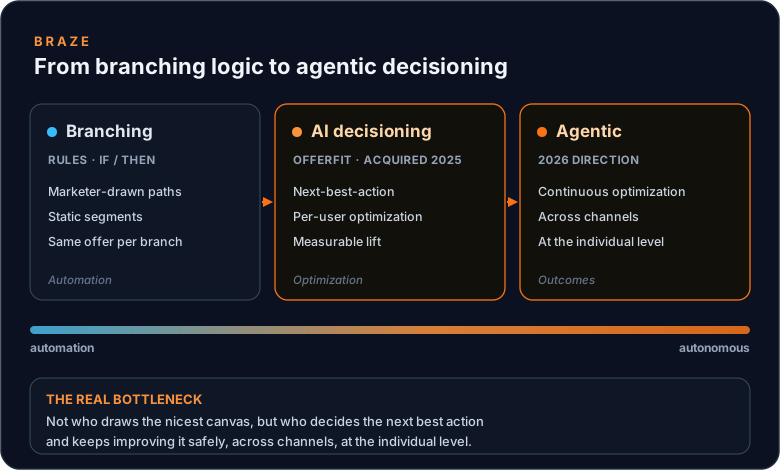
By now, the 2025 acquisition of OfferFit has moved past the ‘integration phase.’ It was the loud signal that Braze was moving beyond simple branching logic. In 2026, we are seeing this manifest as AI decisioning and Agentic AI.
My take is that this is a clear bet on where CEP competition is heading: not toward whoever draws the prettiest journey canvas, but toward whoever can decide the next best action and continuously optimize it across channels, at the individual level, with measurable lift.
Why I care about this (beyond the press release)
Most enterprise organizations are already good at producing messages.
The bottleneck is:
- deciding which message is worth sending
- deciding when it should be suppressed
- deciding how to resolve conflicts when multiple triggers fire
- and improving those decisions without creating chaos
A decisioning/optimization layer is what separates “automation” from “outcomes.” And it’s where the next wave of CEP differentiation will happen. When I weigh any of these decisioning or agentic claims, Braze’s included, I use the same test across the series, set out in How I judge any agentic marketing claim.
Competitive set (how it shows up in real programs)
Instead of a flat list, here’s the competitive set in the way it usually manifests during enterprise evaluations.
1) Suite-led ecosystems (portfolio gravity)
- Adobe / Salesforce / Oracle-type stacks (broad experience clouds)
They often win when the enterprise optimizes for:
- Strategic consolidation
- End-to-end governance
- Platform standardization (even at the cost of slower time-to-value)
In these programs, the CEP is often part of a bigger bet: standardized identity, standardized decisioning, standardized content workflows, standardized measurement.
2) Independent CEPs (execution velocity)
- Braze and its peer set (often evaluated against vendors like Bloomreach, Iterable, Insider etc.)
They often win when the enterprise optimizes for:
- Speed and iteration
- Mobile-driven orchestration
- Fast activation and testing
This is often where “business impact in 90 days” is plausible, especially if the data basics are already in place.
3) “Composable CEP” (build-your-own)
Some organizations attempt to assemble CEP capabilities via:
- event streaming + data platform + experimentation + channel APIs
It can work, until orchestration ownership, governance, and operational reliability become the real bottlenecks.
Composable approaches shine when a company has strong engineering maturity and clear platform ownership. They fail when the organization tries to “DIY” governance and ends up rebuilding the same hard problems (identity, consent, frequency management, conflict resolution) repeatedly.
Where Braze is strongest (my delivery-centric view)
If I had to summarize Braze’s most practical advantages in enterprise delivery:
- Event-driven execution mindset (fits modern digital behavior patterns)
- Mobile-first roots that still show in channel depth and operational patterns
- A strategic push toward decisioning & optimization (OfferFit is a meaningful signal)
- Operational cadence that aligns well with cross-functional teams that ship frequently
The questions I like to ask early in a Braze evaluation
To avoid “demo happiness” and get to architectural truth, I usually ask:
- What is the system of record for customer identity, and what is the system of action?
- How do we enforce consent and policy consistently across channels?
- How do we manage conflicts (multiple triggers, multiple journeys, competing goals)?
- What is our frequency strategy and how do we operationalize it?
- Who owns the event taxonomy, and how do we keep it stable over time?
These answers matter more than “does the tool have feature X?”
Watch-outs I put in writing
And the watch-outs I put early in any Braze evaluation:
- Don’t confuse system of action (CEP) with system of record (data foundation). Decide which is which.
- Be explicit about the operating model (centralized vs federated, multi-brand/multi-country, approval gates).
- Invest early in data contracts (events, identities, semantics), this is where most long-term value is won or lost.
- Treat “real-time” as a measurable property (latency, freshness, retry behavior), not as a slogan.
What’s next
Part 2 turns to Bloomreach, the commerce-first mirror image of Braze.
Sources
Braze
- Company and history
- The Appboy to Braze rename, official story and dates
- Completion of the OfferFit acquisition, 2 June 2025.
- Landing page for the 2025 Gartner MQ for MMH. Vendor-hosted access; Gartner content is typically gated.
Investor releases and filings
- Fiscal Q3 2026 results, reported 9 December 2025.
- Agreement to acquire OfferFit for $325M
- IPO closing, 19 November 2021.
- Fiscal year and fourth quarter 2026 results, and Q1 FY2027 acceleration, Business Wire, 2026.
- SEC exhibit, OfferFit acquisition press release as filed
Press coverage
- PRNewswire, Appboy announces rename to Braze, 19 September 2017.
Analysts
- Gartner, Multichannel Marketing Hubs, market definition and reviews
- Forrester, The Forrester Wave: Cross-Channel Marketing Hubs, Q4 2024. Typically gated.