9 min read
When the Architecture Speaks: Four Signals That Tell You Where the Stack Is Going
There is a question I return to every time a major platform acquisition happens in this space: what did the acquirer actually buy?
Not the press release version. The real answer.
Because in most cases, the real answer tells you more about where the category is heading than anything the vendor will say at its next conference.
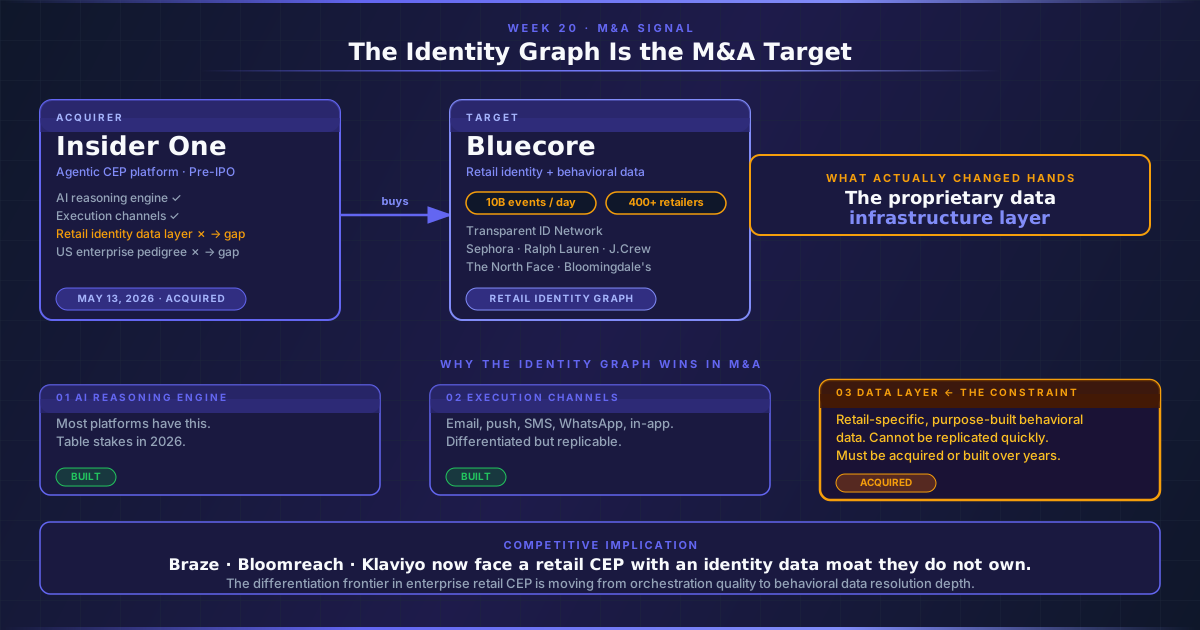
This week, Insider One acquired Bluecore. The simple answer is that it bought a retail martech company with a strong US enterprise customer base. The architectural answer is more interesting: it bought a proprietary retail identity and behavioral data layer.
Bluecore’s Transparent ID Network processes more than 10 billion daily shopper events and feeds machine learning models built specifically for retail and commerce. It also brings more than 400 US enterprise retail customers, including Sephora, Ralph Lauren, J.Crew, The North Face, Bloomingdale’s, ALO Yoga, QVC and Michael Kors.
That is what changed hands.
Not only a product. Not only a channel. A data infrastructure layer with enterprise retail distribution.
That framing matters for how I read everything else this week.
1. The Identity Graph as M&A Target
Insider One acquired Bluecore in May, adding retail identity infrastructure and a deeper US enterprise retail footprint.
In this cases, the acquirer is an AI-forward platform moving closer to execution and the missing piece was not another campaign feature. It was infrastructure.
This is the architecture of agentic marketing becoming visible through deal flow.
An agentic customer engagement platform, one that genuinely decides, acts and optimizes with less constant human intervention, needs three things: the AI reasoning layer, the execution channels, and the data layer to act on.
Most platforms have been investing heavily in the first two.
The constraint is increasingly the third.
General-purpose CRM data, third-party enrichment and basic behavioral event streams are not always enough for real-time, individual-level decisioning. At enterprise scale, and especially in retail, the quality of the decision depends on the quality of the identity and behavioral substrate underneath it.
Bluecore’s Transparent ID Network is interesting precisely because it is not a generic profile store. It is a retail-specific identification and behavioral data layer, processing more than 10 billion daily shopper events and feeding ML models purpose-built for retail and commerce.
For Insider One, acquiring Bluecore means acquiring a stronger data substrate for the autonomous customer engagement story, especially in the US retail enterprise market.
Hande Cilingir, Insider One’s CEO, made the logic explicit:
“Our platform doesn’t layer AI onto marketing – it is the execution layer. Decision ownership has shifted from humans to intelligent systems that think, decide, and act in real time. With the acquisition of Bluecore, we further strengthen our data infrastructure edge to make autonomous customer engagement possible at enterprise scale.”
The IPO context adds a dimension worth noting. Bloomberg reported that the acquisition expands Insider One’s US reach ahead of a planned public offering. Bluecore’s client base is therefore not only a commercial asset. It also strengthens the enterprise US retail narrative for a company that has historically had strong global momentum outside North America.
For the competitive landscape, the implication is not that Insider One has automatically “won” enterprise retail CEP. That would be too strong.
The implication is more specific: Insider One now owns a retail-specific identity and behavioral data asset that many engagement platforms would normally need to build, partner for, or approximate through customer-owned data infrastructure.
That is an important shift.
The differentiation frontier in enterprise retail CEP is moving beyond orchestration quality. It is moving toward behavioral data resolution depth, and toward who controls the data substrate that autonomous decisions are made on.
2. Klaviyo’s Platform Statement
I have described Klaviyo as an ESP in these digests out of habit, and because that is still the category label many practitioners reach for in competitive evaluations.
After reviewing the full Spring 2026 What’s New release, I think that label is now too small.
Klaviyo is building a B2C CRM.
The distinction is not semantic.
The Spring 2026 release tells a coherent story across service, marketing, data and on-site experience.
The most architecturally significant move from Klaviyo this week was not in the Spring 2026 feature release. It was the May 7 announcement of an expanded integration with Anthropic. The updated Klaviyo MCP Connector gives Claude access to campaign data, flow performance, customer profiles, metric reporting and other lifecycle signals. Klaviyo’s own framing is important: Claude is not only a conversational reporting surface; in Cowork-style workflows, it can move from insight to briefs, audits and campaign-ready assets.
That is a different product philosophy from what we historically meant by ESP.
Customer Agent now runs across email and WhatsApp, with the same brand voice, customer context and handoff logic. Agent guidance gives teams more explicit control over tone, conversational rules and escalation criteria. Instagram social auto-replies convert follower engagement into email, SMS or WhatsApp subscribers. Personalized Send Time applies AI-based timing at the individual recipient level. Audience optimization removes profiles likely to unsubscribe before send time. Multi-email profile support allows up to five email addresses on a single profile while preserving consent, suppression, properties and activity history. Customer Hub is extending to WooCommerce, removing the Shopify-only constraint.
Acquisition through Instagram opt-ins. Engagement through richer mobile messaging and personalized send timing. Service through Customer Agent. Data management through multi-email profiles and audience optimization. On-site experience through Customer Hub. AI execution through MCP-based integration with Claude.
An ESP competes on deliverability, templates and flow automation.
A B2C CRM competes on the depth of its customer relationship layer and the AI infrastructure that activates it.
Klaviyo is clearly positioning itself in the second category. The market comparison framework should follow.
3. AI Reads Your Email Before Your Customer Does
HubSpot’s Email Quality Checks, reported in the week of May 11 and currently described as a private beta in multiple HubSpot-community posts and partner recaps, include a capability that caught my attention: the email editor can show how AI inbox assistants may summarize the email before the recipient opens it.
I want to be careful with the source quality here.
I could not find a public official HubSpot documentation page that fully describes this capability at the time of writing. The signal appears in HubSpot partner recaps and in public LinkedIn posts referencing a HubSpot Product Update from May 5. That is enough for me to treat it as a signal worth tracking, but I would not treat it as fully documented GA functionality yet.
Still, the idea is architecturally significant.
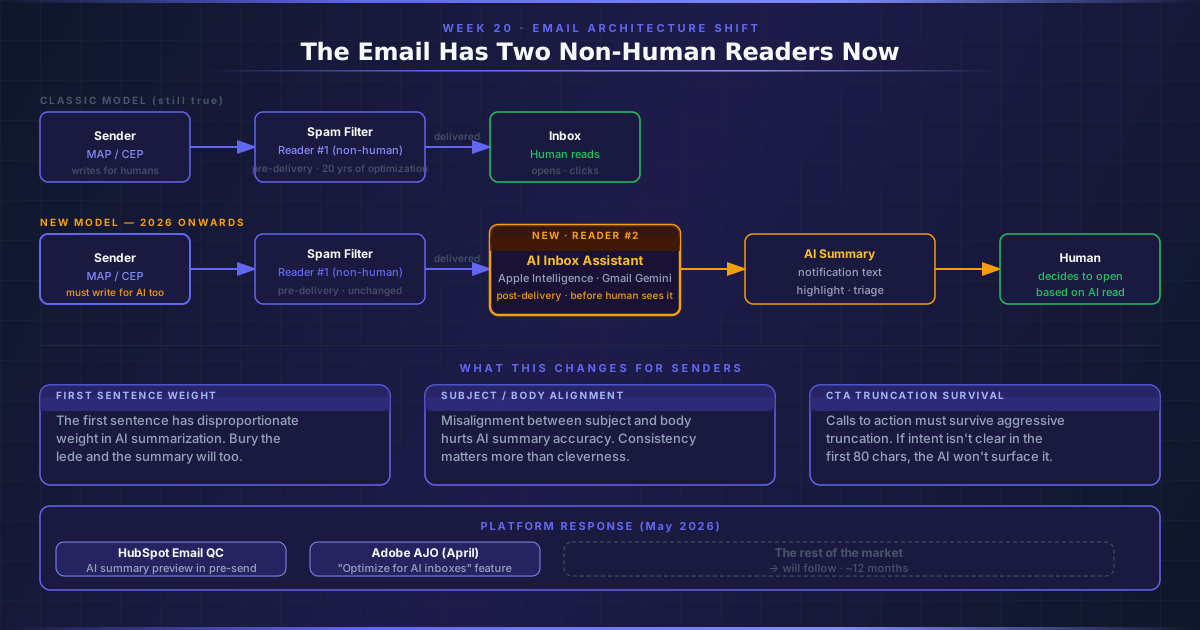
Email has always had an implicit first reader: the spam filter.
Deliverability practitioners have spent twenty years optimizing for that non-human reader: reputation signals, authentication, trigger phrases, HTML structure, engagement patterns.
The AI inbox assistant is a second non-human reader.
It operates after delivery, not before it.
Gmail’s Gemini-powered summaries and Apple Intelligence summaries increasingly change the way recipients see emails before they decide whether to open or engage. In that context, the sender is no longer writing only for the human reader and the deliverability layer. The sender is also writing for the summary layer.
That changes the editorial brief.
The first sentence matters more. Subject/body alignment matters more. The call to action needs to survive summarization and truncation. A vague opening paragraph is no longer just weak copy; it is weak input for the model that may decide how the message is represented to the user.
Adobe addressed a similar structural problem in April with AJO’s “Optimize email for AI inboxes” capability. HubSpot’s reported implementation is lighter and more operationally embedded: not a separate optimization feature, but part of the quality check before send.
I expect this type of capability to become standard across email platforms.
The interesting question is what happens when senders systematically optimize for AI summarization at scale. Does it improve clarity? Does it homogenize email structure? Do inbox AI systems adapt to sender optimization behavior in the same way spam filters adapted to sender behavior over the last two decades?
The editorial brief has a new audience.
Most teams have not updated it yet.
4. Salesforce MCN: The Migration Calculus Changes
The consent management gap in Marketing Cloud Next has been one of the harder technical conversations to have with clients considering migration from SFMC Classic.
Not because consent is a small feature.
Because consent is architecture.
How consent is captured, stored, mapped and honored across email, SMS and WhatsApp directly affects whether a platform can be used safely in regulated or highly governed environments.
The Summer ’26 release cycle appears to address an important part of this gap.
Independent Salesforce release recaps indicate that consent mapping for email and SMS/WhatsApp is on the Summer ‘26 roadmap. I was not able to confirm specific rollout dates from official Salesforce release note pages at the time of writing, treat these as directional signals until confirmed.
I would still verify the final official Salesforce release note before treating this as fully closed in a client recommendation. Salesforce’s public release-note pages are available, but the specific Marketing Cloud Next pages are not always easy to extract cleanly from the public web.
That caveat matters.
But the direction is clear: MCN is reducing one of the main functional reasons to defer migration.
Combined with AMPscript support in the same Summer ’26 cycle, MCN is starting to address two capabilities that practitioners in financial services, insurance and healthcare-adjacent marketing often cite as migration prerequisites: consent handling and legacy personalization logic.
A second Summer ’26 item is worth separate attention: new data-source capabilities that allow Salesforce CRM objects such as Cases, Leads, Opportunities and custom objects to be referenced as merge fields directly in messages, without the same level of data-extension-style mapping overhead that SFMC Classic practitioners are used to.
For anyone who has spent time inside the SFMC Classic architecture, this matters.
Classic SFMC often makes transactional and lifecycle messaging feel like a data plumbing exercise before it becomes a messaging exercise. If MCN can make CRM-native data more directly usable in message content, the architecture becomes simpler for a large class of Salesforce-centric use cases.
Real-Time Offer Management is also appearing in the Summer ’26 discussion as a next-best-offer capability for MCN. I would not overstate it yet. The public information I found is not sufficient to assess ranking logic, governance model, integration patterns or production constraints.
So I would treat it as a directionally important signal, not yet as a fully assessable capability.
What the Architecture Is Telling Us
Insider One/Bluecore, Klaviyo’s platform breadth, HubSpot’s AI inbox preview, MCN consent parity: these are individually coherent developments.
What is interesting is the cumulative direction they describe.
The identity and behavioral data layer is becoming a primary strategic asset in the CEP category. AI execution is moving closer to individual-level, real-time autonomous decisions, and that requires data infrastructure that many platforms do not fully own natively.
The inbox is increasingly mediated by AI before the human interacts with the message.
And the platforms sitting between mid-market scale and enterprise ambition, Klaviyo and Salesforce MCN in different ways, are removing friction points that previously justified mixed-stack or multi-vendor architectures.
The governance question for the rest of 2026 is not which platform has the best journey canvas.
It is which platform has the data resolution to support autonomous decisions at the granularity your use cases require.
Sources
Insider One / Bluecore
- Insider One acquires Bluecore — press release
- Bloomberg | Insider One buys Bluecore ahead of IPO
- AlleyWatch | Insider One / Bluecore acquisition analysis
Klaviyo
- Klaviyo What’s New — Spring 2026
- Klaviyo Blog | Agentic marketing workflows with Klaviyo and Anthropic Claude
HubSpot
Salesforce Marketing Cloud
- Medium @marketingcloudtips | Marketing Cloud Next Summer ‘26 highlights
- SalesforceBen | Top 9 Summer ‘26 updates for Salesforce marketers
- Martech Notes | Salesforce Summer ‘26 release notes overview
Adobe Journey Optimizer
The digest behind each weekly article is produced through a structured AI-assisted scan of official release notes and product update sources. I review the output, verify the relevant signals and write the architectural interpretation.
This article draws from the Martech Weekly Digest scans run on May 14, 2026, covering release notes and product updates across 11 CEP platforms and 10 vendors.
If you find errors or gaps in coverage, I want to know. The process improves when the output is challenged.