8 min read
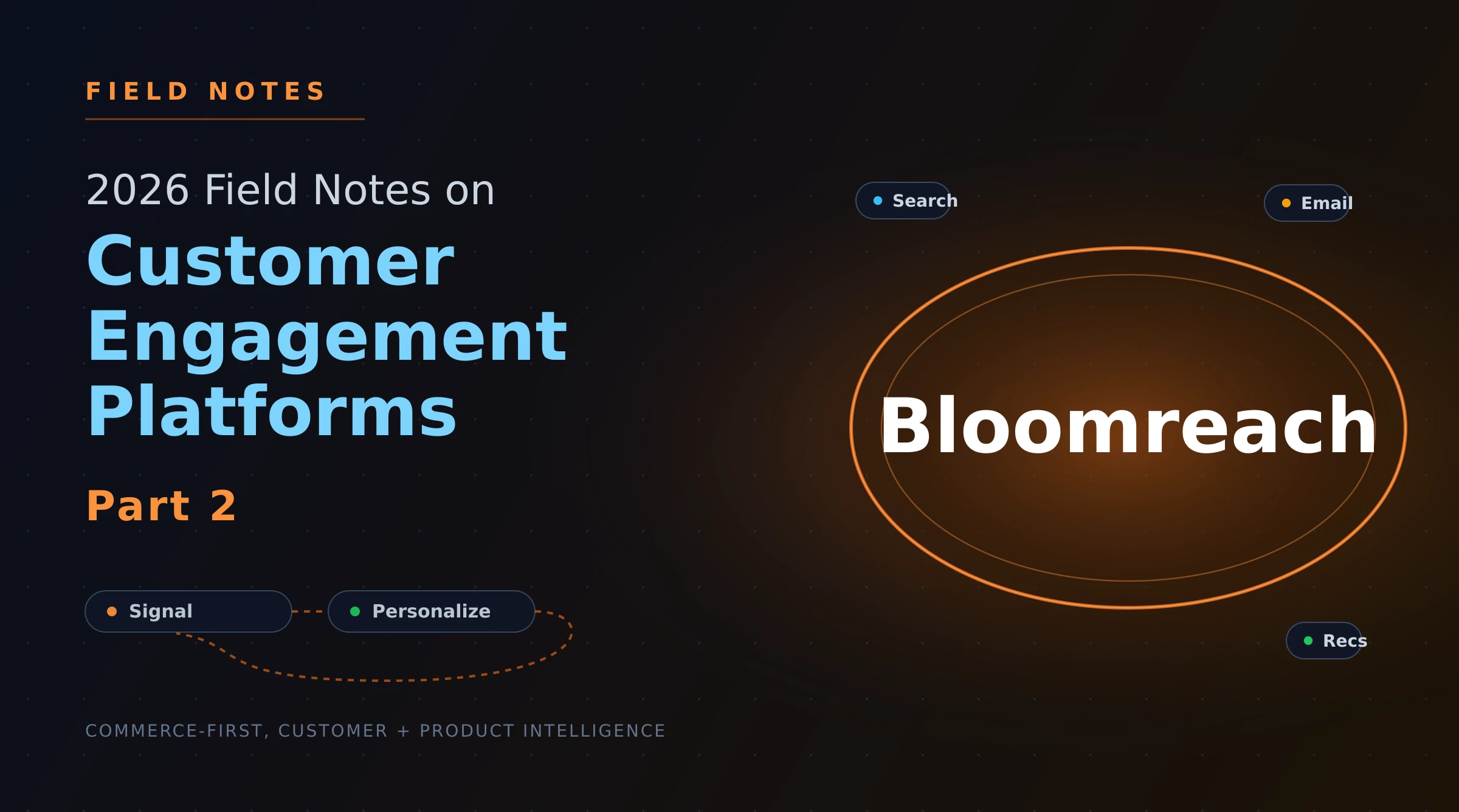
Why Bloomreach is Part 2 (and why it’s a very different CEP story than Braze)
If Part 1 (Braze) was about event-driven engagement with a mobile-first origin, Bloomreach is almost the mirror image. Braze’s origin story is engagement-first, while Bloomreach’s is commerce-first, born in the world of product discovery, merchandising and content. That difference matters more than it first appears.
Because in retail and ecommerce, personalization is not just about “the right message.” It’s also about:
- the right product (availability, margin, stock, category strategy)
- the right discovery experience (search, recommendations, browse)
- the right content layer (SEO, landing pages, headless composition)
Bloomreach’s CEP narrative is essentially: unify customer + product intelligence, then activate it across the journey.
For the purposes of this series, I’m evaluating Bloomreach Engagement as the CEP, while acknowledging that its commerce modules give it a unique activation surface.
This article is the second in my CEP series: one platform per chapter, same evaluation lens, no brochure tone.
A quick note on what I mean by “CEP” (and where Bloomreach stretches the definition)
In my working definition, a CEP is a system of action that:
- listens to customer signals
- evaluates decision logic (rules, policies, models)
- orchestrates activation across channels
- measures outcomes and feeds learnings back into the loop
Bloomreach fits this definition through Bloomreach Engagement (marketing automation + customer data + analytics), but it also stretches the category because it adds something many CEP vendors don’t have natively:
- product discovery & merchandising (search, recommendations)
- content orchestration (headless content)
- strong inbound personalization features
In fact, Gartner named Bloomreach a Leader in the 2025 Magic Quadrant™ for Personalization Engines, and for the second year running, a Visionary in the 2025 Magic Quadrant™ for Multichannel Marketing Hubs. As with every badge in this series, I read these as signals to validate through customer references, not as proof of fit.
This dual-threat positioning is what makes it unique:
- Search & Discovery: High-intent product finding.
- Engagement: Native CDP for journey orchestration with native activation channels for both in-session (on-site/in-app) and out-of-session (email/push/SMS) channels.
- Conversational AI: The “Clarity” and “Loomi” layer for agentic commerce.
Bloomreach in one sentence
Bloomreach is a commerce experience platform that is built on a native CDXP (Engagement) to unify customer behavior with product intelligence, allowing brands to orchestrate connected journeys across off-site channels and onsite storefronts via a single AI-powered brain (Loomi).
Its physics: commerce and product intelligence. Every platform in this series has a centre of gravity that predicts how it behaves under load, and I map all eight against each other in Part 9. Bloomreach’s is commerce and product intelligence: it reasons from the catalogue and the customer profile as much as from the raw event stream.
A brief history: from “commerce experience” roots to a Customer Engagement Platform
Bloomreach was founded in 2009 by Raj De Datta and Ashutosh Garg, with the thesis that online experiences could be dramatically improved if they were tailored to each user, powered by algorithms that get smarter over time.
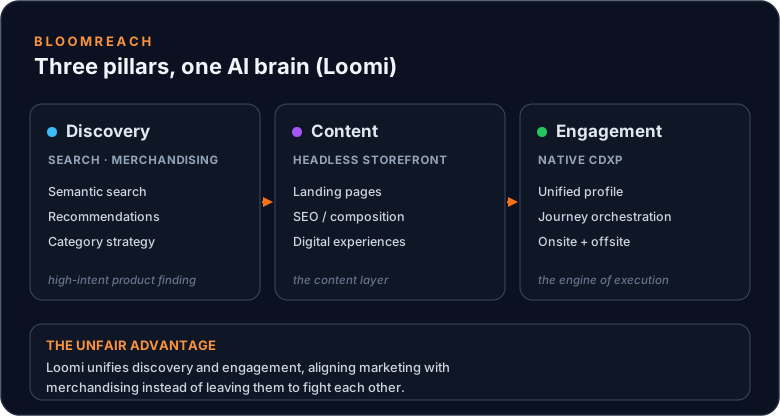
Over time, Bloomreach built a commerce-focused suite that today includes three main pillars:
- Discovery: product discovery (search, merchandising, recommendations)
- Content: headless content platform for digital storefronts
- Engagement: marketing automation + customer data activation
A major inflection point arrived in January 2021, when Bloomreach announced the acquisition of Exponea (a Customer Data and Experience Platform), combined with a $150M investment from Sixth Street Growth. This wasn’t just adding a “module”; it was adding the engine of execution.
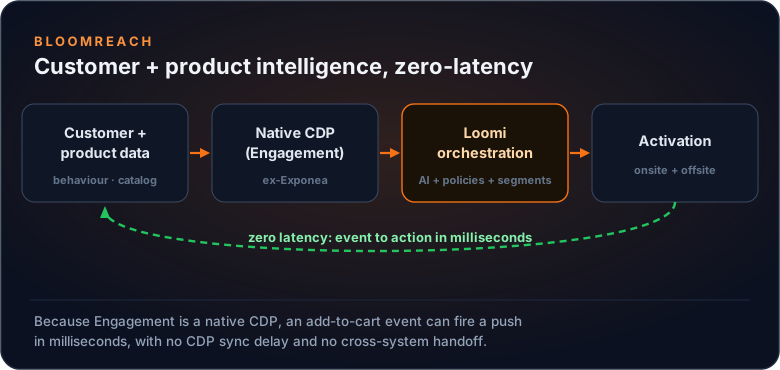
While many CEPs try to “bolt on” a CDP or integrate with one, Exponea brought a native Customer Data and Experience Platform. In the Bloomreach ecosystem, Engagement merges a real-time CDP with a powerful execution engine. There is zero latency between a customer event being captured and that event being available for a journey trigger or an on-site personalization change.
Together, it formed a story that many retailers find immediately intuitive:
unify customer + product data, then personalize everywhere.
How Bloomreach is positioned today
Bloomreach positions itself as an AI-powered commerce personalization platform, with Loomi AI as a unifying narrative across search/merchandising and marketing automation.
Crucially, Loomi isn’t just a chatbot wrapper; it’s a set of specialized models designed for commerce, from semantic search intent to predicting the next best channel in a journey.
A useful way to describe Bloomreach’s positioning, without the marketing language, is that it is strongest when e-commerce is the core business model, and that it is designed to help you personalize not only communications but the storefront itself.
This positioning becomes more visible in regions like Europe, where retailers often have complex assortments, multi-language sites, and strong merchandising governance.
The Bloomreach mental model (how I explain it internally)
If you want a simple mental model for Bloomreach, it’s this:
- Customer intelligence (identity, attributes, behavior)
- Product intelligence (catalog, categories, availability, merchandising strategy)
- Intelligent Orchestration Layer (Loomi AI + Business Policies + Real-time Segments)
- Activation, both onsite (search, recommendations, content)
and offsite (email, SMS and other channels via Engagement)
The “unfair advantage” of this model is that it naturally aligns marketing with merchandising.
When personalization is disconnected from product strategy, you often get:
- irrelevant recommendations
- campaigns pushing out-of-stock items
- “personalization” that breaks business rules
Bloomreach’s commerce-first architecture is designed to reduce that friction, at least in theory.
Recent financial and growth milestones (what we can and can’t know)
Unlike public companies, Bloomreach is privately held, so we don’t get quarterly earnings calls and standardized financial disclosures.
But we do have credible milestone signals from company announcements and major outlets:
- September 2021: Bloomreach announced it surpassed $100M in ARR.
- February 2022: Bloomreach announced $175M in funding and a $2.2B valuation, covered by Forbes.
- January 2023: Bloomreach announced it surpassed $150M in ARR at the close of 2022.
- November 2024: Bloomreach crossed $200M in revenue, confirmed by CEO Raj De Datta to Axios.
- 2025: Bloomreach ~2x its growth rate in 2025 at pre-IPO scale
What I take from these milestones (in CEP terms):
- Bloomreach has crossed the operational scale where enterprise buyers expect stability and ecosystem maturity.
- The growth acceleration in 2025 suggests strong demand for unified commerce + customer intelligence platforms.
- As a private company with selective disclosure, buyers should focus on customer references and implementation track records rather than relying solely on public metrics.
As of July 2026, these remain the latest disclosed milestones for a company that still reports selectively as a private, pre-IPO business.
Loomi AI and the “agentic” direction
In 2024, Bloomreach increased its emphasis on Loomi AI capabilities and described a new generation of its marketing automation platform rebuilt around more autonomous AI workflows.
Whether we call it “agentic” or simply “automation at the decision level,” the strategic direction is consistent with the broader CEP market shift:
- less manual journey building
- more continuous optimization
- faster experimentation and iteration
What matters in practice is not the label, but the operational truth:
- Can it optimize without causing chaos?
- Can it respect constraints (consent, frequency caps, business rules)?
- Can it explain decisions sufficiently for marketers and governance teams?
Competitive set (how it shows up in real programs)
Bloomreach’s competitive set depends heavily on how you define the problem.
1) “Commerce personalization platform” competitions
When the brief is: improve onsite conversion and discovery, Bloomreach often gets evaluated against:
- other product discovery/personalization vendors
- commerce suite capabilities (native search/recs)
- experimentation + recommendation stacks
2) “CEP / marketing automation + CDP activation” competitions
When the brief is: activate customer journeys across channels, Bloomreach Engagement can land in the same room as:
- independent CEP vendors (Braze, InsiderOne, Iterable, etc.)
- suite ecosystems (where engagement is part of a broader cloud) (Adobe, Salesforce, etc.)
Where Bloomreach is strongest (my delivery-centric view)
If I had to summarize Bloomreach’s most practical strengths in enterprise delivery:
- Commerce-native personalization: product discovery, merchandising logic, and content aren’t “adjacent”, they’re built-in.
- Customer + product intelligence in the same narrative: reduces the classic marketing-vs-merchandising disconnect.
- Zero-Latency Activation: Because the “Engagement” module is a native CDP, there is no sync delay. In many stacks, an add-to-cart event syncs to a CDP in 15–30 minutes, then triggers a journey. With Bloomreach Engagement, that event can fire a push in milliseconds, no handoff.
- Engagement activation layer: makes it possible to connect onsite behavior to offsite journeys in one platform family.
The questions I like to ask early in a Bloomreach evaluation
To get past demo aesthetics and into architectural truth:
- Who owns the product catalog truth (PIM/commerce), and how is it synced into Bloomreach?
- What is the event model for customer behavior (web/app/store), and how do we enforce semantics?
- How do we manage business rules vs AI recommendations (and who wins when they conflict)?
- How do we implement consent + frequency strategy across channels?
- What is the operating model between merchandising, ecommerce, and CRM/marketing?
Watch-outs I put in writing
- If you don’t fix your data quality (taxonomy, attributes, rules…), no AI layer will save personalization.
- If you don’t align ownership across commerce and marketing, you will end up with two personalization systems fighting each other.
- If you treat “AI” as a feature rather than a decision system, your governance will lag behind your activation speed.
What’s next
Part 3 turns to Insider One, the platform that bridges engagement and experience optimization.
Sources
Bloomreach
- About and milestones
- Acquisition of Exponea and $150M investment, 26 January 2021.
- Product page: Engagement
- Product page: Content
- Discovery documentation overview
- $175M funding at a $2.2B valuation
- Loomi AI enhancements, 26 June 2024.
- Next-generation Engagement rebuilt around Loomi AI, 3 October 2024.
Analyst recognition
- Named a Leader in the Gartner Magic Quadrant for Personalization Engines, February 2025.
- Named a Visionary in the Gartner Magic Quadrant for Multichannel Marketing Hubs, October 2025.
Press coverage and milestones
- Forbes, Coverage of the $175M funding and $2.2B valuation, 23 February 2022.
- PRNewswire, Surpassing the $100M ARR milestone, 8 September 2021.
- PRNewswire, Surpassing the $150M ARR milestone, 18 January 2023.
- Business Wire, Expansion in Spain and Italy, 28 January 2025.
- CEO Raj De Datta on “an incredible 2025”, 7 January 2026.