13 min read
Why Adobe Journey Optimizer is Part 4 (and why “suite gravity” changes everything)
After three “independent CEP” perspectives (Braze, Bloomreach, Insider), Part 4 moves to a different kind of decision: not just choosing a tool, but effectively choosing an operating system for your experience stack. Adobe Journey Optimizer (AJO) is not “just another journey builder.” It is a journey engine built natively on Adobe Experience Platform (AEP), and that single architectural fact changes how you evaluate it.
With AJO, the conversation is rarely “can the tool do X?” and almost always “what system are we building, and where do we want decisioning to live?” AJO is intentionally designed to sit at the center of an Adobe Experience Cloud ecosystem: AEP and Real-Time CDP for identity, profiles and audiences, Customer Journey Analytics for measurement and insight, AEM and Workfront for content and workflow governance, often Marketo Engage for B2B motions, and Adobe Campaign heritage for legacy delivery patterns.
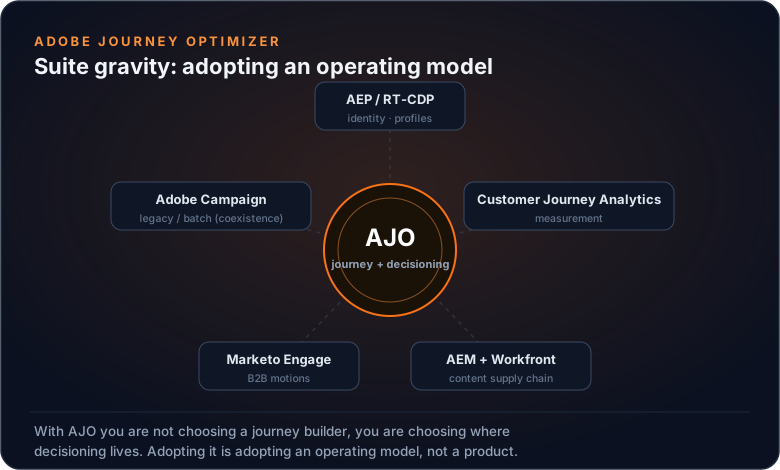
AJO vs Adobe Campaign (and why both can be “right”)
Adobe has two B2C-grade execution products that often appear in the same conversation: Adobe Journey Optimizer (AJO) and Adobe Campaign. They can overlap in outcomes (especially email), but they come from different eras and are optimized for different operating models.
AJO is built as a real-time journey and decisioning engine on Adobe Experience Platform (AEP). It shines when the enterprise goal is to put profiles, events, eligibility, and arbitration at the center of engagement and to treat orchestration as a control loop across channels, not just a batch send system.
Adobe Campaign (Classic or Standard) is the heritage campaign execution platform. It is typically strongest in organizations that run mature, high-volume email operations with established production patterns, rich templating/operations discipline, and long-standing deliverability processes especially when the motion is still primarily batch-oriented and centered around campaign calendars.
A simple way to decide:
- If your core challenge is real-time orchestration and decisioning (event-driven triggers, next-best-action logic, cross-channel consistency, and governance around “who gets what, when”), AJO is usually the right center of gravity.
- If your core challenge is industrialized email production and delivery at scale with mature workflows and existing Campaign investment, Campaign can still be the pragmatic workhorse.
In the real world, many enterprises land on a coexistence pattern for a period of time: keep Campaign for legacy/batch-heavy delivery where it’s deeply embedded, and use AJO to introduce real-time journeys, cross-channel arbitration, and AEP-native decisioning, gradually shifting the operating model as data, governance, and content supply chain catch up.
A quick note on what I mean by “CEP” (and why AJO is closer to a control plane)
In this series, I use “CEP” for systems of action that:
- listen to customer signals
- evaluate decision logic
- orchestrate activation across channels
- measure outcomes and feed a learning loop
AJO clearly fits this definition, but in many enterprise programs it is used as something stronger: a real-time orchestration and decisioning control plane for the entire experience stack.
This is why AJO’s success is so tightly coupled to the quality of the organization’s identity strategy, event semantics, governance maturity, content supply chain and measurement discipline. At that point, you are not just adopting a product; you are adopting an operating model.
Adobe Journey Optimizer in one sentence
Adobe Journey Optimizer is a real-time journey orchestration and decisioning engine built on Adobe Experience Platform, designed to unify customer data, decision logic, content and delivery in one canvas so that enterprise teams can orchestrate cross-channel journeys with strong governance and measurement built in.
Its physics: suite gravity. Every platform in this series has a centre of gravity that predicts how it behaves under load, and I map all eight against each other in Part 9. Adobe Journey Optimizer’s is suite gravity: it behaves as a control plane over the Adobe foundation rather than as a standalone tool.
A brief history: why AJO exists (and what it replaced in the conversation)
Adobe introduced Adobe Journey Optimizer in 2021 as a new application to help brands optimize and personalize experiences across the customer journey. The timing was not accidental. The market was already shifting away from batch segmentation and scheduled campaigns towards event-driven engagement and real-time decisioning.
Adobe’s key move was not simply “add journeys” on top of an existing stack (Adobe Campaign), but anchor orchestration on AEP’s real-time profile and event model. That is the philosophical departure from traditional marketing automation: not “build a campaign and then target segments” but “listen to events and decide in context.”
This also changed ownership patterns. Where classic marketing automation often lives as a relatively self-contained kingdom, AJO forces tighter coupling with the data platform team (schemas, events, identity), privacy and legal (consent and policies), content operations (assets, localization and approvals) and analytics (measurement definitions and governance). That coupling is a strength when you can align, and a drag when you cannot.
The AJO mental model (how I explain it internally)
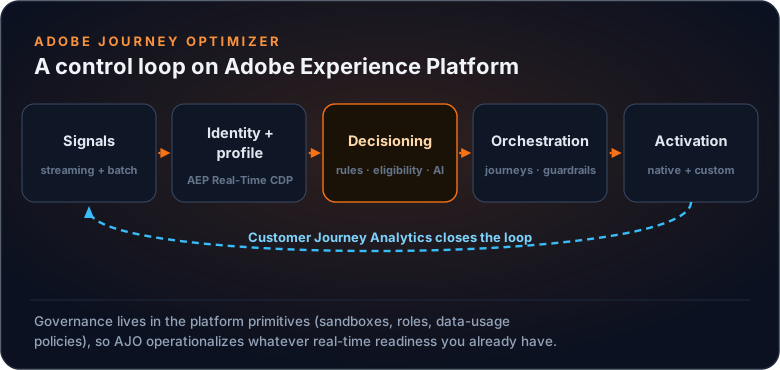
The most useful way I’ve found to explain AJO is as a control loop rather than as a campaign tool.
- Signals: streaming events that capture behaviour, batch attributes on the profile and contextual information from operational systems, location or status.
- Identity and profile: AEP Real-Time Profile unifies identities, applies consent and usage policies, and maintains customer state across channels.
- Decisioning: you design audiences, rules and constraints, decision management for offers and eligibility, and, where it makes sense, AI‑driven recommendations and optimization.
- Orchestration: journeys listen to events and decisions, combine real-time and scheduled paths, manage guardrails such as timeouts, conditions and re-entries, and enforce frequency and pressure strategies.
- Activation: decisions are executed through native channels and integrations, with custom actions to push into external systems when needed.
- Measurement: tools like Customer Journey Analytics close the loop by feeding insights and outcomes back into audiences, journeys and decisions.
That loop is, in practice, the real product. If you treat AJO as “a nicer campaign tool,” you will underuse it; if you treat it as “the brain of engagement,” you also inherit the responsibility of making that brain reliable.
The practical implication
In real AJO programs, the hardest problems are rarely about “how to send.” They are usually about defining customer state consistently across teams and systems, making decision logic deterministic and governable, preventing conflicting logic when multiple triggers/journeys compete, and building a content operation that can keep up with real-time decisioning.
AJO rewards good systems thinking and punishes ad-hoc campaign habits. That’s why it often feels particularly powerful in mature organizations, and frustrating in organizations that still expect engagement to be “a set of disconnected campaigns.”
What AJO is (and isn’t)
Seen through this lens, AJO is a real-time orchestration engine that supports streaming and batch patterns, plus a decisioning layer that binds profile, events, and policies into a controlled execution model. When the underlying foundations are well designed, it can scale across brands, regions, and large portfolios of use cases.
What it is not: a complete enterprise data foundation by itself, a universal replacement for every channel execution tool in every scenario, or a shortcut around identity governance, consent strategy, instrumentation, and content operations. Adobe stacks are powerful, but unforgiving when you try to skip the prerequisites.
Product posture: why Adobe’s strength is also its complexity
AJO’s main strength and its typical source of friction are the same: it is built natively on a real-time data platform. That gives it unusually strong capabilities around unified profiles across many systems, real-time triggers and contextual personalization and an enterprise-ready governance posture with roles, sandboxes and policies. It also makes it a natural fit for multi-brand or multi-region organizations where governance is non‑negotiable.
The price of that strength is dependency on organizational maturity. Event instrumentation must be thought through: what you track and how consistently you do it matters. Identity resolution needs clear definitions of person, device and household. Consent and policy enforcement must be designed intentionally, with a clear view on where they are executed. Content operations need to be fast and compliant enough to feed real-time decisioning, and release management must respect dev/test/prod environments, approvals and QA cycles. AJO does not create real-time capability from scratch: it operationalizes whatever real-time readiness you already have.
AJO’s “hidden feature”: governance‑by‑design
One of Adobe’s less glamorous, but highly consequential, design choices is that governance lives in the platform primitives, not only in process documents. Sandboxes, roles, data usage labels, policies and shared profile semantics are all first‑class concepts in the stack, and they shape how teams can build and deploy journeys. In regulated industries, that often becomes the difference between a successful pilot that can scale and a pilot that remains an isolated experiment.
AI direction: from assistants to agents, a snapshot as of early 2026
Adobe has moved steadily from AI focused mainly on content and analytics to AI that increasingly supports orchestration and decisioning directly. The following capabilities are generally available or in active rollout as of early 2026:
- Journey Agent (GA, September 2025): Powered by the AEP Agent Orchestrator, it supports text-to-journey creation from natural language prompts, proactive conflict detection across journey inventory, deep fallout analysis and operational Q&A (“which journeys are live?”, “which audiences are over-saturated?”).
- Experimentation Accelerator and AI-first experimentation: Unified experiment management across AJO and Adobe Target, with Multi-Armed Bandit support for real-time traffic allocation to winning experiences.
- Experimentation Agent (October 2025): AI-powered experiment management across all channels, with actionable guidance on what to test next.
- AEP Agent Orchestrator: Announced at Adobe Summit 2025, this agentic framework supports third-party and customer-built AI agents with trust, transparency and extensibility built in.
- High Throughput Mode: Scales to 5,000 transactions per second for real-time messaging.
- Expanded channels: WhatsApp, Line, RCS and iOS Live Activities added in recent releases.
My practitioner view remains the same regardless of what gets announced next, and I apply the same test to any agentic claim, written up in full in How I judge any agentic marketing claim: the label matters far less than whether the AI improves operational reality under governance, and features that cannot work within governance constraints get disabled sooner or later.
Typical implementation pattern (what actually happens in enterprise programs)
Looking across real AJO programs, I tend to see a similar pattern in the implementations that succeed.
- Foundation: teams align on an identity strategy and sources of truth, define a minimal but high‑quality event taxonomy, and decide how consent enforcement will work across channels.
- First activation loop: they launch a small set of journeys tied to clear KPIs, supported by a disciplined measurement setup with agreed‑upon definitions, attribution expectations and, where possible, holdouts or control groups.
- Scale the operating model: they invest in a content supply chain that can handle variants, localization and approvals, clarify governance for journey ownership, change management and QA, and treat journey portfolio management as a deliberate practice instead of letting “journey sprawl” emerge.
- Optimization: once the previous layers hold, they add more sophisticated decisioning (eligibility, constraints, prioritization) and mature experimentation, with incrementality and guardrails.
When organizations try to jump straight to the optimization layer, AJO becomes a theatre system: demos look great, operations stay fragile.
Recent Adobe financial context (why it matters even for CEP evaluations)
Adobe’s financial durability is rarely the core risk in AJO evaluations. It’s the platform gravity behind it.
In Adobe’s Q4 and full FY2025 results (reported December 10, 2025), Adobe reported Q4 revenue of $6.19B, full FY2025 revenue of $23.77B, and total ARR exiting FY2025 of $25.20B.
For AJO buyers, the implication is simple: Adobe’s investment capacity is real, and Experience Cloud roadmaps tend to translate into shipped capabilities. The harder question is whether your organization can absorb the operating-model maturity the platform assumes.
Update, as of July 2026: Adobe has since reported record second-quarter fiscal 2026 results (quarter ended May 29, 2026): revenue of $6.62B, up 13% year over year, total ARR of $27.10B, and AI-first ARR past $500M after tripling year over year. The point for AJO buyers is unchanged: the investment capacity is real and the AI roadmap is funded. The harder question is still whether your organization can absorb the operating-model maturity the platform assumes.
Competitive set (how AJO is evaluated in real programs)
AJO’s competitive context changes with the enterprise setting, but the evaluation lens is the same one I’ve used throughout this series: runtime capabilities, data and AI depth, and how well the platform supports an operating model for engagement.
In suite‑led ecosystems, where companies have already standardized on Adobe Experience Cloud, AJO is typically evaluated as the natural orchestration layer. The real competition is often internal: whether to orchestrate in AJO or continue relying on legacy Adobe Campaign tooling; whether to centralize decisioning in AEP/AJO or keep logic distributed per channel; and how to integrate AJO with existing ESP, SMS and push infrastructures.
In “independent CEP” cycles, AJO shows up alongside Braze, Insider, Bloomreach, Iterable and others. Here, the decisive factors are less about feature‑by‑feature comparisons and more about:
- time‑to‑value versus the effort of building foundations
- governance maturity the organization already has or is willing to build
- suite lock‑in versus composability
- willingness to treat data and orchestration as a shared product across teams
In engineering‑led organizations, AJO sometimes competes with composable, build‑your‑own stacks built on event streaming, homegrown decisioning engines and channel services. Adobe tends to win in those contexts when the enterprise wants strong, standardized governance without rebuilding everything from scratch, and tends to lose when the organization prizes extreme flexibility and is willing to own a large engineering and maintenance burden.
Where AJO is strongest (my delivery‑centric view)
From a delivery point of view, AJO is at its best when it can use AEP’s real‑time profile, event and policy model end‑to‑end. That is where real‑time orchestration is not just a feature but the default operating mode, and where enterprise governance, with sandboxes, roles and controls, is implemented seriously rather than left on paper. It is also strong when organizations pair it with Customer Journey Analytics for measurement, and with AEM and Workfront for content supply chains, so that engagement logic is connected both to experience data and to the processes that create and approve content.
The questions I like to ask early in an AJO evaluation
To get beyond demo aesthetics and into architectural reality, I like to ask a handful of questions very early:
- What is the identity strategy, and what are the sources of truth?
- How do we enforce consent and policy consistently across channels?
- What does our event taxonomy look like, and who owns it?
- What is our latency budget, and what does “real‑time” really mean for us?
- How do we handle conflicts between multiple journeys, overlapping triggers and competing goals?
- What is our content operating model, including AEM, approvals and localization?
- How do we plan to govern the journey portfolio itself, from ownership to documentation and lifecycle?
The answers usually tell you more about AJO fit than any RFP matrix.
Watch‑outs I put in writing
There are a few patterns I like to make explicit at the start:
- If AEP foundations are weak, AJO behaves like a Ferrari stuck in city traffic.
- If the operating model is unclear, governance friction will grow and teams will eventually blame the tool.
- If the content supply chain is slow, real-time decisioning will not translate into real-time experiences.
- If measurement is under‑designed, with no clear definitions, holdouts or incrementality, then “optimization” becomes a matter of opinion.
- If journey creation is left entirely unrestricted, journey sprawl is almost guaranteed and control will be lost over time.
Writing these down early makes the trade‑offs visible.
When AJO wins vs when it hurts (a simple heuristic)
As a rule of thumb, AJO tends to win when an enterprise is already investing in AEP and wants a unified control plane for engagement, when governance and compliance are core requirements, and when cross‑channel engagement needs to be deeply measurable and aligned with analytics. It tends to hurt when the organization expects visible results in a few weeks but has not built identity and event foundations, when marketing expects a standalone tool with minimal cross‑team dependency, or when content operations are too slow to keep up with real‑time orchestration.
What’s next
Part 5 covers Salesforce Marketing Cloud and the pull of CRM gravity.
Sources
Adobe
- Journey Optimizer product overview
- Experience League, About Journey Orchestration. Core concepts and architecture.
- Fuelling the next era of journey orchestration in Adobe Journey Optimizer. New features, AI and arbitration.
- Q4 and FY2025 results hub
- Adobe reports record Q2 fiscal 2026 results, 11 June 2026.
Analysts and research
- Gartner, Magic Quadrant for Multichannel Marketing Hubs. Market overview.
- McKinsey, Next best experience: how AI can power every customer interaction, October 2025.