13 min read
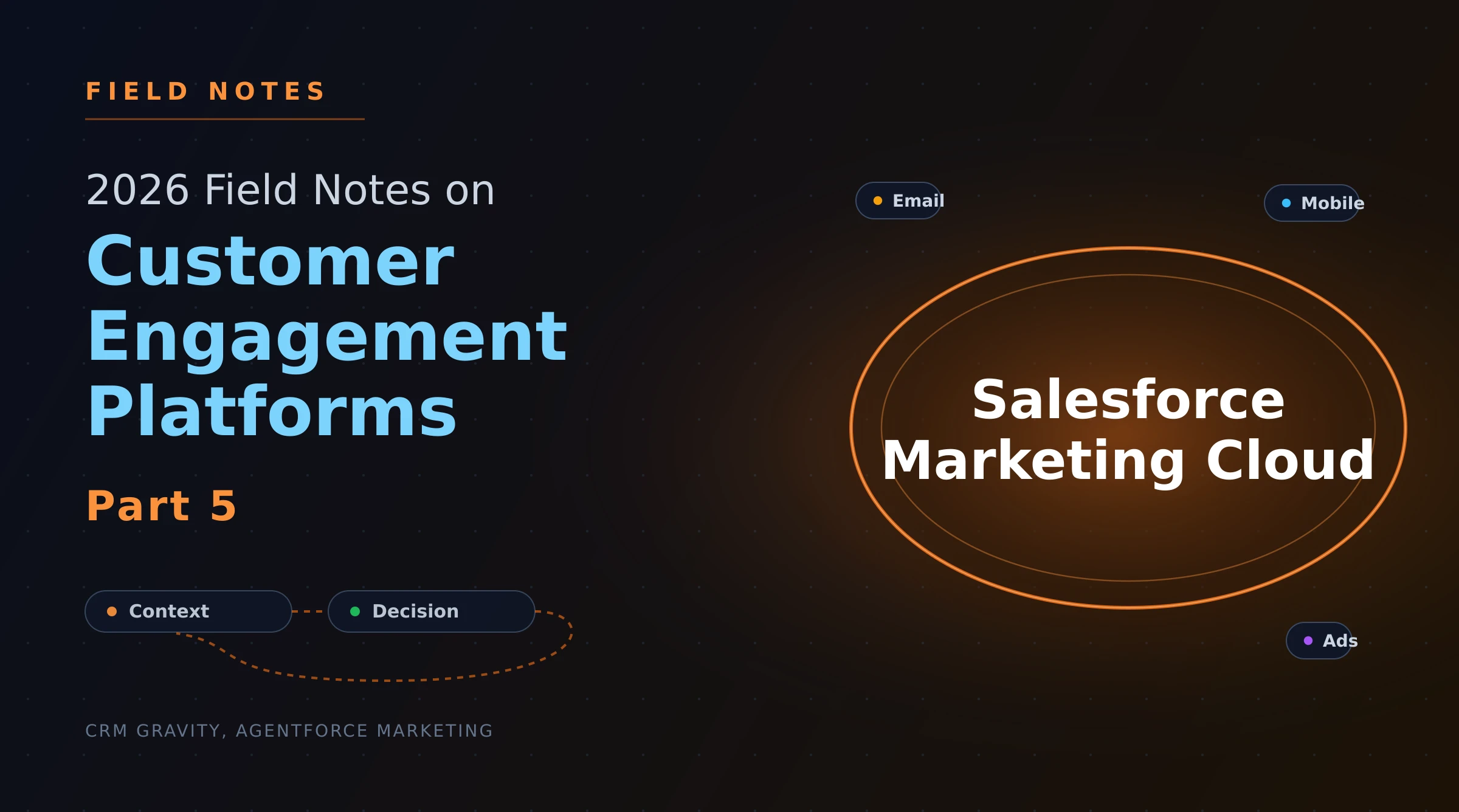
Why Salesforce is Part 5 (and why “CRM gravity” is a different kind of gravity)
If Adobe Journey Optimizer is powered by suite gravity, Salesforce is powered by something even stronger in large enterprises: CRM gravity.
Salesforce doesn’t start from “marketing automation.” It starts from a platform where sales, service, commerce, and partners already live and then asks marketing to become a first-class citizen of that operating system.
That’s the fundamental positioning: Salesforce isn’t only trying to orchestrate campaigns.
It’s trying to orchestrate customer relationships, with marketing becoming a connected layer that can react to what happens in:
- Sales pipelines and account activity
- Service cases and customer support journeys
- Commerce transactions and behavioral signals
- Partner ecosystems (AppExchange)
- Internal collaboration (Slack)
This is why Salesforce evaluations are rarely “Is it the best email tool?”
They’re usually: “Do we want marketing orchestration to be anchored to the same platform that runs our commercial engine?”
And increasingly, because of the Agentforce narrative, also: “Do we want AI agents to live in the same place as our customer truth?”
A practical way to phrase the trade-off is:
- Independent CEPs often win on speed-to-execution.
- Salesforce often wins on context-to-decision (because the context already sits in CRM + Service + Commerce).
If your business believes the next advantage comes from joining these worlds, Salesforce becomes less of a product selection and more of a platform strategy.
A quick note on scope (because Salesforce marketing is not one product)
When people say “Salesforce Marketing Cloud,” they might mean one of three different realities:
- Marketing Cloud Engagement (the legacy-yet-powerful ExactTarget lineage)
Email Studio, Mobile Studio, Journey Builder, Automation Studio, etc. - Marketing Cloud on Core (Growth / Advanced)
Newer editions built on the Salesforce core platform, designed to work natively with Data Cloud - Next-Gen / Marketing Cloud Next (Agentic Marketing)
The “agentic” layer Salesforce is building to turn journeys, personalization, and conversations into an AI-driven operating model
In this article, I’m treating Salesforce’s CEP proposition as the combination of these layers, because that’s how enterprise roadmaps increasingly evaluate it.
Why this portfolio reality matters
Most of the confusion I see in CEP evaluations comes from mixing these worlds as if they were the same architecture.
They’re not.
- Engagement has its own operational patterns, data model assumptions, and historically a different “distance” from CRM.
- On-core / Next are designed to reduce that distance and make marketing feel like a native extension of the Salesforce platform.
So the key is not to ask: “Is Salesforce Marketing Cloud good?”
Ask: “Which Salesforce marketing world are we in, and which one are we moving toward?”
Salesforce’s CEP proposition in one sentence
Salesforce’s marketing stack (often branded today under an “Agentforce Marketing / Next‑Gen Marketing Cloud” narrative) is an enterprise engagement system anchored to CRM + Data Cloud, designed to orchestrate cross-channel journeys while connecting marketing decisions to sales/service/commerce context, and progressively shifting from marketer-built automations to agent-assisted (and eventually agent-driven) execution.
If you want a shorter version:
Salesforce is turning marketing into an extension of the CRM operating system with Data Cloud as the context engine and Agentforce as the intelligence layer.
Its physics: CRM gravity. Every platform in this series has a centre of gravity that predicts how it behaves under load, and I map all eight against each other in Part 9. Salesforce Marketing Cloud’s is CRM gravity: the operational customer record is the anchor everything else orbits.
A brief history: from ExactTarget to “Agentforce Marketing”
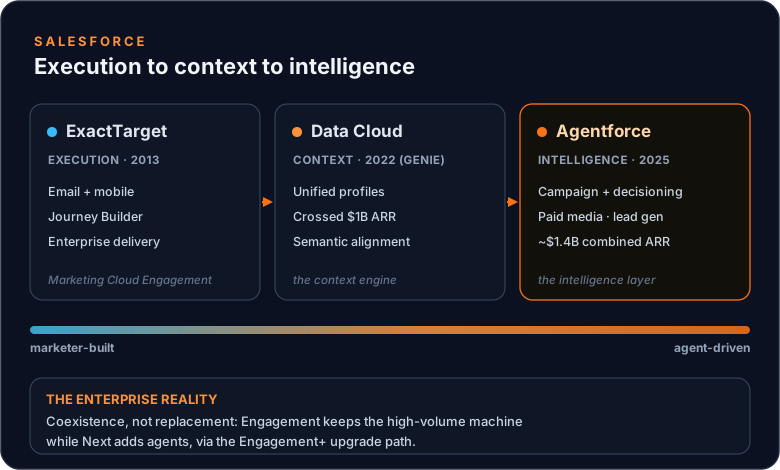
Salesforce entered modern digital marketing in a serious way in 2013, when it acquired ExactTarget, the foundation that would become the core of what most practitioners still recognize as “SFMC Engagement.”
This matters because it explains a lot of what you see today:
- Marketing Cloud Engagement has historically been a highly capable system, especially for enterprise email + mobile + journey execution.
- But it also carries architectural DNA that’s not fully identical to the Salesforce core platform (objects, metadata, security model, release and DevOps patterns).
In parallel, Salesforce’s strategy evolved toward a unified data layer.
- In 2022, Salesforce announced Genie as a hyperscale real-time data platform powering Customer 360.
- Genie evolved into what most of us now refer to as Data Cloud (which crossed $1B ARR in Q1 FY26, marking 120% year-over-year growth and confirming enterprise adoption is real, not just a narrative).
And then, in 2025, Salesforce accelerated an explicit shift:
- Marketing Cloud Next reached general availability, bringing Agentforce Campaign Creation, Agentforce Personalization Decisioning, Agentforce Lead Generation & Management, Agentforce Paid Media Optimization, and Segment Intelligence all to GA
- “Agentforce” became more than a feature label. It became the product narrative and the financial story
So the history arc is simple:
Execution (ExactTarget) → Context (Data Cloud) → Intelligence (Agentforce)
The key takeaway: Salesforce is not rebuilding marketing from scratch. It’s re-platforming marketing around a data + AI narrative consistent with the broader Salesforce platform strategy, and the FY26 financials confirm the investment is not slowing down.
The Salesforce mental model (how I explain it internally)
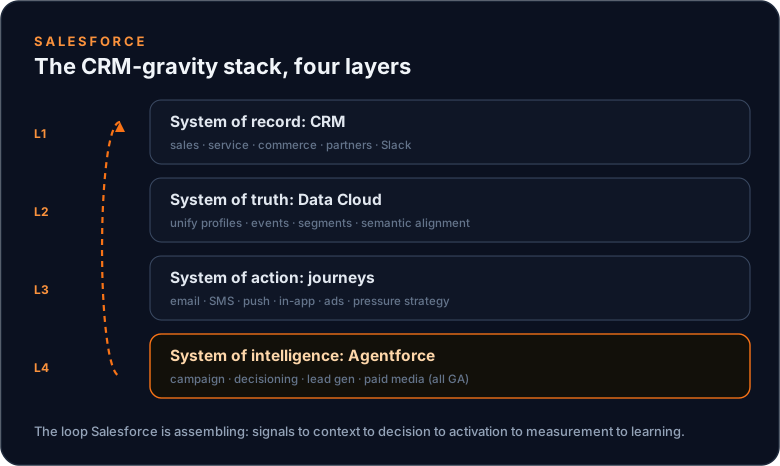
I frame Salesforce marketing as a layered system.
If you get these layers right, the stack behaves like a loop.
If you mix them without a plan, it behaves like a portfolio.
Layer 1 System of record and operational context
This is the CRM layer:
- accounts, contacts, leads
- opportunities and lifecycle stage
- service cases
- preferences and permissions (where implemented)
The core advantage is that marketing doesn’t need to guess what the business is doing. It can read it.
In practical terms, it enables patterns like:
- suppression based on service friction (don’t push promotions when a case is open)
- journey branching based on lifecycle stage and account health
- “assist the seller” journeys tied to opportunity movement
Layer 2 System of truth for customer signals
This is Data Cloud:
- Unify profiles from multiple systems
- Ingest events and behavioral signals
- Create segments and calculated insights
- Provide enterprise context for agent decisions
The hidden power of Data Cloud isn’t segmentation. It’s semantic alignment.
Once the enterprise agrees on what a customer is, what consent means, and what events represent intent, the marketing layer can stop being a set of disconnected lists.
Layer 3 System of action (journeys and activation)
This is where Marketing Cloud Engagement, Growth/Advanced, and Next‑Gen capabilities come into play:
- Build journeys and automations
- Activate via email, SMS, push, in-app, and other channels
- Connect to ads and external systems
In this layer, success is often less about features and more about pressure strategy:
- Prioritization rules
- Channel mix and fallback logic
- Frequency caps and cooldowns
- Conflict resolution when multiple triggers fire
Layer 4 System of intelligence (Agentforce)
This is the layer that is now shipping, not just announced:
- Campaign creation and brief generation (GA)
- Personalization decisioning (GA)
- Lead generation, nurturing, and qualification (GA)
- Paid media optimization (GA)
- Web curation and dynamic experience assembly (GA late 2025)
- Two-way conversational interactions (not just broadcasts)
With Winter ‘26 and Spring ‘26 releases, the layer is expanding further: in-app messaging for mobile, sandbox testing for Marketing Cloud Next, improved campaign record unification between Engagement and Next, and new Agentforce Campaign Experience capabilities.
A Salesforce-centric CEP strategy is basically the attempt to make these layers feel like one loop:
signals → context → decision → activation → measurement → learning
What Salesforce Marketing is (and isn’t)
It is
- A broad engagement ecosystem that can connect marketing actions to CRM context
- A journey and automation capability at enterprise scale (especially in Engagement)
- A platform strategy that increasingly treats data + AI agents as the growth engine
- An ecosystem with strong enterprise integration levers (MuleSoft patterns, AppExchange, Slack)
It isn’t
- One uniform product surface (today it’s still a portfolio in transition)
- A guaranteed “simple setup” (because the power comes with architecture)
- Automatically real-time everywhere unless you’ve designed your data/event model to be real-time
- A substitute for disciplined deliverability operations (especially when email volume and segmentation complexity scale)
Product posture today: two worlds, one roadmap
If you’ve worked with Salesforce Marketing Cloud for years, you’ve seen the split:
- Engagement: battle-tested enterprise execution (especially email/journeys) with strong operational patterns, but historically more separated from CRM “core.”
- On-core and Next‑Gen: an effort to bring marketing experiences closer to the unified Salesforce platform and Data Cloud, with AI/agents as a differentiator.
The key question for enterprises becomes:
Are we optimizing what we have (Engagement), or are we building toward the next-gen model (on-core + agents)?
In many programs, the real answer is: both.
And that’s where complexity shows up.
The real enterprise pattern: coexistence, not replacement
Most large organizations can’t “flip a switch.” They end up with a transition phase where:
- Engagement keeps running the high-volume machine (email, lifecycle, core journeys)
- Data Cloud centralizes identity and calculated insights
- Next-Gen capabilities are introduced where they create measurable value
That requires an explicit coexistence architecture, otherwise you get:
- duplicated audiences and inconsistent eligibility rules
- conflicting frequency caps
- multiple “sources of truth” for consent
- measurement fragmentation
Salesforce has anticipated this with the Engagement+ upgrade path: existing Engagement customers keep their journeys, content, and data, while gaining access to smarter journey orchestration in Flow, unified campaign dashboards, and Marketing Cloud Next add-ons. The coexistence is now a product reality, not just a service engagement pattern.
A practical implementation pattern I’ve seen work
If I strip the marketing narrative away, Salesforce programs succeed when teams stage adoption like this:
1) Foundation: identity, data, permissions
Define what “customer truth” means and where it lives. Decide what Data Cloud unifies vs what stays operational. Align consent and preference enforcement across channels. Create a small event taxonomy with strong semantics.
It’s not glamorous, but it’s what enables the agentic layer later.
2) First activation loop: pick a narrow set of journeys
Connect 2–3 systems cleanly (don’t connect 12 badly). Measure with discipline (KPIs, and holdout mindset where possible). Formalize a basic pressure strategy.
This is where organizations learn the real bottleneck:
It’s not that we can’t build journeys, it’s that we can’t keep journeys consistent.
3) Scale: governance and portfolio management
Prevent journey sprawl. Define ownership, lifecycle, QA and release processes. Implement templates and reusable patterns. Build a journey catalog.
At scale, governance becomes a product feature. If you don’t build it, you’ll relive the same incidents every month.
4) Agent layer: only after the system is reliable
Agents should optimize a stable system. If your baseline is inconsistent, AI just accelerates inconsistency.
Start with narrower agent use cases:
documentation, anomaly detection, content operations, and conflict detection. Expand toward deeper decisioning only when you trust governance and constraints.
Recent financial context (why it matters for CEP decisions)
Salesforce’s story in FY26 has been defined by AI and data momentum translating into financial results.
A few waypoints that matter for the marketing portfolio:
Q1 FY26: Data Cloud crossed $1B ARR, up 120% year-over-year. Nearly half of the Fortune 100 became both AI and Data Cloud customers.
Q3 FY26 (Oct 31, 2025): Agentforce and Data Cloud combined ARR reached nearly $1.4B. Paid Agentforce deals were up 50% quarter-over-quarter. Salesforce raised full-year revenue guidance to $41.45B–$41.55B.
Q4 FY26 and full year (Jan 31, 2026, reported Feb 25, 2026):
- Full-year revenue: $41.5B, up 10% year-over-year
- Q4 revenue: $11.2B, up 12% year-over-year
- Remaining Performance Obligation: $72.4B, up 14% year-over-year
- Operating cash flow: $15B, up 15% year-over-year
- 2.4 billion agentic work units delivered; 19 trillion tokens processed all-time
- $14.3B returned to shareholders
As a practitioner, I interpret this less as “marketing is huge” and more as:
Salesforce is now financially obligated to push an agentic, platform-led marketing future. The roadmap is not a side quest, it’s the corporate growth narrative for FY27 and beyond.
In plain language, the Marketing Cloud Next direction is not experimental. It’s strategic, it’s funded, and it’s already shipping.
Update, as of July 2026: Salesforce has since reported first-quarter fiscal 2027 results (quarter ended April 30, 2026): revenue of $11.1B, up 13% year over year, and current remaining performance obligation of $33.6B, up 14%. The company now reports along new segment lines (Agentforce Apps, and Data 360) and has folded in the Informatica acquisition, which only reinforces the reading above: the agentic, data-led marketing future is the corporate growth narrative, not a side quest.
AI direction: “agentic marketing” is the product strategy
Salesforce is clearly betting that the next wave of marketing differentiation is not “better journeys,” but:
- better decisions in context
- faster creation and iteration
- two-way interactions (not just broadcasts)
- AI agents that can plan, generate, optimize, and execute
I’m not interested in the label.
I’m interested in the operational test.
The Agentforce test
I put Agentforce through the same test I apply to any agentic claim, the six questions I set out in How I judge any agentic marketing claim: can it explain why a customer got something and why not, respect consent, eligibility and frequency, detect conflict across journeys, improve speed without breaking governance, and hold up in production rather than in a demo. If Agentforce cannot pass those questions, the “agentic” layer stays a demo. If it can, it becomes a durable differentiator.
Where I see immediate value (before “full autonomy”)
In real organizations, the first agent wins are usually pragmatic:
- Generating better journey summaries and documentation
- Detecting anomalies (sudden volume spikes, audience shifts)
- Suggesting suppression rules and conflict resolution
- Assisting content operations (variants, localization drafts)
The last thing to automate is the thing with the highest blast radius: decisioning without constraints.
Competitive set: who Salesforce is really competing with
Salesforce competes on two axes at the same time.
1) The “enterprise execution suite” axis
Here, Salesforce is compared to other big-suite options:
- Adobe (AEP + AJO), see Part 4 of this series
- Oracle (Responsys / CX suite)
- SAP (including Emarsys)
Differentiators are usually: where identity and decisioning live, enterprise governance model, how tightly marketing connects to sales/service, and how mature the content supply chain and analytics integration become.
2) The “independent CEP” axis
Here, Salesforce gets compared to:
- Braze, see Part 1 of this series.
- Bloomreach, see Part 2
- InsiderOne, see Part 3
- Iterable (and others)
Differentiators are usually: speed and usability, mobile-first execution, experimentation maturity, developer friendliness vs admin complexity.
Salesforce’s core advantage across both axes
Salesforce is one of the few vendors that can credibly say:
“Your marketing engine can be native to the same platform as your commercial operations and your AI agents.”
That’s not always what a company should do, but it’s a compelling proposition when the business’s next advantage is expected to come from joining marketing, sales, service, and commerce into a single context loop.
Where Salesforce is strongest (my delivery-centric view)
- CRM-context activation: marketing decisions informed by sales/service reality
- Enterprise ecosystem integration: AppExchange, Slack, MuleSoft-style integration patterns
- Portfolio breadth: email + mobile + journeys, plus a path to data + AI agents
- Viability and investment capacity: the company can fund and ship big roadmap bets
- Cross-functional alignment potential: marketing, sales, service, and commerce can share the same customer operating system
Watch-outs I put in writing
- Portfolio complexity: “Marketing Cloud” can still mean different architectures, and coexistence between Engagement and Next requires explicit design
- Time-to-value vs foundation build: the more you want real-time and agentic, the more you need disciplined data design
- Governance is not optional: multiple teams touching journeys without guardrails creates chaos
- Legacy vs next-gen planning: you need an explicit coexistence strategy (now formalized as Engagement+), not an accidental one
- Measurement fragmentation risk: if analytics definitions aren’t aligned across dashboards, optimization becomes a debate
The questions I like to ask early in Salesforce CEP evaluations
- Which marketing “world” are we in today (Engagement vs on-core/Next vs both)?
- What is the Data Cloud strategy (what data, what latency, what ownership)?
- How do we enforce consent and preferences across channels?
- How do we handle journey conflicts and prioritization?
- What is the release and QA model (dev/test/prod, approvals, rollback)?
- What is the measurement discipline (incrementality mindset, attribution expectations)?
- How will we prevent “journey sprawl” (catalog, templates, guardrails)?
- What is our coexistence plan: which capabilities stay in Engagement and which move to Next, and on what timeline?
What’s next
Part 6 turns to Iterable, the independent moment engine.
Sources
Salesforce
- Completion of the ExactTarget acquisition, 2013.
- Genie announcement, 20 September 2022.
- Journeys and Automations in Marketing Cloud Engagement. Help documentation.
- Marketing Cloud Next announcement, the end of do-not-reply marketing, 11 June 2025.
- Next-generation Marketing Cloud product details, 10 September 2025.
- Agentic Marketing page
- Marketing Cloud Growth and Advanced expansion, 26 June 2025.
Investor releases
- FY26 Q3 earnings, 3 December 2025.
- Record first quarter fiscal 2027 results, 27 May 2026.
Press and community coverage
- Reuters, FY26 guidance and AI momentum, 3 December 2025.
- ITPro, Agentforce 360 partner expansion, December 2025.
- SalesforceBen, Data Cloud breaks the $1B ARR milestone in Q1 FY26, June 2025.
- SalesforceBen, Top 10 Spring ‘26 updates for Salesforce marketers, January 2026.
- MarTech, Winter 2026 Salesforce release, heavy on Agentforce for marketers, August 2025.