8 min read
When the Architecture Speaks: Four Signals That Tell You Where the Stack Is Going
I have a rule of thumb for evaluating platform news: ignore what platforms say about themselves and look at what they build. Feature announcements are marketing. Architecture decisions are signal.
This week’s scan ran across the usual stack. What came back was unusually clear: not a collection of isolated drops, but four separate signals pointing in the same direction.
A funding event.
An acquisition.
A platform release.
A product roadmap pattern.
Each tells you something specific about where the marketing stack is heading. Unusually, they all point in the same direction.
1. Hightouch at $2.75B Makes Warehouse-Native Activation Hard to Ignore
On April 29, Hightouch announced a $150 million Series D at a $2.75 billion valuation. Two weeks earlier, TechCrunch reported that the company had reached $100 million in ARR.
If that ARR figure is accurate, it implies roughly 27× revenue at scale, from institutional growth equity, in a category that did not exist as a named segment four years ago. This is not a bet on a feature. This is not a bet on a feature. It is a structural conviction that warehouse-native marketing intelligence is becoming a serious enterprise architecture pattern.
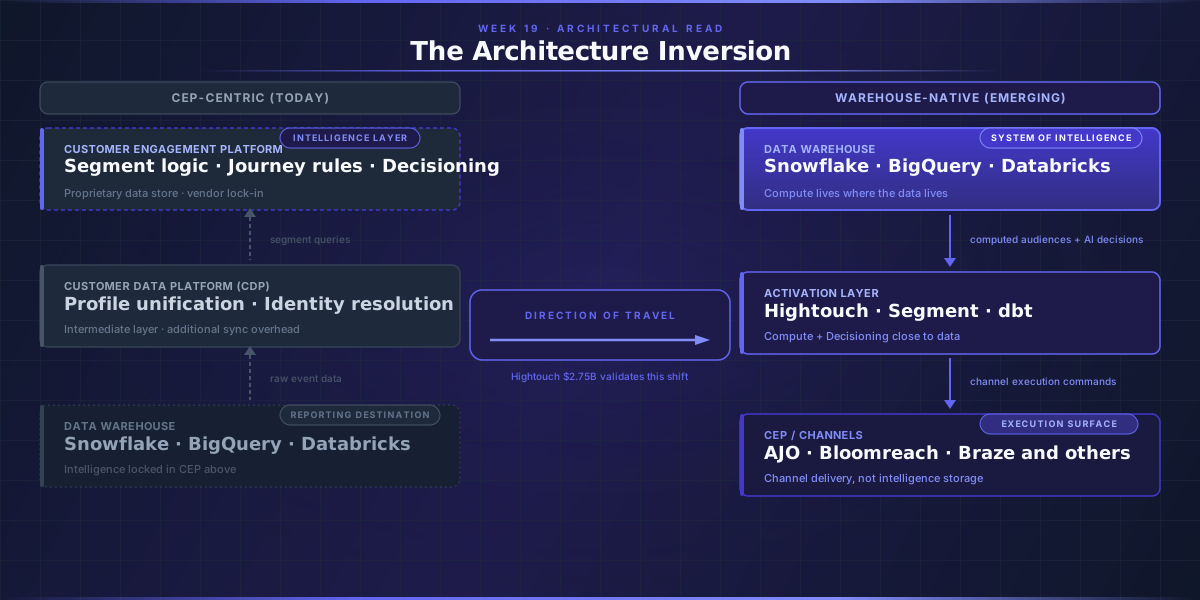
What Hightouch has built and what that valuation is paying for, is not a CDP. It is an activation layer that treats the data warehouse as the system of truth and everything else, including the CEP, as a channel. Audiences are computed in Snowflake, BigQuery or Databricks. Decisioning runs close to the data. Agents are goal-directed, not rule-driven. The result is a marketing stack where the intelligence lives at the data layer and the platform layer executes it.
This is architecturally the inverse of how most enterprise MarTech stacks are built today. In most organizations, the CEP is the system of intelligence: it holds segments, rules and audience logic in a proprietary data store and the data warehouse is a reporting destination.
Hightouch’s growth suggests that this reversal is no longer a fringe architectural pattern. Enterprise teams are taking it seriously and vendors that assumed the CEP would remain the default intelligence layer should probably pay attention.
If your current CEP’s competitive moat is proprietary segment management, you need to pressure-test whether that moat still holds against warehouse-native compute, especially when the warehouse is already the enterprise system of truth. If your data architecture is warehouse-first, the question is not whether to adopt warehouse-native activation, it is which activation layer you build on top.
2. Canva Buys Ortto: The Mid-Market CEP Map Just Changed
On April 9, Canva announced the acquisition of Ortto, a customer data and marketing automation platform, alongside Simtheory, an AI collaboration and agent platform. This acquisition is being underread.
The headline writes itself: design platform buys marketing automation. But that framing understates what is actually happening. Ortto is not a complementary tool that adds a feature to Canva. It is a functioning journey orchestration platform with segmentation, campaign execution, multi-channel delivery and analytics. Canva is not extending its design platform. It is building a marketing execution platform.
The strategic logic is straightforward. Canva has hundreds of millions of monthly users, with very strong penetration across SMB, mid-market and creative teams. For years, those users have been building assets in Canva and then exporting them into whatever CEP or email tool their organization uses: Mailchimp, HubSpot, Klaviyo, Braze or others. Every export is a point of friction, a risk of asset degradation and an opportunity for a competitor to own the relationship.
If Ortto is integrated deeply, Canva can start offering a much more complete workflow: design the asset, define the segment, build the journey, send the campaign — without leaving the platform. For teams that currently use Canva for creative and a separate tool for execution, the switching cost calculation changes entirely.
The architectural question is not whether Canva becomes a full enterprise CEP. It is whether the creative surface becomes an execution surface for a large part of the mid-market.
The incumbent marketing execution vendor in that organization may soon find itself competing against a bundled alternative inside the tool the team already uses every day.
This will not affect Braze’s enterprise accounts or AJO’s Adobe ecosystem customers in the near term. But in the mid-market — which is exactly where Klaviyo, HubSpot Marketing Hub and Bloomreach Engagement compete hardest, Canva/Ortto is a new entrant with distribution advantages that none of those vendors can easily replicate.
For platform architects evaluating MarTech for clients in the $50M–$500M revenue range: add Canva to the long list. Not because it is ready today, but because the acquisition trajectory is clear and the distribution moat is real.
3. Braze April 30 Is an Operational Consolidation Statement
Braze’s April 30 release is worth reading carefully because the items cluster around a coherent theme: reducing the operational surface area required to run complex marketing programs.
Read it item by item and the pattern becomes clear:
WhatsApp Template Builder removes the requirement to manage template creation in Meta Business Manager and then import back into Braze. For teams running WhatsApp at scale, the round-trip between two platforms was both slow and error-prone.
eCommerce recommended events introduces a standardized behavioral data schema: six events covering the purchase journey from product_viewed to order_refunded. This matters because behavioral event proliferation is one of the most common root causes of MarTech architecture debt.
Multi-language translations means a single campaign can serve all markets rather than requiring language variants to be built and maintained as separate campaigns. Send to Destination Canvas means shared messaging logic can be modularized across Canvases rather than duplicated. Zero-copy CDI Canvas triggers mean event-driven personalization from warehouse data no longer requires writing context fields to Braze profiles first.
Each of these reduces a point where a human was previously required to intervene, translate, or maintain something. Collectively, they describe a platform making itself more operable with less operational overhead. That is a competitive statement directed at enterprise procurement — where the total cost of ownership argument is increasingly decided by how much team capacity a platform consumes, not just its license cost.
4. Adobe Journey Optimizer Is Building Toward Autonomous Journey Management
I have been watching AJO’s release cadence closely across these three digest runs. A pattern is emerging that is worth naming.
Look at the individual May items: Journey Simulation lets practitioners validate journey logic against simulated users without touching production. Decisioning AI optimization detects and suggests simplifications in rules and formulas that would otherwise require a specialist to audit. The Integrations feature GA removes the need for a separate data pipeline to bring third-party content into journeys. Journey Fragments (coming May 12) will let teams build reusable node sets rather than rebuilding common logic patterns from scratch.
None of these are individually revolutionary. But read together, they describe a systematic reduction in the human interventions required across the journey management lifecycle. Simulation reduces QA intervention. AI optimization reduces formula maintenance. Fragments reduce rebuild effort. Integrations reduce data engineering dependencies.
Adobe is building toward a model where practitioners define intent (what audience, what goal, what constraints) and the platform handles the execution detail. That is not fully autonomous marketing. But it is a coherent architectural direction and it is being executed at a release cadence that competitors are going to find difficult to match without similar vertical integration across the product stack.
The governance question this raises is one I keep returning to: as the platform takes more execution decisions autonomously, where does accountability sit when it makes the wrong one? Journey Simulation is partly an answer to this. You can validate logic before it reaches customers. But simulation tests the rules you thought to test. Autonomous AI-driven prioritization (Journey Arbitration AI Models, Decisioning AI optimization) operates across cases you did not anticipate. This is not a reason to avoid adoption. It is a reason to think carefully about what your evaluation, audit and override framework looks like before you enable it.
What the Architecture Is Telling You
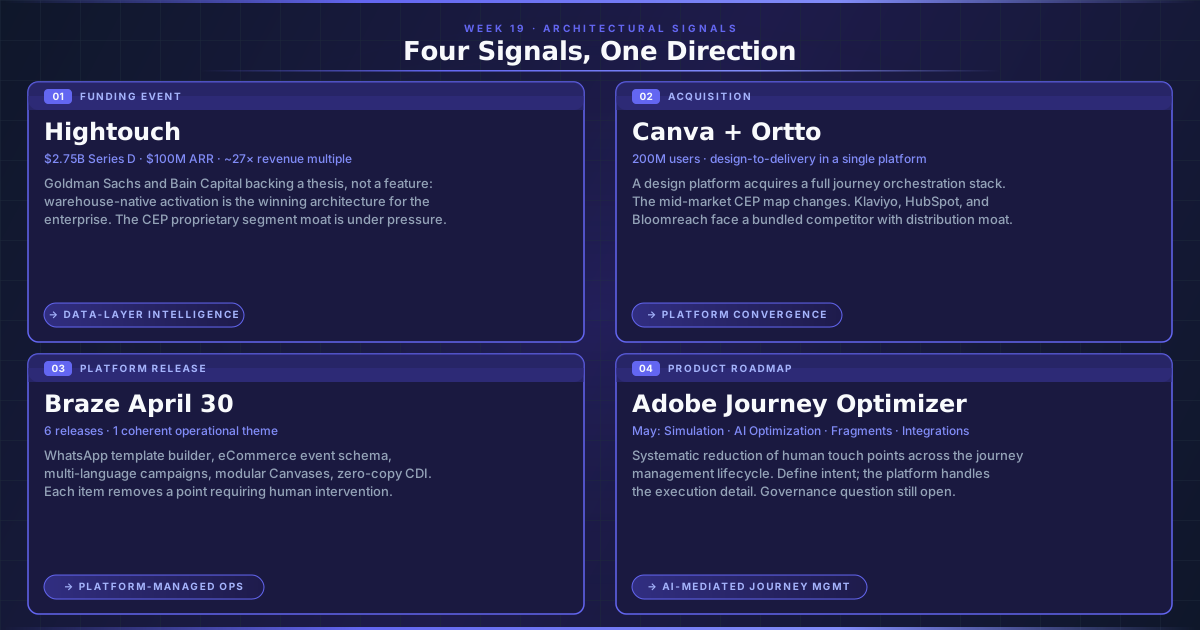
Four signals, one direction. The marketing stack is reorganizing around:
Data-layer intelligence: Activation that starts in the warehouse and flows down to channels, rather than CEP-managed proprietary data stores. Hightouch at $2.75B is a strong institutional confirmation.
Platform-managed operations: CEPs reducing the human intervention required to run complex programs, schema standardization, template management consolidation and modular journey components. Braze April 30 is the operational expression of this trend.
Platform convergence via acquisition: Design platforms buying automation platforms (Canva/Ortto). AI agent platforms being acquired to add execution capability (Simtheory). The assumption that the marketing stack will remain specialized is being tested by acquirers with distribution advantages.
AI-mediated journey management: Not autonomous marketing, but systematically AI-assisted, from rule optimization to journey simulation to personalization expression generation. AJO is the most explicit articulation of this roadmap, but the pattern is increasingly visible across the category.
The practical consequence is that platform evaluation can no longer stop at channel coverage, journey builder usability or AI feature lists. The more important questions are becoming architectural: where intelligence is computed, where customer truth is mastered, how operational complexity is absorbed and which layer is allowed to make decisions.
Sources
Adobe Journey Optimizer
Braze
Hightouch
- Hightouch | Raising $150M to build the AI platform for marketers
- TechCrunch | Hightouch reaches $100M ARR fueled by marketing tools powered by AI
Canva
The digest behind each weekly article is produced through a structured AI-assisted scan of official release notes and product update sources. I review the output, verify the relevant signals and write the architectural interpretation.
This article draws from the Martech Weekly Digest scans run on May 7, 2026, covering release notes and product updates across 11 CEP platforms and 10 vendors.
If you find errors or gaps in coverage, I want to know. The process improves when the output is challenged.