
15 min read
For years, one of the most repeated promises in MarTech has been business autonomy.
The idea was simple and attractive: give marketers the platform, give them the canvas, give them the segmentation builder, give them the drag-and-drop editor, and finally give them the possibility to launch without constantly waiting for IT, data teams or external agencies.
In many ways, that promise was real.
Marketing teams became faster. Campaign managers could build journeys without opening a ticket. CRM specialists could define audiences without writing SQL. Lifecycle teams could test subject lines, adjust timing, duplicate flows and move from idea to execution with much less friction than before.
But after years of working with these platforms, I think the reality is more complicated.
Business autonomy was never only a matter of giving the business a better user interface.
In practice, business autonomy depends far more on architecture, governance, and operating model than on how friendly the interface looks.
And now that agentic AI is entering the marketing stack, the same question comes back with more intensity: will AI agents really make powerful platform capabilities easier to access, or will they simply move complexity from the interface into the operating model?
The old promise of autonomy
The first generation of marketing automation and customer engagement platforms promised autonomy mainly through abstraction.
A journey canvas replaced custom workflow development. A segmentation UI replaced direct database queries. A content editor replaced static template requests. A campaign scheduler replaced manual coordination. A dashboard replaced exported reports.
This was an important shift.
It also created a misunderstanding.
Many companies started to believe that if a platform looked easy to use, the operating model around it would also become easy. In reality, that almost never happens.
A visual canvas can make orchestration more accessible, but it does not solve audience definition. A drag-and-drop editor can simplify content creation, but it does not solve brand governance. A no-code segmentation tool can empower marketers, but it does not solve data quality. A campaign approval flow can reduce some operational risk, but it does not solve unclear ownership. A recommendation engine can personalize experiences, but it does not solve consent, eligibility or measurement.
The user interface can remove friction from the surface.
It cannot remove complexity from the system.
Autonomy without architecture becomes fragility
When business teams are given powerful tools without strong foundations, autonomy can quickly turn into fragmentation.
More people can create segments, but nobody knows which segment is the canonical one. More journeys can be launched, but nobody has a complete view of customer pressure. More tests can be activated, but measurement logic becomes inconsistent. More content variants can be generated, but reuse and governance disappear. More campaigns can go live, but no one is fully sure which data, consent rules or exclusions were applied.
The result is not always visible chaos.
Sometimes it is something more subtle, and in many ways more dangerous: slowness.
Not the old slowness of waiting for IT to implement a request, but a new kind of slowness. The slowness of checking. The slowness of asking who owns a rule. The slowness of validating whether a segment is correct. The slowness of understanding which journey wins when two journeys overlap. The slowness of explaining why a customer received a message. The slowness of rebuilding trust after one visible mistake.
This is why business autonomy cannot be reduced to the question of whether the marketer can click the button.
The real question is whether the marketer can safely act without creating downstream ambiguity.

Enter the agentic layer
Now a new promise is arriving.
AI agents will help marketers access complex platform capabilities without needing to understand every configuration detail.
Instead of manually building a segment, a marketer will describe the audience in natural language. Instead of designing a journey step by step, they will ask the system to propose one. Instead of manually reviewing performance, an agent will detect anomalies or opportunities. Instead of writing every content variant, generative tools will create them. Instead of configuring every experiment, the platform will suggest what to test next.
This is not science fiction anymore.
Across the MarTech stack, agentic capabilities are moving from roadmap language to product capability.
Adobe is pushing AI deeper into Journey Optimizer capabilities such as decisioning, AI-assisted journey expressions, rule and ranking-formula optimization, journey simulation and model monitoring. Iterable describes Nova Agents as goal-driven AI agents that turn customer behavior and marketing intent into action. Klaviyo frames marketing agents as systems that can turn a plain-language prompt, goal, brief or idea into complete campaigns or flows for review and approval. Salesforce describes Agentforce in Marketing Cloud Next as a way to draft, refine and generate multichannel and conversational marketing campaigns.
At first sight, this should be the perfect answer to the business autonomy problem.
If platforms are powerful but difficult, agents should make them easier. If marketers do not know where a feature is hidden, they can ask. If they do not know how to configure a journey, the agent can propose it. If they do not know how to read performance, the agent can summarize it. If they do not know which audience to target, the agent can suggest one.
But this is exactly where I think we need to be careful.
The agentic layer does not remove complexity.
It changes where complexity appears.
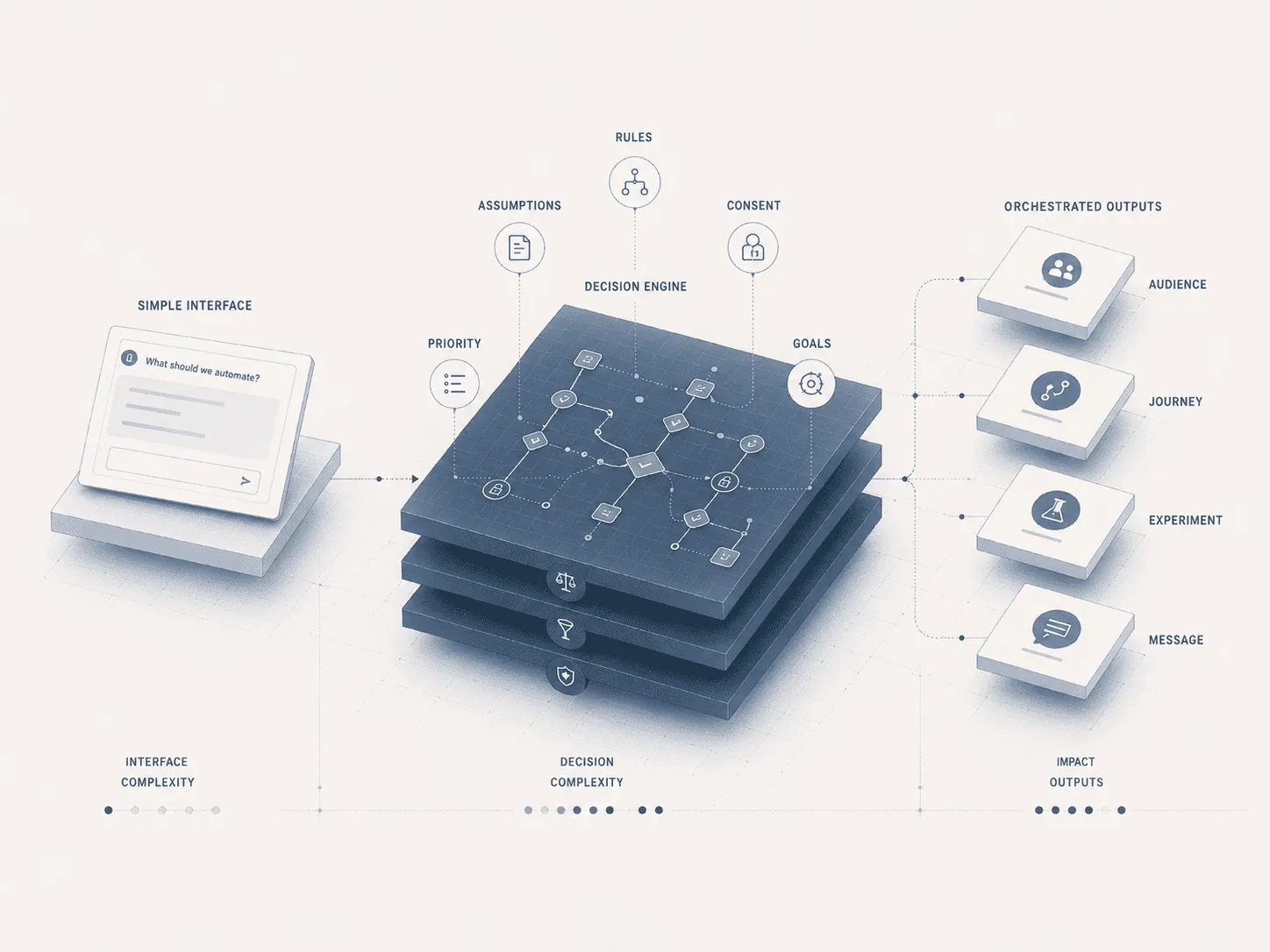
From interface complexity to decision complexity
Traditional MarTech complexity was often visible.
You had to know where to click, understand the data model, configure the journey, select the right audience, define the rule and build the test.
The difficulty was in the interface and in the configuration.
Agentic AI may reduce that friction significantly, but it introduces another kind of complexity: decision complexity. By this, I mean the effort required for people to understand, challenge, and trust the decisions a system makes on their behalf.
What exactly did the agent understand? Which data did it use? Which assumptions did it make? Which business rule did it prioritize? Which exclusions did it apply? Which consent logic did it respect? Which goal did it optimize for? Which trade-off did it silently make?
In other words, the marketer may no longer need to know every step required to build an activation, but someone still needs to understand whether the activation makes sense.
And this may become harder, not easier.
A poorly configured journey is visible if you know where to look.
A poorly reasoned agentic recommendation may look perfectly polished.
That is the new risk.
A simple example
Imagine a lifecycle marketer asks an agent:
Create a reactivation journey for high-value customers likely to churn.
The request sounds clear.
But underneath it, the system has to answer several questions before it can act responsibly.
What is a high-value customer? Is value based on revenue, margin, frequency, predicted lifetime value or strategic segment? What does “likely to churn” mean? Which model produced that score, how fresh is it, and is it valid for this market?
Which customer profile is authoritative? Are anonymous and known identities reconciled? Which consent status should be enforced? Which channels are eligible? Which products or offers should be excluded?
What happens if the same customer is already in an onboarding, win-back or complaint journey? What is the measurement logic? What does success mean: conversion, retention, margin, engagement or reduced risk?
Even a “simple” journey hides decisions about:
- Who should be eligible and when.
- Which channels and content combinations are acceptable.
- How much pressure and risk the business is willing to tolerate.
If these questions are already encoded in the architecture, the agent can become useful very quickly.
It can translate intent into a proposed audience, journey, content set, experiment and measurement plan. It can explain what it used, what it excluded, what needs approval and where confidence is low.
But if these questions are not answered in the system, the agent has only two options.
It can ask for clarification, which may slow the process down.
Or it can make assumptions.
And assumptions are where business autonomy becomes dangerous.
Customer engagement is coordination complexity
In customer engagement, complexity is rarely isolated.
A campaign decision is also an audience decision, a consent decision, a channel decision, a pressure decision, a measurement decision and sometimes a commercial priority decision.
You see this every day in channel conflicts, last-touch attribution fights, and unclear ownership of who is allowed to contact whom and when.
The agent may help with one of these layers, but the customer experiences the combination.
This is why agentic marketing cannot be evaluated only at the level of individual task automation. The real test is not whether an agent can create a journey, generate content or suggest a segment. The real test is whether it can operate inside a system where journeys, audiences, channels, eligibility rules and business priorities are already coordinated.
Otherwise, the agent may simply make isolated execution faster while making systemic coordination harder.
Prompting is not an operating model
This is why I do not think the future of business autonomy is simply that marketers will prompt the platform.
That is too simplistic.
Prompting is not an operating model.
A prompt can express intent, but the platform still needs a controlled environment in which that intent can be executed. Teams do not manage accountability, consent, and pressure with prompts; they manage them with processes, permissions, and shared definitions.
For agentic autonomy to be useful, the system needs reusable definitions, approved rules, governed data access, clear permissions, explainable recommendations and auditable decisions. Otherwise, agents may become just another layer that needs to be checked, corrected, approved and debated.
The promise is speed; the risk is a new review bottleneck.
Before, teams reviewed campaigns because humans made mistakes in configuration. Tomorrow, teams may review agentic recommendations because nobody fully understands the assumptions behind them.
That is not autonomy.
**That is assisted uncertainty.**willa
Real autonomy means controlled freedom
I think we need a better definition of business autonomy in MarTech.
Business autonomy should not mean that the business can do anything alone. That is not realistic, and in enterprise environments it is not even desirable.
Business autonomy should mean that business teams can act safely within a well-designed system.
Safely means they can use trusted data without having to rebuild its meaning every time. It means they can activate audiences knowing that consent and eligibility rules are enforced. It means they can launch journeys knowing that pressure and priority rules are respected. It means they can generate content knowing that brand, legal and localization constraints are embedded. It means they can test ideas knowing that measurement is consistent. It means they can use AI recommendations knowing that the logic is explainable enough to trust.
Most of all, it means they can move fast because the system has already absorbed part of the complexity.
This is very different from “the UI is easy.”
It is closer to controlled freedom.
And controlled freedom requires architecture.
The platform is not enough
This is also why I am skeptical when business autonomy is sold as a vendor feature.
Of course, platform capabilities matter. Some tools are clearly easier to use than others. Some platforms expose data better. Some have stronger AI assistance. Some provide better governance, permissions, templates, approval workflows, experimentation controls or journey management. These differences are real, and they matter in any serious evaluation.
But no platform can compensate for an organization that has not decided who owns customer definitions, where consent is mastered, how campaign priority is resolved or what “good performance” actually means.
If consent logic is fragmented across systems, the platform will inherit the ambiguity. If product data is inconsistent, personalization will remain fragile. If campaign priorities are political rather than explicit, the journey canvas will reflect that confusion. If measurement is not aligned, AI optimization may simply optimize the wrong thing faster.
The platform can enforce logic, but it cannot invent organizational clarity.
The architecture always wins.
Not because technology is unimportant, but because technology can only execute the logic it is given, the data it can access and the constraints it is able to enforce.
Agents as interface or control layer
The most interesting question is not whether agents will make platforms easier to use.
They will, at least for many tasks.
The more important question is what role agents will play in the engagement architecture.
Most current “AI copilots” stop at being a smarter interface; the real shift happens when agents become a control layer that can orchestrate actions across systems.
A smarter interface helps users find features, generate content, summarize analytics and configure campaigns faster. That is useful.
A control layer does something more important.
It understands goals, checks constraints, evaluates conflicts, applies governance, explains decisions, learns from outcomes and helps coordinate action across journeys, audiences, channels and systems.
That is where the real value may be.
It is also where the risk increases.
Once an agent moves from suggestion to execution, the governance question becomes much more serious.
Who defines the goal? Who approves the guardrails? Who decides what the agent is allowed to change? Who monitors performance? Who audits decisions? Who is accountable when the system acts correctly from a technical point of view, but wrongly from a business point of view?
This is where many organizations are not ready yet.
It is also where broader AI governance frameworks become relevant. NIST, for example, describes trustworthy AI through characteristics such as validity, reliability, safety, security, resilience, accountability, transparency, explainability, privacy enhancement and fairness. In Europe, this conversation will also become harder to separate from regulatory expectations, as EU AI Act transparency rules are scheduled to apply from August 2026.
For most marketing and product teams, this will translate into more explicit documentation of who owns which rules, where they live, and how they change.
I would not overstate the compliance angle for every marketing use case.
But I would not ignore the direction either.
The more AI moves from assistance to execution, the more the operating model will need to answer questions of transparency, accountability and control.
Autonomy will not be evenly distributed
Another point is worth considering: agentic AI may not increase autonomy equally for everyone.
For experienced users, it may become a multiplier. A strong CRM manager, lifecycle marketer or MarTech specialist will use agents to move faster, explore alternatives, reduce repetitive work and access advanced capabilities with less friction.
For less experienced users, however, the same layer may create a different problem.
If you do not understand the system, a confident AI recommendation can be hard to challenge. The agent may make a weak idea look operationally mature. It may optimize for short-term conversion while quietly damaging the long-term customer experience.
The question is not only whether AI will democratize access, it probably will.
The question is whether organizations will also democratize understanding.
Autonomy without understanding is not empowerment. It is dependency with a better interface.
The new bottleneck
There is a possible future I find very realistic.
Marketing teams start using agents to create more ideas, more variants, more journeys, more tests and more recommendations. The volume of possible action increases dramatically, but governance, approval, measurement and coordination do not evolve at the same speed.
So the bottleneck moves.
It is no longer campaign creation but campaign validation; no longer “who can build this?” but “who can approve all of this?”; no longer lack of ideas but too many executable ideas.
This is where agentic AI could paradoxically make some processes slower.
Not because the AI is slow, but because the organization is not ready for the increase in executable complexity.
When creation becomes cheap, prioritization becomes expensive.
And when execution becomes easier, governance becomes the real constraint.
What I would look for in a mature agentic layer
If I had to evaluate agentic capabilities in a customer engagement platform, I would not start from the demo.
I would start from the boundaries.
At minimum, I would want the agentic layer to answer the following clearly:
What can the agent see? What can it change? What can it only recommend? What requires approval? What is logged? What is explainable? What is reusable? What is governed centrally? What can be overridden locally? How does it handle conflicts between journeys? How does it understand consent and channel eligibility? How does it distinguish business goals from platform metrics? How does it learn from outcomes without creating uncontrolled drift?
These questions are less exciting than a natural language demo, but they matter more.
In enterprise MarTech, the problem is rarely whether a platform can generate an idea.
The real problem is whether the organization can trust that idea enough to act on it.
You can think of a simple maturity progression for agentic layers:
- Level 1: Assistants as a friendlier UX on top of existing tools.
- Level 2: Guarded execution, where agents can perform actions within clear boundaries and approval gates.
- Level 3: Governed control layer, where agent behavior is tied to explicit policies, ownership, and monitoring.
If you only do three things
Before evaluating any agentic capability, make sure your organization has addressed the fundamentals:
- Decide who owns customer definitions, consent rules, and pressure thresholds, and make that ownership explicit and documented.
- Define what agents are allowed to decide and what must remain a human decision, and write down why.
- Make the agent’s sources, assumptions, and limits visible so that non-technical teams can question them.
Business autonomy is becoming architectural autonomy
The more I look at the direction of the market, the more I think business autonomy is evolving.
In the past, autonomy meant asking whether the business could use the platform without technical support.
Now it should mean asking whether the business can express intent and let the system translate it into safe, governed, measurable execution.
That is a much higher bar.
Business autonomy is becoming architectural autonomy: the ability for business teams to express intent inside a system where data, rules, permissions, measurement and accountability are already structured enough to make that intent executable.
It requires more than AI.
It requires a clear data model, identity resolution, consent enforcement, decision governance, reusable definitions, content and brand constraints, pressure management, measurement discipline, explainability and an operating model that knows where human judgment still matters.
The agentic layer may become the most important interface between business intent and platform execution, but only if the architecture underneath is strong enough.
Otherwise, it will become another layer of translation, another layer of review, another layer of uncertainty and another place where everyone waits for someone else to confirm that the system did the right thing.
The real promise
I am not pessimistic about agentic marketing.
Actually, I think it will become one of the most important shifts in customer engagement platforms.
But its value will not be in making complex platforms magically simple.
Its value will be in making complexity more manageable.
There is a difference.
The best agentic layers will not remove the need for architecture. They will expose where architecture is missing.
They will make weak definitions visible. They will reveal unclear ownership. They will stress-test governance. They will show whether data is usable, fresh and trusted. They will force companies to decide what can be automated and what still needs human judgment.
In that sense, agentic AI may not be the final answer to business autonomy.
It may be the mirror.
A mirror showing whether the organization has built a system where the business can really move faster, or whether it has simply placed a conversational interface on top of the same old ambiguity.
Business autonomy was never just a UI problem.
And the agentic layer will not change that.
It will only make it more obvious.
Sources
Adobe
Iterable
Klaviyo
Salesforce
NIST
European Commission