
8 min read
The future of marketing isn’t automation — it’s collaboration between human imagination and machine intelligence.
What if your marketing team had an AI colleague — one that could design, test, and optimize campaigns overnight while you focused on strategy and creativity? That’s not a hypothetical for tomorrow. That’s Agentic Marketing.
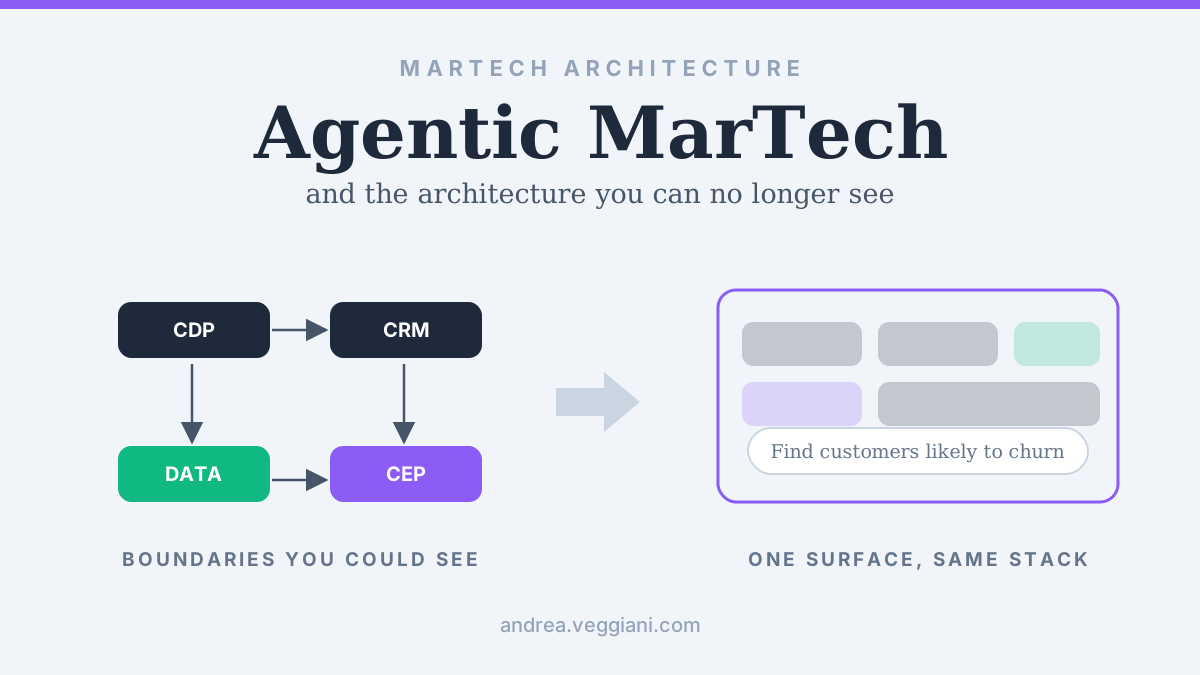
If Marketing Automation was about scaling actions and Customer Engagement about predicting needs, Agentic Marketing is about delegating intent, letting AI act toward your business goals while humans steer purpose.
From Automation to Autonomy: The Great Shift
For decades, we’ve relied on automation tools to scale our efforts. Today’s Customer Engagement (CE) platforms already leverage predictive intelligence to suggest the best offer or timing (Part 2 covered this shift).
Agentic systems represent the next evolutionary leap — a move from Level 1 Automation (scripted workflows) to Level 4 Autonomy (goal-driven execution) (6). They act with defined autonomy toward a business outcome that you, the marketer, set. It’s the difference between a self-driving car that only suggests a turn (prediction) and one that executes the entire, complex journey, handling unexpected traffic and road closures without continuous manual input (agency).
Defining the Mission, Not the Mechanics
The power lies in Goal Decomposition. Instead of building a complex journey map with hundreds of nodes, you issue a strategic directive, like the example below, and the agent breaks it down into thousands of tactical micro-goals:
“Increase Customer Lifetime Value (CLV) for silver‑tier customers by 15% this quarter.”
An agentic system doesn’t just queue emails; it becomes a performance orchestration engine for the entire customer base.
Orchestrating the Autonomous Strategy
The sequence below is an illustration of how such a system would behave, a design sketch rather than a report of results measured in a deployment. With that said, the actions are data-driven and aimed at the 15% CLV target:
- Experiment Design and Scaling: It automatically sets up multiple parallel A/B/C tests across email, push notifications, in-app messaging, and paid social. It doesn’t just run a test; it dynamically scales the winning variant, moving audience segments from the test pool to the execution pool in real-time.
- Resource and Budget Allocation: This is where true agency shines. The system sees that conversions from low-value email segments are stalling (low ROI), while a high-intent segment responding well to personalized in-app messages offers a higher predicted CLV uplift. It immediately pauses the low-performing email budget and reallocates those funds to the high-converting mobile channel.
- Content Generation and Curation: The agent observes that a specific email subject line variant — perhaps one using humor — performed exceptionally well in A/B testing. It uses this insight to automatically generate new, contextually similar copy and visual assets for dynamic social ads and on-site banners, adhering to the brand’s style guide (the “Brand Voice Genome,” which we discuss below).
- Continuous Learning Loop: The system constantly learns from the live performance data streamed back immediately via the Real-Time CDP (6). It adjusts channel mix, offers value, and creative variants hourly — all without a human needing to touch a workflow configuration.
This is the fundamental difference: the shift from prescriptive automation to autonomous, goal-oriented autonomy. The machine manages the mechanics; the human manages the mission.
The New Role of the Marketer: Orchestrator, Ethicist, Storyteller
As AI reliably takes over the mechanical burden of execution, the role of the marketer undergoes a profound and exciting transformation. We evolve from being operators — workflow builders and button-clickers — to becoming Orchestrators of intelligent systems.

The marketer of tomorrow won’t manage 50 individual workflows; they’ll manage three core pillars:
1. The Strategist (Vision and System Design)
The marketer’s primary function becomes outcome planning, not campaign planning. We shift from asking, “How do I build this email?” to “What business outcome must this AI system deliver?”. Marketers define high-level, human-centric objectives (e.g., “Deepen emotional connection with new parents in the first 90 days,” or “Increase engagement by reducing intrusive contact frequency by 20%”). The AI then translates this into measurable, agentic goals, like the CLV example. This requires a new skill: System Design. The marketer designs the AI’s feedback loop, input data sources, and permissible actions, rather than designing the individual message path.
2. The Storyteller (Creativity and Brand Integrity)
The unique human capability — creativity — is amplified, not replaced.Marketers must define the Brand Voice Genome — the non-negotiable set of ethical and emotional rules (tone, humor, visual style, acceptable messaging) that generative AI tools like Adobe GenStudio (1) must strictly adhere to. This genome prevents the AI from becoming generic or, worse, going “off-brand.” For instance, a luxury brand must hard-code a rule preventing the AI from generating copy that uses slang or offers deep, margin-eroding discounts. Only humans can create true emotional meaning and brand identity; the AI simply ensures that meaning reaches every person, every time, at scale.
3. The Data Ethicist (Guardrails and Governance)
This is the most critical new role: the Data Ethicist. As the AI agent is granted autonomy, the human marketer is responsible for building AI Fences — strict limitations on the agent’s behavior. Examples of these fences include:
- Frequency Capping: “Do not contact any customer more than 3 times in 48 hours across all channels.”
- Exclusion Zones: “Exclude any customer categorized as ‘highly price sensitive’ from receiving full-price product announcements.”
- Bias Mitigation: “Ensure the Next Best Offer selection does not create disparate impacts across protected demographic groups.” You must ensure the AI operates within the brand’s ethical boundaries, preventing unintentional bias or predatory targeting.
Trusted Data and Ethical AI (Non-negotiable Foundation)
Agentic marketing is only as effective as its foundation. If the data is siloed, delayed, or untrustworthy, you get the digital equivalent of “garbage in, garbage out.” Trusted, unified, and governed data is a prerequisite for autonomy. An agent can only act responsibly if it has a complete, accurate, and real-time view of the customer.

Key enablers that make ethical agency possible:
- Data Unification & Real-Time Profiles: Agents require instant context. Enhancing customer understanding is impossible without a unified, real-time data layer. Waiting for batch processes to update a customer profile means the agent will always be acting on yesterday’s data. Platforms like Adobe Experience Platform (AEP) (3), Salesforce Data Cloud (4), Tealium AudienceStream, and several others consolidate billions of fragmented customer events into a single, real-time profile. This process is complex, requiring precise Identity Resolution to stitch together interactions from anonymous web browsing, authenticated app usage, and in-store purchases into one golden record. The agent needs this instantaneous, comprehensive view to act responsibly.
- Data Clean Rooms & Privacy-First Design: In a multi-party data environment, collaboration is key, but privacy is paramount. Data Clean Rooms allow competitive brands (e.g., a CPG manufacturer and a major retailer) to safely collaborate on audience insights without sharing raw Personally Identifiable Information (PII) (7). This capability allows the agent to receive high-fidelity, privacy-compliant signals (like “customer is likely to purchase competitor X’s product”) which feeds their autonomous actions, ensuring collaboration without leakage.
- Explainable AI (XAI): Transparency is vital for building trust. Marketers must be able to pull back the curtain and understand why a model chose a specific action before it goes live. For instance, in a “Next Best Offer” scenario, XAI might reveal that the model favored a mid-level discount coupon because the customer recently viewed the returns policy on the website (signaling high price sensitivity), not just because they were a “silver tier.” This transparency allows the human ethicist to intervene, correct data biases, and build confidence in the system.
- Regulatory Alignment: The increasing global focus on AI governance, such as the EU AI Act (2), sets clear expectations on risk, transparency, and mandatory human oversight for high-risk AI systems. Agents must be designed with these regulations baked in from the start, requiring documentation of their decision-making processes — a task XAI is critical in supporting.
Ultimately, accountability matters. As the Salesforce State of Data & AI 2024 report confirms, most teams still demand human-in-the-loop oversight — not because AI lacks value, but because the ultimate accountability for the customer experience rests with the brand and the marketer. The machine executes consistently and at a scale no team can match, and when it is wrong it tends to be wrong quietly and systematically rather than obviously, which is exactly why a human has to stay accountable for the outcome.
The Human Factor: Empathy at Scale
On narrow, well-posed questions, such as whether this person will open, churn, or buy again within thirty days, a model trained on enough of the right history can be accurate enough to act on, and it can optimize relentlessly for clicks, conversions, and CLV. That accuracy is conditional: it holds while the training data still resembles the population you are scoring, and it degrades quietly when the market, the product or the audience moves. What no model supplies, at any accuracy, is a reason for the whole exercise. Only humans can create meaning.
The next era is not about machines replacing creativity; it’s about machines amplifying it to unprecedented scale. The AI provides the perfect brush and canvas, but the human defines the emotional resonance and strategic intent — the masterpiece that moves people.
Marketers must define the brand’s emotion, values, and ethics. The Agentic system then ensures those values and stories reach the right person, at the perfect moment, at a speed and scale impossible for a human team alone. That’s the true promise of Customer Engagement.
The Takeaway
Marketing began as storytelling. Automation made it scalable. Agentic AI is making it meaningful again by freeing human capacity from mechanical tasks.
Agentic marketing is not the end of human creativity — it’s its renaissance. When technology handles the mechanics, humans are finally free to focus on what we do best: creating powerful stories and setting the ethical vision that guides the machine.
Series Recap
- Part 1 — When Efficiency Killed Empathy (why Marketing Automation is broken)
- Part 2 — The AI Imperative (how AI + CDP enable Customer Engagement)
- Part 3 — Agentic Marketing (future‑ready teams and governance)
If this series resonated with you, let’s connect: I’m Andrea Veggiani, Head of Cross Channel Marketing @ BitBang and MarTech Solution Architect.
- LinkedIn: https://www.linkedin.com/in/aveggiani/
Sources
Regulation
- EU AI Act overview. The regulatory landscape for accountable AI systems.
Platform documentation
- Adobe, Experience Platform and Real-Time CDP. The unified data layer powering agentic systems.
- Salesforce, Data Cloud. The trusted data foundation for Einstein’s autonomous actions.
Research and commentary
- BCG, The Value of Data Clean Rooms. On privacy-preserving collaboration in marketing data.
- Adaline Labs, The 5 Levels of Agentic AI: From Basic Automation to Autonomous Intelligence in 2025