9 min read
Why Insider One is Part 3 (and why it sits at the crossroads of CEP and “Experience Optimization”)
If Braze (Part 1) felt like a pure engagement runtime and Bloomreach (Part 2) felt like commerce intelligence + experience, Insider One is the platform I often describe as “the bridge” between:
- Customer Engagement Platforms (orchestration, lifecycle, channel activation)
- Experience Optimization (personalization, experimentation, onsite decisioning)
In other words, Insider shows up when the enterprise brief is not simply “send more messages,” but:
- unify profiles
- personalize across owned channels (web/app)
- activate across messaging channels (WhatsApp is often a key driver in EMEA)
- reduce fragmentation between personalization tools and campaign tools
This is the third article in my series: one platform per chapter, same evaluation lens, practitioner-first.
Rebrand note: the vendor rebranded from Insider to Insider One in December 2025. I’ll use “Insider One” throughout, but some analyst material and older links still reference “Insider.”
A quick note on what I mean by “CEP” (and why Insider is often evaluated beyond it)
In my working definition, a CEP is a system of action that:
- listens to customer signals
- evaluates decision logic (rules, policies, models)
- orchestrates activation across channels
- measures outcomes and feeds learnings back into the loop
Insider One fits this definition, but it’s frequently evaluated for something broader: the ability to deliver personalized experiences onsite and in-app, not just in outbound comms.
Many enterprises already have an ESP, and most CEPs support inbound channels too, but Insider One really leans into inbound personalization as a first-class capability, a positioning that the 2026 Gartner Magic Quadrant for Personalization Engines also reinforces.
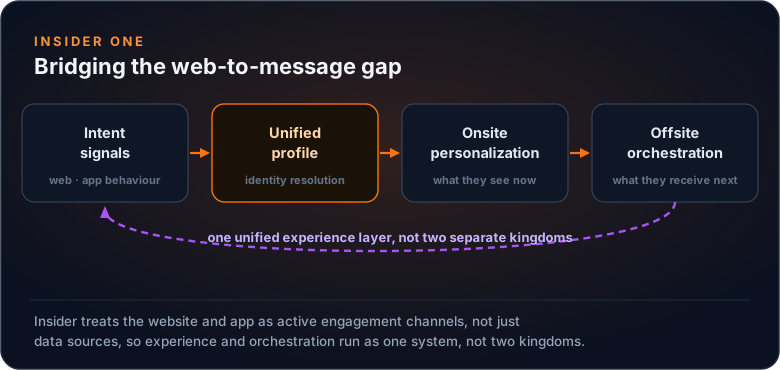
What they’re missing is a platform that can connect:
- customer intent (behavioral signals)
- onsite personalization (what the customer sees now)
- and offsite orchestration (what the customer receives next)
Insider One in one sentence
Insider One is a customer engagement platform that connects unified profiles to real-time activation, with standout strength in web/app personalization and messaging-first orchestration.
Its physics: user-centric growth. Every platform in this series has a centre of gravity that predicts how it behaves under load, and I map all eight against each other in Part 9. Insider One’s is user-centric growth: it arrives with the brain pre-installed, optimised for conversion and the web-to-message path.
A brief history: the “growth stage” platform that matured into a global enterprise player
Insider One was founded in 2012, and over the last decade it has positioned itself as an enterprise-grade platform focused on omnichannel engagement and personalized experiences.
From public company storytelling (and the way the product evolved), Insider One’s trajectory looks like a classic pattern in modern CX stacks:
- Start with onsite personalization / experience layer
- Expand into cross-channel engagement and orchestration
- Build (or integrate) customer data / profile capabilities
- Push hard into AI-driven decisioning and automation as scale increases
A practical indicator of Insider One’s enterprise posture is how often it appears alongside the core CCMH/CEP vendor set in analyst research (not only “personalization engines”).
How Insider is positioned today
Insider One positions itself as a consolidated platform that brings together:
- AI capabilities (agentic + predictive + generative, per its messaging)
- An integrated customer profile / (CDP-like layer)
- Personalization & experimentation surfaces
- Journey orchestration and multi-channel activation
A consistent theme in Insider One’s public positioning is the breadth of native channel support, including WhatsApp and other messaging-first channels, that can be critical in EMEA and emerging markets.
From a buyer’s perspective, Insider One often resonates when organizations want:
- One platform to cover both experience personalization and campaign orchestration
- Faster execution than suite-led ecosystems
- Strong coverage of channels that don’t always get “first-class product love” in older marketing clouds
Recent funding and growth milestones (and what they suggest)
Insider One is privately held, so we don’t get quarterly earnings calls. But we do have credible milestone signals via funding announcements and analyst coverage.
Series D, the unicorn moment
Insider in 2022 announced a $121M Series D at a $1.22B valuation (unicorn status). This round is widely referenced as a major inflection point that accelerated scale and global expansion.
Series E, $500M and the “AI + US expansion” narrative
In November 2024, Insider announced a $500M Series E led by General Atlantic, with explicit messaging around:
- accelerating AI investments
- fueling US expansion
- continuing to scale global operations
This is strategically important. In this market, a late-stage round of this size typically signals:
- ambition to become a category-defining enterprise platform
- heavier investment in R&D and go-to-market
- higher expectations from enterprise buyers around governance, scale, and ecosystem maturity
As of July 2026, the Series E remains the latest disclosed funding milestone; Insider is private and reports selectively.
Analyst signals: CCMH + Experience Optimization
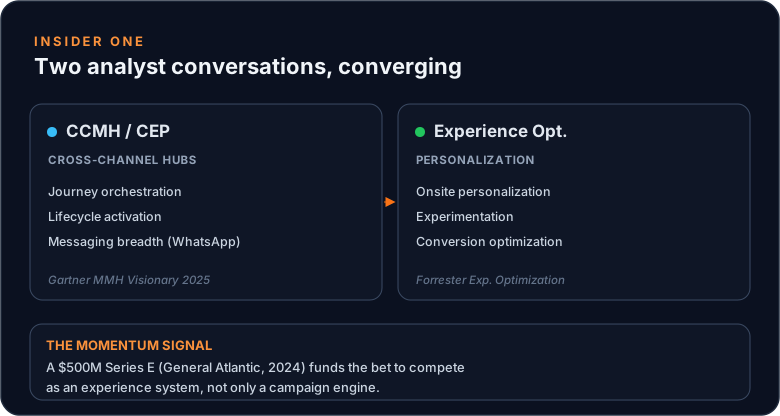
Insider shows up in two analyst “conversations” that are increasingly converging.
1) Cross-channel marketing hubs / CEP conversation
Forrester’s Cross-Channel Marketing Hubs market framing explicitly lists Insider among the significant vendors evaluated in its Q4 2024 Wave (alongside Adobe, Braze, Bloomreach, Iterable, Salesforce, and others).
The 2025 Gartner Magic Quadrant for Multichannel Marketing Hubs also recognized Insider as a Visionary, and Insider One has also highlighted recognition in Gartner Peer Insights “Voice of the Customer” contexts for Multichannel Marketing Hubs.
2) Experience optimization conversation
Insider One also shows up in the experience optimization conversation, the one about personalization and experimentation rather than campaigns. That matters because it means Insider One is being evaluated as an experience system, where personalization, experimentation and orchestration are tightly coupled, and not only as a campaign engine. It is the clearest signal of where the platform actually wants to compete.
A word of discipline on these badges, the same one I apply to every vendor in this series. Analyst placements and Peer Insights recognitions are useful signals, not proof of fit. A Wave or Magic Quadrant position depends heavily on the scope and criteria of that specific report, and a Voice-of-the-Customer style recognition, while harder to fake because it aggregates operator sentiment, still turns on review composition, participation thresholds and how actively the vendor solicits reviews. I read Insider One’s analyst presence as real evidence of ambition and momentum, then validate the specifics through reference calls and implementation track record rather than the badge itself.
The physics of Insider One: user-centric growth
I introduced this physics at the top; here is what it means in practice. Insider One is engineered around the “Growth Manager” persona, and its core logic assumes the channel is secondary to the user’s current intent. Where Braze asks you to build the brain through event design and Bloomreach reasons from the catalogue, Insider One arrives with the brain pre-installed, optimised for conversion and product discovery. That is a genuine head start, and it is also the thing to interrogate, because a pre-built brain is fast but only as good as your ability to see and govern the decisions it is making.
The Insider One mental model (how I explain it internally)
A useful way to think about Insider is as a Unified Experience Layer.
- It is not just an engine: It’s a strategic middleware.
- It bridges the web-to-message gap: Unlike “outbound-first” CEPs, Insider treats your website and app as active engagement channels, not just data sources.
- It’s “Managed Efficiency”: It thrives in environments where speed-to-market is valued over DIY engineering.
Competitive set (how it shows up in real programs)
Insider One’s competitive set depends on what the enterprise is actually trying to fix.
1) Independent CEP competition
When the buyer wants a high-velocity engagement platform, Insider frequently lands in the same room as:
- Braze / Iterable / CleverTap / MoEngage / Netcore / Optimove / Zeta
The differentiation often comes down to channel priorities (especially messaging), onsite personalization depth, and how “integrated” the data + orchestration layers really are.
2) Experience optimization and personalization competition
When the buyer is trying to optimize onsite conversion and experiences, Insider competes with:
- experience optimization and experimentation vendors
- personalization engines
- and (in some cases) the native capabilities of commerce platforms
3) Suite-led ecosystems competition
In large enterprises standardizing on Adobe or Salesforce ecosystems, Insider One must justify why a specialized independent platform is worth it.
In these cases, the real conversation isn’t “features.” It’s:
- speed-to-value
- operating model
- and where decisioning should live
Where Insider One is strongest (my delivery-centric view)
If I had to summarize Insider’s practical strengths in enterprise programs:
- Breadth across owned + messaging channels (often compelling in EMEA)
- Personalization + orchestration in one narrative (reduces stack fragmentation)
- Strong market momentum (funding and analyst coverage suggest ambition + investment)
In delivery, the clearest win I have seen looks like this. A retailer with a heavy mobile app and a strong EMEA footprint uses Insider One to read intent from onsite and in-app behaviour, personalise the storefront in session, and then carry the same profile into a WhatsApp and email follow-up, so a browse-and-abandon on the app becomes a timely, relevant message on the channel the customer actually reads, with no separate CDP sync and no handoff between two tools. That is Insider One at its best: one profile driving both what the customer sees now and what they receive next. The failure mode is the mirror image, and the same programme stalls the moment the app team and the CRM team resolve identity differently, because then the profile is unified only on the slide.
When Insider One can struggle (or require a clearer design)
The specific trade-offs I watch for with Insider One are less about the product and more about the seams around it. The first is organisational: the whole promise is unifying the web-to-message path, but in most enterprises the website is owned by a digital or e-commerce team and the outbound channels by CRM, and if those two teams keep separate profiles and separate rules, you end up running Insider One as two products that happen to share a login, and the unified experience never actually shows up. The second is the pre-installed brain itself. The growth-optimised defaults that make Insider One fast to launch can be opaque when a merchandiser or a compliance lead asks why a particular customer saw a particular offer, so the more regulated the brand, the harder you have to push for explainability rather than accepting the recommendation on trust. The third is messaging pressure: WhatsApp and push are cheap to add and easy to overuse, and Insider One will happily let a lean team scale volume faster than its frequency and consent discipline can keep up, which is exactly where opt-outs and complaints begin. None of these are reasons to avoid the platform. They are the decisions to make on purpose before launch, rather than discover in month three.
The questions I like to ask early in an Insider evaluation
To get past demo aesthetics and into architectural truth:
- What is the identity strategy and how do we resolve profiles across web/app/CRM?
- How does the platform enforce consent and policy across channels?
- How do we manage frequency caps and conflict resolution across journeys?
- How do we operationalize personalization so it respects business rules (pricing, stock, margins, brand constraints)?
- What is the model for experimentation (A/B, holdouts, incremental lift), and who owns it?
Watch-outs I put in writing
- If your identity and event semantics are weak, “AI-native” becomes “AI-noisy.”
- If your governance model can’t keep up with activation speed, you will create cross-journey conflicts.
- If the org treats onsite personalization and outbound orchestration as two separate kingdoms, the platform’s unified promise won’t materialize.
What’s next
Part 4 moves to Adobe Journey Optimizer and what suite gravity changes.
Sources
Insider One
- Company and product overview
- Recognition in The Forrester Wave: Experience Optimization, Q4 2024
- Unicorn status and the $121M Series D at a $1.22B valuation
- Gartner Peer Insights Voice of the Customer, Multichannel Marketing Hubs
- Gartner Peer Insights Voice of the Customer, Personalization Engines
Forrester
- Vendor list for The Forrester Wave: Cross-Channel Marketing Hubs, Q4 2024. Mentions Insider among the 14 vendors.
- The Forrester Wave: Cross-Channel Marketing Hubs, Q4 2024. Gated.
- The Forrester Wave: Experience Optimization Solutions, Q4 2024. Gated.
Funding and company history
- Endeavor, Insider CEO story. Includes founding year and platform framing.
- General Atlantic, $500M Series E led by GA, 1 November 2024.
- GlobeNewswire, $500M Series E announcement