10 min read
The identity layer is contested ground again
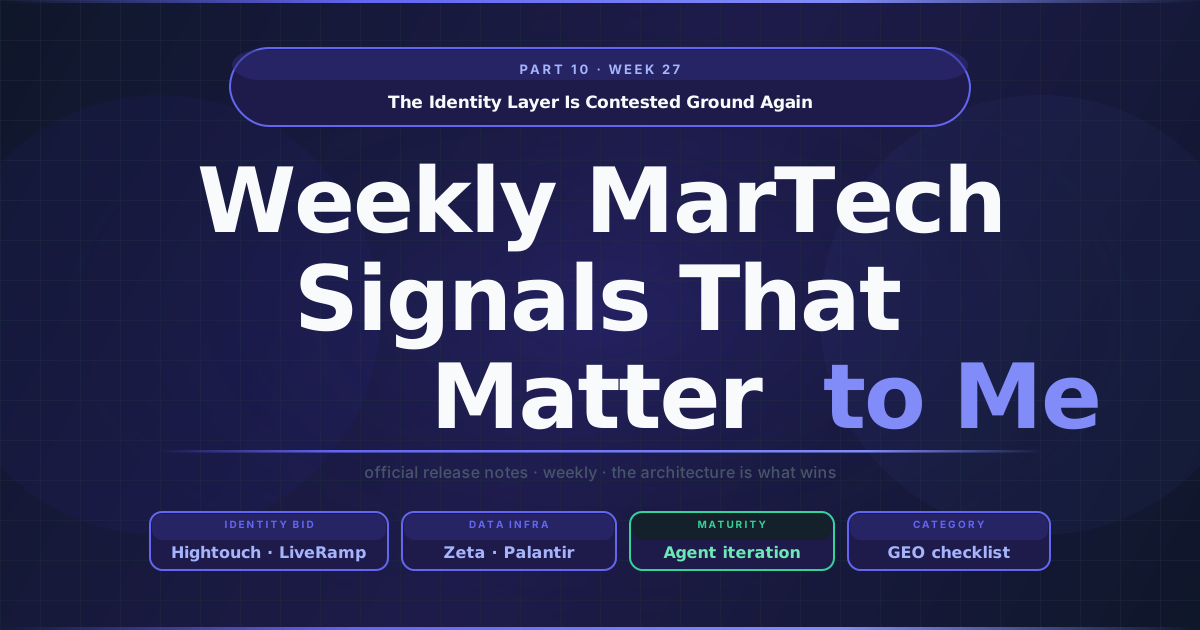
Twice in the last few years I have watched the industry decide, collectively and without much discussion, that the identity layer was a solved problem. Buy a resolution vendor, plug it into your CDP, move on to the more interesting work of orchestration and personalisation. Week 27 is a reminder that it never actually got solved, it just got quiet for a while.
Two unrelated stories, an identity-asset bid and a data-infrastructure partnership, both point at the same layer of the stack. And both are more interesting for what they reveal about who wants to own it than for what either company will actually ship next.
TL;DR
- Hightouch offered Publicis somewhere between $800M and $1.2B for LiveRamp’s identity assets, including RampID. A reverse-ETL company trying to become a full activation platform is no longer just integrating into the identity layer. It tried to buy part of it.
- Zeta Global is rearchitecting its Data Cloud on Palantir’s Foundry. Rather than build every governance and ontology capability in-house, Zeta is importing a layer Palantir already sells to enterprises for sensitive, cross-system operational data.
- Iterable, HubSpot, and Bloomreach all shipped, but the signal was iteration rather than launch. Nova Agent got usability polish, Prospecting Agent got broader distribution, and Loomi Conversational Agent got deeper shopper-facing intelligence.
- Contentful launched Palmata, another GEO and AEO measurement product. In a few weeks, answer-engine visibility has moved from emerging category to vendor checklist item. That should create interest, but also skepticism.
- Salesforce Marketing Cloud Next’s consent-mapping rollout has a real deadline attached. Email consent mapping is expected by July 13, with SMS and WhatsApp following by August 17. For MCE to MCN migrations, this is the least dramatic item and possibly the most operationally important one.
Who gets to be the identity substrate
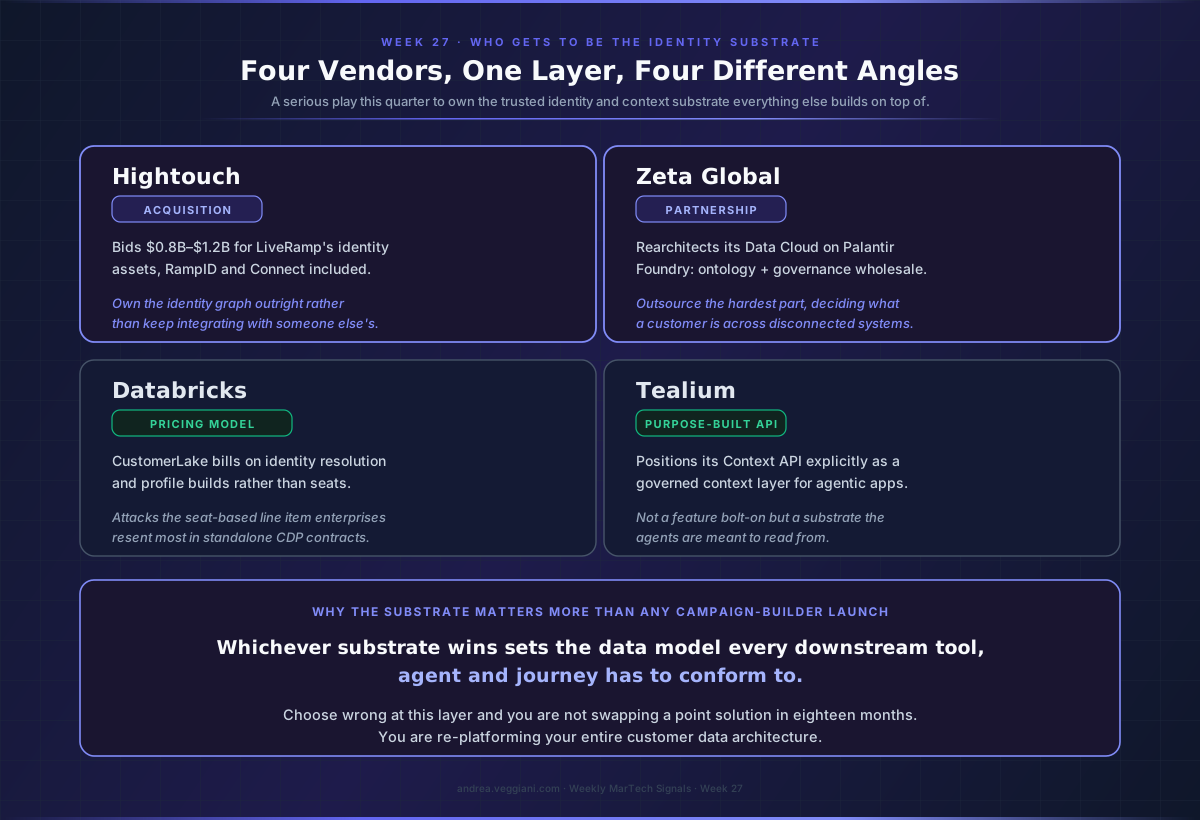
Start with the bid, because it is the more concrete of the two stories. Hightouch, valued at 2.75 billion dollars after its April Series D, offered Publicis somewhere between 800 million and 1.2 billion dollars in cash and stock for LiveRamp’s identity and data-onboarding businesses, RampID and LiveRamp Connect among them. That is a company built on reverse ETL, on moving warehouse data out to the tools that activate it, trying to buy the identity resolution layer that sits underneath every one of those activations.
I do not think that is a coincidence, and I do not think it is unrelated to the other thing Hightouch did in the same window. Lifecycle Studio, the second studio inside its Agentic Marketing Platform, gives marketers agents grounded in brand context, customer history, creative history, campaign history and the broader marketing stack to build and optimise cross-channel campaigns. Put the two announcements side by side and you get a company that has decided the fastest way to control the full activation stack is not to keep integrating with someone else’s identity graph, campaign by campaign, but to own more of the identity graph directly.
Whether the bid succeeds is almost beside the point. It tells you where Hightouch thinks the next moat is, and it is not only in the campaign-building agent everyone else is also shipping. It is underneath it.
Zeta Global’s move the same week comes at the identical question from a different angle. Rather than buy an identity vendor, Zeta is rearchitecting its own Data Cloud on Palantir’s Foundry, bringing Foundry’s ontology, governance, and operational infrastructure into the marketing data layer instead of building every equivalent capability itself.
That is a genuinely unusual partner for a marketing cloud to choose. Palantir is not a conventional martech vendor. It has no CDP, no CEP, and nothing resembling a campaign tool. What it does have is a governance and ontology layer that enterprises already trust for exactly the kind of sensitive, cross-system data modelling that customer identity requires. Zeta is not buying a feature. It is importing infrastructure for the hardest, least glamorous part of customer data architecture: deciding what a customer is across a dozen disconnected systems.
Neither of these is a market I can call yet. But read alongside Databricks positioning CustomerLake around identity resolution, profile creation, governed activation and agentic workflows, and Tealium’s Context API positioning itself as a governed real-time context layer for AI agents and applications, I count four separate vendors this quarter making a serious play to be the trusted identity and context substrate that everything else in the stack builds on top of.
That is worth more of your attention than any single campaign-builder launch, because whichever substrate wins does not just win a deal. It sets the data model that every downstream tool, agent, and journey has to conform to. Choose wrong at that layer and you are not swapping out a point solution in eighteen months, you are re-platforming your entire customer data architecture.
Agent launches are turning into agent iteration
Set the identity story aside for a moment, because the other pattern this week is a genuinely encouraging one. For most of this year the cadence has been launch, launch, launch, a new vendor announcing its own agent almost every week. This week three platforms shipped, and the more interesting signal was not a new agent category. It was iteration on agents that already exist.
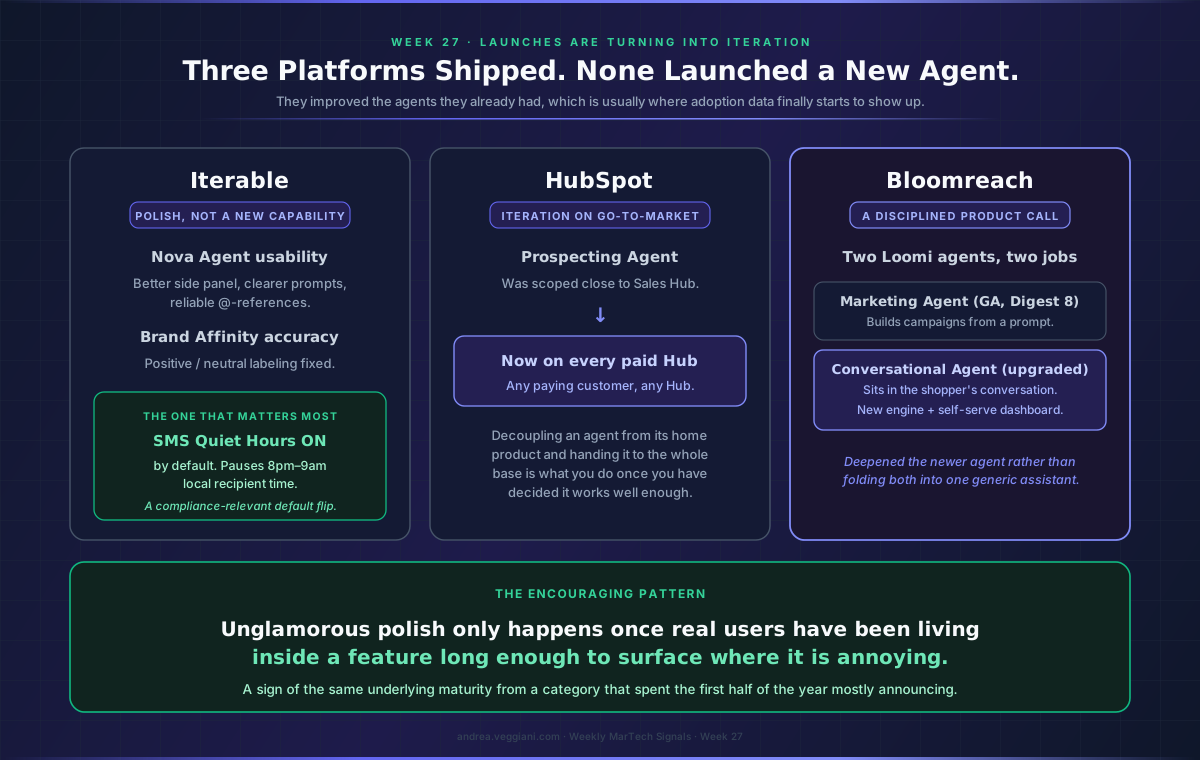
Iterable’s June monthly release is a good example of what that looks like in practice. Nova Agent did not get a category-defining new capability. It got a better side panel, clearer feedback prompts, and more reliable handling of the @ references you use to point it at a specific campaign or template. Brand Affinity’s labeling also got more accurate, particularly in positive and neutral categories where subtle classification errors can change how teams interpret sentiment.
None of that makes a headline. All of it is the kind of unglamorous polish that only happens once real users have been living inside a feature long enough to surface where it is annoying.
I would also flag, separately, a smaller but more consequential change buried in the same release notes: new SMS campaigns now default to Quiet Hours on, pausing sends between eight in the evening and nine in the morning local recipient time. That shipped back on June 9 and should have made it into this digest three weeks ago. A default flip like that is exactly the kind of compliance-relevant change that gets missed when everyone is watching for the next big agent launch instead of the quiet settings changes underneath it.
HubSpot’s move is a distribution decision more than a product one, but it belongs in the same category. Prospecting Agent is now available to every paid HubSpot customer, regardless of which Hub they pay for. HubSpot’s own framing is that prospecting is not confined to sales reps, because marketers qualifying inbound and ops teams running outbound need the same capability. I read it slightly differently. Decoupling an agent from its original product gravity and handing it to the entire paid customer base is what you do once you have decided the agent works well enough to seed broader adoption, not while you are still proving it out. That is iteration on go-to-market, and it is a sign of the same underlying maturity.
Bloomreach’s Loomi Conversational Agent enhancements complete the pattern in the most literal way. This is not the Loomi Marketing Agent that went GA back in Digest 8, the one that builds campaigns from a prompt. This is a different Loomi agent with a different job, one that sits in the shopper’s conversation rather than the marketer’s workflow, now upgraded with a more capable conversational engine and a self-serve dashboard that turns those conversations into catalog and merchandising insight.
Bloomreach now has multiple Loomi agents doing different jobs, and it chose to deepen the shopper-facing one rather than collapse everything into a single generic assistant narrative. That is a more disciplined product decision than it might look like at first glance.
GEO and AEO went from novelty to checklist fast
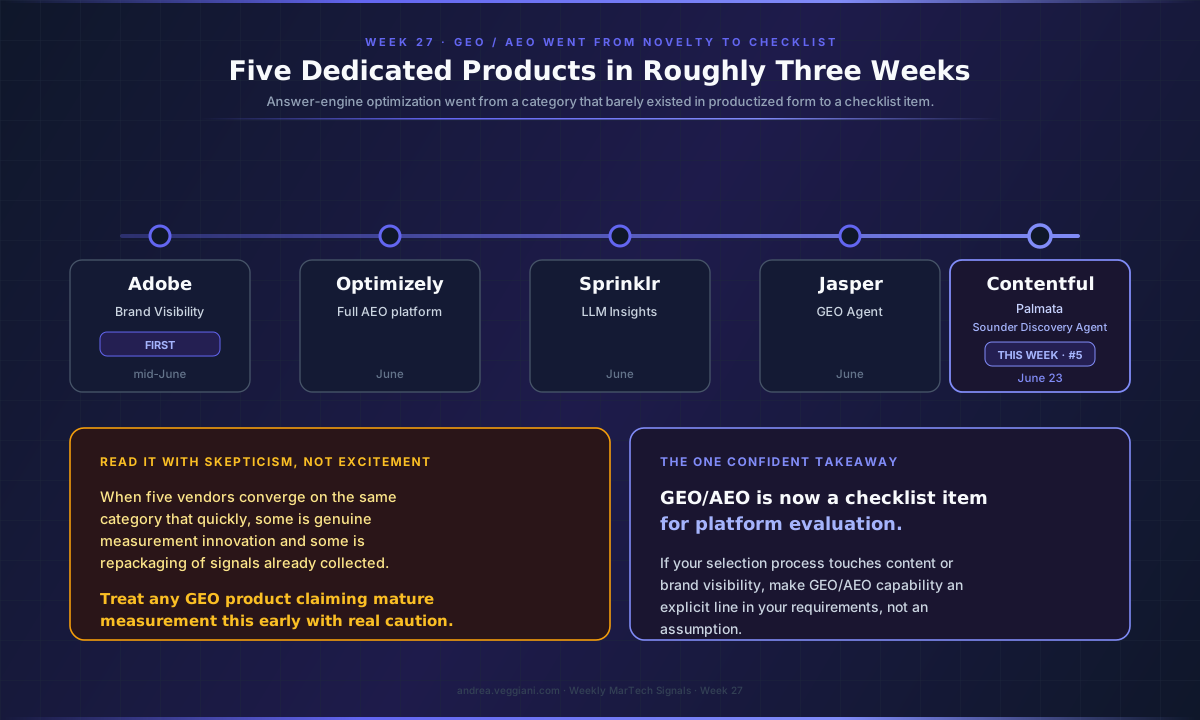
I want to flag one more pattern quickly because the speed of it is the story. Contentful launched Palmata this week, a product built on what it calls a Sounder Discovery Agent, designed to measure and influence how a business is represented inside AI answer engines. On its own that is a reasonable, well-timed product. What makes it worth a paragraph is that it is the fifth dedicated GEO or AEO product I have logged in this tracker in roughly three weeks, following Adobe’s Brand Visibility, Optimizely’s full AEO platform, Sprinklr’s LLM Insights, and Jasper’s GEO Agent.
A category that barely had a productized shape a month ago is now something every major content and CX platform feels obligated to ship into. That speed should make you a little skeptical rather than a little excited. When five vendors converge on the same category that quickly, some of what you are seeing is genuine measurement innovation and some of it is marketing repackaging of signals these platforms were already collecting.
I do not yet have a confident read on which of the five is which, and I would treat any GEO product claiming mature measurement this early with real caution. The one thing I am confident about is that this is now a checklist item for evaluation, and if you are running a platform selection process that touches content or brand visibility, GEO and AEO capability needs to be an explicit line in your requirements, not an assumption.
The consent-mapping clock is still ticking
Set against acquisitions and identity bids, a staged consent-mapping rollout sounds like a footnote. It is not, if you are one of my clients mid-migration from Marketing Cloud Engagement to Marketing Cloud Next. Salesforce’s Summer ‘26 release cycle is closing a real compliance gap between the two platforms, where consent captured in one system did not cleanly map to the other. The rollout is staged, not all at once: email consent mapping is expected by July 13, eleven days from this digest, with SMS and WhatsApp following by August 17.
I am including it here, deliberately, as the least dramatic item in this week’s list, because governance work almost always is the least dramatic item on the list, right up until it is the only one that matters. An identity bid or a Palantir partnership makes for a better headline than a consent-mapping deadline. But if you are running dual-track on MCE and MCN right now, July 13 is the date that may change what you can safely send, to whom, and on what legal basis.
spet## The question worth holding
Four vendors are now making a real bid to be the identity and context substrate underneath the rest of the stack: Hightouch through acquisition, Zeta through partnership, Databricks through a native lakehouse CDP model, and Tealium through a purpose-built API. None of them are competing on the same axis, which makes the choice harder, not easier, because you cannot simply compare feature lists.
You are being asked to decide who you trust with the layer that defines what a customer record even means inside your organisation, before you know whether that vendor will still hold the position it is claiming in eighteen months.
I do not have a tidy answer, and I am suspicious of anyone who does this early. What I do believe is that the decision deserves the same rigor you would give a core platform selection, not the lighter diligence that identity and context tooling sometimes gets because it feels like plumbing rather than product.
Plumbing is exactly the layer you cannot easily replace once everything downstream has been built to depend on it. Choose the substrate the way you would choose the foundation, because that is precisely what it is.
Sources
The identity layer
- Axios: Hightouch offers Publicis up to $1.2B for LiveRamp assets. Bid details, RampID, LiveRamp Connect, June 16.
- Hightouch: Introducing Lifecycle Studio. Lifecycle Studio launch, second AMP studio, June 24.
- Zeta Global: Palantir and Zeta Global announce strategic partnership. Zeta Data Cloud rearchitected on Foundry, June 23.
- Databricks: CustomerLake press release. CustomerLake, identity resolution, audience building and activation, June 16.
- Databricks: Introducing CustomerLake. Native lakehouse CDP positioning, governed foundation, June 16.
- CMSWire: why Databricks CustomerLake upended the CDP space. Referenced for pricing and market interpretation.
- Tealium: Context API. Governed real-time context layer for AI agents, apps and experiences, June 9.
Agent iteration
- Iterable: 2026 Release Notes, June’s Monthly Release. Nova Agent usability improvements, Brand Affinity accuracy, and default Quiet Hours for SMS.
- HubSpot Community: June 2026 Product Updates. Prospecting Agent expanded to every paid HubSpot customer.
- Bloomreach: Loomi Conversational Agent enhancements. Conversational engine enhancements and self-serve insights dashboard, June 24.
GEO/AEO
- Contentful: Introducing Palmata. AI discovery platform for answer engines, June 23.
- BusinessWire: Contentful introduces Palmata. Sounder Discovery Agent, recommended actions and simulated impact, June 23.
Governance
- Salesforce Help: Summer ‘26 Release Notes. Official Summer ‘26 release note hub.
- Marketing Cloud Tips: Marketing Cloud Next Summer ‘26 Release Highlights. Practitioner walkthrough with consent-mapping rollout dates: email by July 13, SMS and WhatsApp by August 17.
The digest behind each weekly article is produced through a structured AI-assisted scan of official release notes and product update sources. I review the output, verify the relevant signals and write the architectural interpretation.
This article draws from the Martech Weekly Digest scans run on July 2, 2026, covering release notes and product updates across several CEP platforms and vendors.
If you find errors or gaps in coverage, I want to know. The process improves when the output is challenged.