10 min read
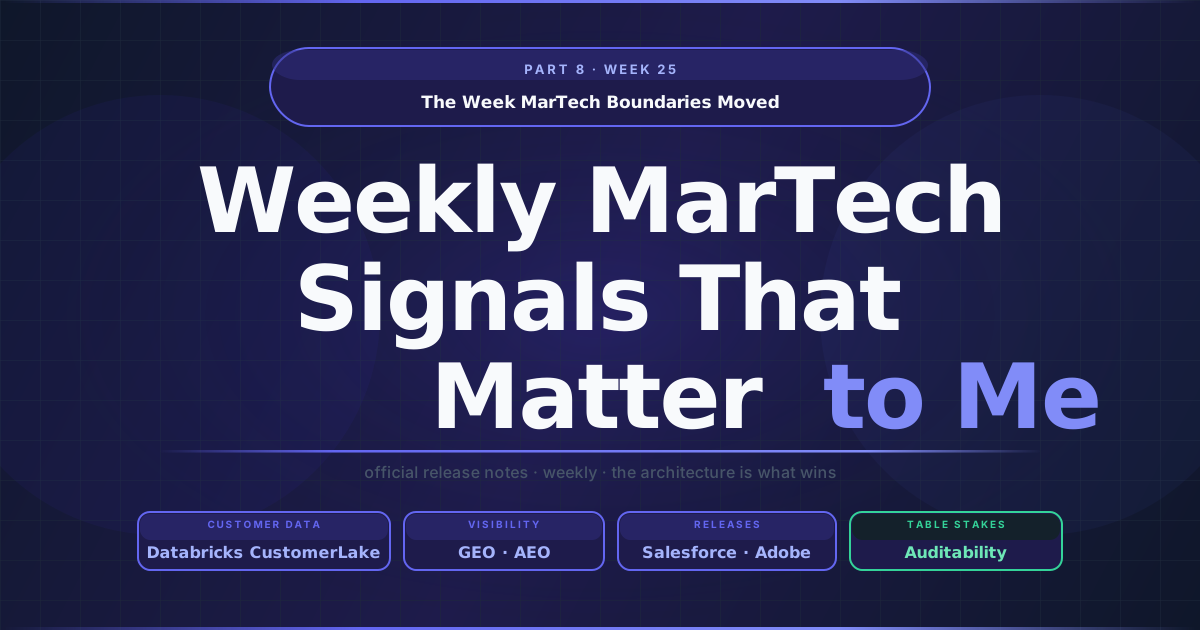
The Week MarTech Boundaries Moved
Some weeks the news is a list of features. This week the news was a list of boundaries being redrawn, and three of them matter enough that I want to take them slowly. A data-cloud hyperscaler walked directly into the customer-data-platform market. The discipline of being found, what we used to call SEO, fractured into a new category built entirely around how machines describe your brand. And the two largest suites in our space, Salesforce and Adobe, shipped their summer releases into that shifting ground. The releases were the loudest part of the week. They were not the most important signal.
TL;DR
- Databricks CustomerLake puts an agentic CDP natively inside the lakehouse, governed by Unity Catalog, eroding the case for a separate CDP.
- GEO/AEO turned buyable in two weeks (Adobe, Optimizely, Sprinklr): governing how machines describe your brand, the mirror image of MCP.
- Salesforce and Adobe shipped summer releases, but the quiet wins matter most: AJO journeys 100 to 200, email validation, Email Archiving.
- Auditability is now table stakes: Salesforce Email Archiving follows Bloomreach’s a week earlier, proving what each customer received instead of reconstructing it.
Let me take the structural move first, because it reframes everything underneath it.
Databricks claimed the CDP layer
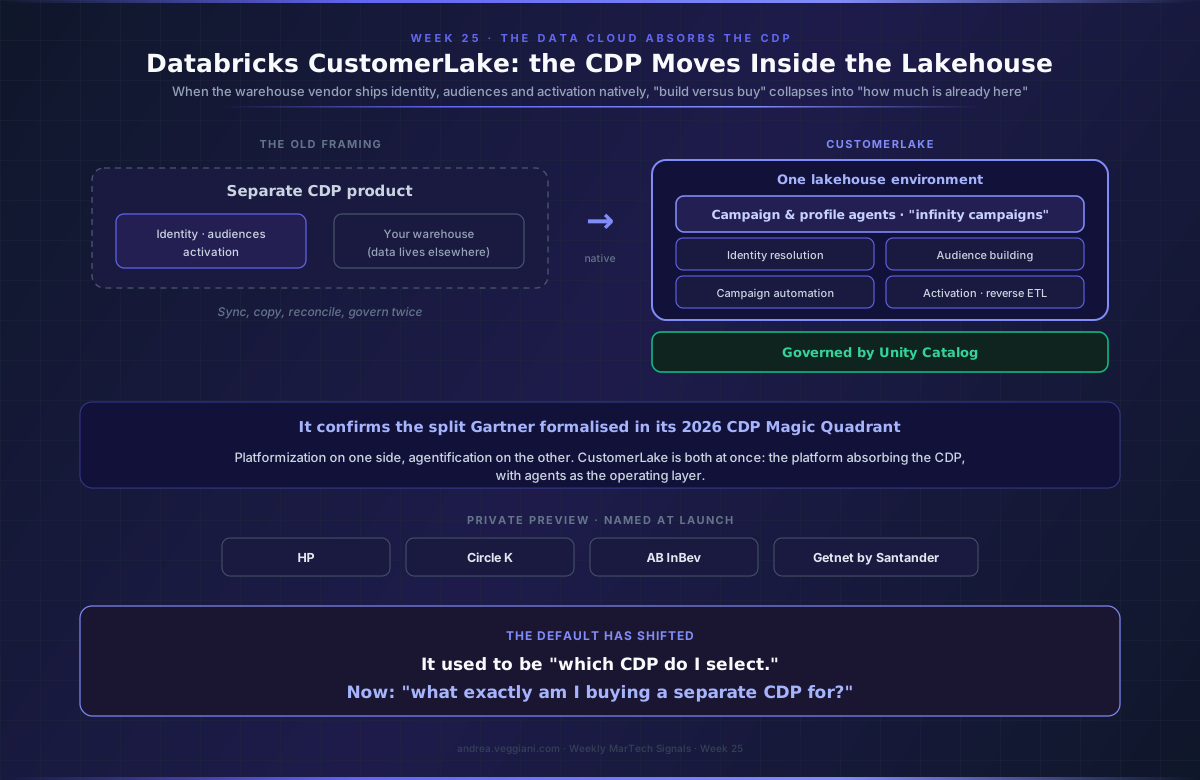
At its Data + AI Summit, Databricks announced CustomerLake: an agentic Customer Data Platform built natively on the lakehouse and governed by Unity Catalog. Read that sentence again, because the word that matters is natively. This is not a CDP that simply connects to your warehouse. It is a CDP that lives inside the same lakehouse environment where customer data is already stored, processed and governed; customer-data unification, identity resolution, audience building, campaign automation and activation running under the same governance catalog that already governs the rest of your enterprise data. It launched into Private Preview with HP, Circle K, AB InBev, and Getnet by Santander already named, and with Integral Ad Science as a launch partner wiring first-party records to contextual and attention signals through clean rooms that live inside the CustomerLake environment.
I have spent a good part of the last few years helping clients navigate the composable-versus-packaged CDP question, whether to buy a CDP as a product or assemble one on top of the warehouse they already own. CustomerLake does something more aggressive than either side of that debate. It makes the old framing harder to defend. If the warehouse vendor ships identity resolution, audience building, and activation as native capabilities governed by Unity Catalog, then “build versus buy” starts to collapse into “how much of this is already here, governed the way everything else you own is governed.” That is a genuinely different proposition, and it is the logical endpoint of a trend I have been tracking for months; the warehouse-native thesis that Hightouch, Census, and the Snowflake-native ecosystem have been building toward. Databricks just took it to its conclusion and put a workforce of agents on top.
It also confirms, in the most concrete way so far, the split that Gartner formalised in its 2026 CDP Magic Quadrant: platformization on one side, agentification on the other. CustomerLake is both at once: the platform absorbing the CDP, with agents as the operating layer. For anyone designing a customer-data architecture right now, the question has quietly changed. It used to be “which CDP do I select.” Increasingly it is “does my customer data already live where the agents and the activation can reach it natively, and if it does, what exactly am I buying a separate CDP for.” I am not telling clients to rip anything out. I am telling them that the default has shifted, and a default shifting is worth more attention than a feature shipping.
Marketing discovered it has to be legible to machines
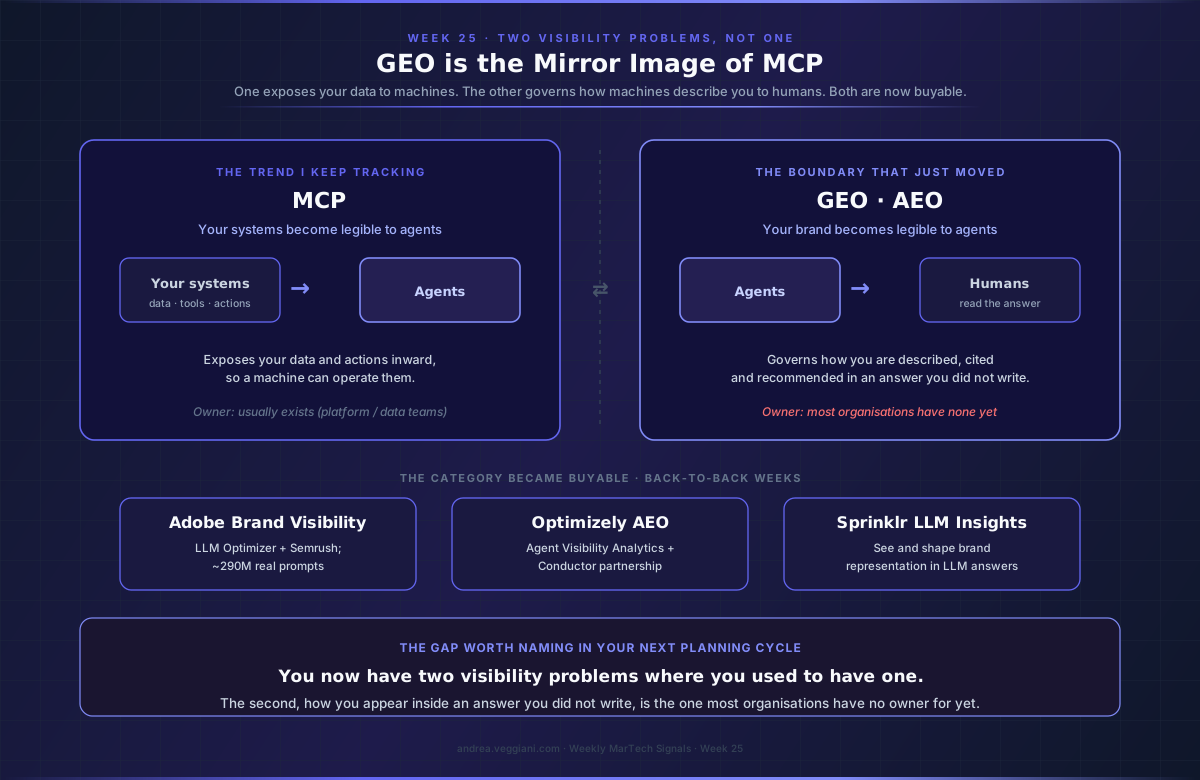
The second boundary moved around Cannes Lions, and it moved fast. In barely two weeks, Adobe launched Adobe Brand Visibility, its first generative-engine-optimization product since acquiring Semrush, combining Adobe’s LLM Optimizer with Semrush’s AI Optimization tooling and its dataset of nearly 300 million real prompts. Optimizely shipped a full AEO platform with Agent Visibility Analytics and a partnership with Conductor that fuses log-based AI-traffic data with citation, mention, and crawl intelligence. Sprinklr revealed LLM Insights to help brands see and shape how they are represented inside LLM answers. Three serious vendors, back-to-back weeks, one category becoming real.
The idea is this: when your customers increasingly ask a model instead of a search box, the strategic question is no longer “where do I rank” but “how am I described, cited, and recommended when a machine answers on my behalf.” That is not SEO with a new acronym. It is a different problem with a different shape. SEO optimised a page for a crawler that returned a list of links. GEO and AEO are not perfectly identical labels, but they point to the same operational problem: optimising your entire representable footprint for systems that return a synthesised answer in which you are either present, absent, or wrong. The thing being optimised is not a page. It is the brand’s legibility to a reasoning system.
What strikes me as an architecture person is the symmetry with the trend I keep writing about. For a year I have tracked MCP servers spreading across the stack, the mechanism by which your systems become legible to agents.
GEO is the mirror image: the mechanism by which your brand becomes legible to agents. One exposes your data to machines; the other governs how machines describe you to humans. Both have now become first-class, buyable concerns with competing platforms and measurement layers. If you run marketing technology, you now have two visibility problems where you used to have one, and the second one, how you appear inside an answer you did not write, is the one most organisations have no owner for yet. That gap is worth naming in your next planning cycle.
The summer releases landed, and the boring parts are the real story
Against that backdrop, the suites shipped. Salesforce Summer ‘26 reached its June production rollout window, bringing a long list of Marketing Cloud Next capabilities into general availability: AMPscript finally in Marketing Cloud Next, RCS as a native channel, the Marketing Cloud Engagement MCP server, dynamic email sender details, merge fields from Salesforce objects, real-time offer management. Adobe shipped a broad June Experience Platform release: private-link routing for Azure and Snowflake destinations, audience-level reporting across high-usage destinations, the LAVA source moving to GA, and new operational health checks around anti-pattern detection and TTL. And Adobe Journey Optimizer’s June release raised the live-journey ceiling from 100 to 200, added automated technical validation in the email designer, and shipped AI-generated content variants for simulation.
I want to argue that the most important items in that entire paragraph are the least glamorous ones, and I want to be specific about why.
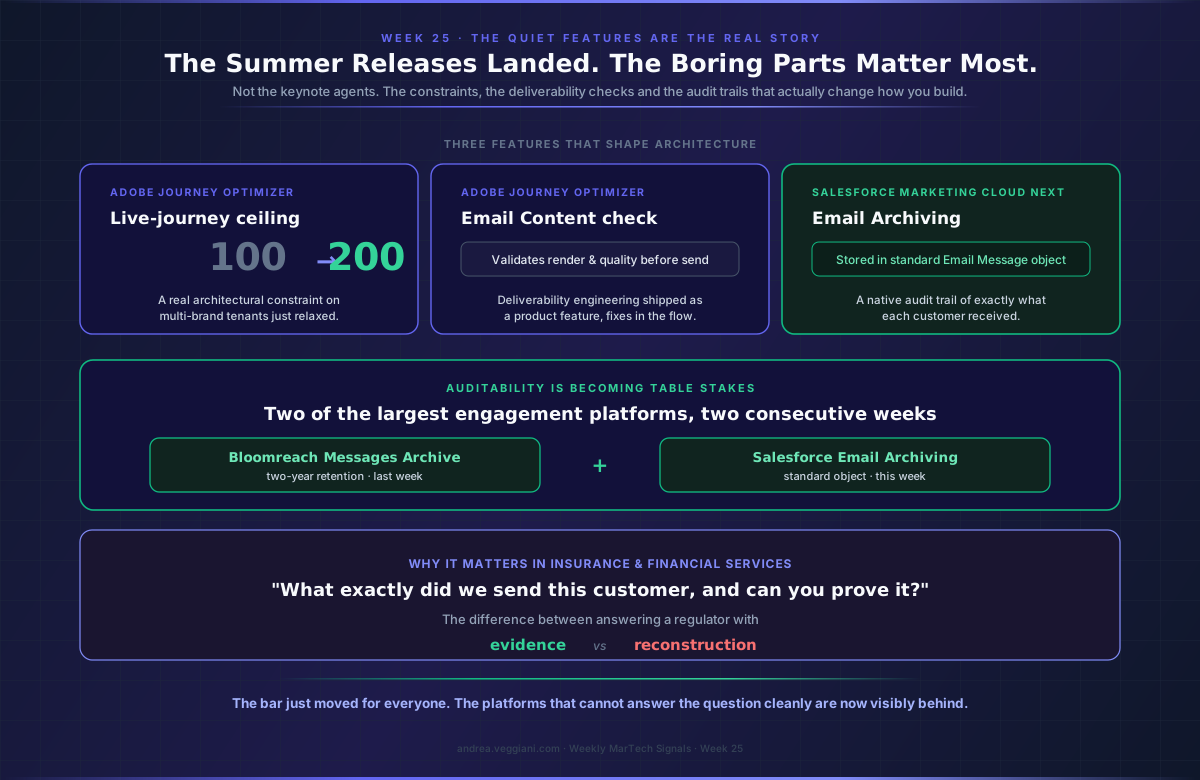
Start with the AJO journey limit. Raising the live-journey ceiling from 100 to 200 will not be the feature most people remember from the release. But anyone who has run a large multi-brand, multi-market AJO tenant knows the 100-journey ceiling has been a real architectural constraint; the thing that forces you to consolidate journeys you would rather keep separate, or split into more sandboxes than you want to govern. Raising it changes how you can legitimately structure a journey estate. That is the kind of constraint that shapes architecture decisions far more than any agent does, and it just relaxed.
Then the AJO email Content check: automated validation that catches technical, rendering and quality issues before you send, with fixes surfaced directly in the authoring flow. This is deliverability engineering shipped as a product feature. For teams without a dedicated email-rendering specialist, which is most teams, it is worth more than another generative gimmick, because it prevents the unglamorous failures that quietly erode inbox placement and engagement.
And then the one I keep circling back to: Salesforce Email Archiving. Marketing Cloud Next now supports Email Archiving, automatically storing copies of sent emails in the standard Email Message object and giving regulated teams a more native audit trail for customer communications. Here is what makes it notable beyond the feature itself; it is the second notable engagement-platform message-archive capability in two weeks. Bloomreach shipped a two-year Messages Archive last week. When two of the largest engagement platforms independently make “retain an exact, retrievable copy of what each customer received” a headline capability in consecutive weeks, that is not coincidence. It is the market discovering, together, that auditability is becoming table stakes.
For the regulated clients I spend most of my time with, this is the most consequential pattern of the month. “What exactly did we send this customer, and can you prove it” is not a support nicety in insurance or financial services; it is the difference between answering a regulator with evidence and answering with reconstruction. Two vendors making that a first-class capability in two weeks tells me the bar just moved for everyone, and the platforms that cannot answer the question cleanly are now visibly behind the ones that can.
The thread connecting all three
So: the data cloud absorbed the CDP, the brand acquired a second visibility problem aimed at machines, and the suites shipped releases whose quietest features may change how teams actually build. Pull back far enough and these are not separate stories. They are the same architectural movement seen from three angles.
A thing that used to sit beside the platform is being pulled inside it. The CDP is being pulled inside the data platform. Brand visibility is being pulled inside the agent’s answer. Deliverability, auditability and scale guardrails are being pulled inside the engagement platform as native capabilities rather than bolt-ons.
That is the through-line I keep underlining, and this week handed me three fresh pieces of evidence for it. As more of the stack collapses inward, the components that decide whether the whole thing works are not the visible ones: not the agent, not the GEO dashboard, not the launch headline. They are the data model the CDP now shares with your entire enterprise, the governance catalog that decides who and what can touch it, and the audit trail that proves what actually happened. The architecture wins, as it always does. It is just becoming harder to see, because more of it now lives inside platforms that present a clean surface and hide the seams.
The question worth holding
If you run marketing technology, week 25 handed you three decisions that did not exist in quite this form a month ago. Your customer data may soon live natively inside the data platform your whole company already runs, governed by one catalog. Do you still buy a separate CDP, and if so, for what? Your brand now has a representation inside machine-generated answers that you do not author and may not even monitor. Who owns that, and how would you know if it went wrong. And auditability has gone from a compliance checkbox to a competitive capability your platforms now ship by default. Does yours, and can you prove what you sent.
None of these is a feature question. All of them are architecture-and-governance questions, which is exactly why they are easy to miss in a week full of go-live announcements and Cannes launches. The platforms made their moves. The harder work is still yours: deciding which boundaries you actually want dissolved, and who is accountable inside the systems that now do more on your behalf. Nobody shipped a product this week that does that for you.
Sources
Databricks CustomerLake (agentic CDP)
- Databricks: Introducing CustomerLake: The Agentic CDP embedded in Databricks
- Databricks newsroom: Databricks Enters the Marketing Industry with CustomerLake
- Integral Ad Science: IAS as CustomerLake launch partner
- MarTech: Databricks unveils CustomerLake, its agentic CDP
Gartner CDP Market Context
GEO / AEO becomes a category
- Adobe Brand Visibility (MediaPost)
- Adobe brings GEO to CX Enterprise with Adobe Brand Visibility (MarTech)
- Optimizely launches full AEO platform
- Sprinklr introduces LLM Insights
Salesforce Marketing Cloud Next Summer ‘26
- Salesforce Summer ‘26 Product Release
- SalesforceBen: Summer ‘26 before go-live
- Salesforce Summer ‘26 Release Notes
Adobe Experience Platform & Journey Optimizer June releases
- Adobe Experience Platform: June 2026 release notes
- Adobe Journey Optimizer: Release Notes
- Adobe CX Enterprise Coworker: General Availability
Auditability as table stakes (companion item)
Weekly roundup
The digest behind each weekly article is produced through a structured AI-assisted scan of official release notes and product update sources. I review the output, verify the relevant signals and write the architectural interpretation.
This article draws from the Martech Weekly Digest scans run on June 18, 2026, covering release notes and product updates across several CEP platforms and vendors.
If you find errors or gaps in coverage, I want to know. The process improves when the output is challenged.