13 min read
Agentic Marketing Is No Longer a Roadmap Item
I scan release notes for a living. Not because I enjoy reading HTML changelogs (though I have made my peace with that) but because release notes are one of the most honest signals in this industry.
Vendors can say anything in a press release. What they actually ship tells a different story. This series is my attempt to separate product noise from architectural signal.
This week I ran two structured digest scans (using my Claude Cowork agent) across the full stack I track: AJO, AEP, Braze, Bloomreach, Insider, Iterable, Klaviyo, Salesforce Marketing Cloud, Marketo, AJO B2B, Account Engagement, HubSpot, plus the vendor layer (HighTouch, Tealium, Segment, Treasure AI).
Across the platforms and vendors covered in those scans, something unusual emerged: not a collection of isolated feature drops, but a coordinated market signal arriving from multiple directions at the same time.
Agentic marketing is no longer a roadmap item. It is shipping as product reality across the stack.
TL;DR
- Agentic AI shipped across multiple platforms this week, from Adobe and Iterable to Salesforce and HubSpot. Journey orchestration, offer decisioning and sales qualification are running autonomously in production, not beta, not preview.
- MCP landed in four major platforms this cycle (AJO, RTCDP, HubSpot, Iterable) and is on course to become the integration standard for enterprise AI stacks.
- HighTouch hit $100M ARR, driven also by agentic features. The clearest market validation of the thesis this quarter.
- Klaviyo’s Composer now generates complete campaigns from a natural language prompt, on top of its e‑commerce data model.
- The CDP label is fading from the hero story. Treasure AI, HighTouch and Segment are selling something a generation past it.
1. Agentic AI Shipped. Not Announced. Not Roadmapped. Shipped.
Let me start with the vendor-level picture, because the pattern is striking.
Iterable released Nova Agent on April 22.
It is not a copilot in a sidebar. It is a context-aware AI operating on behalf of the marketer via natural language: creating campaigns, auditing templates, assisting with Handlebars-style personalization logic and surfacing performance analytics on demand.
The fact that Iterable chose this as its Spring ‘26 flagship says something about where the market has moved.
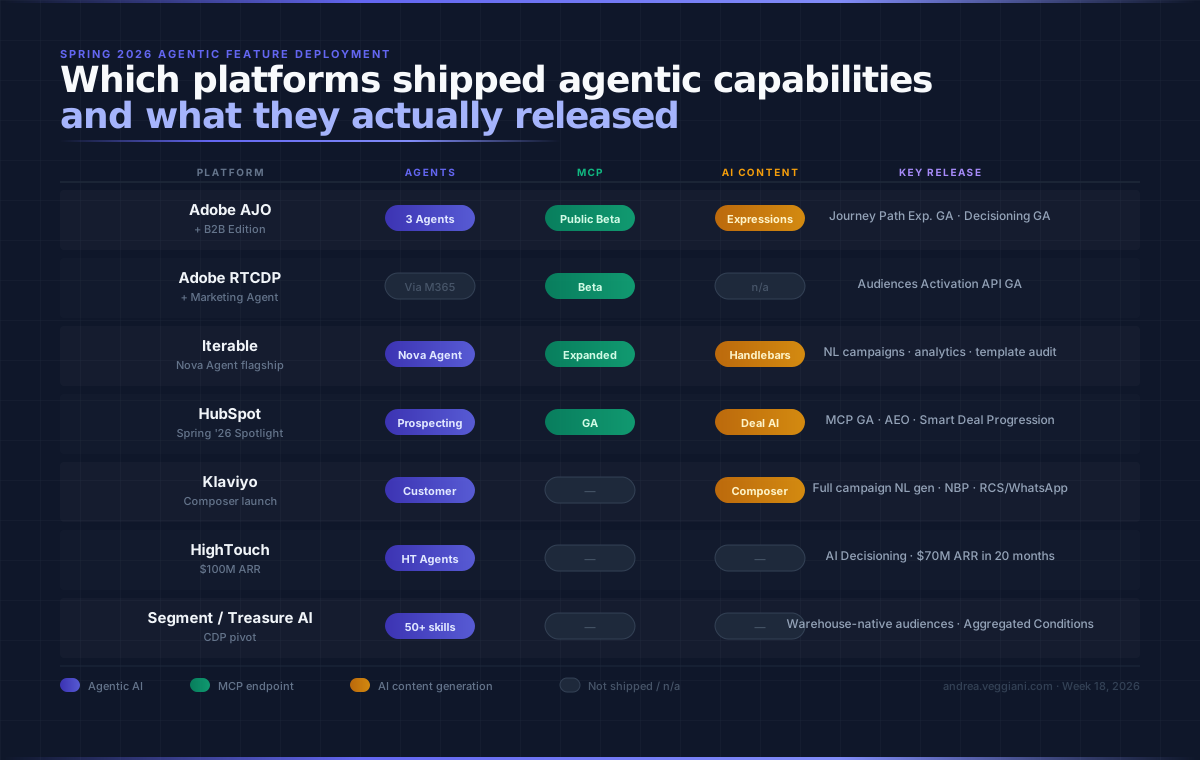
Adobe Journey Optimizer B2B shipped three agents in one release: Journey Build Agent, Audience Agent and Sales Qualifier.
Sales Qualifier is designed to automate large parts of BDR qualification, outreach and buyer engagement, moving AI into territory that was previously considered too nuanced for automation.
HubSpot’s Spring ‘26 Spotlight shipped its MCP Server to GA, launched AEO (Answer Engine Optimization) and pushed Smart Deal Progression, an AI that analyses call transcripts and emails to suggest CRM updates and next steps.
The quiet corner of the market, B2B demand gen, has fully joined the agentic wave.
HighTouch hit $100M ARR on April 15, with AI Decisioning and Hightouch Agents cited as key growth drivers.
It added roughly $70M ARR in 20 months after launching its agent platform, with customers like Domino’s, Chime, PetSmart and Spotify in production.
That is one of the strongest pieces of independent validation for the agentic marketing thesis this quarter.
And Treasure Data rebranded to Treasure AI on April 20: not a logo change, but a full pivot to what it calls an “agentic experience platform,” with Treasure AI Studio, conversation-based pricing and dozens of pre-built skills for autonomous customer engagement.
Salesforce is moving in the same direction from the CRM side of the market. The Summer ’26 updates around Marketing Cloud Next, Agentforce Account Nurturing Agent, Distributed Marketing Agent and MCP support for Marketing Cloud Engagement all point to the same architectural shift: marketing execution is being pulled closer to CRM context, sales motion and agentic orchestration.
The important signal is not one isolated feature. It is that Salesforce is making Marketing Cloud Next the place where classic campaign execution, CRM data, Flow, Data 360 and Agentforce begin to converge.
Then Adobe’s April 28 release landed and the picture became clearer still.
Journey Path Experimentation reached GA: not just A/B testing, but multi-armed bandit experimentation with automatic weekly weight rebalancing and a Scale the Winner capability that rolls out the winning journey path to your full audience automatically once significance is achieved.
Decisioning reached GA in email: AI models selecting the optimal offer per recipient in the highest-volume channel most enterprises actually use.
The AI Assistant for Personalization Expressions shipped directly in the expression editor: describe what you want to personalize in plain language, get valid Handlebars code back, no syntax expertise required.
The shift from “tools that execute human-defined rules” to “systems that pursue human-defined goals” is no longer theoretical.
It is live in production across the full landscape and it is happening faster than most architecture plans account for.
2. MCP Is becoming the Integration Standard You Need to Care About Now
Model Context Protocol (MCP) appeared in the release notes of four major platforms this week alone.
Adobe Journey Optimizer (MCP Server, Public Beta, all customers). Adobe Real-Time CDP (MCP, Beta, same day). HubSpot (MCP Server, GA). Iterable (MCP Server, expanded AI client support for Gemini CLI, Windsurf, Google Antigravity).
That is four MCP endpoints from major MarTech platforms in a single release cycle.
If you have not been following MCP, here is the short version: it is an open protocol that lets AI agents (Claude, ChatGPT, Gemini, Cursor, enterprise LLMs) read and write structured data from external systems through a standardised interface.
Campaigns, journeys, audiences, offers, destinations and configuration objects all become addressable resources that an AI can inspect and, in controlled ways, modify.
When AJO exposes campaigns, channel configuration and sandbox operations via MCP and Real-Time CDP exposes audiences, destination configuration and activation runs via MCP, it means this: any AI agent with appropriate access can inspect your marketing environment, describe what it finds and, in future iterations, take action on it.
Not through a bespoke integration. Through a standardised conversational layer.
The AJO MCP Server in Public Beta allows any MCP-compatible client to interact with campaign and orchestration data by describing intent in natural language and letting the AI invoke the appropriate tools.
The RTCDP MCP initially focuses on read access to key objects such as audience membership, destination configuration and activation runs, without writing a single Experience Platform REST API call.
The implications for how you evaluate platforms are significant.
I have seen what happens when a protocol reaches critical mass in enterprise software: API-first architectures around 2015-2018 being the most recent example.
MCP feels like it is approaching the same kind of inflection point. It may still be early and enterprise adoption will depend heavily on governance, permissions and vendor implementation quality. But the direction is now too visible to ignore.
Add it to your shortlisting criteria now. Vendors without it will face increasing integration friction as enterprise AI stacks mature.
3. Klaviyo Changed the E-commerce CEP Equation
This is being underreported, so let me be direct about it.
Klaviyo launched Composer this spring.
Describe a campaign in natural language: “create a spring product launch for high-value customers who have not purchased in 90 days” and Composer generates the entire thing: subject line, copy, images, audience segment and send logic, built on top of your existing customer and catalog data.
Launch-ready from a prompt, with editing and governance controls layered on top.
That alone would be notable.
But the same release cycle also delivered Customer Agent with retail-specific skills (order edits, returns, subscription changes, loyalty lookups), Next Best Product recommendations extended from email to SMS, RCS, WhatsApp and personalized onsite banners built into Customer Hub without third-party tools or custom code.
Here is the architectural reality behind this.
Klaviyo’s competitive moat has always been its e-commerce data model. It understands orders, products and catalog-level events across Shopify-era stacks at a depth that few platforms match, because it has sat at the centre of those stacks for years.
Composer adds an AI generation layer on top of that data depth. It is not a general-purpose content tool. It is a content tool trained on richer e‑commerce behavioural context.
For brands evaluating B2C CEP platforms right now: Klaviyo is no longer the email platform that happens to have good segments. Whether it can stretch beyond commerce-native use cases is a different question. But inside e-commerce, the claim is becoming harder to dismiss.
It is making a credible claim to be a complete agentic marketing platform for e-commerce.
Braze, Iterable and Bloomreach are building in the same direction.
4. Adobe Is Building a Platform-Wide AI Nervous System
I track Adobe across four products in this digest: AEP, AJO, Marketo and AJO B2B.
This week’s scans revealed the same pattern appearing across all four simultaneously: AI content generation with brand governance, agentic journey orchestration and developer-facing MCP/API infrastructure.
The Adobe Marketing Agent for Microsoft 365 Copilot (which surfaced in the March AEP release) is the most strategically significant item in this full week’s scan.
It embeds Adobe marketing intelligence (campaign insights, audience signals, journey context) directly inside Teams, Word and PowerPoint.
That is not a new feature for marketers. That is a distribution strategy: Adobe is planting its data layer inside the tools where enterprise decisions actually get made.
The April 28 release then added:
- Journey Path Experimentation GA with multi-armed bandit and Scale the Winner
- Decisioning in email GA, including AI model-driven offer selection
- AI Assistant for Personalization Expressions
- AJO MCP in Public Beta
- RTCDP MCP in Beta
- Orchestrated Campaigns gaining Incremental Query and Global Variables
- Inbox, a Content Cards persistence layer for in-app message centers
- AEM Content Fragment Variation Support going GA
Across four products, the same horizontal capabilities are arriving in parallel: brand governance AI (Marketo, AJO, AJO B2B), agentic orchestration (AJO, AJO B2B), developer-facing MCP/API infrastructure (AEP, AJO, RTCDP) and Microsoft 365 ecosystem integration (AEP).
This level of cross-product coordination does not happen by accident.
Adobe is converging toward a unified AI marketing layer and it is moving faster than most of its enterprise customers’ implementation roadmaps.
5. CDPs Are Repositioning: the Pattern Is Clear
Treasure Data became Treasure AI, HighTouch expanded from reverse ETL to an agentic marketing platform and Tealium launched an AI Partner Ecosystem. Segment released three Advanced Audiences capabilities to General Availability: the Audiences Activation API (audience lifecycle management fully programmable via API), Aggregated Conditions (warehouse-native sums, counts, averages and min/max from raw warehouse tables in the audience builder, no SQL) and Part of Audience (reference one Linked Audience inside another as a reusable source of truth).
The architecture emerging from Segment’s three GAs is a thesis statement: the warehouse is the system of record, the CDP is the orchestration and activation surface and audience logic should live where the data lives, not in a proprietary store.
This is the same direction HighTouch has been building toward for years and it is the pattern the market is validating at scale.
Several of these vendors either avoid the “CDP” label entirely in their hero messaging or treat it as a legacy descriptor rather than the main story.
What they are selling is: unified customer data, real-time activation, AI-driven decisioning and autonomous execution.
The CDP was always a means to an end. The vendors that understood this early are now positioning around the end.
If you are building a MarTech stack on the assumption that the CDP is a stable category with stable vendors, it is time to revisit that assumption.
The best players in this space are already a generation past “CDP”.
What It Means in Practice
I am not going to tell you to “implement an AI agent strategy” or “adopt MCP.”
That kind of advice is not useful without context.
What I will say is this.
The data foundation is more critical than ever. Agentic systems make faster, higher-frequency decisions. They will amplify the quality (or lack of it) in your identity resolution, your profile unification and your behavioural event streams at a speed that manual processes never could.
Over-merged or under-merged profiles will not just misfire; they will misfire autonomously and at scale.
Fix the data foundation before you layer AI on top.
Experimentation and orchestration are converging. If your A/B testing lives outside your journey platform, you have a gap.
AJO has absorbed experimentation, conditions and path optimization into a single Optimize node, the same one powering Journey Path Experimentation.
The future architecture is simple: journey orchestration is the experimentation layer.
Your warehouse relationship deserves a review. Segment’s Aggregated Conditions, HighTouch’s architecture and RTCDP’s Query Service Session Management all point toward the warehouse as the authoritative layer.
If your CDP manages audiences in a proprietary store separate from your warehouse, the friction cost of that architecture is increasing, not decreasing.
Watch what your current platforms are doing with MCP. If you are on AJO, HubSpot, Iterable or RTCDP, you have MCP endpoints available now.
Your marketing platform can be queried and, in controlled cases, acted upon through AI agents today.
Start with the question: what would I do if I could describe marketing operations in natural language and have them execute?
The architecture follows from there.
The Question That Remains Unanswered
Here is the question I keep returning to as I process this week’s releases.
If my marketing platform can now act autonomously on customer data: if it can experiment without human intervention, decide which offer to show without a marketer approving each rule, instruct channel execution through an AI agent: who in my organisation is responsible for defining the goals, the guardrails and the evaluation criteria?
And do they have the context and authority to do it well?
Journey Path Experimentation GA means AJO can identify and scale a winning journey path with no human in the loop required.
Klaviyo’s Customer Agent can edit orders, process returns and manage subscriptions on behalf of customers.
Adobe’s AI Assistant generates personalization logic that executes across millions of profiles.
These are extraordinary capabilities.
They are also extraordinary responsibilities.
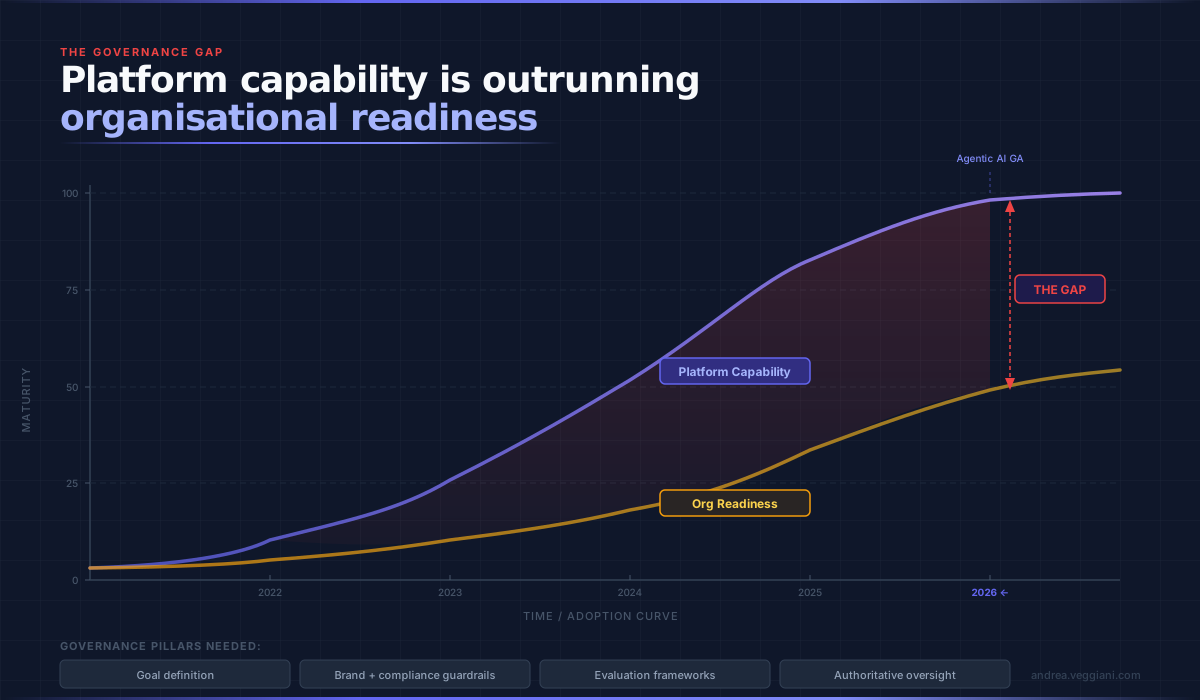
The governance infrastructure for agentic marketing is not keeping pace with the platform capability.
Teams are excited about the AI features.
They are not yet consistently building the oversight structures that make it safe to use these systems at scale. Those structures include clear goal definition, brand and compliance guardrails the AI can reason about, evaluation frameworks that tell you whether the agent is making the right calls and a named owner with the context and authority to set all three.
Agentic marketing is no longer only a technical problem. The hard problem is governance: who decides what the AI is optimising for, what it is not allowed to do and how you measure whether it is making the right decisions on your behalf
The platforms are ready. The organisations directing them are not yet.
That is the real gap in 2026.
And it is widening faster than most people realise.
Sources
Adobe Journey Optimizer
- AJO Release Notes — April 2026 — Journey Path Experimentation GA, Decisioning in email GA, AI Assistant for Personalization Expressions, Inbox, MCP Server Public Beta, Incremental Query, Global Variables
- AJO 2026 Release Notes Archive — January and February 2026 releases referenced in context
Adobe Experience Platform / Real-Time CDP
- AEP Release Notes — April 2026 — Real-Time CDP MCP (Beta), Query Service Session Management
- AEP Release Notes — March 2026 — Adobe Marketing Agent for Microsoft 365 Copilot
Adobe Journey Optimizer B2B Edition
- AJO B2B Release Notes — Journey Build Agent, Audience Agent, Sales Qualifier
Iterable
- Iterable 2026 Release Notes — Nova Agent (April 22), MCP Server updates (March)
HubSpot
- HubSpot Spring 2026 Spotlight — Vantage Point — MCP Server GA, AEO, Smart Deal Progression, Prospecting Agent, Serverless Functions
- HubSpot April 2026 updates — Sidekick Strategies — Multi-Brand Support, AI Model Training Controls, Reddit integration
Klaviyo
- Klaviyo What’s New — Spring 2026 — Composer, Customer Agent retail skills, NBP across SMS/RCS/WhatsApp, personalized onsite banners
- Klaviyo Q1 2026 Product Updates — Community — Composer launch details
Segment (Twilio)
- Twilio Segment — Advanced Audiences GA — Audiences Activation API, Aggregated Conditions, Part of Audience
HighTouch
- HighTouch $100M ARR — TechCrunch — $100M ARR milestone, AI Decisioning, Hightouch Agents
- HighTouch Series C / AI Platform — HighTouch Blog — Hightouch Agents architecture and customer references
Tealium
- Tealium Newsroom — AI Partner Ecosystem launch (April 14, 2026)
Treasure Data → Treasure AI
- Treasure AI rebrand announcement — BusinessWire — Full rebrand and Treasure AI Studio launch (April 20, 2026)
Salesforce Marketing Cloud
- Top 9 Summer ‘26 Updates for Marketers — Salesforce Ben — AMPscript in Marketing Cloud Next
- Salesforce Spring ’26 Release Notes — Marketing Engagement — Spring ’26 features referenced for context
The digest behind each weekly article is produced through a structured AI-assisted scan of official release notes and product update sources. I review the output, verify the relevant signals and write the architectural interpretation.
This article draws from the Martech Weekly Digest scans run on April 28 and April 30, 2026, covering release notes and product updates across 11 CEP platforms and 10 vendors.
If you find errors or gaps in coverage, I want to know. The process improves when the output is challenged.