10 min read
Agentic MarTech Is Converging. Governance Is Not.
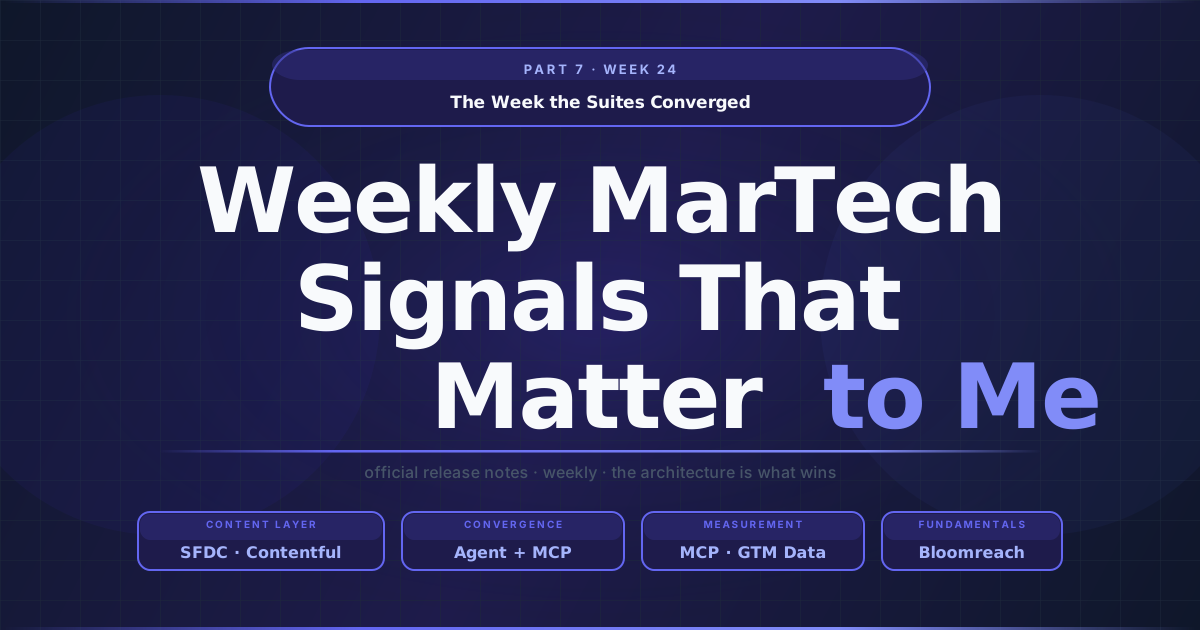
In a single seven-day window, Optimove, Bloomreach, MoEngage and Salesforce all shipped the same thing: a native agent layer inside the platform, combined with an MCP surface that makes platform capabilities addressable from external AI environments such as Claude or ChatGPT. In parallel, Salesforce signed a definitive agreement to acquire Contentful, pulling the composable content layer closer to its customer-data-and-agent core.
That is the story of week 24, and it is not that one vendor launched an agent. Everyone is launching agents. The point is that when several vendors arrive at the same architecture in the same week, that architecture has stopped being a differentiator and become the new baseline.
Once that happens, the competition moves somewhere less visible: data models, content layers, governance seams, auditability and control. That shift is the lens for everything below.
TL;DR
- Salesforce signed a definitive agreement to acquire Contentful, making the content layer native to its data-and-agent core. In an agentic architecture content becomes something agents retrieve and assemble, which turns the content repository into a control point and reframes the contest Adobe has tried to lead through integration.
- Optimove, Bloomreach, MoEngage and Salesforce all shipped the same agent-plus-MCP pattern in one week. Once the architecture is the baseline, the demo stops being the differentiator: the real evaluation is what each agent can read, write, execute or only draft, and what the organization can later prove.
- MCP crossed out of the engagement layer into measurement and GTM data, with Lifesight and ZoomInfo. The concern shifts from activation to interpretation, because a wrong audience makes a bad campaign but a wrong measurement model makes a bad executive decision.
- Bloomreach quietly shipped a Messages Archive (exact copies of every sent email and SMS, retained up to two years). Unglamorous, but in regulated industries the ability to retrieve exactly what a specific customer received is the difference between evidence and approximation.
Salesforce moves for the content layer
Salesforce signing a definitive agreement to acquire Contentful is the most strategically important move of the week. It is not just another Salesforce acquisition, because the position of Contentful in the stack is the point.
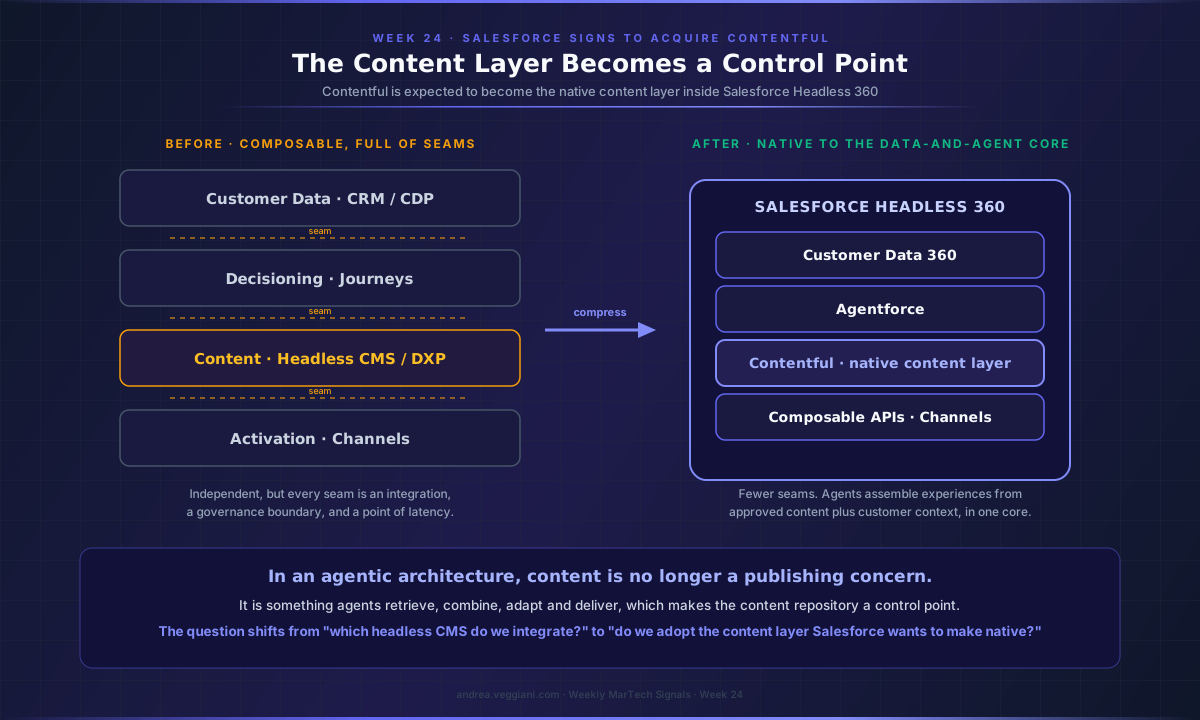
For most enterprises, the content layer has lived next to the customer data layer and the engagement layer. The CMS, DXP or headless content platform was integrated with the CRM, the CDP, the marketing automation platform, the commerce engine and the analytics layer. That model was composable, but it was also full of seams: between data and content, between content and decisioning, between decisioning and activation, and between content governance and journey governance.
Salesforce is trying to compress those seams. In its own framing, which is worth reading as positioning rather than fact, Contentful is expected to become the native, enterprise-grade content layer inside Salesforce Headless 360, connecting customer data, Agentforce and composable APIs to deliver AI-assembled experiences across channels. That changes the strategic question for Salesforce-centric enterprises. It is no longer only, “which best-of-breed headless CMS should we integrate?” It becomes, “do we keep the content layer separate, or do we adopt the content layer that Salesforce wants to make native to the data-and-agent core?”
Neither answer is automatically right. A separate content layer can preserve architectural independence, reduce suite dependency and protect a broader composable strategy. A native Salesforce content layer may reduce integration effort, simplify governance and make it easier for agents to assemble customer-facing experiences using approved content and customer context. The point is that the decision has become more strategic than it was before.
Content is no longer just a publishing concern. In an agentic architecture, content becomes something agents retrieve, combine, adapt and deliver. That makes the content repository a control point, not only a system of record. It also makes the move a direct signal to Adobe, which has long argued that enterprise CX value sits in the connection between content, data, journeys and personalization. Adobe has been building toward a similar destination through its agentic AI positioning, enterprise coworker narrative and ongoing Journey Optimizer releases. Salesforce buying its way to a native content layer reframes a contest Adobe has tried to lead through integration.
The Salesforce-versus-Adobe contest deserves its own piece, and I will give it one. For this digest the point is narrower: Salesforce is not only buying a CMS. It is strengthening its claim on the content layer as part of the future customer experience operating model.
Four vendors, one architectural pattern
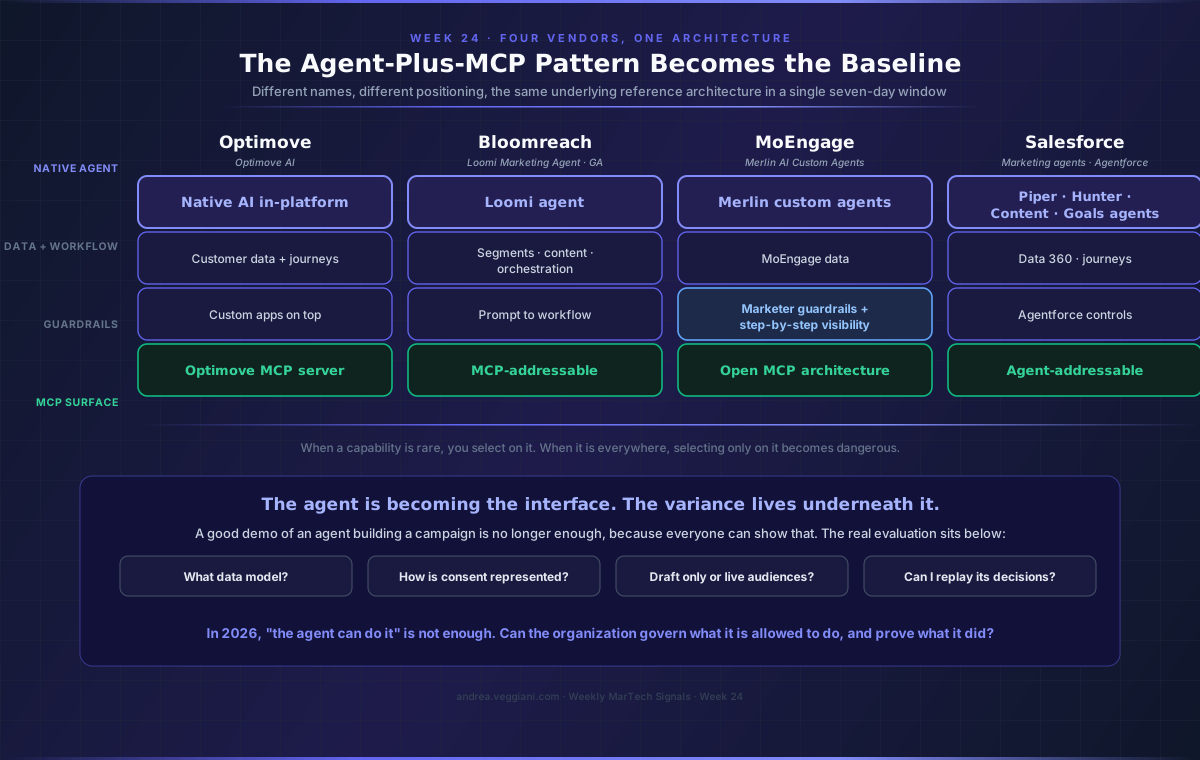
The second signal of the week was convergence. Optimove launched Optimove AI, Bloomreach moved its Loomi Marketing Agent to general availability, MoEngage launched Merlin AI Custom Agents, and Salesforce announced a new collection of marketing agents. The names and positioning differ, but the underlying pattern is increasingly the same.
Optimove describes a structure made of native AI inside the platform, an Optimove MCP server for external AI environments, and custom apps built on top. Bloomreach’s Loomi Marketing Agent turns natural language prompts into campaign workflows, combining conversational campaign building, segmentation, content creation and journey orchestration. MoEngage’s Merlin lets marketers build custom workflow agents on top of MoEngage data, with marketer-defined guardrails, step-by-step visibility and an open MCP architecture. Salesforce announced marketing agents such as Piper, Hunter, a Content Agent and a Marketing Goals Agent, all positioned within the broader Agentforce strategy.
Strip away the product names and the pattern is familiar: a native agent inside the platform, a platform-specific data and workflow layer beneath it, a set of guardrails and approvals around what the agent can do, and an MCP surface that exposes platform capabilities to external agents. That is becoming the reference architecture for enterprise marketing platforms.
But reference architecture does not mean equivalence, and the differences are concrete. Take the four offerings on the dimension that actually matters, what the agent is allowed to do to live systems. Bloomreach’s Loomi builds campaign workflows end to end, segmentation through orchestration, which is powerful and also the broadest write surface of the four. MoEngage is the only one that leads with the opposite emphasis: marketer-defined guardrails and step-by-step visibility into every action, an agent designed to be watched. Optimove splits the question across a native in-platform agent and a separate MCP server, which means the read-versus-write boundary depends on which surface you expose to which environment. Salesforce ships named agents inside Agentforce, where the governance story is the Agentforce permission model rather than anything specific to the marketing agents themselves. Same market label, four different answers to “what can it touch.”
That is the evaluation. When a capability is rare you select on it; when it is everywhere, selecting on the demo becomes dangerous, because every vendor can demo an agent building a campaign. The questions that separate them sit underneath: what data model does the agent operate on, how does the platform represent consent, can permissions be scoped by role or market or channel, can the agent be held in draft mode, can a decision be replayed, and can you prove why a given customer received a given message.
MoEngage’s bet is the instructive one, assuming the implementation matches the promise. Leading with observability and control rather than autonomy and magic is a bet on the enterprise buyer who will eventually have to explain what happened when something went wrong. In 2026, “the agent can do it” is table stakes. Whether you can govern what it is allowed to do, and prove what it actually did, is the product.
MCP moves beyond engagement
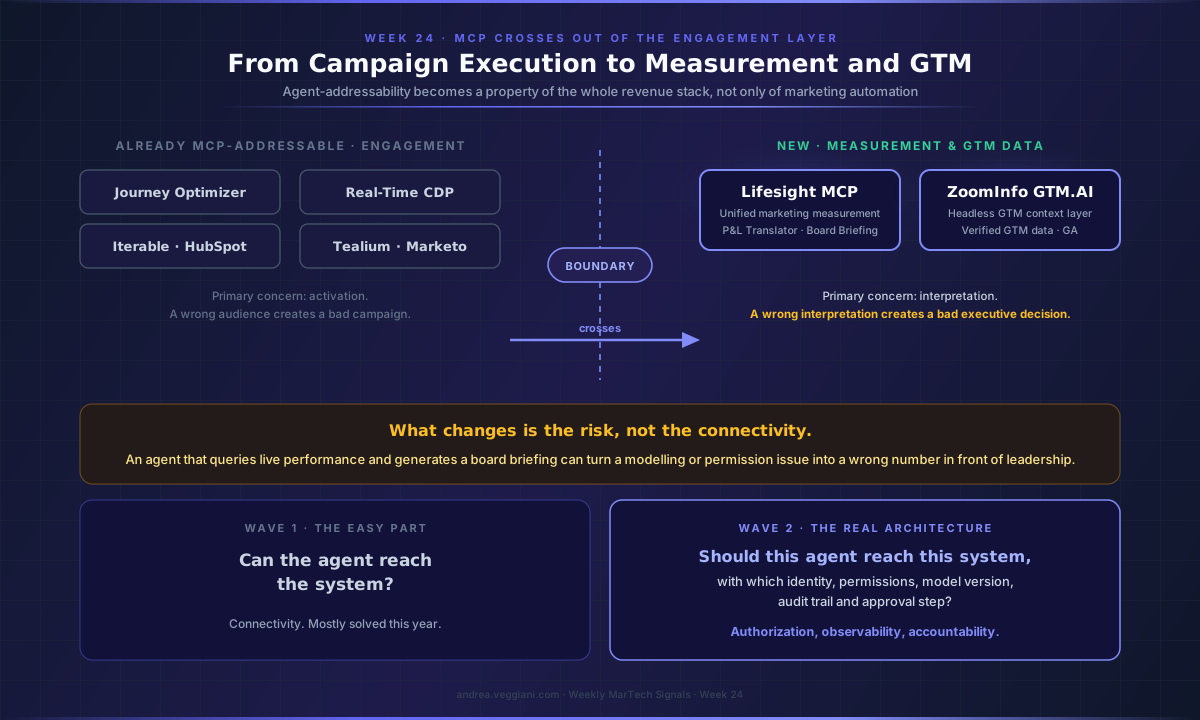
For several weeks, MCP has been spreading across engagement and marketing automation platforms: Journey Optimizer, Real-Time CDP, Iterable, HubSpot, Marketing Cloud Engagement, Tealium and Marketo. This week the pattern crossed an important boundary, because it moved beyond engagement into measurement and go-to-market data.
Lifesight launched an MCP that gives Claude and ChatGPT access to a company’s unified marketing measurement model. The use cases include scenario planning, channel deep-dives, anomaly triage, a P&L Translator that reframes marketing performance in finance language, and a Board Briefing tool. ZoomInfo moved GTM.AI to general availability, positioning it as a headless go-to-market context layer and MCP home for verified GTM data, accessible to AI agents across the tools revenue teams already use.
The pattern is consistent: expose the model to the agent, make the system addressable, and let Claude, ChatGPT or another agentic environment query, reason and act on top of structured business context.
What changes is the risk.
When MCP exposes an email campaign tool, the primary concern is activation. When MCP exposes a measurement model, the concern becomes interpretation. A wrong audience can create a bad campaign, but a wrong measurement interpretation can create a bad executive decision.
The Lifesight example makes this concrete. An agent that can query live marketing performance and generate a board briefing is extremely useful. It is also a system that can confidently turn a modelling issue, a permission issue or a misunderstood prompt into the wrong number in front of leadership. The first wave of MCP adoption answered one question: can the agent reach the system? That wave is essentially won. The second is harder, because authorization, observability and accountability are what determine whether the connection can be trusted, and a measurement model raises that bar higher than a campaign tool ever did.
The Bloomreach release nobody will quote
The least glamorous release of the week may be one of the most useful. Alongside its Loomi agent news, Bloomreach shipped changelog 1.311, and buried inside it is a Messages Archive: exact copies of every sent email and SMS, retained for up to two years, accessible from the customer profile in the UI or through the Data API.
This is not an AI feature and it will not get the same attention as an agent launch, but for regulated industries it matters enormously. In insurance, financial services, utilities and other regulated environments, the question “what exactly did we send this customer?” is not a support curiosity. It can become a compliance requirement.
It is not enough to reconstruct the template, to show that a campaign existed, or to say that the customer was eligible for a journey. Sometimes you need to retrieve the exact message that a specific person received, with the exact content that was sent at that time. That is the difference between evidence and approximation, and approximation is often where risk begins.
This is why the fundamentals keep mattering: identity, consent, data residency, deliverability, auditability, retention, exportability and access control. The vendors that keep shipping this kind of work in the same week they ship headline AI features are the ones worth paying attention to, because in enterprise MarTech durable architecture is rarely made of the most exciting features. It is made of the features that keep you out of trouble.
The same Bloomreach release also addressed a mobile push delivery issue where one invalid token could block delivery to other devices for the same customer, and added more practical merchandising controls for recommendations. Again, not glamorous, but important. These are the kinds of improvements that do not always win demos but often win production.
The question worth holding
Week 24 surfaced four signals. Salesforce is claiming the content layer as a strategic control point. Several major platforms are converging on the same agent-plus-MCP pattern, which means that pattern is becoming the floor rather than the ceiling. MCP is moving beyond campaign execution into measurement and GTM data, which means agent-addressability is becoming a property of the whole revenue stack, not only of marketing automation. And the fundamentals are still shipping quietly in the background, as Bloomreach’s Messages Archive shows.
The common thread runs underneath all four: the agent is becoming the interface, and the work that matters has moved to what sits below it.
The question to put to any marketing or technology leader is this: your platforms are converging on an architecture where agents can reach your content, your customer data, your journeys, your measurement model and your GTM context. The connectivity is being handed to you faster than your governance model is probably evolving. Have you decided who is allowed to drive which system, with what scope, under which controls, and with what record of what they did?
The vendors are making that decision more urgent, but they are not making it for you.
Sources
Salesforce / Contentful
- Salesforce Signs Definitive Agreement to Acquire Contentful
- Contentful: A New Chapter for Contentful: Scaling Our Vision with Salesforce
Salesforce marketing agents
Adobe
Marketing AI suite convergence
- Optimove Launches Optimove AI
- Bloomreach Announces the General Availability of Loomi Marketing Agent
- MoEngage Launches Merlin AI Custom Agents
MCP into measurement and GTM data
Bloomreach fundamentals
Weekly market roundup
The digest behind each weekly article is produced through a structured AI-assisted scan of official release notes and product update sources. I review the output, verify the relevant signals and write the architectural interpretation.
This article draws from the Martech Weekly Digest scans run on June 11, 2026, covering release notes and product updates across several CEP platforms and vendors.
If you find errors or gaps in coverage, I want to know. The process improves when the output is challenged.