10 min read
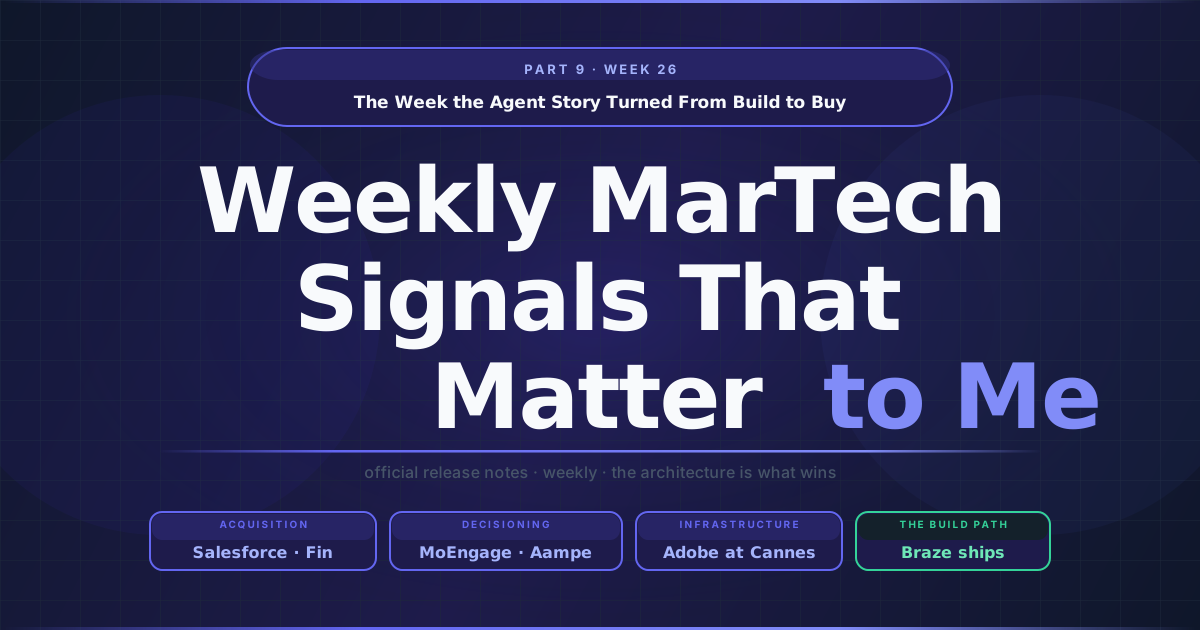
The Week the Agent Story Turned From Build to Buy
For most of this year, the agentic story in our industry has been a story about shipping. Every week another vendor announced its own agents, its own MCP server, its own way of letting a marketer talk to a campaign in natural language. I have written about that cadence so many times it started to feel like the weather. Over the last few weeks, the weather changed. Week 26 made the pattern hard to ignore. Two of the largest moves in the current agentic cycle were not product launches at all: they were acquisitions. Salesforce agreed to acquire Fin in a deal valued at around 3.6 billion dollars, the customer-agent company formerly known as Intercom. MoEngage acquired Aampe, an infrastructure company whose entire premise is one autonomous agent per customer. When the most important signal in a week about agents is not only who shipped what, but who bought whom, the phase of the cycle has shifted, and it is worth slowing down to say why that matters.
TL;DR
- Salesforce agreed to acquire Fin (formerly Intercom) for about $3.6B, its third agent-related move in roughly two weeks, in the same window in which role cuts were reported across parts of Agentforce, Marketing Cloud, and MuleSoft. My read: Salesforce is buying time and deployment maturity around a capability it cannot afford to let mature too slowly.
- MoEngage acquired Aampe, whose model is one dedicated autonomous agent per customer rather than one agent for the marketer. That is a different architectural bet from the orchestration-agent pack (decisioning as the substrate, not orchestration as the surface), and it is the most interesting acquisition of the week for anyone thinking about where agentic engagement actually lives.
- Adobe used Cannes to reframe itself as “the agentic infrastructure layer,” with major agency holding companies deploying its stack and its CX skills and MCP servers confirmed GA inside Claude Enterprise and Microsoft 365 Copilot Cowork. The product story had already been told; Cannes was the distribution and interoperability story layered on top of it.
- The data-cloud substrate keeps compounding underneath all of it: CMSWire reported that CustomerLake has no platform fee and bills on identity resolution and profile builds, while Snowflake’s annual report named Iterable and Tealium among its activation leaders. The activation layer is increasingly defined by which data cloud it sits closest to.
- Braze shipped a major organic release the same week. BrazeAI Operator now absorbs every standalone assistant and builds entire campaigns end-to-end, not just copy.
Let me take the two acquisitions together, because the pairing is the point.
Salesforce bought deployment maturity, not just another agent
Salesforce signed a definitive agreement to acquire Fin, the company most of us still think of as Intercom, for roughly 3.6 billion dollars. The stated logic is straightforward: Fin is a customer-service agent company, and once the deal closes Salesforce can offer rapidly-deployable support agents on top of Agentforce and the Service Cloud estate. Read in isolation it is a sensible service-AI tuck-in. Read in context it is something more revealing.
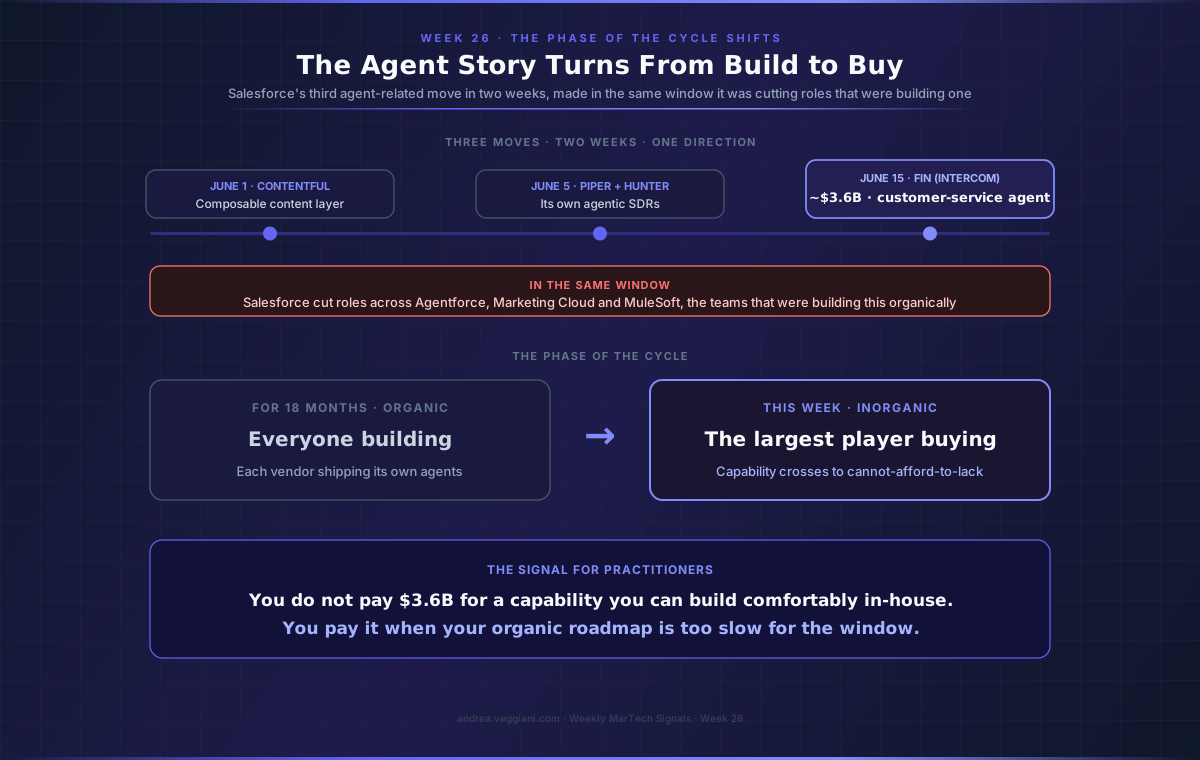
Because this is Salesforce’s third agent-related move in roughly two weeks. The Contentful acquisition on the first of June gave it a composable content layer to feed agent-assembled experiences. The Piper and Hunter marketing agents announced earlier in June gave it its own agentic SDRs. And now Fin gives it a customer-service agent with real production maturity. Three moves, two weeks, one direction. And it all happened in the same window in which Salesforce was also reported to be cutting roles connected to Agentforce, Marketing Cloud, and MuleSoft, a detail I keep turning over because the two facts belong in the same reading of the market. You do not pay 3.6 billion dollars for a capability you believe you can build comfortably in-house on your own timeline. You pay it when the capability is strategic enough to matter and deployment maturity matters more than purity of roadmap. My read is that Salesforce is buying time, while also reshaping the teams and cost base around the agentic bet.
That is the signal I want practitioners to register. For eighteen months the agentic wave has been organic: everyone building. In this window it turned inorganic: the largest player buying. That turn suggests the capability has crossed from differentiator-you-experiment-with to capability-you-cannot-afford-to-lack. And when the consolidation phase of a technology cycle begins, it rarely stops at one deal.
MoEngage bought a different idea about where the agent sits
Which brings me to the acquisition I find more architecturally interesting, even though it carried no disclosed price. MoEngage, a B2C customer-engagement platform strong across APAC and EMEA, one I added to this watchlist only a few weeks ago, acquired Aampe. And Aampe is built on a premise that quietly contradicts almost every “agentic CEP” launch I have catalogued this year.
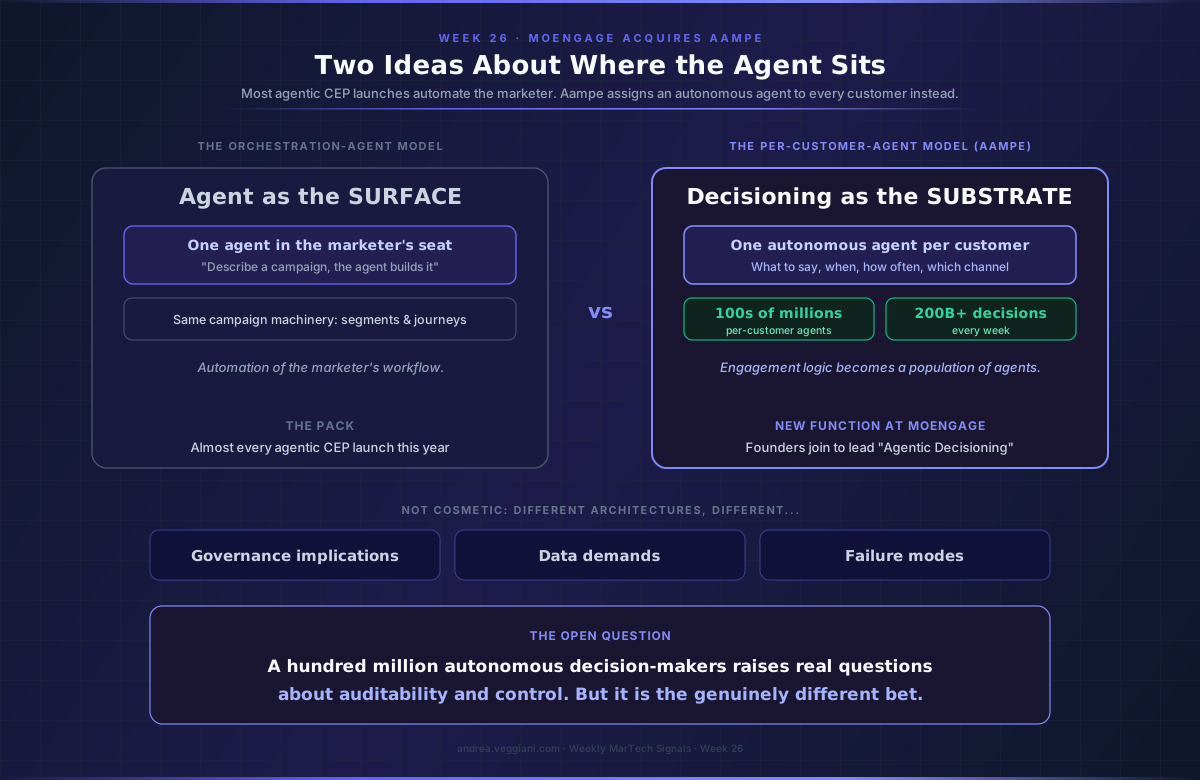
Most of those launches put a single agent in the marketer’s seat. You describe a campaign, the agent builds it; you set a goal, the agent orchestrates toward it. Useful, but it is automation of the marketer’s workflow. Aampe does something else. It assigns a dedicated, autonomous agent to every individual customer, each one deciding what to say to that person, when, how often, and on which channel, learning from every outcome, inside guardrails the marketer sets. At scale the platform reportedly runs hundreds of millions of these per-customer agents and processes more than two hundred billion decisions a week. The founders are joining MoEngage to lead a function they are calling Agentic Decisioning.
Sit with the difference for a moment, because it is not cosmetic. The orchestration-agent model treats the agent as a surface, a more natural way to drive the same campaign machinery. The per-customer-agent model treats decisioning as the substrate: the engagement logic itself becomes a population of agents, one per person, rather than a set of segments and journeys a marketer designs. Those are different architectures with different governance implications, different data demands, and different failure modes. I am not yet convinced the per-customer model is the right answer for every brand. Running a hundred million autonomous decision-makers raises real questions about auditability and control that “set guardrails and trust it” does not fully resolve. But it is the most genuinely different bet in the agentic CEP space right now, and MoEngage just made it the centre of its strategy. For a platform trying to leapfrog larger incumbents, betting on a different architecture rather than a faster version of the same one is at least a coherent move.
Adobe spent Cannes claiming the layer beneath everyone
The third thing worth your attention happened on the Croisette. Adobe used Cannes Lions to reframe CX Enterprise as, in its words, “the agentic infrastructure layer across models, platforms, agents and ecosystem.” The substance behind the slogan: major agency holding companies, Accenture Song, Omnicom, Stagwell’s Code and Theory, and WPP, are now deploying Adobe’s content, data, and AI platforms at scale, and Adobe’s CX skills and MCP servers are confirmed generally available inside Anthropic’s Claude Enterprise and Microsoft 365 Copilot Cowork.
The product story for CX Enterprise Coworker had already been told, and I wrote about it then. What Cannes added was the distribution and interoperability story layered on top: the agencies that sit between Adobe and a large share of the world’s brand budgets are running its agentic stack, and that stack now reaches users inside two AI assistants enterprises actually use. That is a positioning play, and a clever one. While Salesforce and MoEngage buy individual agent capabilities, Adobe is trying to be the substrate they all run on, the connective tissue beneath an automating stack rather than another agent in it. Whether it earns that claim is a question for the next year, not this week. But it is the most ambitious framing any vendor put forward, and it is consistent with the interoperability-and-control theme that ran through every serious Cannes ad-tech announcement.
The counter-example: Braze kept building
It would be too neat to say the whole industry spent the week buying agents instead of building them, and Braze made sure of it. In the same window, it shipped a substantial organic release, and the centrepiece is the clearest statement yet of the build path. BrazeAI Operator, until now one assistant among several scattered across the dashboard, has absorbed all of them: the copywriter, the Liquid agent, the HTML email-template agent, the image generator, the content QA, the data-transformation copilot. Operator is now the single generative surface. And it no longer just writes the message: it builds the whole campaign from a prompt, taking over the schedule, targeting, audience, and conversion steps it previously left to you.
Two smaller items in that release deserve a practitioner’s nod, because they are the unglamorous kind I keep arguing matter most. Braze’s six eCommerce recommended events no longer count toward billable data points, a quiet but real change to the cost model for any retail or commerce brand standardising on those events. And User deletion went generally available, which for my regulated clients is the same auditability-and-compliance drumbeat I flagged last week: the ability to actually remove a profile on request is not a nice-to-have in a GDPR or CCPA conversation.
Underneath all of it, the data cloud kept compounding
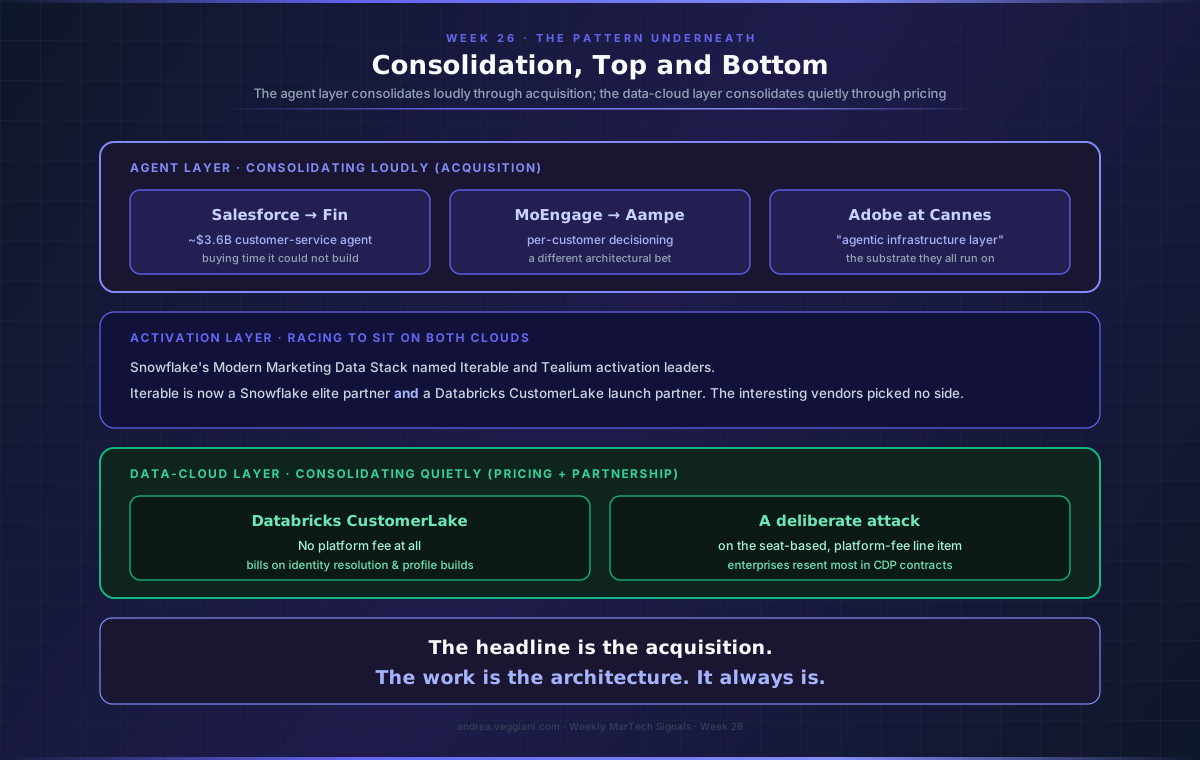
I would be repeating myself if I dwelt too long on the substrate story, but it advanced again this week and the advance reinforces everything above. CMSWire reported the most interesting detail in CustomerLake’s pricing model: no platform fee, with the bill landing each time the system resolves an identity or builds a profile. If that model holds in practice, it is a deliberate attack on the exact line item enterprises resent most in standalone CDP contracts: the seat-based or platform-fee licensing that feels disconnected from value delivered. And around the same Modern Marketing Data Stack cycle, Snowflake named Iterable and Tealium among activation leaders, with Iterable also positioning itself as both a Snowflake elite partner and a Databricks validated launch partner for CustomerLake.
Pull those threads together and the pattern is the one I keep underlining. The agent layer is consolidating on top, loudly, through acquisition. The data-cloud layer is consolidating underneath, quietly, through pricing and partnership. And the activation vendors in the middle are racing to be first-class citizens on whichever data cloud their customers have standardised on, because that proximity, not the feature list, is increasingly what determines whether they stay relevant. The interesting companies this week were not picking sides between Snowflake and Databricks. They were making sure they sat cleanly on both.
The question worth holding
So week 26 handed us a turn rather than a list. The agent story moved from build to buy, and it did so at the top of the market, with large players paying real money for capabilities adjacent to what they had already been trying to make central to their roadmaps. That should change how you read the next two quarters of announcements. When you see a vendor launch its own agent now, the honest follow-up question is no longer just “is it any good.” It is “is this a capability they will keep building, or one they are dressing up to be acquired, or one a larger platform will simply buy out from under them.” Consolidation phases are unkind to point solutions.
And for those of us who design the architecture rather than the cap table, there is a more durable point underneath the deal flow. An acquired agent does not arrive as a clean capability. It arrives carrying the acquirer’s data model, the acquirer’s governance, the acquirer’s integration debt, and the value of the deal is won or lost in that integration, not in the press release. Salesforce buying Fin is not the same as Salesforce having Fin’s agents working natively against trusted, governed customer data. MoEngage buying Aampe is not the same as hundreds of millions of per-customer agents being safely accountable inside MoEngage’s existing controls. The headline is the acquisition. The work is the architecture. It always is, and it is about to get a great deal busier.
Sources
Salesforce acquires Fin (Intercom)
- Salesforce: definitive agreement to acquire Fin
- TechCrunch: Salesforce acquires AI customer service platform Fin for $3.6B
- Solutions Review: Top MarTech News, Week of June 19th
MoEngage acquires Aampe
Adobe at Cannes Lions 2026
- Adobe newsroom: Adobe accelerates agentic AI adoption
- Adobe blog: the conversation at Cannes has changed
- Digiday: agentic AI, interoperability and control dominate Cannes
Data-cloud substrate (Databricks, Snowflake, Iterable, Tealium)
- CMSWire: why Databricks CustomerLake upended the CDP space
- Iterable + Databricks milestones (MarTech Cube)
- Iterable: Snowflake Modern Marketing Data Stack recognition
- Tealium: Snowflake Modern Marketing Data Stack recognition
Braze June 25 release (the build counter-example)
Agent-plus-MCP tail (context)
- Jasper launches end-to-end GEO Agent
- Fullstory launches MCP + StoryAI Agents + Workflow Intelligence
- Tealium Context API
The digest behind each weekly article is produced through a structured AI-assisted scan of official release notes and product update sources. I review the output, verify the relevant signals and write the architectural interpretation.
This article draws from the Martech Weekly Digest scans run on June 25, 2026, covering release notes and product updates across several CEP platforms and vendors.
If you find errors or gaps in coverage, I want to know. The process improves when the output is challenged.