11 min read
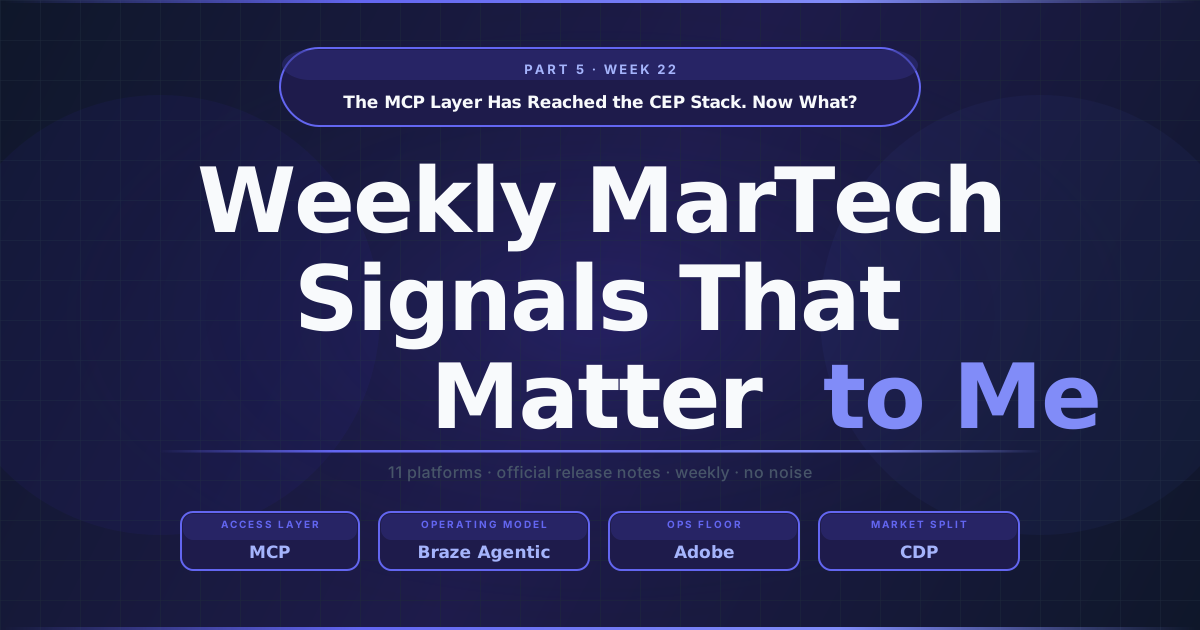
MCP Is Not the Feature. It Is the Premise.
Salesforce Marketing Cloud Engagement now has a documented MCP Server that practitioners can use to work with content, campaigns, journeys, automations and customer data through an AI client.
That matters because of what it completes, at least for the platforms I regularly track in this digest.
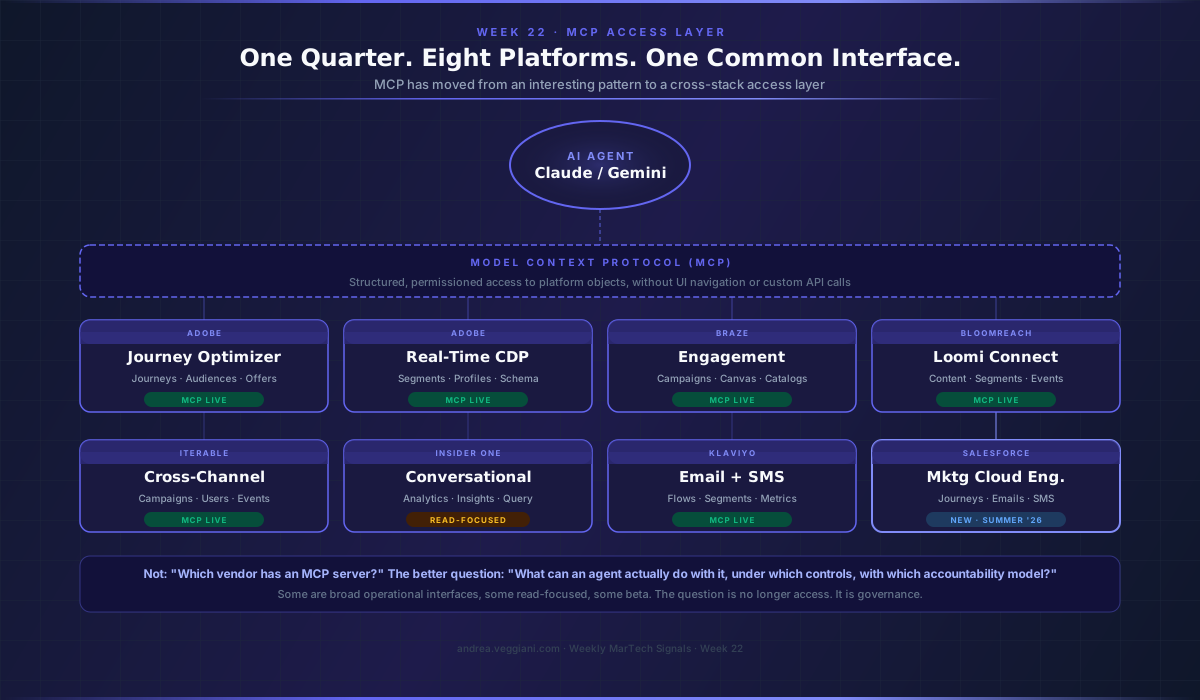
Adobe Journey Optimizer has one. Adobe Real-Time CDP has one. Braze has one. Bloomreach has one. Iterable has one. Insider One has one. Klaviyo has one. Salesforce Marketing Cloud Engagement now has one too.
Some of these are broader operational interfaces. Some are read-focused. Some are beta or limited-access implementations. That difference matters, but the pattern is now too visible to ignore.
In one calendar quarter, MCP has moved from an interesting technical pattern to a common access layer across a meaningful part of the enterprise customer engagement stack.
That does not mean every implementation is mature. It does not mean every tool is production-ready for unrestricted write access. It does not mean governance is solved.
But the direction is now clear.
The AI layer is no longer sitting above the marketing stack as a generic assistant. It is starting to become an operating interface for the stack itself.
That is the real signal.
TL;DR
- MCP is becoming a common access layer across a meaningful part of the customer engagement stack, but maturity, permissions and write safety still vary a lot by platform.
- Braze shows where the agentic interface is heading: not a generic chatbot, but controlled workflow surfaces for campaign work, custom agents and creative-to-campaign production.
- Adobe’s less glamorous May updates matter because agentic systems need a clean operational floor: manageable objects, reusable assets, observable dataflows and stable permission surfaces.
- The CDP question is shifting from “which vendor is highest in the quadrant?” to “is this platform becoming an ecosystem data layer, an agent-consumable activation layer, or a governance layer between the two?”
1. MCP Is Becoming the New Access Layer
I want to be precise about this, because the sentence “the MCP layer is complete” sounds stronger than the reality underneath it.
For the platforms I track most closely, the pattern is now visible enough to treat MCP as a serious architectural signal.
What is actually true is this: the major customer engagement platforms I follow are beginning to expose campaign, journey, audience, content, configuration and performance objects through MCP-compatible interfaces.
That means an AI client can inspect parts of the marketing environment without a human navigating multiple dashboards or writing direct API calls. Depending on the platform and the permission model, it can retrieve objects, summarize configurations, compare assets, identify operational patterns and, in more controlled cases, trigger changes.
On the Marketing Cloud Engagement side, the tool coverage already points to a broad operational surface: automations, contacts, content, Data Extensions, email, journeys, push, SMS and utility functions. Some tools are read-only. Some are potentially destructive. Some require asynchronous handling. That distinction matters.
Because this is where the discussion should move next.
Not: “Which vendor has an MCP server?”
But: “What can an AI agent actually do with it, under which controls, and with which accountability model?”
Marketing operations teams were built around a set of assumptions: each platform required trained human operators; data access required UI navigation or direct API calls; campaign analysis required reports, dashboards and manual interpretation.
MCP does not immediately invalidate those assumptions. But it starts to erode the premises they rest on.
When an analyst can ask an AI assistant to identify the journeys with the highest unsubscribe rate in the last 30 days, summarize the shared exit patterns, and compare them with recent content or audience changes, the work changes.
It does not disappear.
It moves.
The premium shifts from data retrieval to problem framing, from dashboard navigation to interpretation, from platform knowledge alone to validation and control.
The platforms that win in this environment will not be the ones that shipped MCP first. They will be the ones that expose the most useful operational surface, with the clearest permission model and the most sensible governance around what agents can and cannot do without human approval.
That is now part of CEP differentiation.
2. Braze Shows Where This Goes Next
I missed this in a previous digest run, so I am correcting it here.
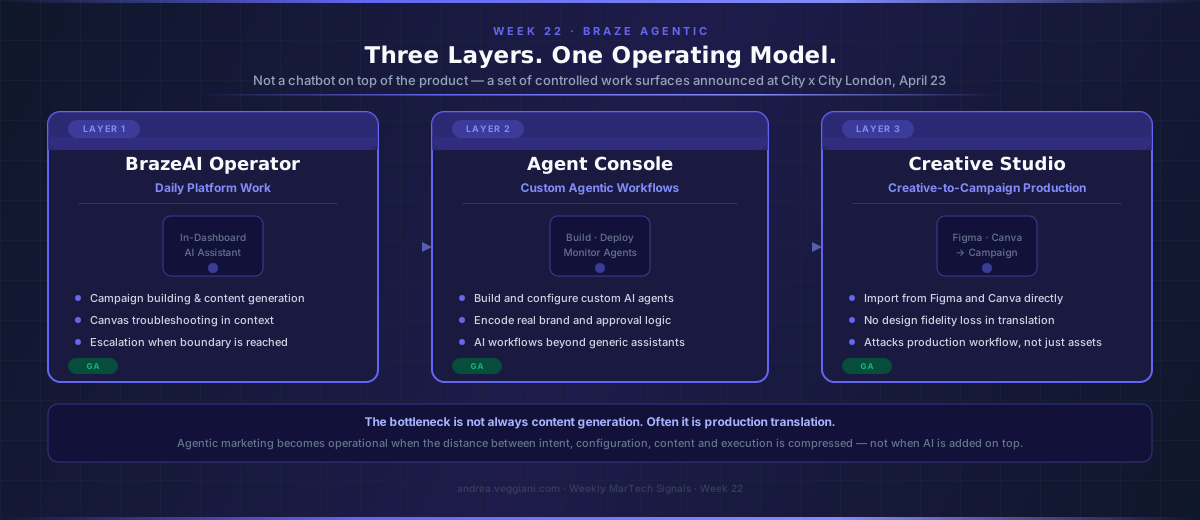
On April 23, 2026, at City x City London, Braze announced BrazeAI Operator, BrazeAI Agent Console and Braze Creative Studio.
Viewed together, these are more interesting than three separate AI features. They describe an operating model.
BrazeAI Operator is the practitioner-facing assistant. It sits inside the platform and helps with campaign building, content generation, Canvas troubleshooting and support-ticket creation without forcing the user to leave the working context.
That last part is not a small detail. A useful AI assistant is not only one that generates text or suggests a configuration. It is one that understands when the issue has moved beyond its current operating boundary and needs escalation.
BrazeAI Agent Console is the more architectural move. It gives teams a way to build, configure, deploy and monitor custom agents. That shifts Braze from “a platform with AI features” toward “a platform where teams can build AI-assisted marketing workflows.”
Braze Creative Studio is the third piece, and maybe the easiest one to underestimate.
It connects Figma and Canva workflows more directly with campaign production in Braze. That may sound less strategic than “agentic AI”, but anyone who has operated high-volume campaign programs knows the truth: the bottleneck is not always content generation. Often it is production translation.
Together, the pattern is coherent:
- Operator for daily platform work.
- Agent Console for custom agentic workflows.
- Creative Studio for creative-to-campaign production.
This is the shape of agentic marketing when it starts to become operational: not a chatbot on top of the product, but a set of controlled work surfaces that compress the distance between intent, configuration, content and execution.
Whether Braze executes consistently across all three layers will determine whether this becomes a durable differentiator. But the direction is the right one.
3. Adobe Is Fixing the Operational Floor
The Adobe updates from this run are much less exciting on the surface.
Bulk actions in campaign lists. Better sorting and column resizing in Fragments and Templates. Inline profile attribute editing in Push. Cross-organization asset repository access. New AEP source connectors. Automatic disabling of persistently failing dataflows. Array field export for enrichment attributes.
None of this is keynote material.
That is precisely why it matters.
For the last two years, many enterprise practitioners have said some version of the same thing about Adobe Journey Optimizer and Adobe Experience Platform: the capability ceiling is high, but the operational floor is demanding.
The platform can do a lot. The question is how hard it is to operate at scale.
When a team manages hundreds of journeys, fragments, templates, audiences, assets, dataflows and channel configurations, small interface limitations become real operating costs. Lack of bulk operations is not an inconvenience. It is a governance and velocity issue. Poor sorting is not cosmetic. It affects production control. Missing cross-organization asset access is not just an admin nuisance. It shapes how reusable content and governance patterns can actually work.
This is why the boring additions are important.
Agentic systems still need operational infrastructure.
Actually, they need it more.
If AI agents are going to inspect, summarize, recommend or eventually operate parts of a marketing environment, the underlying platform needs clean object models, manageable lists, stable configuration surfaces, reliable permissions, reusable assets and observable dataflows.
Otherwise the agent only accelerates the mess.
The AEP additions point in the same direction. Delta Sharing, LAVA and Meta Ads sources are not dramatic announcements, but they close integration gaps that teams often solve today through custom pipelines. Delta Sharing is particularly worth watching because it supports open-protocol, zero-copy data sharing patterns for enterprises working with environments such as Databricks or Snowflake.
That matters because the future operating interface may be agentic, but the future data architecture is still constrained by movement, duplication, governance and lineage.
AI does not remove those constraints.
It exposes them faster.
4. The CDP Split Is the Data-Layer Version of the Same Story
Tealium had a busy two weeks.
On May 7 it announced AI at the Edge, an MCP-powered Configuration Agent, AI Decisioning with Invoke Your Own Model, AI Recommended Audiences and new ecosystem connectors. On May 14 it announced Audience Discovery for Snowflake as a Native App, enabling joint customers to build, govern and activate audiences directly within their Snowflake environment without moving data.
Viewed individually, each of these is a product update. Viewed together, they describe a strategic position and that position is only legible if you understand the split that is reshaping the CDP market right now.
The way I read the CDP market is that it is being pulled in two architectural directions at once.
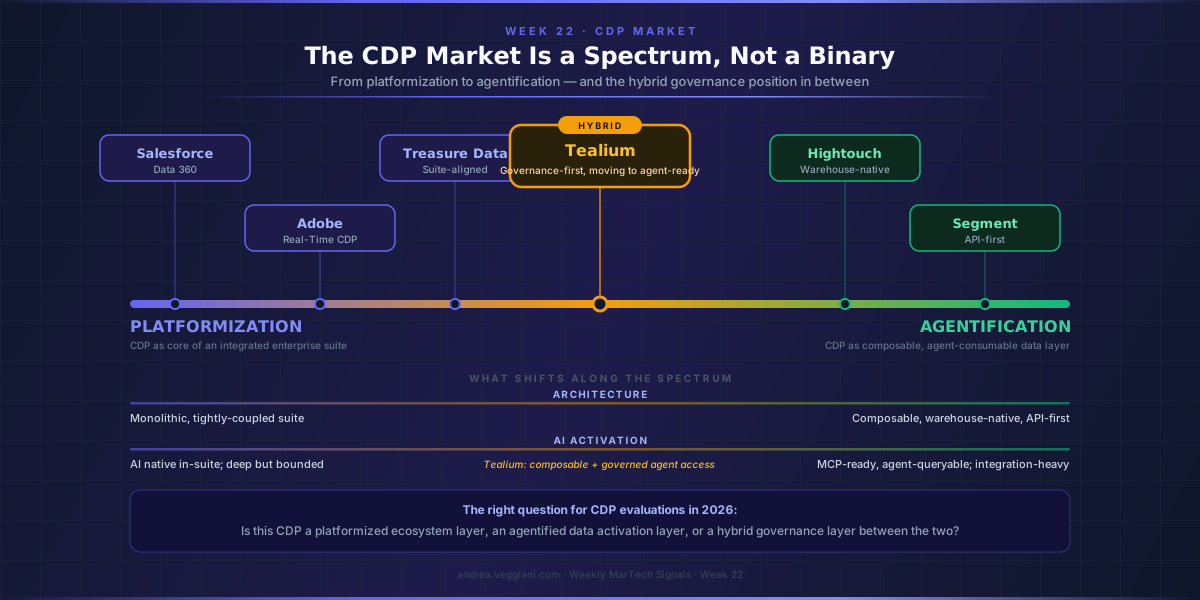
One direction is platformization. In this model, the CDP becomes the data foundation of a broader enterprise application ecosystem. Salesforce Data 360 and Adobe Real-Time CDP are the obvious examples. The value proposition is not only customer data unification. It is the connection between identity, data governance, activation, analytics, journey orchestration, personalization and the rest of the enterprise suite.
The Gartner CDP Magic Quadrant 2026 reflects this shift only indirectly: Salesforce remains in the Leaders quadrant, Hightouch enters as a Leader with a warehouse-native and composable story, and Adobe remains the only Visionary. Since the full Gartner report is paywalled, I treat this as a directional market signal rather than as the foundation of the argument.
The other direction is agentification. In this model, the CDP or data activation layer becomes more composable, warehouse-native, API-first and agent-consumable. Hightouch is one of the clearest examples of this trajectory. The center of gravity is not a monolithic marketing suite. It is the enterprise data layer and the ability to make that data actionable across tools, agents and destinations, without duplicating or moving it.
These are not the same product. They are not evaluated in the same way. And they do not create the same operating model.
Tealium is trying to hold a position between both.
Its MCP-powered Configuration Agent is a direct signal: Tealium wants to be agent-consumable, meaning a practitioner should be able to configure tag rules, audiences and connectors through a natural language interface connected to an AI client. Its Snowflake Native App points in the same direction: keep the data where it lives, make it activatable without extraction. Both moves are architecturally consistent with the agentification trajectory.
At the same time, Tealium has always competed on governance, consent management and data collection discipline, capabilities that matter most in regulated industries where identity and event logic cannot simply be absorbed into a single engagement suite. That is the composable, governance-first position it is trying to protect while moving toward agent-readiness.
That hybrid position is not easy. But it may be the right one for a specific segment of the market: enterprises that need composable data infrastructure and governed agent access, not a monolithic AI suite.
For practitioners evaluating or renewing CDP contracts, the important question is no longer only “which vendor is highest in the quadrant?”
The better question is:
Is this CDP becoming a platformized ecosystem layer, an agentified data activation layer, or a hybrid governance layer between the two?
That answer will determine which AI use cases are easy to activate in 2027 and which ones require custom workarounds.
The Question That Follows
I started with MCP because it changes the frame for everything else in this week’s scan.
MCP is not a feature. It is a new operating premise. And operating premises have planning consequences.
The first consequence is for CEP strategy. If your customer engagement platform now exposes its journey, audience and campaign objects to an AI agent, the question is no longer whether the platform has a good UI. The question is whether its permission model is mature enough to define what agents can read, what they can propose, and what requires human approval before execution. That is a governance conversation that most CEP implementations have not had yet. It needs to happen before the MCP tooling is handed to a team, not after.
The second consequence is for CDP evaluation. The platformization versus agentification split described in Section 4 is not an abstract taxonomy. It directly determines which AI use cases a CDP makes easy and which ones it makes hard.
A platformized CDP makes agent-native capabilities more straightforward when your AI use cases live within that vendor’s ecosystem. An agentified CDP can make similar capabilities available across a broader set of tools, provided the APIs, permissions and governance model are strong enough. If your 2026 CDP contract renewal is coming up and you have not asked the vendor which architectural direction they are moving in, that question is overdue.
The third consequence is for stack review. The question for every point solution in your current stack is no longer only “does this still do its job?” It is also “does this product expose enough structure, context and control to remain useful in an AI-operated environment?” If the answer is no, the tool may still function, but its architectural argument is getting weaker.
The architecture still wins.
What is changing is that the architecture now has a new operating interface. And most planning assumptions were written before that interface existed.
Sources
MCP platform references
- Adobe Journey Optimizer MCP documentation
- Adobe Real-Time CDP MCP documentation
- Braze MCP Server documentation
- Bloomreach Loomi Connect MCP documentation
- Insider One MCP Server for Conversational Analytics
- Iterable MCP Server setup documentation
- Klaviyo MCP Server documentation
- Salesforce MCE MCP Server — Developer Documentation
- Salesforce MCE MCP Tools Reference
Adobe product updates
- Adobe Journey Optimizer May 2026 release notes
- Adobe Experience Platform May 2026 release notes
- Adobe Experience Platform May 2026 pre-release notes
Braze
SiliconAngle
Tealium
- AI at the Edge, AI Decisioning, Configuration Agent, AI Recommended Audiences, May 7, 2026
- Audience Discovery for Snowflake Native App, May 14, 2026
Gartner / CDP Market
- Gartner Magic Quadrant for CDPs 2026 — CX Today analysis (secondary analysis; primary Gartner report behind paywall)
- CDP Institute — 18th Industry Update, H2 2025 data
The digest behind each weekly article is produced through a structured AI-assisted scan of official release notes and product update sources. I review the output, verify the relevant signals and write the architectural interpretation.
This article draws from the Martech Weekly Digest scans run on May 28, 2026, covering release notes and product updates across several CEP platforms and vendors.
If you find errors or gaps in coverage, I want to know. The process improves when the output is challenged.