11 min read
When the MCP Server Reaches the MAP Layer: Why a ‘Quiet’ Week Tells You More Than a Loud One
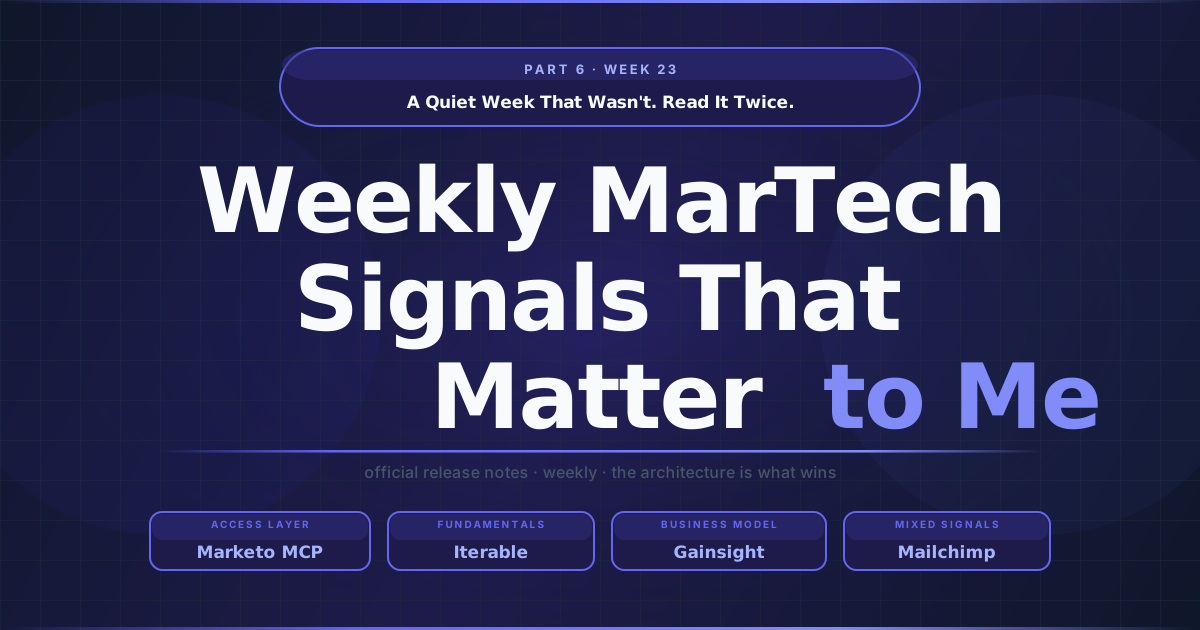
Some weeks in this industry announce themselves with a headline acquisition or a Magic Quadrant. Others look quiet on the surface and reward a second reading. Week 23 was the second kind.
In the scan window I used for this issue, none of the major customer engagement platforms I track most closely showed a net-new release significant enough to anchor the week. On a superficial scan, you would conclude nothing happened.
You would be wrong.
Underneath the flat product surface, three things moved. Each matters more for how we design and operate stacks than another batch of channel features would have.
The first: the MCP wave finally reached the B2B marketing automation layer.
The second: the unglamorous fundamentals, data pipelines and deliverability, are still shipping alongside the AI narrative, and we should pay attention to who is doing that work.
The third: vendors are beginning to sell agents not as a feature inside the platform but as the business model itself.
Let me take each in turn, and then the small, instructive contradiction Intuit handed us this week.
TL;DR
- Marketo brought MCP to the enterprise MAP layer, with 100+ operations exposed across core Marketo objects. The pattern is now clear across the engagement stack: the question is no longer whether AI can access the platform, but under which permissions, scopes and audit trails.
- Iterable shipped the unglamorous fundamentals (EU data residency, holdout lift reporting), and those determine enterprise fit more than another generative feature would.
- Gainsight moved from selling software to selling the outcome, with agents running the renewal motion end-to-end. The software-versus-services line is starting to dissolve.
- Intuit named Mailchimp as a reduced-investment area two weeks ago, then shipped a flagship AI capability this week. The lesson: don’t over-read a single signal, including the ones in this digest.
The MCP pattern has reached the MAP layer
For six digest runs I have been tracking the spread of Model Context Protocol servers across the platforms and adjacent layers in my monitoring set. And I have been saying, with the slightly tiresome insistence of someone who thinks an architectural pattern matters, that this is not just a feature. It is a shift in the operating model of the category.
This week Adobe Marketo Engage brought its MCP Server into the product conversation around the May ‘26 release cycle. It exposes more than a hundred operations across forms, programs, smart campaigns, people and leads, emails, snippets, lists, and folders to MCP-compatible AI clients. Alongside it, Marketo AI introduced a suite of agents to automate repetitive operational work, with two available now and more on the roadmap.
It is worth noting that this is not a blank cheque for agents to do anything inside Marketo. Adobe’s current MCP operations surface is broad, but the most important design choice is that it is governed: Adobe describes the available operations as generally read-oriented or non-destructive, with destructive actions excluded from the AI system. That detail matters because it shows where serious enterprise MCP implementations will compete: not only on breadth of access, but on the quality of the permission and safety model around that access.
The reason I keep returning to this is that it completes an architectural pattern. Through the prior runs we watched MCP servers appear across Adobe Journey Optimizer, Real-Time CDP, Iterable, HubSpot, Salesforce Marketing Cloud Engagement, Tealium, and even retail-media platforms like Pacvue. Marketo was the conspicuous gap in the map. That gap is now filled. MCP is no longer a marginal integration experiment; it is becoming a common operating surface across the engagement stack.
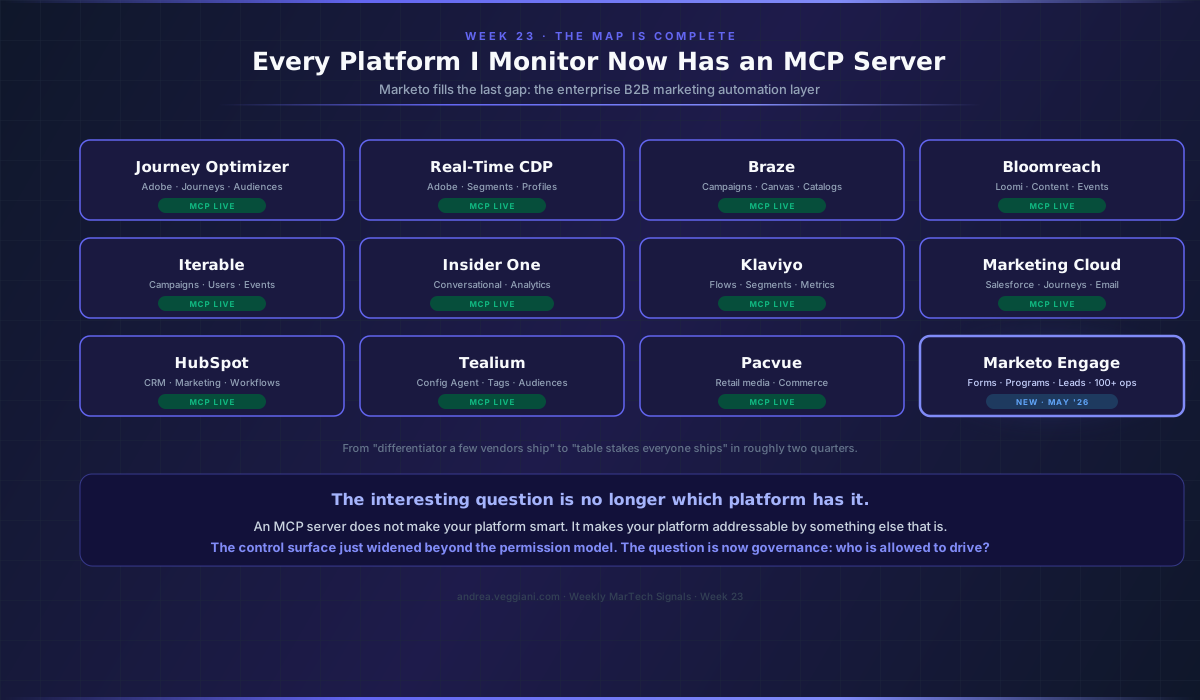
When a capability moves from “differentiator that a few vendors ship” to “emerging table stake across the category” inside roughly two quarters, the interesting question is no longer which platform has it. It is what does it change about how the work gets done. And here is where I want to be precise, because the hype around this is considerable and the architecture, as always, is what wins.
An MCP server does not make your Marketo instance smart. It makes your Marketo instance addressable by something else that is smart. The 100+ operations Adobe exposes are, in effect, a natural-language access surface: a way for an agent, or a practitioner driving an agent, to inspect and, where permitted, manipulate the platform without clicking through the UI or hand-writing REST calls.
That is genuinely useful for the repetitive, high-volume operational work that consumes a B2B marketing operations team: auditing smart campaigns, reconciling list memberships, cleaning up folder structures, checking program configurations.
But it also means the governance question moves. The control surface is no longer only the Marketo permission model. It is now also which agents can reach the MCP endpoint, with what scope, and with what audit trail.
If you are running Marketo at enterprise scale, the question to put to your team this quarter is not “should we use the MCP server.” It is “who is allowed to, and how do we log what they did.”
The capability is arriving faster than most governance models are.
The fundamentals still ship: watch who ships them
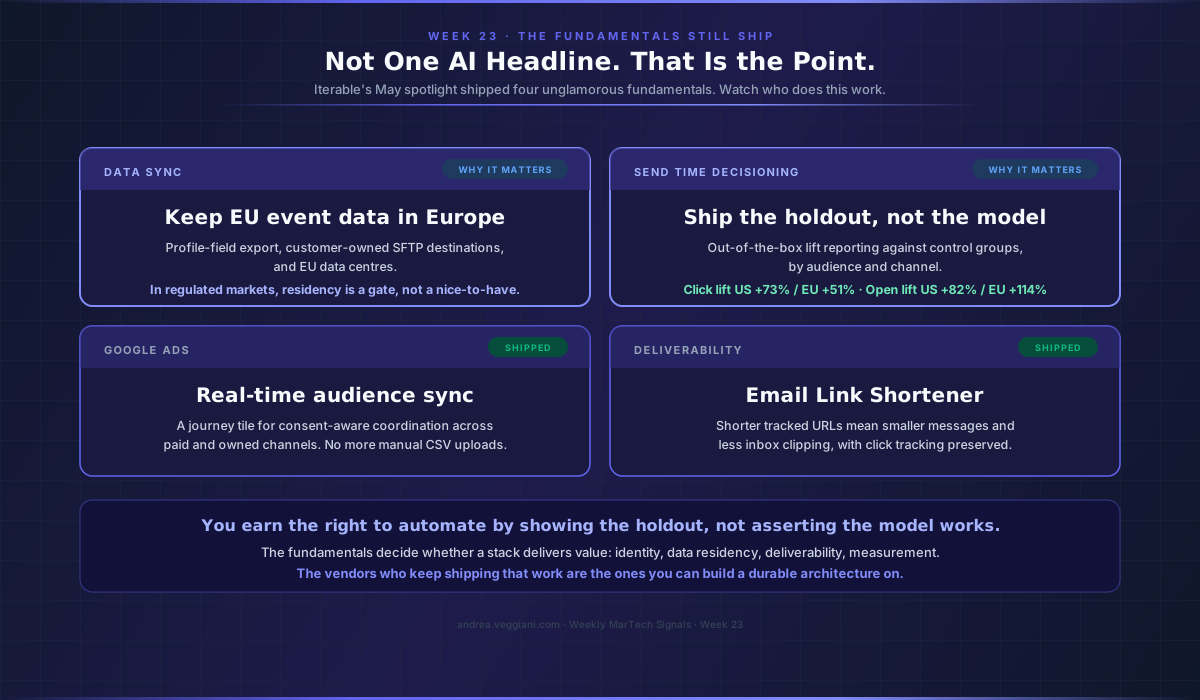
Iterable’s May Product Spotlight, which I had flagged for this run, is a useful corrective to the idea that everything interesting is an agent. Four features shipped, and not one of them is an AI headline. Data Sync gained the ability to export user-profile fields alongside event data, to sync to EU data centres, and to write to customer-owned SFTP destinations. Send Time Decisioning got a more advanced model and, more importantly, out-of-the-box lift reporting against control groups. The Google Ads integration gained a journey tile for real-time, consent-aware audience syncing. And there is a new Email Link Shortener to reduce message size and inbox clipping while preserving click tracking.
I want to dwell on two of these because they are quietly the most important. The EU data-centre option for Data Sync is the kind of feature that never makes a keynote and routinely makes or breaks an enterprise procurement in a regulated European market. For the clients I work with across insurance and financial services, data residency is not a nice-to-have. It is a gate. A platform that cannot keep European event data in Europe does not get to the shortlist. Iterable quietly clearing that gate is more consequential to its enterprise prospects than another generative feature would be.
The lift reporting on Send Time Decisioning is the second. The vendor-reported numbers Iterable cites are eye-catching: median click lift of 73% and open lift of 82% in the US, 51% and 114% in the EU. They should be read as vendor-reported benchmark data, not as a universal promise. But the number is not the point. The point is that they built the reporting layer that lets a customer see the lift against a control group, by audience and channel. This is the correct answer to the “AI as black box” trust problem that is, in my experience, the single biggest barrier to scaling AI-driven decisioning inside conservative marketing organisations. You do not earn the right to automate send-time decisions across millions of messages by asserting that the model works. You earn it by showing the holdout. Iterable shipping the holdout reporting is a more mature move than shipping the model itself.
The broader lesson, and one I find myself repeating to clients who are dazzled by demo-ware: the fundamentals are what determine whether a stack delivers value. Identity. Data residency. Deliverability. Measurement. The vendors who keep shipping that work, even in the weeks when AI dominates the narrative, are the ones whose platforms you can actually build a durable architecture on.
Vendors are starting to sell the agent, not the feature
The third movement this week happened outside my core CEP set, in the broader vendor landscape, and it is the one I will be watching most closely over the coming quarters. A cluster of agentic-AI launches landed in the same week: Afiniti shipped three new contact-centre products under a unified AI decisioning architecture; Attentive unveiled agentic capabilities at its Thread event; Madhive launched Maverick AI Agents for local advertising; Capacity shipped an AI analytics assistant. Individually, each is a product release. Collectively, they describe a direction.
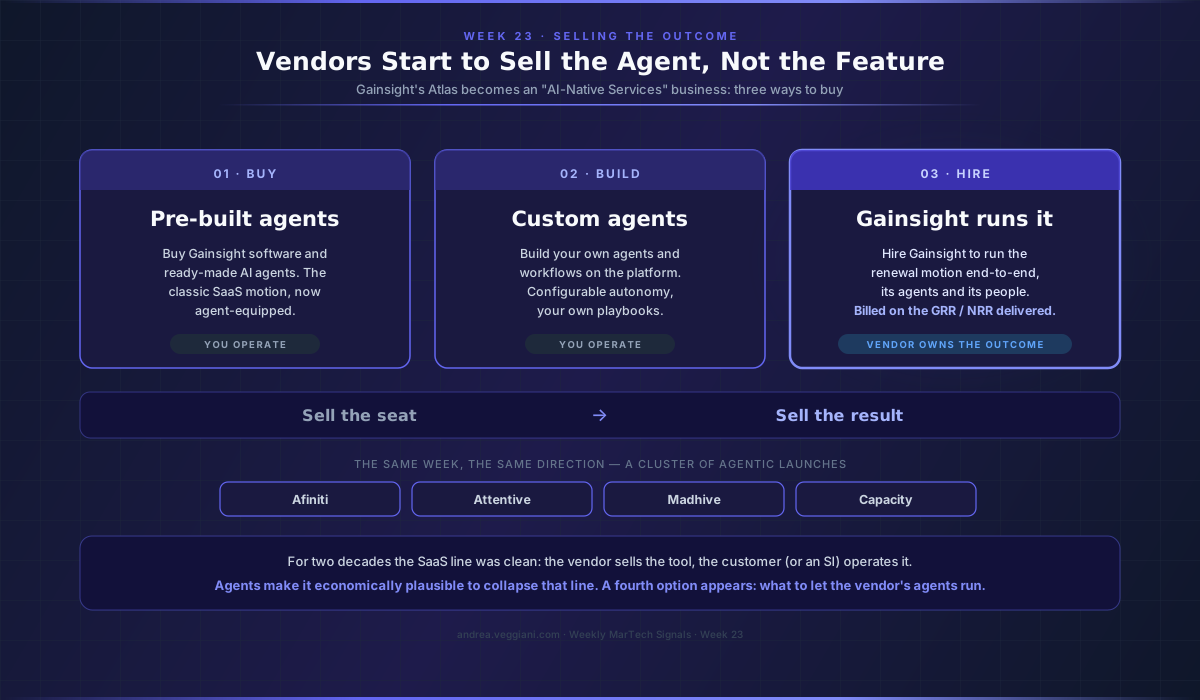
But the most strategically novel of them was Gainsight. The company announced the evolution of its Atlas agent into what it calls an “AI-Native Services” business. It is a shift from selling software to selling software-plus-services. The customer can buy pre-built agents, build their own on the platform, or hire Gainsight to run the renewal motion end-to-end on their behalf and be measured on the gross and net revenue retention it delivers.
Read that third option again, because it is the interesting one. Gainsight is not selling you a tool to do the work. It is offering to do the work, using its own agents, and to be paid on the outcome.
That is the software-versus-services boundary dissolving under agentic pressure. For two decades the SaaS model held a clean line: the vendor sells the tool, the customer (or a systems integrator like us) operates it. Agents make it economically plausible for the vendor to collapse that line and sell the outcome directly.
If that model proves out in customer success, it will not stay in customer success. It is not hard to imagine a CEP vendor eventually offering to run your lifecycle programme on its own agentic infrastructure and bill on incremental revenue rather than seats.
I am not predicting that this is good or bad. That depends entirely on execution and on how much control you are willing to cede over the customer relationship. But as someone whose job is partly to help enterprises decide what to build, what to buy, and what to outsource, I am noting that a fourth option is appearing on that menu: what to let the vendor’s agents run for you. The organisational and architectural implications of that option are significant, and most marketing leaders have not yet started thinking about them.
The Mailchimp contradiction
I will close with the week’s most instructive small story, because it is a useful caution against over-reading any single signal, including the signals I report in this digest.
Two weeks ago I recorded, with some weight, that Intuit had named Mailchimp as an area of reduced investment amid a round of layoffs. It read as a clear strategic signal: a mature ESP being quietly deprioritised while Klaviyo, HubSpot, and others kept growing. This week Intuit shipped a flagship conversational analytics capability for Mailchimp, called Analytics AI, and expanded its data integrations to include Anthropic’s Claude, Wix, and WooCommerce. That is not the behaviour of a product with no roadmap momentum.
So which is it? Both, and that is exactly the point. “Reduced investment” is a relative budget statement, not a roadmap obituary. A product can be deprioritised at the portfolio level and still ship meaningful features, because shipping features is cheaper than the strategic repositioning the executive language implied. For an enterprise weighing Mailchimp as a primary ESP, the lesson is not “Mailchimp is dying,” and it is not “Mailchimp is fine.” It is that the strategic direction is genuinely ambiguous. And ambiguity from a vendor about its own commitment is itself the risk you are underwriting when you build on the platform. The roadmap is not the question. The intent behind the roadmap is.
The question worth holding
So, a quiet week that was not quiet at all. Marketo’s MCP server widens the operating surface of the MAP layer. Iterable’s releases remind us that enterprise readiness still depends on data movement, residency, deliverability and measurement. Gainsight shows that vendors may not only sell the tools anymore, but offer to run the motion through their own agents. Mailchimp shows why single signals should be read carefully, not worshipped.
The thread is control.
The architecture, as ever, is what wins. And the architectural question this week leaves on the table is the one I would put to any marketing leader reading this: as your platforms become addressable by agents, your own and increasingly your vendors’, have you decided who is allowed to act, what they can touch, which decisions require human approval, and how every action is recorded?
Because that decision is being made for you, by default, every time a new MCP server ships.
It is worth making it on purpose.
Sources
Adobe Marketo Engage
- Marketo MCP Server, Developer Guide: MCP endpoint hosted by Adobe at
marketo-mcp.adobe.io/mcp. - Marketo MCP Server operations reference: 100+ operations across forms, programs, smart campaigns, leads, emails, snippets, lists and folders; current operations are generally read-oriented or non-destructive.
- Marketo Engage Release Notes: May ‘26 release cycle; Marketo AI agent suite; SOAP/
access_tokendeprecations.
Iterable
- Iterable May Product Spotlight: Data Sync enhancements (profile field export, EU data centres, SFTP); vendor-reported Send Time Decisioning lift reporting; Google Ads journey tile; Email Link Shortener.
- Iterable 2026 Release Notes: full May 2026 release detail.
Gainsight
- Gainsight: AI-Native Services Business: Atlas → AINS; three agentic purchase paths including managed renewal motions, billed on GRR/NRR.
- Gainsight Opens Its Platform with MCP: the April MCP foundation the agents-as-a-business move sits on.
Agentic vendor wave
- Afiniti: Unified AI Decisioning Platform: Orchestrator, Intelligence, Agents.
- Solutions Review: Top MarTech News, Week of May 29th: Attentive, Madhive, Pipedrive, Capacity, Circana, Infolinks/Basis.
Intuit / Mailchimp
- Intuit Mailchimp: Analytics AI and expanded integrations: conversational analytics agent; Claude, Wix, WooCommerce integrations.
- MarTech.org: What Intuit’s layoffs mean for Mailchimp customers: prior-week “reduced investment” signal (context).
Context: platforms with no net-new this week (scanned)
- Adobe Journey Optimizer Release Notes; Braze Release Notes; Bloomreach Changelog; Klaviyo What’s New; SFMC Summer ‘26 (SalesforceBen).
The digest behind each weekly article is produced through a structured AI-assisted scan of official release notes and product update sources. I review the output, verify the relevant signals and write the architectural interpretation.
This article draws from the Martech Weekly Digest scans run on June 4, 2026, covering release notes and product updates across several CEP platforms and vendors.
If you find errors or gaps in coverage, I want to know. The process improves when the output is challenged.