11 min read
First of a pair on the data layer beneath the engagement stack, the foundation the ESP to MAP to CEP lineage was quietly reading from all along. Read alongside its older sibling, the DMP, the layer that lost.
Of all the acronyms in the modern stack, CDP is the one almost everybody agrees they need and almost nobody defines the same way. Ask five marketers what a Customer Data Platform is and you will get a data warehouse, a tag manager, an identity graph, a segmentation tool, and a suite that also sends email. They are not wrong, exactly. They are describing five things the same three letters have been stretched to cover. That is the tell. When a category wins its naming war so completely that the word attaches to everything adjacent, the word stops being a specification and becomes a flag.
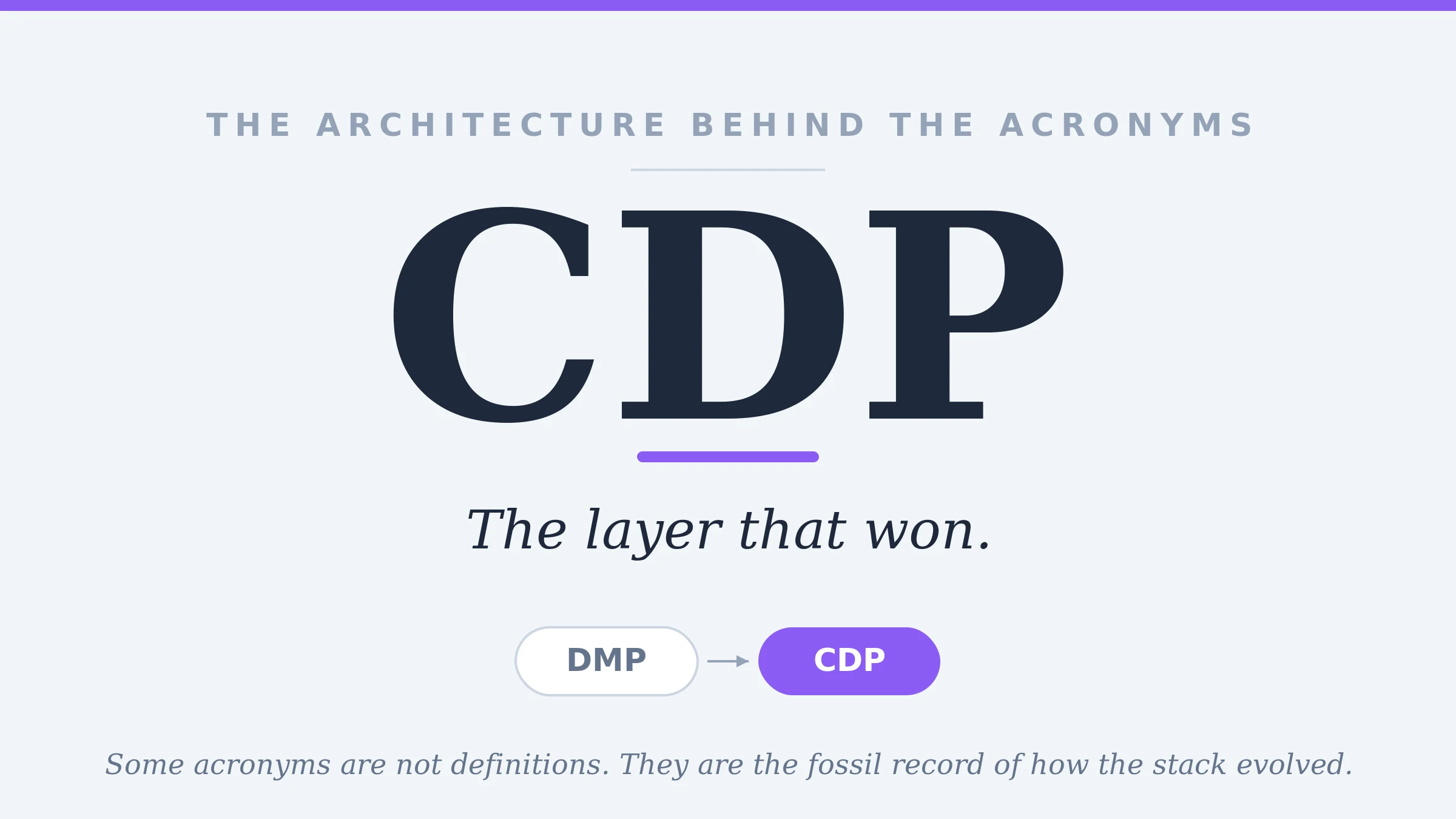
The interesting thing about CDP is that it won and then started coming apart. It beat every rival term for the customer data layer, earned its own Gartner Magic Quadrant, and became the line item every enterprise stack was expected to have. And in the same few years, a counter-movement argued that the CDP should not be a separate box at all, several of the independent CDPs were absorbed into larger companies, and some frontier vendors began reframing the data layer as context and memory for agents. The story of the letters is the story of how “own your first-party data” went from a marketing pitch to an architecture decision, and how winning the name settled almost nothing about the architecture.
What it actually solved
The CDP solved an ownership problem before it solved a technical one. By the early 2010s the marketer’s dilemma was concrete. The data that mattered lived in places the marketer did not control. The transactional record sat in the warehouse, which belonged to IT and moved at IT’s pace. The addressable audience sat in the DMP, but that was anonymous, cookie-based, and rented rather than owned. The behavioural stream was scattered across the web analytics tool, the email platform, the mobile app, and half a dozen point solutions, none of which talked to each other. There was no single place where a marketer could assemble a persistent, identified, first-party view of a real person and then act on it.
David Raab named the category in a blog post in April 2013, after noticing a cluster of new applications that all did the same unusual thing: they built and kept their own unified customer database rather than borrowing one. He published the first industry report that September, profiling eleven systems. The definition he settled on has held up remarkably well precisely because it is about ownership and persistence, not features: packaged software that creates a persistent, unified customer database accessible to other systems. Every clause is load-bearing. Packaged, so the marketer owns it rather than commissioning IT to build it. Persistent, so the profile survives the campaign. Unified, so identity is resolved across sources. Accessible to other systems, so it feeds the rest of the stack rather than hoarding.
The architectural contribution is clean and it is the opposite of the DMP’s. The CDP is where first-party identity is resolved and made durable. Its job is not to decide or to send, which is CEP work, and not to store raw events at rest, which is the warehouse’s. Its job is to turn scattered signals about the same human being into one profile the rest of the stack can trust. Hold that job description in mind, because everything that happened next is vendors arguing about where that job should physically live.
The market that shaped it
CDP as a term sat quietly for three years and then caught fire. Interest climbed sharply in 2016, the year the category first appeared on the Gartner Hype Cycle and the year the CDP Institute was founded to organise the market around the word. The timing was not accidental. This was exactly the moment the third-party cookie began to look unreliable, GDPR was moving through the European legislature, and every brand was being told that first-party data was now a strategic asset rather than a byproduct. The CDP was the box that promised to hold that asset. It arrived with a story the market was desperate to buy.
Because the term named a need rather than a design, every kind of vendor rushed the territory from a different direction, and each poured its own heritage into the three letters. Pure-play startups such as Segment, mParticle, Tealium, and BlueConic built CDPs as their whole reason to exist. The marketing clouds bolted the label onto data products they already had or quickly acquired, so Salesforce shipped Data Cloud, Adobe shipped Real-Time CDP, and Twilio bought its way in by acquiring Segment for roughly 3.2 billion dollars in 2020. Analytics and engagement vendors added “CDP” to their slides overnight. By the late 2010s the acronym meant something different depending on whether the person saying it grew up in event collection, in enterprise data, or in campaign execution, even when all three used the same word.
The analysts took their time, which is itself part of the story. Gartner did not publish a dedicated Magic Quadrant for Customer Data Platforms until 2024, more than a decade after the term was coined, naming Salesforce and Tealium among its early Leaders. A Magic Quadrant is Gartner’s signal that a market has matured enough to rank. The remarkable thing is what the market did the moment it received that blessing: it split.
How vendors changed the meaning
With the ESP and the MAP, vendors changed the meaning by climbing up out of the category into something grander. With the CDP, the most consequential move was the reverse. A serious faction argued that the CDP should not be a product you buy at all, and that the packaged customer database was solving a problem the modern data stack had already solved better somewhere else.
The argument came from the warehouse. Once Snowflake, BigQuery, and Databricks became where enterprises actually kept their data, the packaged CDP started to look like a second, redundant copy of the customer record, sitting beside the warehouse, expensively re-ingesting the same events, and creating exactly the data silo the CDP was supposed to abolish. The composable, warehouse-native alternative inverted the design: leave the data in the warehouse as the single source of truth, and add thin specialised layers on top for identity resolution, segmentation, and activation. Tools built for this, such as Hightouch and Census, used reverse ETL to push segments and attributes from the warehouse out to the downstream marketing, sales, and advertising tools, doing the activation half of the CDP’s job without ever holding the data. Hightouch’s own positioning is a compressed history of the whole argument: reverse ETL, then composable CDP, then agentic marketing platform, all while the underlying architectural promise remained the same, to activate the data where the enterprise already keeps it.
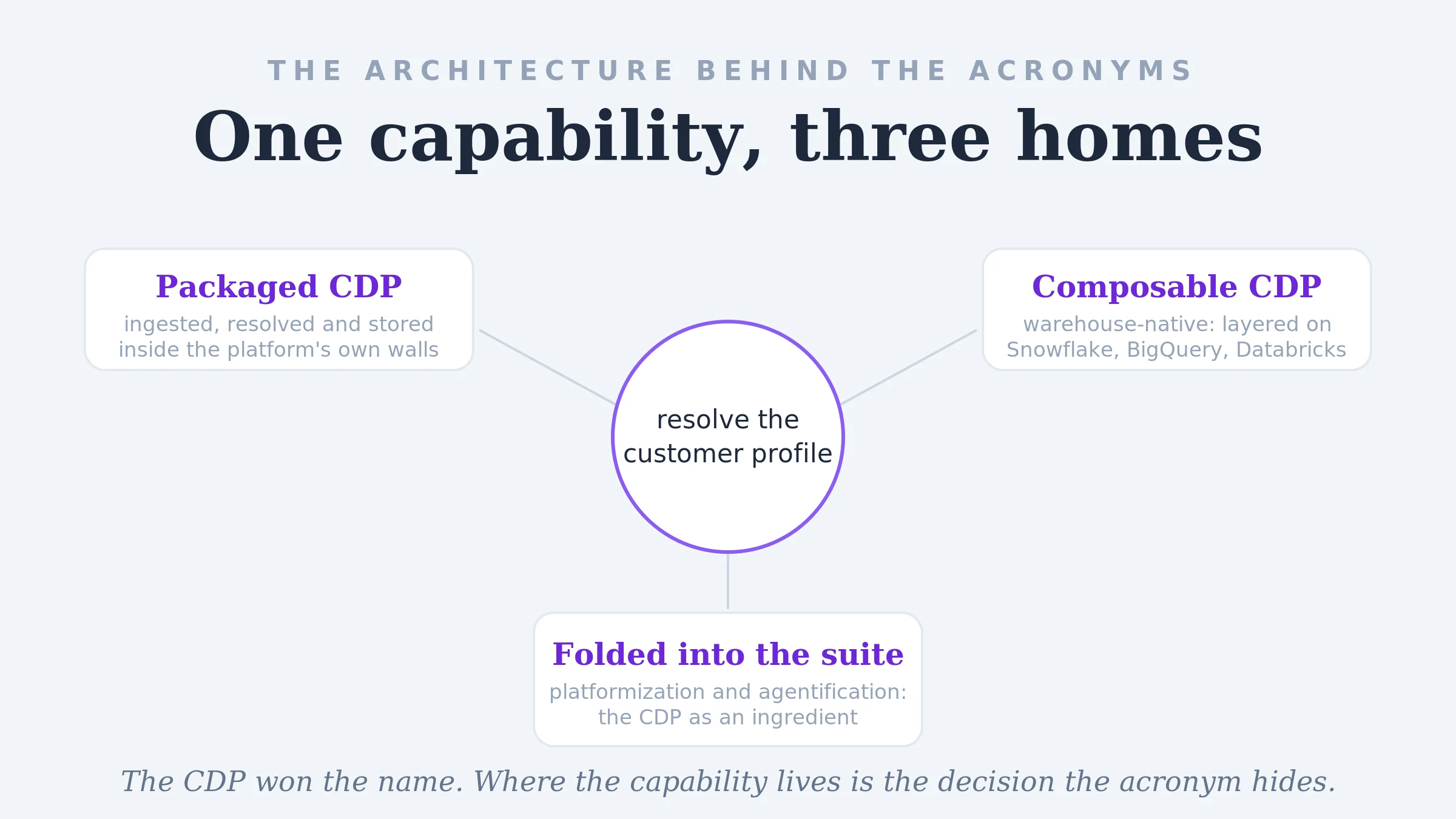
So “CDP” on a vendor slide can now mean two architecturally opposite things. It can mean a packaged platform that ingests, stores, resolves, and activates your customer data inside its own walls, the marketing cloud reading. Or it can mean a composable set of capabilities layered on the warehouse you already own, where the data never leaves the lake. Those are not two flavours of the same product. They are opposite answers to the central question of the modern stack, which is whether your customer data should have one physical home that everything reads from, or many application-owned copies. The acronym hides the difference, and the buyer who does not force the question inherits whichever answer the vendor was selling.
What it means architecturally today
The useful way to hold the CDP today is not as a product category but as a capability every stack must have and that no longer needs to live in a single box with that name on it. The capability is stable: ingest customer signals from everywhere, resolve them to a persistent identity, and make the resulting profile available to whatever decides and acts. What has come unfixed is the deployment. That capability can sit in a packaged CDP, in a composable warehouse-native arrangement, or, increasingly, folded inside a broader platform that also does the engagement.
That folding is the newest turn and it is worth watching closely. Gartner’s 2026 read on the market describes a bifurcation between platformization and agentification, which is the analyst way of saying the CDP is being pulled in two directions at once. On one side it is being absorbed as the foundational data layer of larger application suites. On the other it is being reframed as the memory and context store for AI agents that plan, decide and execute against customer context. Either way, the CDP as a proud standalone destination is no longer the only credible architectural answer. Increasingly, it is becoming an ingredient.
The consolidation numbers make the point more bluntly than any positioning statement. Several of the independent pure-plays that defined the category have been bought and absorbed. Twilio took Segment in 2020. Then, in a compressed window between late 2024 and mid-2025, mParticle went to the commerce company Rokt through a 300 million dollar investment and merger, ActionIQ went to the enterprise-AI vendor Uniphore, Lytics went to the content platform Contentstack, and Census, the reverse-ETL pioneer, went to the data-movement company Fivetran. That does not mean the CDP market is dead. Gartner still tracks a live field of vendors, and enterprises are still buying the capability. But it does suggest that the capability has become strategic enough to be absorbed by larger platforms, not isolated as a permanent destination of its own.
The failure mode that runs through this whole series shows up here in data-layer form. Organisations buy a CDP to get a single customer view, then wire it up as one more silo: a copy of the warehouse that only marketing uses, fed by a subset of sources, resolving identity in a way nothing else in the company trusts. The CDP problem was never only where the data sits. It was whether the rest of the organisation trusts the profile enough to act on it. Too often, teams buy the promise of unification and deploy another island. The acronym was never the hard part. The architecture underneath it was.
What it gets confused with
The CDP gets confused with the warehouse, because both now hold unified customer data; the difference is that the warehouse is a general-purpose store for all analytical data at rest, while the CDP is opinionated about one thing, the resolved customer profile, and about making it available to operational systems in near real time. It gets confused with the CEP, because both want to own the profile; the difference is that the CDP’s job ends at serving a trustworthy identity, while the CEP’s job is to decide and act on it, and whether one platform should do both is the open architecture question I traced through the CEP article and the one running underneath the CDP-meets-CEP acronym war. And it gets confused with the DMP most instructively of all, because the two look superficially alike and are opposites underneath. The DMP dealt in anonymous, third-party, rented audience segments for ad targeting. The CDP deals in identified, first-party, owned profiles for engagement. One was built to reach strangers at scale. The other was built to know the people you already have. That is why the CDP won and the DMP lost, and it is the whole reason the two belong in the same pair.
Does it still matter
The capability matters more every year. The acronym matters less every year. That is the honest state of the CDP, and the two halves of that sentence are not in tension once you stop treating CDP as a box to shop for. You will always need somewhere to resolve first-party identity into a durable, shared, trustworthy profile. That requirement is permanent and it is getting more central as AI agents make the quality of the underlying customer context the thing that decides whether automation helps or embarrasses you. What is no longer settled, and what “we need a CDP” quietly pretends is settled, is where that capability should live: in a packaged platform, on your warehouse, inside the engagement suite that also acts, or across a deliberately designed combination of those layers.
So the CDP won its naming war and lost its shape in the same decade, and that is not a contradiction. It is what winning looks like for an acronym that named a genuine need before anyone had agreed on the architecture to meet it. The word became universal precisely by staying vague about the one decision that actually matters. The discipline, as with every acronym in this series, is to translate the flag back into the question it is hiding: not “which CDP do we buy,” but “where does our single customer profile physically live, who else trusts it, and what reads from it.”
CDP won the name and lost the shape, so treat it not as a box on the architecture diagram but as a capability your stack must have somewhere, and make owning that somewhere a decision you take deliberately rather than one the vendor takes for you.
Sources
CDP Institute
- The CDP Institute Backstory (David Raab coined the term in 2013; first report September 2013; Institute founded 2016) · CDP.com, The History of the CDP
Raab Associates
Gartner
- Magic Quadrant for Customer Data Platforms (first dedicated CDP MQ, 2024; paywalled) · Magic Quadrant for Customer Data Platforms (2026 abstract; platformization and agentification) · Customer Data Platforms (market definition, Peer Insights)
Twilio
Rokt
- Redefining Real-Time Relevance with mParticle Merger (2025) · AdExchanger, Rokt Acquires mParticle For $300 Million
Uniphore
Contentstack
Fivetran
Hightouch
- Composable CDP · Agentic Marketing Platform · CDP.com, What Is Hightouch?