10 min read
Second of a pair on the data layer, and the cautionary half. Read it against the CDP, the layer that won. These two look alike on a diagram and are opposites underneath, which is the whole lesson.
DMP is the one acronym in this series you can now safely retire as a standalone marketing layer, and that is exactly what makes it worth an article. The others are contested, blurred, or still fighting for scope. The Data Management Platform is no longer a box I would put at the centre of a modern stack, because its job has been folded into other systems, its analyst visibility has faded, and its flagship products have been switched off. Writing the obituary is easy. Understanding the cause of death is not, because the DMP collapsed even though the event everyone said would kill it never actually happened.
The story marketers tell themselves is tidy: third-party cookies died, and the DMP died with them. It is a good story and it is wrong. In April 2025 Google reversed course again and said Chrome would maintain its existing user-choice model for third-party cookies rather than introduce a new standalone prompt or complete the long-promised deprecation. Then, in October 2025, Google also retired many of the Privacy Sandbox advertising APIs that had been meant to support the post-cookie web. So the neat version of the story fell apart from both sides. The thing the DMP was supposedly doomed by is still technically alive, while many of the proposed replacements also lost momentum. The DMP is still dead. So the interesting question is not why cookie loss killed the DMP. It is why the DMP died anyway, and the answer says more about how architecture actually works than the cookie story ever could.
What it actually solved
To see why it lost, you have to be fair about what it solved, because for a decade it solved something real that nothing else did as well. In the late 2000s a large advertiser had audience data scattered across campaigns, ad networks, and data vendors, all keyed to anonymous cookies, none of it joined up. There was no way to collect all those signals, stitch them into audience segments, buy additional third-party data to enrich them, and push the result out to the ad-buying systems at the scale the open web demanded. The DMP was the box built to do exactly that.
The category took shape around 2011 and 2012. Lotame, founded in 2006, claims the first DMP in 2011; BlueKai became one of the defining platforms for audience data and data-marketplace logic; the IAB and Winterberry Group were publishing framing papers on the category by late 2012. The job was specific and, for its moment, valuable: aggregate mostly anonymous, cookie-based audience data, enrich it with third-party segments bought from a marketplace, and activate it for programmatic ad targeting at web scale.
Notice the shape of that job, because it is the entire reason the DMP and the CDP ended up on opposite sides of history. The DMP was built to reach strangers. Its natural unit was the anonymous cookie, its data was largely third-party and rented rather than owned, its time horizon was the ninety-day life of a cookie, and its purpose was media buying, not relationship building. Everything it was good at depended on a supply of cheap, plentiful, third-party identifiers and a market willing to trade them.
The market that shaped it
The DMP had a classic land-grab phase, and the acquisitions map it precisely. The big marketing and enterprise clouds did not build DMPs, they bought them, because the DMP was the piece that connected their software to the programmatic advertising economy. Oracle acquired BlueKai in February 2014 for a figure reported around 400 million dollars, renaming it the Oracle BlueKai Data Management Platform and making it a centrepiece of Oracle’s data cloud ambitions. Salesforce acquired Krux in 2016, rebranding it Salesforce DMP and later Salesforce Audience Studio. Adobe had Audience Manager. For a few years every serious marketing cloud needed a DMP the way it needed an email engine, and the category looked permanent.
It was not, and the analysts spotted the ceiling before most buyers did. The tightening began with regulation rather than technology. GDPR took effect in 2018 and CCPA followed, and both made the DMP’s core practice, hoovering up third-party identifiers and trading audience segments, legally fraught in a way it had never been. The signal from the research firms is the quietest and most damning evidence in this whole series: Forrester’s dedicated DMP Wave in 2019 still ranked a mature market, but it also reads now like a late snapshot of a category near its ceiling, with Adobe, Oracle and Salesforce still visible as DMP vendors. Gartner never gave the marketing DMP the same Magic Quadrant halo that CDP later received. When the analyst machinery stops treating a category as a strategic battleground, the category is already losing heat. That happened years before the products fully disappeared.
How the meaning came apart
With most acronyms in this series, vendors changed the meaning by stretching it. The DMP is the one case where the meaning came apart by subtraction. Nobody stretched “DMP” to claim more territory. Instead, every distinct thing the DMP did got quietly reassigned to a system that did it better under the new rules, until there was nothing architecturally specific left for the three letters to point at.
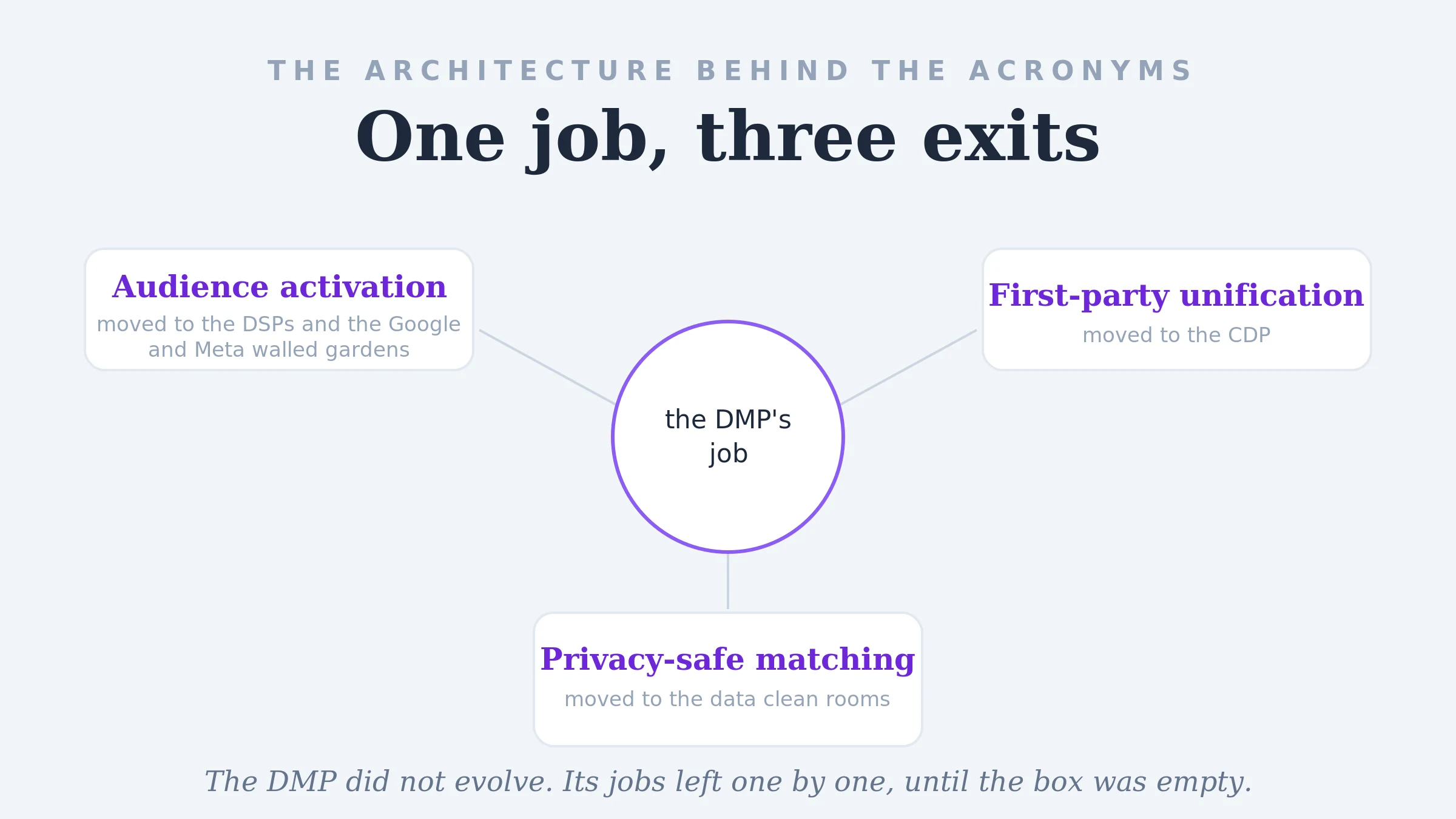
The audience-buying-and-activation job moved into the ad platforms themselves. The demand-side platforms and, above all, the walled gardens of Google and Meta could target their own logged-in, first-party audiences at a scale and accuracy no independent cookie-based DMP could match, so the activation that used to justify the DMP migrated inside the platforms doing the media buying. The first-party data job, the part that was actually strategic, moved to the CDP, which was built from the start around identified, owned, persistent profiles rather than anonymous rented ones. And the one genuinely new need the privacy era created, letting two parties match audiences without either handing over raw user data, was met by the data clean room, a privacy-safe collaboration model the DMP’s open-marketplace design could not become. Audience activation to the ad platforms, first-party unification to the CDP, privacy-safe matching to the clean rooms. Once those three jobs moved away, there was very little left that required a standalone marketing DMP.
The endgame played out on schedule and it did not wait for the cookie. Oracle, which had made BlueKai a pillar of its data cloud and advertising ambitions, decided to exit the advertising business in fiscal 2024 after revenue had reportedly fallen to roughly 300 million dollars from a peak of around 2 billion. BlueKai was part of what disappeared. Salesforce had already stopped selling Audience Studio, the DMP that came from Krux, and its end of life followed in 2024. Those decisions happened before Google’s 2025 cookie reversal. The DMP’s flagships were already dark or closing when Google decided to keep third-party cookies after all. The supposed cause of death was cancelled, and the patient stayed dead, because the real cause was never the cookie alone. It was absorption.
What it means architecturally today
Architecturally, the honest answer is that the standalone marketing DMP no longer means much as a layer, and that is the useful conclusion, not a dismissive one. The capabilities are all still in use. Somewhere in every large advertiser’s stack, audiences are still being built, enriched, and activated. But that work now happens as features inside the demand-side platforms and walled gardens, as first-party segmentation inside the CDP, as publisher-side audience products, and as matched-audience collaboration inside clean rooms. There is no remaining advertiser-side job that clearly requires a box labelled DMP, which is why the box disappeared.
This is the cleanest illustration of the thesis that runs under the whole series, that acronyms are the fossil record of how the stack evolved. The DMP is a complete fossil. It marks a specific geological layer, the decade when the open web’s third-party cookie was the dominant identifier and reaching anonymous audiences at scale was the central problem. When the ground shifted, first through regulation and platform consolidation, then through the industry’s own move to first-party data, the layer did not adapt. It was replaced from three directions at once. The cookie’s survival is almost beside the point, a fossil does not come back to life because the climate warms again.
There is one honest caution worth keeping. Some DMP capability genuinely lives on, especially on the publisher side and inside the platforms, and vendors will keep the letters alive on a few slides for continuity. Treat those as legacy labelling unless the architectural job is very clearly described. The architecture moved on even where the acronym lingers, which is the opposite of the CDP’s situation, where the capability is ascendant even as the standalone box dissolves.
What it gets confused with
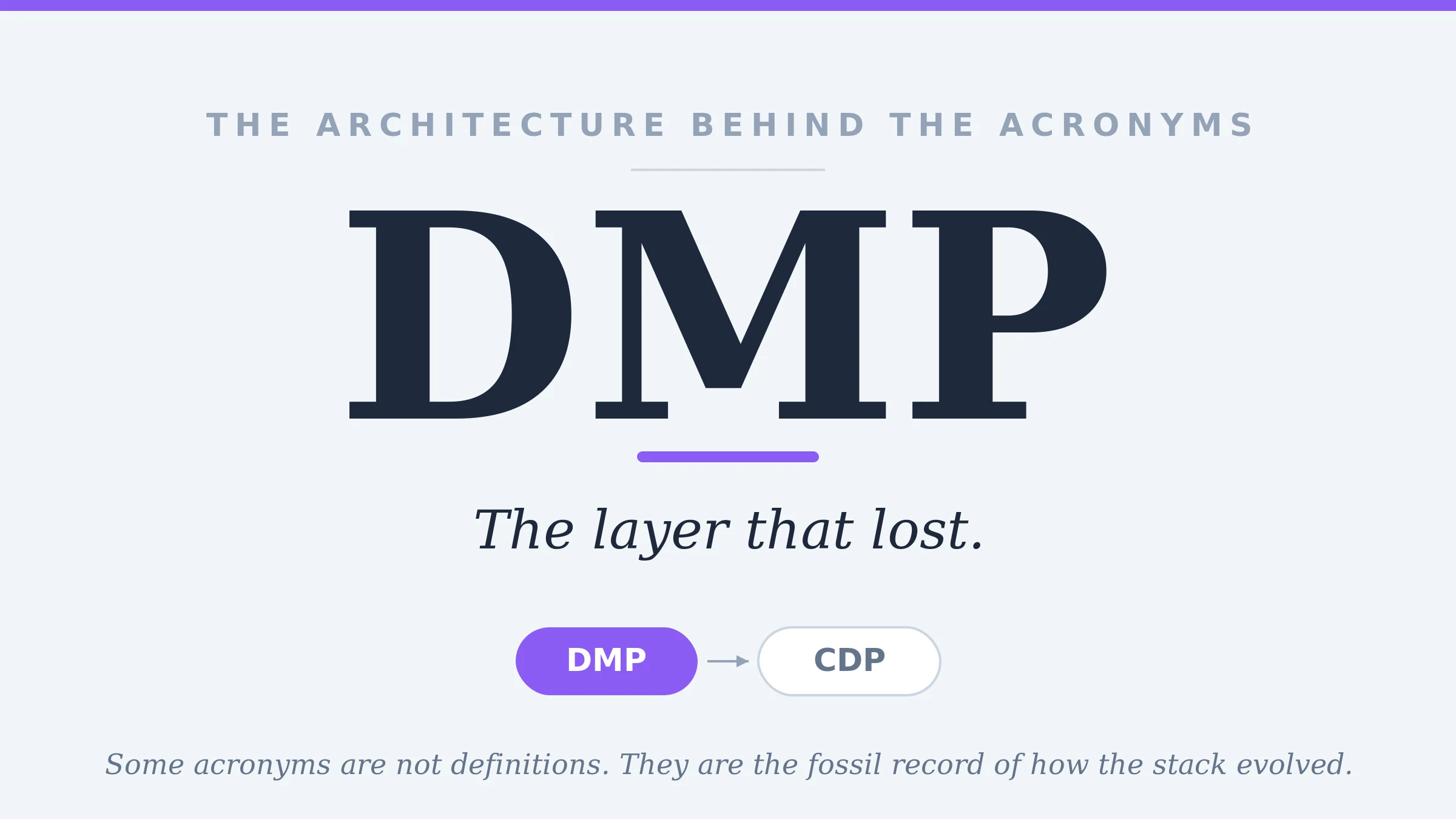
The DMP gets confused with the CDP constantly, and untangling them is the single most useful thing this article can leave you with, because the confusion is not superficial, it points at the exact axis on which one survived and the other did not. Both collect data, segment it, and push it to downstream systems, so on a diagram they look like siblings. Underneath they are opposites on every axis that turned out to matter. The DMP dealt in anonymous identifiers; the CDP deals in known individuals. The DMP’s data was mostly third-party and rented; the CDP’s is first-party and owned. The DMP lived on the ninety-day horizon of a cookie; the CDP builds a persistent profile that survives. The DMP existed to reach strangers through media buying; the CDP exists to know the customers you already have. When the privacy era made owned first-party data the only durable asset, the CDP was already built around it and the DMP was built around the thing that was being taken away. Same-looking box, opposite bet, and the bet is why one is the layer that won and the other is the layer that lost. I traced the messier three-way version of this fight, with the CEP joining in, in The Acronym War.
Does it still matter
As a standalone advertiser-side system to buy, no, and you should be slightly suspicious of anyone still selling you one under that name without explaining what job it performs that a CDP, DSP, clean room or publisher data platform cannot. As a lesson, it matters more than any live acronym in this series, and that is precisely why it earns a place here rather than a line in a glossary. The DMP is the cleanest cautionary tale in modern MarTech about what happens when an acronym names a data source rather than an architecture. The DMP was defined by its dependence on a particular external input, the third-party cookie, and a particular external market, the trade in anonymous segments. When you build a category on an input you do not own, you are one platform decision or one regulation away from obsolescence, and it will not even take the input actually disappearing. The mere loss of confidence in the cookie, plus the rise of a better-owned alternative, was enough. The cookie is still here. The DMP is not.
So keep the DMP as the warning label on the shelf. Every time a vendor sells you a category defined by the data it happens to plug into today rather than the architectural job it does, remember the box that ran a decade of advertising and then vanished while the thing it depended on was still, technically, alive.
The DMP did not die of cookie loss, it died of absorption, so read it as the standing proof that any acronym built on a data source you do not own is one market shift from obsolete, whether or not the source ever actually goes away.
Sources
Oracle
AdExchanger
- Oracle To Buy BlueKai For Estimated $350M to $400M (reported deal range, 2014) · Inside The Fall Of Oracle’s Advertising Business
IAB / Winterberry Group
Salesforce
Forrester
Business Insider
- Why Oracle Is Shutting Down Its Advertising Business · The Register, Oracle Is Shutting Down Its Once-$2B Advertising Business (revenue ~$300M in FY2024)
TechTarget
- Salesforce to Pull Plug on Audience Studio DMP · LiveRamp, Salesforce Audience Studio / Krux End of Life
Google Privacy Sandbox
- Next Steps for Privacy Sandbox and Tracking Protections in Chrome (April 2025 cookie-choice model) · Update on Plans for Privacy Sandbox Technologies (October 2025 retirements)
Gartner