8 min read
Salesforce signing a definitive agreement to acquire Contentful is easy to read as a CMS story. I think that reading misses the point. It is a customer experience architecture story, because Contentful gives Salesforce something it has never owned with the same credibility as Adobe: a modern, composable, enterprise content layer.
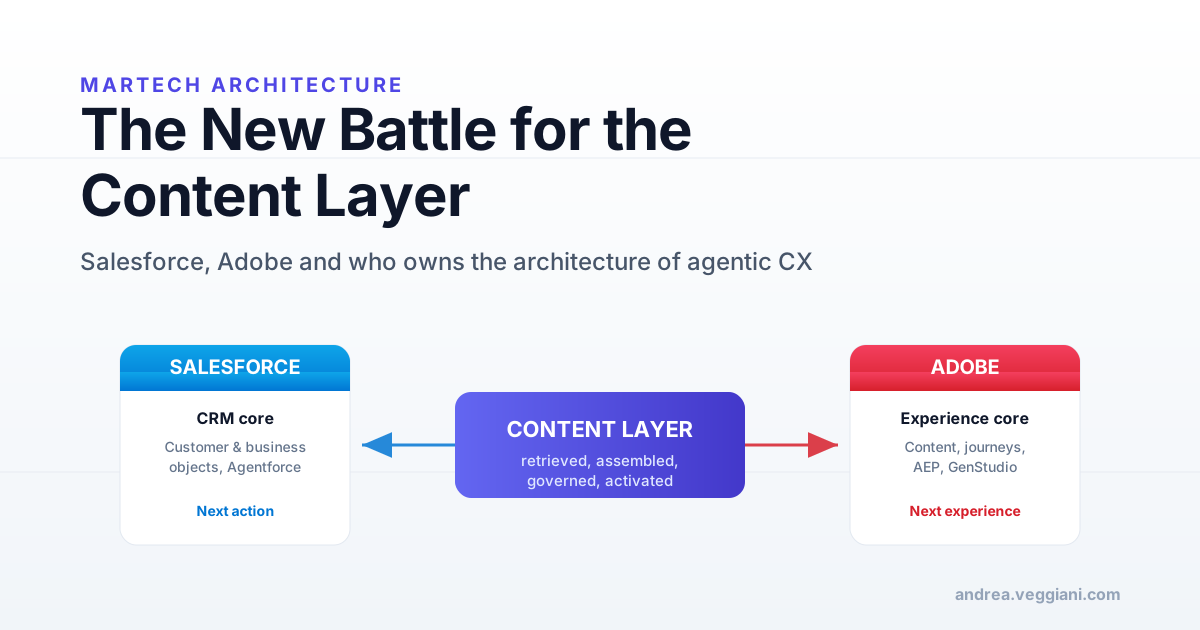
That matters because, in an AI-driven stack, the content layer is no longer just where pages, assets and content models live. It is where agents retrieve approved material, where brand and compliance constraints are enforced, and where reusable content is assembled into customer-specific experiences. As the boundary between content supply chain, personalization and activation dissolves, the platform that governs that boundary gains strategic leverage.
So this is not a simple extension of Salesforce’s product catalog. It is Salesforce moving deeper into Adobe’s historical territory in the contest over who owns the operating model for customer experience.
This is not about CMS
For years the enterprise content layer has lived adjacent to the customer data and engagement layers. A company runs a CRM for sales and service, a CDP for profiles and audiences, a marketing automation platform for campaigns, a CMS or DXP for web and app, a DAM for assets, a personalization engine for testing, an analytics layer for measurement.
That architecture is composable, but it is full of seams. Content has to connect to customer data, customer data to decisioning, decisioning to channels, channels to measurement, and governance has to be rebuilt across every layer. It works, but it comes with an integration tax that most enterprises underestimate until they try to make it real.
Read the Contentful move against that background. Salesforce’s own framing is explicit: Contentful is expected to become the native enterprise-grade content layer inside Salesforce Headless 360, connecting customer data with Agentforce and composable APIs to deliver experiences across channels.
That is not “Salesforce now has a headless CMS.” It is “Salesforce wants content to become part of its data-and-agent architecture.” In a traditional stack, content is published. In an agentic stack, content is retrieved, assembled, adapted and activated at runtime. It stops being only a production artifact and becomes a runtime asset, which is exactly where architecture either holds together or breaks down.
Two centers of gravity, one destination
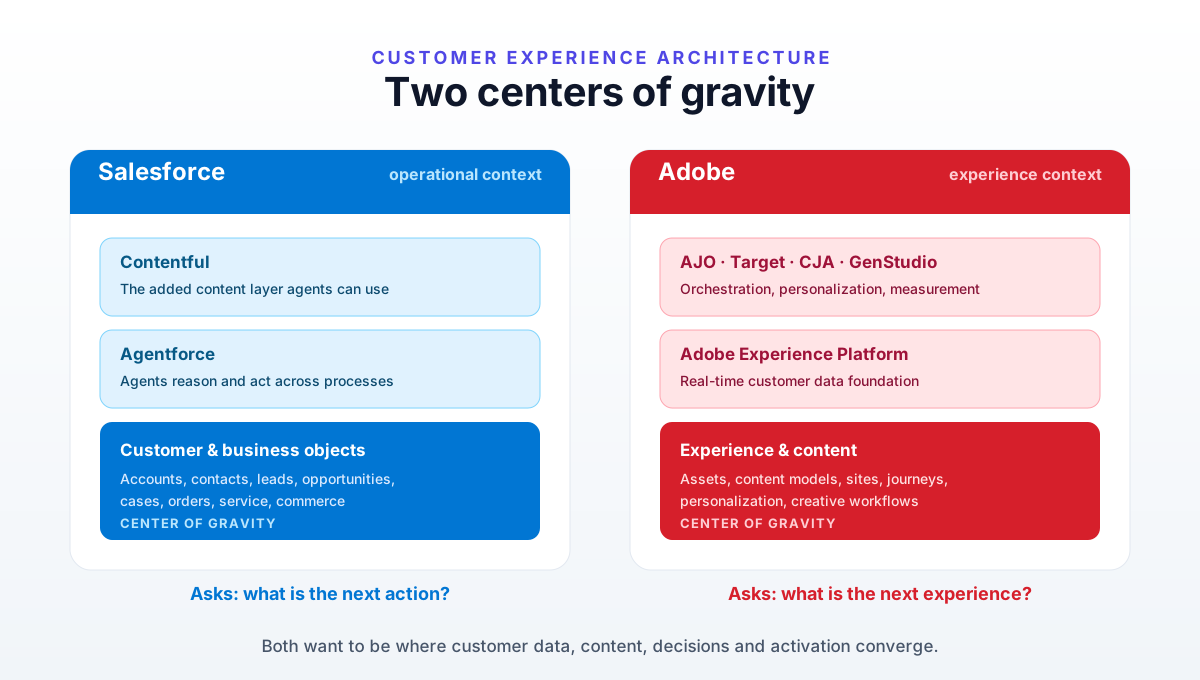
Adobe has spent years making the opposite version of the same argument, and that is exactly why this points at them. Adobe’s center of gravity has always been content, creative workflows and experience delivery. AEM, Experience Platform, Journey Optimizer, Target, GenStudio and Firefly all push the same direction: bring content, data, personalization, measurement and AI delivery into one operating model. Its recent CX Enterprise positioning sharpens it further, from “we help you create content” to “we help you orchestrate the full customer experience with agentic AI grounded in your data and controls.” That is a Salesforce-shaped ambition argued from an Adobe starting point.
The two are walking toward the same place from opposite sides. Salesforce starts from the customer and business object layer: accounts, contacts, opportunities, cases, orders, service interactions, commerce events. Agentforce sits on top of that operational fabric and lets agents reason and act across it, and Contentful supplies the structured content those agents and experiences were missing. Adobe starts from the experience layer: assets, content models, sites, journeys, experimentation, creative operations, with Experience Platform giving it a real-time data foundation underneath.
Put simply, Salesforce asks how customer and business context drives the next action. Adobe asks how content, data and decisioning deliver the next experience. Those questions used to belong to different vendors. They no longer do, and that overlap is the entire competition.
The agent changes what content is worth
Agents raise the stakes because they change content’s role. Before agents, content was managed by humans and activated through rules, templates and journeys. With agents, content becomes something a system can choose, combine, summarize, reframe and deploy on its own.
The upside is obvious. A marketing agent builds a campaign from approved modular content. A service agent retrieves the right policy explanation and adapts it to the customer. A commerce agent assembles a recommendation from structured content, inventory and behavior. The risk is the same coin flipped over: which content is the agent allowed to use, which claims are approved, which disclaimer applies, which adaptation is still on brand, and which decision was made by the agent versus signed off by a person.
This is why the content layer is becoming a control point rather than a repository. In an agentic stack it is part of the governance surface itself, the place where what an agent is allowed to say is actually decided. An agent is only ever as safe, as accurate and as on-brand as the content it is permitted to draw from, and no amount of model sophistication makes up for a content layer that cannot enforce those boundaries. That is the real prize in the Contentful deal, and it is the discipline Adobe has been building from the content side for years.
Suite gravity versus composability
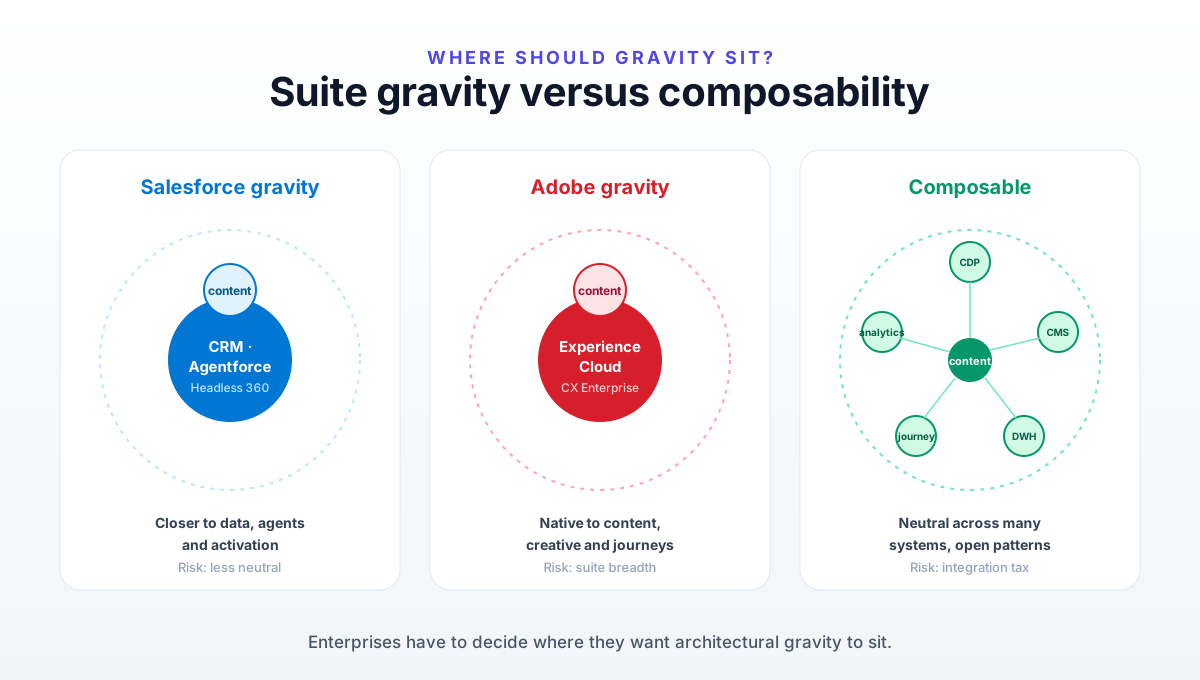
There is an architectural tension underneath the deal. Contentful succeeded because enterprises wanted composable content infrastructure: a headless CMS that sits across channels and integrates into different front ends, commerce platforms and marketing systems. That neutrality is much of its value.
So the acquisition creates a sharp question. Does Contentful become more powerful sitting close to Salesforce data, Agentforce and Headless 360, or more constrained because it gets pulled into suite gravity? My answer is that it depends entirely on where the enterprise already lives. For a Salesforce-centric organization, proximity is the point: governance gets simpler, integration patterns collapse, agentic use cases become realistic. For an organization that deliberately chose a vendor-neutral architecture, the value of Contentful was always its independence, and the more tightly it binds to one suite, the more that value erodes.
This is the tension every major MarTech acquisition produces. The buyer promises integration, the market worries about neutrality, and both are usually true. Salesforce wants more of the architecture to orbit Salesforce. Adobe wants it to orbit Experience Cloud. Composable vendors want it to stay distributed. The enterprise has to decide where it wants gravity to sit, and that is an architecture decision, not a feature decision.
Adobe is not weakened by this
The Contentful deal does not make Salesforce stronger than Adobe in content. Adobe remains highly credible across enterprise content, creative production, DAM, personalization, analytics and experience management, and its stack already ties content operations, data, orchestration and brand governance tightly together. In organizations where content operations and brand consistency sit at the center of strategy, that remains a serious architectural advantage.
Adobe’s real problem is not Salesforce. It is coherence. The breadth is the value and also the burden, and that has always been Adobe’s paradox: a powerful set of products that still demands significant integration and governance work to feel like one operating model. Agentic AI can abstract some of that complexity, but it does not remove the need for clean data models, clear ownership and consent discipline. If anything it raises the bar, because agents only operate safely on top of an architecture coherent enough to support them.
Salesforce becomes more credible
For many companies, Salesforce is already where customer-facing work happens. Sales, service and revenue operations live there, commerce and industry workflows often connect to it, and customer records sit at the center. Agentforce builds directly on that position, and a stronger content layer through Contentful lets Salesforce tell a more complete story: customer data, business context, operational workflows, agent execution, composable content and cross-channel activation in one line.
That is a better story than Salesforce had a year ago. It does not mean every enterprise should move content into the Salesforce orbit. It does mean Salesforce can now challenge Adobe on a layer where Adobe had the more natural advantage. For Salesforce, Contentful is not a CMS purchase. It is a missing piece of the agentic stack.
The decision enterprises actually face
The Salesforce versus Adobe question usually gets framed as a platform comparison. That framing is too narrow. The real question is architectural: where should the intelligence that connects customer data, content, decisioning and activation live?
The Salesforce argument puts gravity closer to CRM and operational workflows. The Adobe argument puts it closer to content and experience orchestration. The third option is a deliberately composable model: warehouse, CDP, headless CMS and journey tooling connected through open patterns. None is right in the abstract. The right answer follows the organization’s strongest operating model. Sales-and-service-led enterprises tend to gravitate to Salesforce. Content-heavy, experience-led organizations often gravitate to Adobe. Digitally mature companies with strong engineering and data-platform capabilities may be better served by composability. The expensive mistake is choosing on features and discovering the architectural consequences too late.
What I would watch next
The acquisition closing is not the interesting part. The operating model Salesforce builds around Contentful is. Does Contentful stay broadly neutral, or does Salesforce prioritize deep Agentforce and Data 360 integration and make it the default content layer for Headless 360? Do existing Contentful customers outside the Salesforce ecosystem feel reassured or nervous?
I would watch Adobe just as closely. It does not need a like-for-like acquisition, but it does need to make the AEM, GenStudio, AEP and CX Enterprise story explicit against Salesforce. The more Salesforce frames Contentful as part of an agentic experience architecture, the more Adobe has to show that its own content, data and AI story is not just broader but operationally clearer. Breadth that an enterprise cannot operationalize is not an advantage.
The bottom line
Salesforce acquiring Contentful is not just a content management move. It signals that the content layer is becoming strategic infrastructure for agentic customer experience. Adobe recognized this from the experience side earlier; Salesforce is now reinforcing it from the CRM and agent side.
The next phase of this competition will not be about CRM versus DXP, CDP versus CDP, or journey tool versus journey tool. Salesforce wants the control point next to the customer record. Adobe wants it inside the experience cloud. Composable vendors want it to stay independent. However an enterprise leans, the decision it is really making is not about features. It is about where the control point for agentic customer experience will sit: the layer that decides which content an agent can use, which claims it can make, and which adaptations stay on brand.
That is the layer worth fighting for, because in an agentic stack the content layer is no longer where content is stored. It is where customer experience becomes executable, and where it stays governable once it does.
Sources
Salesforce / Contentful
- Salesforce Signs Definitive Agreement to Acquire Contentful
- Contentful: A New Chapter for Contentful: Scaling Our Vision with Salesforce
- Salesforce Debuts New Marketing AI Agents
Adobe
- Adobe CX Enterprise Agentic AI
- Adobe CX Enterprise Coworker
- Adobe Experience Platform AI Assistant
- Adobe Journey Optimizer
- Adobe Customer Experience Orchestration Solutions
Context / market coverage