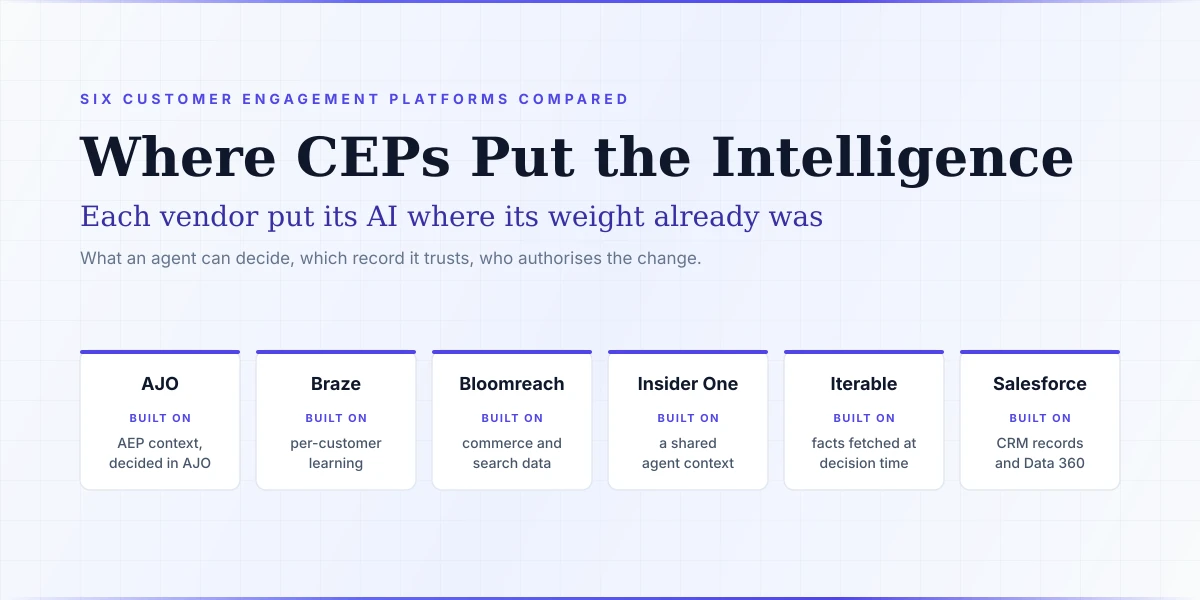
Six customer engagement platforms, six AI strategies, one pattern: each vendor put its intelligence where its architecture already had its weight, and that placement decides what an agent can read, decide and change in your stack.
The demo screen moved out of the platform
On 15 September 2026 Salesforce announced AIforce with a sentence that sums up the month: “people don’t have to come to Salesforce to get work done.” Fourteen days later, on 29 September, Braze put its Operator into Claude, ChatGPT and Microsoft Copilot through Operator Connect, still in beta, and Adobe made the CX Enterprise Coworker plugin available inside ChatGPT on the same day. The scope of each move was narrower than the headlines suggested, because Salesforce in Claude launched with sales skills and only promised marketing ones, and Braze’s connector had not reached general availability, but the direction was the same for all three. They were not the only ones: Bloomreach had opened its product discovery to ChatGPT in January through Loomi Connect, its MCP server, Insider One documents an MCP server of its own, and Iterable followed with a hosted one in November. I start from these three because their moves landed within the same fourteen days. I wrote about the first half of this movement in Weekly MarTech Signals Part 20, when Salesforce and HubSpot moved their interfaces off their own screens in the same week, and by the end of September it had reached the engagement platforms I run in production.
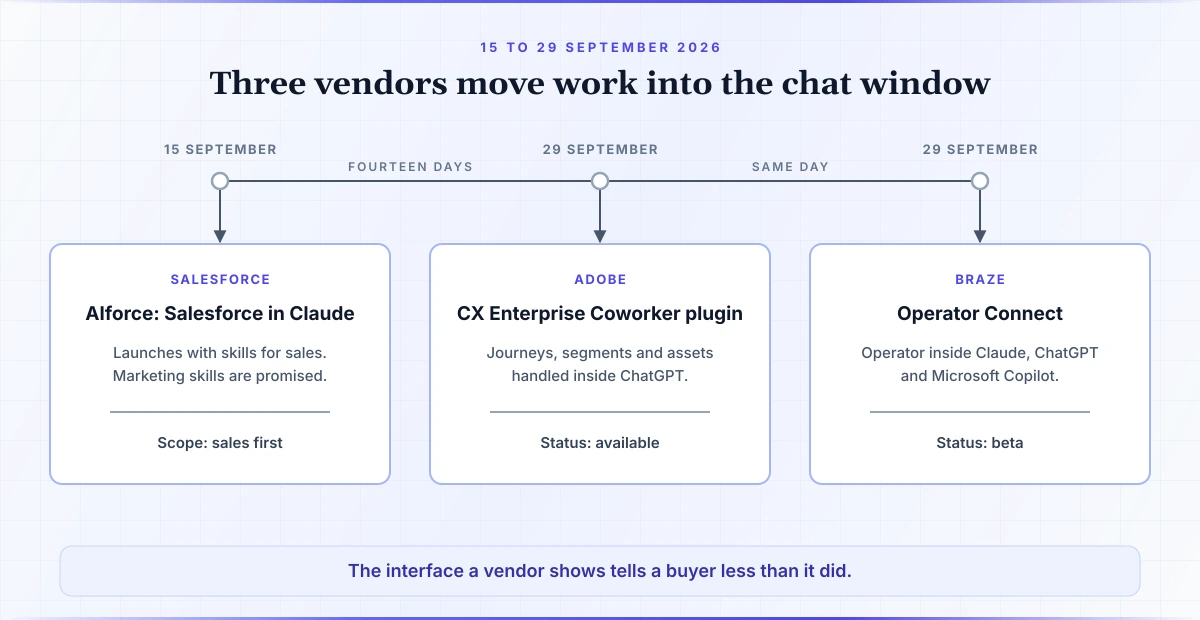 Figure 1. Three announcements in fourteen days, with the scope or status each vendor gave at launch. The other three vendors have an MCP route of their own, covered in the next section.
For anyone running a platform selection, this changes what a demo is worth. I have spent a large part of my career using the interface as a proxy for how a team will really work inside a system, and that proxy gets weaker every time the work moves into a chat window that every vendor can reach. What stays inside the platform, and what therefore still separates them, is where each one placed its intelligence: which decision the AI is allowed to make, which record it trusts when it makes it, and who authorises the change it produces.
This article compares six platforms on those three questions: Adobe Journey Optimizer, Braze, Bloomreach, Insider One, Iterable and Salesforce Marketing Cloud Next. The evidence is dated to what the vendors had shipped or documented by 4 November 2026, with the statuses that moved since then rechecked on 25 November, and every status in the text is the one the vendor gives.
Braze and Salesforce appear here as two separate vendors, and until the deal closes that is what they are. On 20 October 2026 Salesforce signed a definitive agreement to acquire Braze, with closing expected during Salesforce’s fiscal 2028, so the comparison below describes two independent products with their own documentation and roadmaps. What the combination may change for the architecture is the subject of an architect’s read of the acquisition, and what it may change for the teams operating these platforms is covered in its operating companion.
What the shared AI labels hide
Three things now look identical across the six, and none of them is a good reason to choose one platform over another. All six expose some kind of Model Context Protocol surface, although the write scope behind it varies enormously: Braze’s remote MCP server documented 85 tools on 25 November, 39 of which change something in the platform, while Insider One documents that its MCP server cannot send or launch campaigns, trigger journeys or update customer data. I argued in the January to April Movement Notes that the presence of MCP proves little until you know what an agent can inspect, what it can write and what it costs to leave, and that test still holds.
The second shared trait is that agents increasingly act with the permissions of the human who invokes them. Braze authenticates Operator Connect actions as the individual user and governs them by that user’s Braze permissions, Salesforce documents user-scoped execution for its hosted MCP servers, and Adobe says the Coworker inherits existing data policies, consent rules and permissions. Iterable’s hosted MCP server follows the same rule and limits the agent to the permissions of the person signed in. That is a sensible default and it is becoming common, which is exactly why it no longer distinguishes anyone, and it also says nothing about what happens later, when a backend service sends the message that a delegated agent created.
The third is the word decisioning itself. On 5 October 2026 Iterable renamed Send Time, Channel and Frequency Optimization to Decisioning, and its release notes add: “At this time, there are no other changes to these features or their functionality.” I do not read that as a criticism of Iterable, because the features were real before the rename. It is a reminder that the label travels faster than the mechanism, and that a buyer has to ask what is actually being decided, which is where the comparison below starts.
The AI follows the platform physics
In Field Notes Part 9 I mapped the physics of each platform in this group, the centre of gravity that predicts how it behaves under load. Reading the 2026 AI releases against that map, the pattern is consistent enough to be useful: every vendor put its AI where its weight already was. The table summarises the three questions for each platform, and the sections that follow explain each row.
| Platform | What the AI decides | Which state it relies on | Who authorises the action |
|---|---|---|---|
| Adobe Journey Optimizer | Offer eligibility and ranking by rules and AI models, inside AJO | AEP Real-Time Customer Profile | AEP policies and permissions, inherited by the Coworker |
| Bloomreach | Campaign build and send timing from a prompt (Loomi marketing agent) | Commerce, catalogue and search data in the Bloomreach profile | Marketer review, plus hard limits on vouchers, silent hours and caps |
| Braze | Approved creative and send day and time per user (Decisioning Studio Go); any metric across channels (Pro) | Braze user profile and events; Pro also learns from warehouse data, with direct ingestion generally available since 12 November | The marketer, through approval of each Operator action by default in the dashboard; no per-action approval cards in Operator Connect |
| Insider One | Audiences, journeys, content, channels and timing within set goals (Agent One) | Insider's native profile, Bluecore identity, shared agent context | Autonomy mode chosen per use case and channel |
| Iterable | Send time, channel and frequency | Iterable profile and Catalog, plus external facts fetched at journey time | Marketer approval of Nova Agent recommendations |
| Salesforce Marketing Cloud Next | Prioritisation and suppression across competing campaigns (Campaign Agent) | CRM records and Data 360 | User-scoped execution, with an enterprise AI Control Plane announced |
The table records the decision each vendor puts under its AI headline. A capability missing from a row, send-time optimisation for example, can still exist in the product.
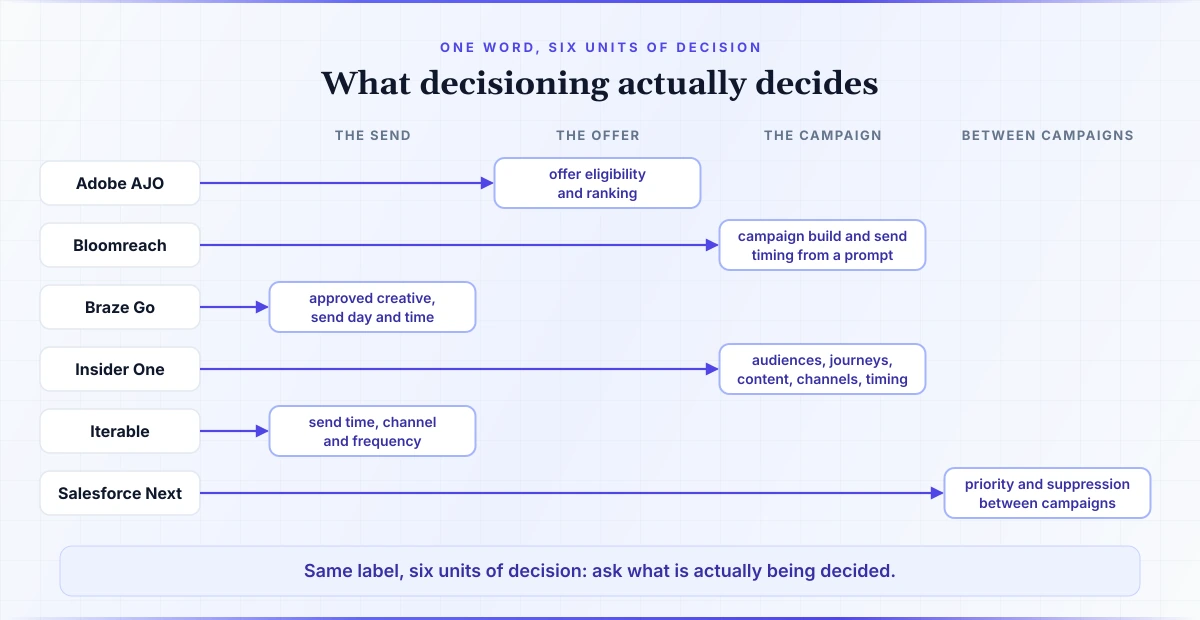 Figure 2. The unit of decision each vendor documents, from a single send to the arbitration between campaigns. The four columns are my grouping of the table above.
Braze: learning per customer, with a separate plane for marketer work
Braze’s AI has two planes that are easy to confuse because they share the BrazeAI brand. The first is per-customer learning, which comes from the OfferFit acquisition that Braze completed on 2 June 2025 and which I treated as the strategic bet of the platform in Field Notes Part 1. Decisioning Studio Go, announced in beta at Forge on 29 September 2026 and listed as generally available in the 15 October release notes, is the self-serve version: according to its FAQ it is built on reinforcement learning, it chooses among the creative elements, base creatives and send days and times that the marketer has approved, and it optimises for unique daily clicks, starting with email. The FAQ is explicit that the agent does not decide between frequencies, even though the launch announcement listed frequency among its choices, so the documentation is the version I would put in a contract. Decisioning Studio Pro, the full-service tier, optimises any business metric across channels with Braze’s own decisioning team.
The second plane is the Operator, which does marketer work: generally available since spring 2026, it gained the ability to build and edit Canvases from a description on 20 August, and since 23 July it can change settings directly, including messaging rules and always-on approval workflows. The documentation says that by default the marketer reviews and approves each proposed action, and it documents an optional auto-approve toggle, off by default, under which saving, archiving and changing workspace-level settings still require explicit approval. It also sets boundaries: the launch of anything that reaches users always stays with a person, and Operator cannot approve its own proposed action or turn auto-approve on for the marketer. Operator Connect, the beta that brings Operator into external assistants, works differently, because its documentation says it does not support the action cards that pre-approve each step, so a request is carried out at once within the user’s permissions, and it sends teams that need per-step approval back to the dashboard. That combination is the governance fact I would look at first, because an agent that can propose edits to the approval workflows of its own workspace turns part of a permission question into a configuration question, and Agentic Standards, the rule checker announced at Forge and generally available since 12 November, logs every check and fix but makes human sign-off something each brand configures. A buyer should ask which of the two planes the contract covers and what each one is allowed to change.
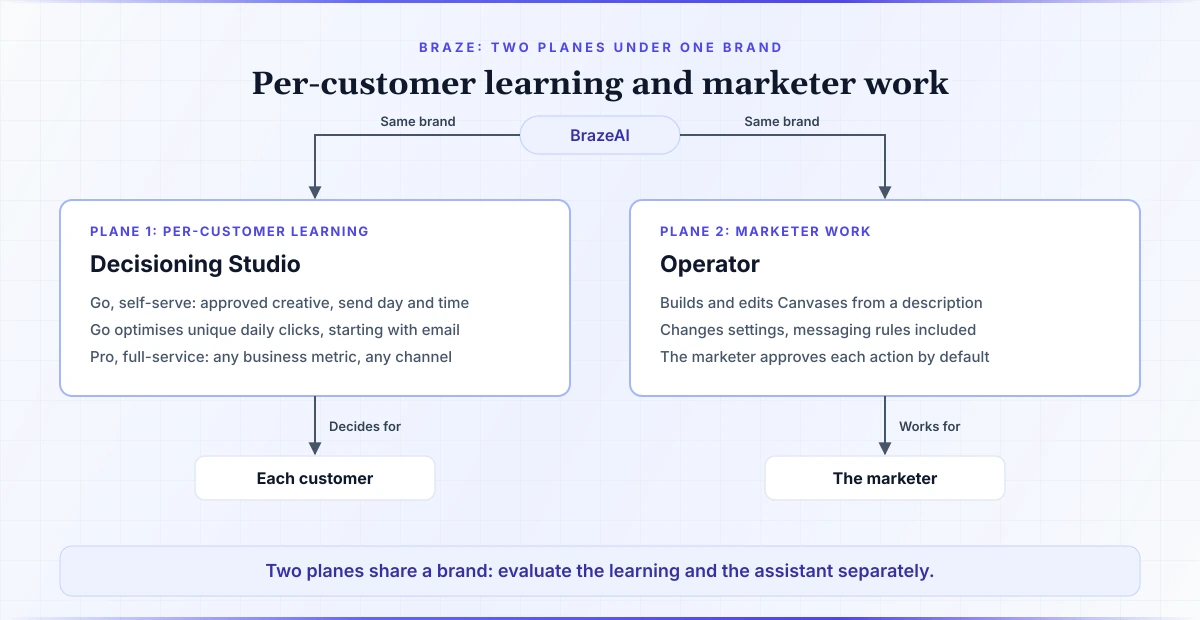 Figure 3. The two planes of Braze AI: Decisioning Studio decides for each customer, Operator works for the marketer.
Adobe: decisions inside AJO, context in AEP, a work layer above
Adobe’s centre of gravity is the experience platform, and the AI follows it in three layers. The customer decision lives inside Journey Optimizer, where offers are filtered by eligibility and ranked by rules or AI models, and where the 2026 releases kept adding runtime capability: AI model ranking in Journey Simulation from 8 September, a Decisioning Explainer skill from 16 September that traces why an offer was or was not shown, and decisioning inside custom outbound channels, generally available from 2 October. The context sits in AEP, which Adobe calls the contextual layer of CX Enterprise, and which Field Notes Part 4 already identified as the foundation everything else depends on.
The Coworker is the work layer above both. It was unveiled at Summit on 20 April 2026, reached general availability on 10 June, and on 29 September became a plugin inside ChatGPT that can diagnose journey performance, build segments from AEP data and search assets in AEM. At the same Summit Adobe announced Engagement Intelligence, described as a decisioning engine optimised for customer lifetime value, and I have not found a general availability date for it, so I treat it as direction. The practical consequence for a buyer is that an Adobe agent working in ChatGPT is coordinating work, while the decision about which offer a customer sees still happens in AJO under AEP’s policies, and the two should be evaluated separately.
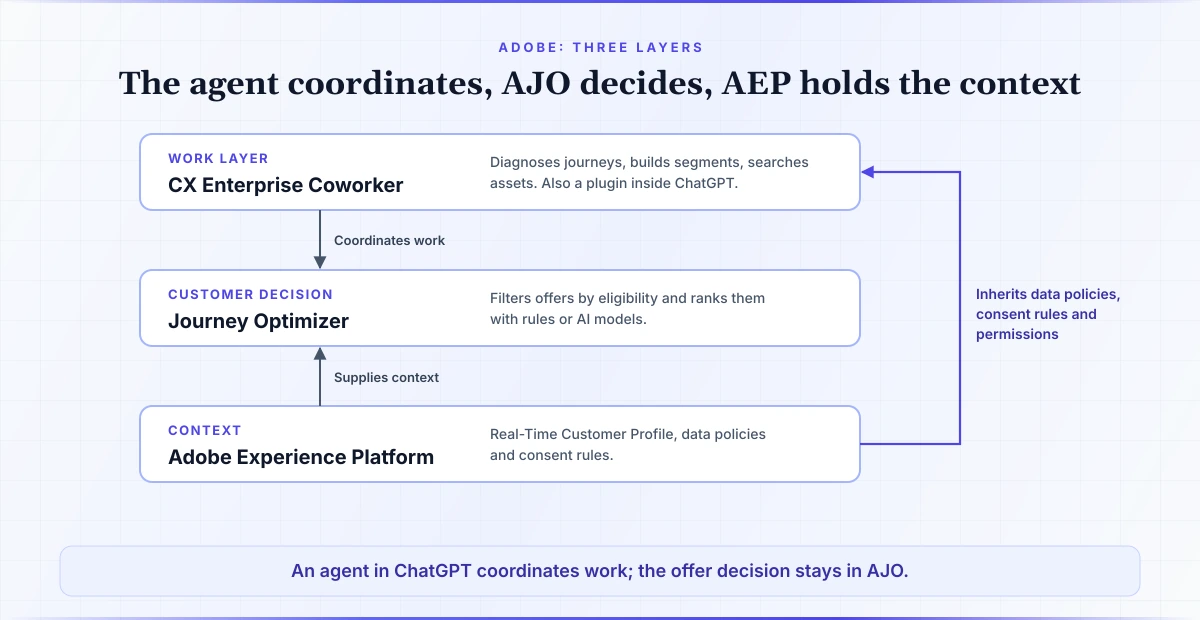 Figure 4. Adobe’s three layers: the Coworker coordinates work, Journey Optimizer makes the customer decision, AEP supplies the context and the policies.
Salesforce Marketing Cloud Next: CRM truth and an enterprise control plane
Salesforce’s gravity is the CRM record, and its AI strategy starts from the whole enterprise before it reaches marketing. On 10 September 2026 it introduced the Enterprise AI Harness, six capabilities from trusted context to trusted models, together with a separate AI Control Plane for discovering, registering and governing agents across Salesforce and third-party systems. The announcement says that many foundational technologies are available now and that new capabilities begin rolling out in early fiscal 2028, so for a selection running this year the architecture is a declared direction more than a product.
Marketing sits inside that design as one of several functions. In this comparison Salesforce means Marketing Cloud Next, the platform the agents are built on, and Marketing Cloud Engagement stays out of the table and the figures. Campaign Agent, listed as generally available in October 2026 for Marketing Cloud Next, creates and runs campaigns and, once they are live, prioritises between competing campaigns and suppresses messages that should not go out, which makes arbitration between campaigns its documented unit of decision. Journey Optimizer handles a similar problem with journey arbitration, through priority scores and ranking formulas. Field Notes Part 5 described the coexistence of Marketing Cloud Engagement and Marketing Cloud Next, and that distinction matters more now, because the agents, Campaign Agent among them, belong to Next, while many enterprise programmes still run on Engagement, which got its own generally available MCP server in June 2026. That unit of decision matters more after 20 October, because if the Braze deal closes, one company will have two orchestration engines that can reach the same customer, and how they coordinate becomes a question for the roadmap. The buyer question here is which Marketing Cloud the agents run on and how much of the control plane exists on the day of signature.
Insider One: one shared context for brand agents and customer agents
Insider’s gravity has always been the shopper journey from web to message, and Agent One, relaunched on 17 September 2026 as a two-sided system, extends it in both directions. Agent One Teams works on the brand side, choosing audiences, journeys, content, channels and timing to reach an outcome the team sets, while Agent One Audiences talks to customers through a Shopping Agent and a Support Agent, and Insider says both “read and write from the same living context.” Since 20 August a partnership with Anthropic brings Claude models into Agent One, those customer-facing agents included, after similar agreements with OpenAI on 24 March and Google on 9 June, and the Bluecore acquisition announced on 13 May brought an identity graph and more than 400 United States enterprise brands.
The governance model sets autonomy per use case and per channel. The Academy documents three modes, and the naming needs care: Command executes what the team instructs, Advance analyses and recommends, and Co-Pilot is the mode that decides and optimises on its own within the goals, budgets, approvals and brand limits the team sets. What the public material does not show yet is how the Bluecore identity graph, the zero-copy segmentation for Snowflake announced on 2 June and the shared agent context resolve into one customer, which is the question I left open in the May to July Movement Notes, and Insider publishes no platform-level release notes yet, so this section rests on fewer dated sources. What a buyer needs to settle is which autonomy mode each use case will run in and who signs off when a mode changes.
Bloomreach: commerce context, with clear limits on what the agent may touch
Bloomreach puts its AI where it has always been strongest, in the connection between commerce data, search and the marketing profile that Field Notes Part 2 described. The Loomi marketing agent, generally available since June 2026, builds a complete campaign from one prompt, with segmentation, content and send timing, and every campaign remains reviewable. The release notes of July state the agent’s limits in operational terms: the agent gained vouchers and SMS in release 1.314, but it can use only voucher pools that already exist, and it follows the project’s silent hours and frequency caps.
The more ambitious part of Bloomreach’s strategy is still a plan. The marketing roadmap briefing recorded on 15 September 2026 describes real-time decisioning with live segmentation and frequency prediction, runtime self-optimisation for the Marketing Agent, and a Shopping Agent that “turns shopper questions into profile insight”, with delivery spread between now and early 2027. That puts Bloomreach in the same commerce-loop family as Insider by intent. I keep them in separate sections because the public evidence covers different things: for Bloomreach it is the limits of the shipped agent and a roadmap for the loop. In a selection, ask which part of the loop is shipped today and which limits on the agent are written down.
Iterable: a moment engine that fetches facts when it needs them
Iterable’s physics, as I put it in Field Notes Part 6, is the moment engine, and its AI keeps that shape. Its decisioning covers send time, channel and frequency, now under the Decisioning name, and Nova Agent, announced in April 2026 a year after Iterable unveiled Nova at Activate Summit 2025, builds and audits campaigns, with a Monitoring Agent rolling out this autumn that prepares an investigation and lets the marketer review and approve the final action. Iterable holds its own profiles, events and Catalog, and since August Nova keeps a persistent summary of each journey to flag risks such as missing exit rules. On 12 November the Winter launch announced a hosted MCP server that brings Iterable into Claude, ChatGPT and Cursor, with requests running through Nova Agent, each person signing in with their own Iterable login and the agent limited to that person’s existing permissions.
What stands out is how Iterable brings in context it does not own. Journeys Live Data fetches facts from external services at the step where a decision is made, routes the customer down a failure path when the call fails, keeps the data temporary unless the marketer writes it to the profile, and can cache identical responses for up to ten minutes. The native Salesforce Sync announced on 24 September works differently, bringing CRM objects into Iterable as data, and since 20 October it also sends email opt-in and opt-out updates back to Salesforce. For a buyer the question is which facts must be fresh at the moment of decision and which can be copied, and Iterable makes that choice explicit as a named step in the journey. It is not the only platform that can call out at runtime, since Braze has Connected Content and Journey Optimizer has external data sources and custom actions.
One consent withdrawal, six enforcement points
Comparing strategies in the abstract only goes so far, so I tested them on one ordinary event. A customer receives the first email of a win-back journey, then withdraws consent for marketing email through a channel the platform supports, and the withdrawal reaches the relevant record before the next send. Every compliant platform must stop the next marketing email, and all six can. What differs, and what the vendors’ own documentation reveals, is where the consent is checked, which record the check reads and what evidence the suppression leaves behind. I am deliberately limiting this to public documentation, so a missing piece below is a finding about the evidence and not proof that a product lacks the capability.
Braze checks a global email state that sits above subscription groups, so a globally unsubscribed user receives no marketing email even when subscribed to a group, and unsubscribed users drop out of audiences targeted at subscribed or opted-in users automatically. The exception is a message configured to send to all users including unsubscribed ones, which is meant for transactional email. What the documentation does not join is the path from an Operator action, taken as one user, to the backend send and the suppression that followed.
Adobe Journey Optimizer removes unsubscribed profiles from the audience of future marketing messages automatically in its authored channels. Its consent documentation, updated on 12 October 2026, adds a boundary that matters once agents start calling decisions from outside: personalisation consent is not applied automatically to decision scopes used through a decisioning API request, and the team has to enforce it with an eligibility audience and a fallback offer.
Salesforce Marketing Cloud Next manages email consent in a dedicated consent layer, and a help article published on 7 July 2026 states that the Email Opt Out field on Contact and Lead records “does not automatically sync” with it. Without two custom Flows, a contact who opted out in the CRM may still receive marketing email through Next, and an unsubscribe on a preference page may never reach the CRM record. For an agent that reads CRM truth and a send governed by the consent layer, that is a documented point where the two can disagree.
Insider One checks reachability before each email in a journey, looking at the email address, email opt-in and GDPR opt-in, and drops the user from the journey when the check fails. What is not yet documented is how a consent change that a customer expresses to the Support Agent is written into the same record that the reachability check reads, which is exactly where a shared agent context would prove its value.
Bloomreach ties every consent flow to the reserved email attribute, and its campaign documentation warns that a custom recipient set manually may disable the automatic check of consent and email policy, so a secondary address receives communications regardless of the customer’s consent status. The standard path is safe, and the exception is precisely the kind of setting an agent building campaigns from a prompt should never be allowed to choose on its own.
Iterable enforces subscription preferences on channels, message types and lists, and its documentation states that when a message is not sent because of those preferences, no send skip event is created in the user’s history. Live Data cannot fill that gap for consent, because a cached response can be up to ten minutes old. The suppression works, and the history shows the unsubscribe, but it holds no record of the send that was skipped, which links directly to the question of whether you can explain why a customer got a message and, here, why one did not.
The pattern across the six is that consent enforcement follows the same physics as the AI. Where the platform owns the profile, the check is close to the send; where truth lives in another system, the junction between the two is where consent can drift; and where an agent can configure the campaign, the dangerous settings are the ones that bypass the standard path. That is the substance of where consent lives in a real stack, and it is the part of an AI strategy that never appears in a launch keynote.
The evidence a suppression leaves behind is also documented in different ways: as an exclusion event with the reason EmailNoConsent in Journey Optimizer, for example, or as a campaign event with status suppressed, typed as missing consent, in Bloomreach.
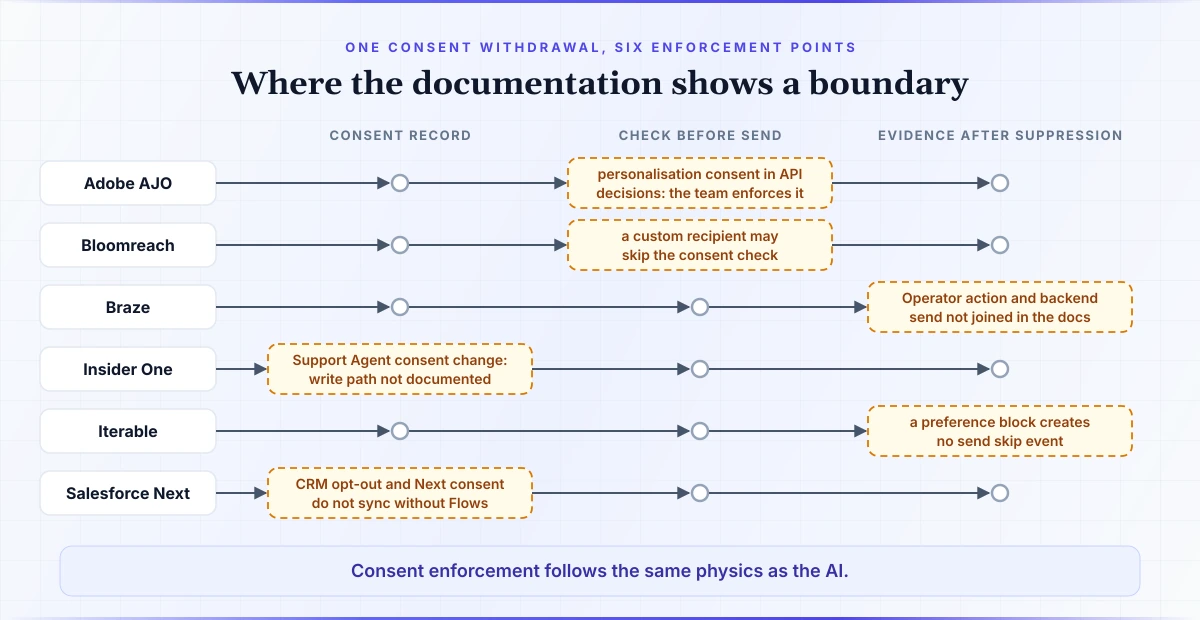 Figure 5. Where each vendor’s public documentation places a boundary on the path of one consent withdrawal. A plain station means the documentation shows no boundary there, not that none exists.
Four questions for the RFP
The six questions I use to judge any agentic claim still apply, and this comparison sharpens four of them into requests a vendor can answer with documentation.
- Can an agent change the approval settings that govern it? Some assistants can now change settings pages, approval workflows included, and the safeguards around that differ: explicit approval for workspace-level changes, limits on what the agent can approve for itself, sign-off that each brand configures. Ask every vendor for the list of settings an agent can change, with the approval each one requires, who is notified and where the change is logged.
- Which consent record is checked at the moment of send, and how does it sync? Two consent records can coexist in one vendor’s stack, as the consent section shows. Ask for a data-flow diagram that names the record, the sync mechanism, its latency and what happens when the sync fails.
- What evidence does a suppressed send leave? The documentation I read answers this in different ways, from an exclusion event that carries its reason to a preference block that creates no send skip event. Ask for the event schema of a suppressed send: where it is recorded, with which reason code, for how long and whether it can be exported.
- Which principal sends a message that an agent wrote? Delegated user identity covers the authoring step. Ask who the system thinks is acting when the message finally goes out, and for one audit trail example that joins the two end to end, which is the authority handoff I described in Agents in Production Part 3.
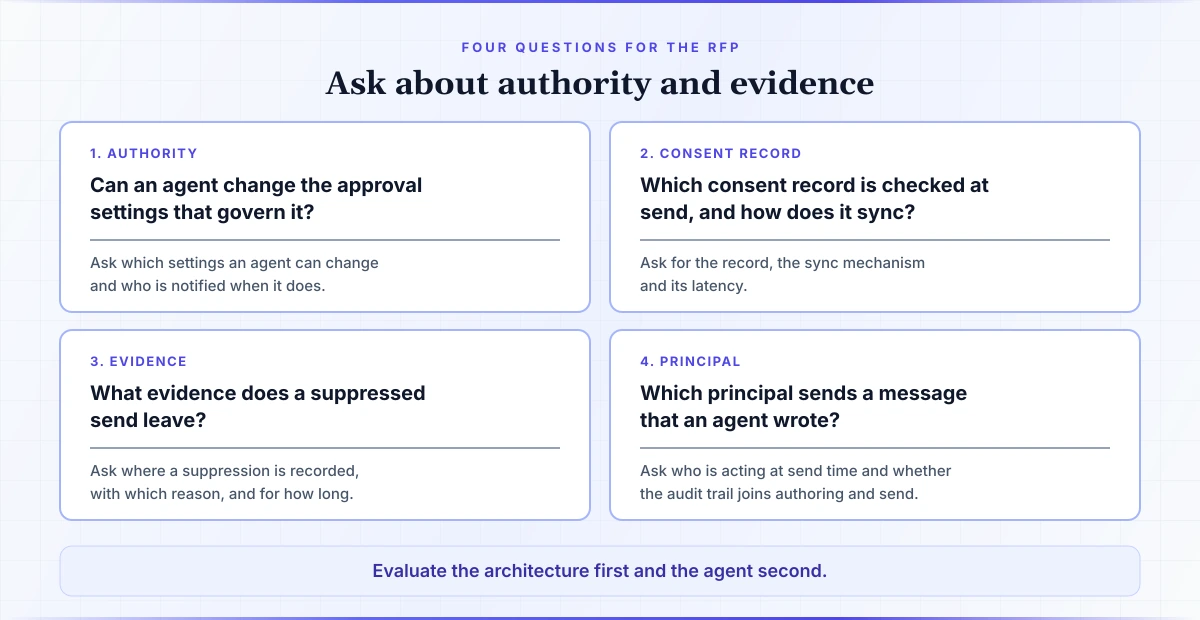 Figure 6. The four RFP questions, each with the evidence to ask for.
Every one of these questions points below the chat window where the demo happens, to the layer where each vendor’s physics decides what the agent can see and what it can change.
The AI you buy inherits the architecture you buy, so evaluate the architecture first and the agent second.
Sources
Adobe
- Adobe Unveils CX Enterprise Coworker, 20 April 2026.
- Adobe Announces General Availability of CX Enterprise Coworker, 10 June 2026.
- Adobe CX Enterprise Coworker in ChatGPT, 29 September 2026.
- Journey Optimizer release notes, consulted 25 November 2026.
- Journey Optimizer release notes 2026, consulted 25 November 2026.
- External data sources, consulted 25 November 2026.
- Exclusion reasons, consulted 25 November 2026.
- Manage opt-out in Journey Optimizer, updated 12 October 2026.
\
Bloomreach
- Bloomreach Announces Loomi Connect, Bringing Your Brand’s Search Intelligence to the OpenAI Marketplace, 12 January 2026.
- Bloomreach Brings AI Agent to General Availability, 2 June 2026.
- Bloomreach Engagement release 1.314, 22 July 2026.
- Bloomreach Marketing Roadmap 2026, recorded 15 September 2026.
- Create email campaigns, consulted 25 November 2026.
- Email tracking and delivery statuses, consulted 25 November 2026.
\
Braze
- Braze Completes Acquisition of OfferFit, 2 June 2025.
- Braze Accelerates AI Innovation, Empowering Marketers to Treat Every Customer Like Their Only Customer, 29 September 2026.
- Decisioning Studio Go FAQ, consulted 25 November 2026.
- BrazeAI Operator, consulted 25 November 2026.
- What you can do with Operator, consulted 25 November 2026.
- Data privacy and security for BrazeAI Operator, consulted 25 November 2026.
- Operator Connect, consulted 25 November 2026.
- Release notes, 23 July 2026, 23 July 2026.
- Release notes, 20 August 2026, 20 August 2026.
- Release notes, 17 September 2026, 17 September 2026.
- Release notes, 15 October 2026, 15 October 2026.
- Release notes, 12 November 2026, 12 November 2026.
- Braze MCP server, consulted 25 November 2026.
- Braze MCP server: available API functions, consulted 25 November 2026.
- Subscription status, consulted 25 November 2026.
- Connected Content Reference, consulted 25 November 2026.
\
Insider One
- Insider One Introduces Agent One, 17 September 2026.
- Agent One, Insider One Academy, consulted 25 November 2026.
- Insider One MCP, consulted 25 November 2026.
- Insider One Announces Strategic Partnership with OpenAI to Advance AI-Driven, Autonomous Customer Engagement, 24 March 2026.
- Insider One & Google Partner to Power Real-Time AI Customer Engagement, 9 June 2026.
- Anthropic partners with Insider One, 20 August 2026.
- Insider One acquires Bluecore, 13 May 2026.
- Zero Copy Segmentation for Snowflake, 2 June 2026.
- Architect Email, consulted 25 November 2026.
\
Iterable
- Iterable Unveils Iterable Nova, A New AI Agent to Power Moments-Based Marketing, 2 April 2025.
- Iterable Unveils Nova Agent and a New Wave of AI Innovations, 22 April 2026.
- Fall 2026 product launch, 24 September 2026.
- Iterable Winter Product Launch, 12 November 2026.
- 2026 Release Notes, consulted 25 November 2026.
- Using Live Data in Journeys, consulted 25 November 2026.
- Message Channels and Message Types Overview, consulted 25 November 2026.
\
Salesforce
- Salesforce Signs Definitive Agreement to Acquire Braze, 20 October 2026.
- Salesforce Introduces the Trusted Enterprise AI Harness, 10 September 2026.
- AIforce announcement, 15 September 2026.
- Marketing Cloud: what’s new, consulted 25 November 2026.
- Introducing The Campaign Agent That Turns Goals Into Growth, consulted 25 November 2026.
- The MCP Server for Marketing Cloud Engagement Is Now GA, June 2026.
- Marketing Cloud Next: Syncing Contact and Lead Email Opt Out with Consent Using Flows, 7 July 2026.