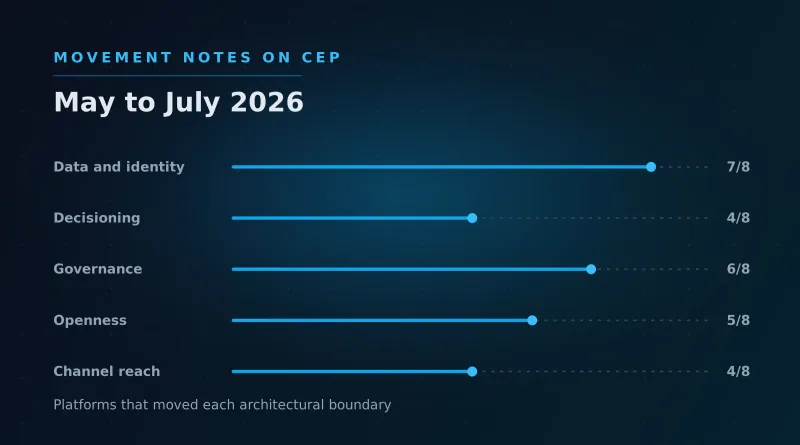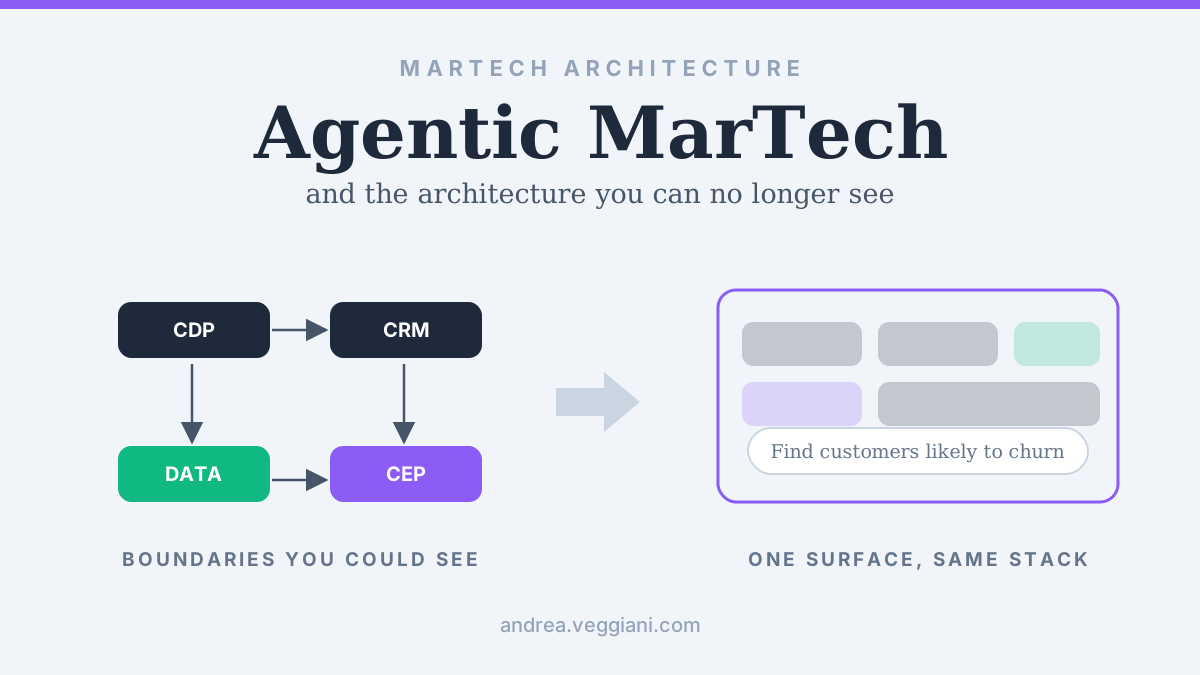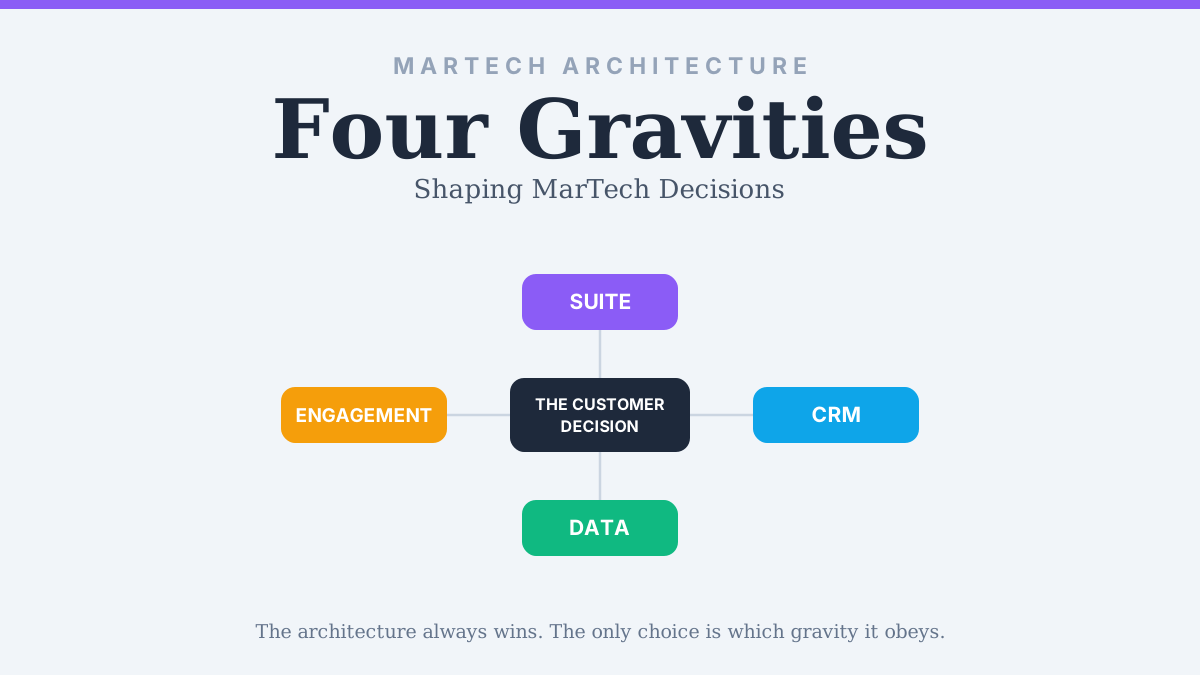
I published the first Field Note on Braze on 3 February 2026, and by the end of April Braze had made Operator and Agent Console generally available and had given agents a place inside Canvases and Catalogs. Nothing in that assessment became wrong. It became undated, which is a more awkward problem, because a reader has no way of telling from the page whether they are looking at a description of the platform or a description of the platform as it stood in February.
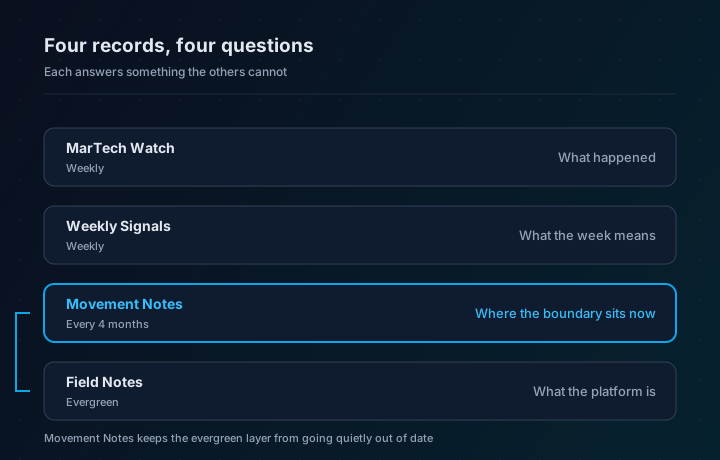
That is the gap this series closes. Field Notes asks what a platform fundamentally is, and the answer changes slowly. The MarTech Watch records what happened in a given week, and Weekly MarTech Signals asks what a week of news adds up to. Movement Notes asks the one question none of those three answers on its own, which is where the architectural boundaries sit now compared with where they sat before.
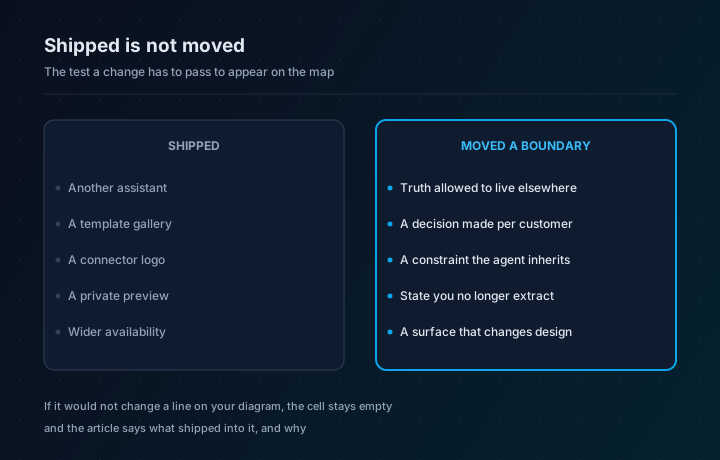
Shipping is not moving. Eight well-funded vendors ship something every month. The question is whether any of it changed a line you had already drawn.
The Unit Is the Boundary, Not the Vendor
This is not a scorecard and it does not rank anybody. There are no points, no totals and no grades, and the reason is not diplomacy. It is that a number cannot carry a reason, and the reason is the only part of this worth reading.
An architect working on a customer engagement stack draws a small number of lines. Identity resolves here and not there. This data stays in the warehouse and that data is replicated. Approval happens inside the platform or outside it in a ticketing system. Optimisation logic belongs to the vendor or belongs to us. Loyalty balances live over there and the platform only reads them. Those lines are the real deliverable of an architecture engagement, and they are expensive to move once a programme is running on them.
So the question each period is not how good a platform is, and not even how much it shipped. It is whether anything it shipped would make you redraw one of those lines. If yes, the map below names what moved. If no, the cell is empty and the article says what the vendor shipped into that empty cell and why it did not move a line. That way the judgement is a sentence you can argue with rather than a mark you can only resent.
Three practical rules follow from that. Availability is recorded alongside every entry, distinguishing generally available from public beta, private beta or early access, announced without a date, and acquired but not yet integrated, because a private beta can still establish a boundary in public while an announcement establishes nothing. Signed but unclosed transactions never appear on the map, since a signature has not moved anything, and they are discussed in the structural section instead. And where the public record is too thin to tell, the cell says so rather than defaulting to a blank that would read as a finding.
Five Boundaries Drawn From Where These Platforms Break
The five columns come from the failure modes that recurred across eight Field Notes and their synthesis, rather than from a procurement checklist, because a checklist would measure what every analyst already measures.
Data foundation and identity is the line between a system of record and a system of action, covering the profile model, identity resolution, event semantics and warehouse access. This is the synthesis’s second failure mode, that no agent compensates for weak customer meaning, and movement here is usually a change in where truth is allowed to live.
Decisioning autonomy is the line between rules you author and processes that select, adapt and learn on their own. An assistant that drafts copy sits on one side of it and a process that changes operational state sits on the other, and the column exists mostly to keep those two apart.
Governance and guardrails is the line between what the platform enforces and what your organisation has to enforce around it, covering permissions, consent, approvals, auditability, observability and frequency control. This is the synthesis’s first and most repeated failure mode, that governance cannot keep pace with activation speed, and almost nobody else tracks it.
Openness and exit cost is the line around the platform itself, covering APIs, agent protocols, warehouse-native access and portability, and it moves only when the platform becomes cheaper to leave or genuinely inspectable from outside. This column is the easiest to fill badly, because a new interface can add a dependency as readily as it removes one.
Channel and surface reach is the line around what the platform is allowed to act on, and it moves when a new surface changes the architecture rather than the brochure. Taking the motivation layer of loyalty into orchestration while leaving the points ledger outside moves a line. Another template gallery does not.
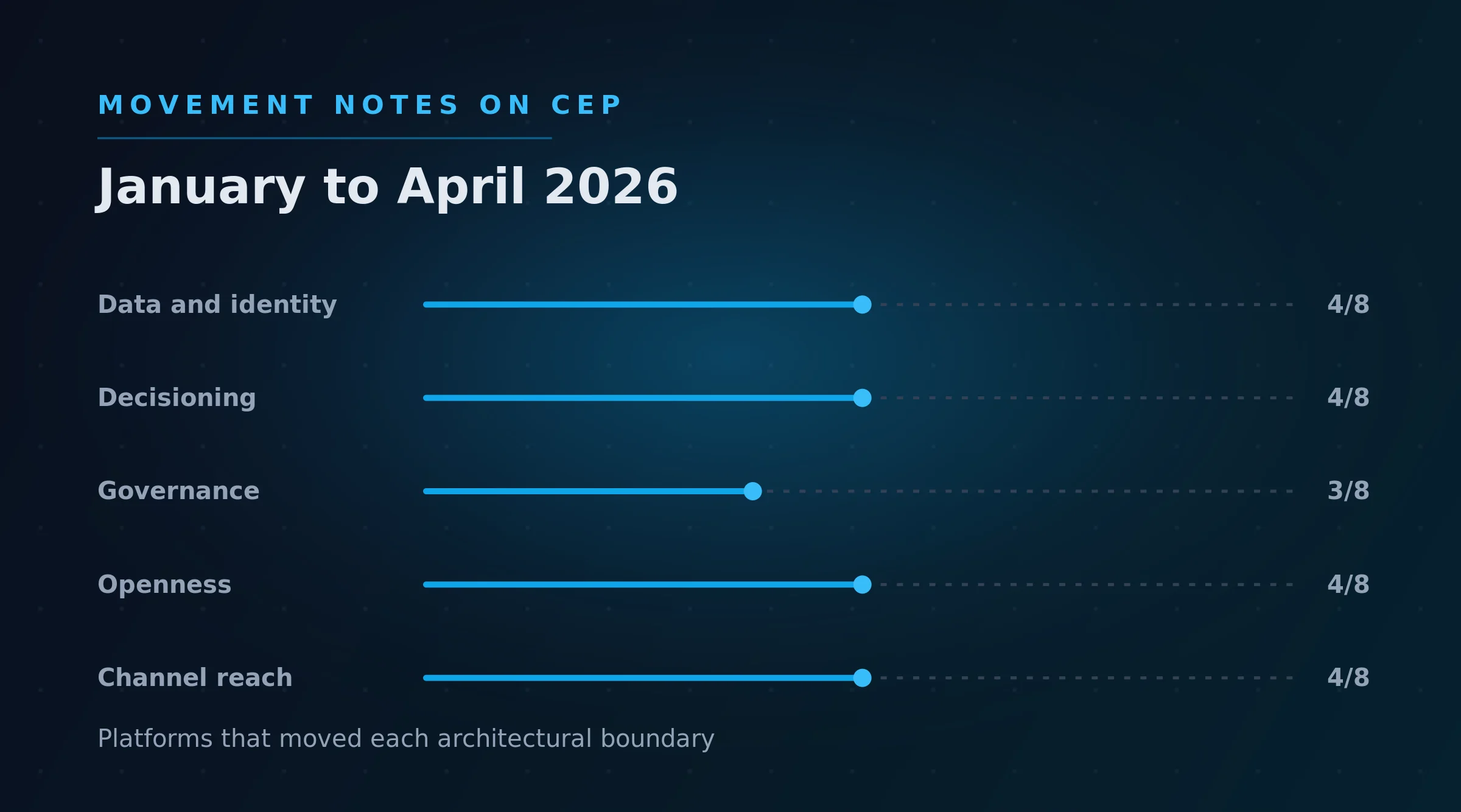
The January to April 2026 Boundary Map
An entry names the boundary that moved. An empty cell means nothing in the public record moved that line during the window, which is not the same as nothing having shipped, and the sections below say what shipped into every empty cell. Not published means the vendor did not make enough public to tell either way.
| Platform | Data and identity | Decisioning | Governance | Openness | Channel reach |
|---|---|---|---|---|---|
| Adobe Journey Optimizer | path experimentation and bandits to GA | separation of duties, quiet hours to GA | direct mail onto the journey canvas | ||
| Bloomreach Engagement | event-stream permissions constrain ingestion | optimisation against business events | bad semantics refused at the boundary | Loomi Connect exposes search over MCP | online and in-store Shopify data joined |
| Braze | zero-copy Canvas triggers | Operator and Agent Console to GA | less state retained to be extracted | ||
| Insider One | BigQuery positioned as the foundation | not published | not published | activation from warehouse-side storage | not published |
| Iterable | action before conventional identification | Command Center as the work surface | retention and policy beside execution | open-source MCP server | paid media as a journey destination |
| Klaviyo | service as an adjacent surface | ||||
| MoEngage | not published | not published | not published | ||
| Salesforce Marketing Cloud |
Two rows are worth reading carefully before anyone reads them as a verdict. Salesforce moved no boundary in this window, and the explanation is in the sections below rather than in the emptiness: almost all of its marketing capacity went into the transition between Marketing Cloud Engagement and Marketing Cloud Next, which is parity work, and parity work does not move lines by design. MoEngage’s row is mostly unpublished rather than mostly empty, which is a different situation with a different remedy.
Data and Identity: Half the Field Moved the Boundary
Four platforms changed where customer truth is allowed to live.
Bloomreach’s event-stream permissions separated public client-side collection from trusted server-side streams and allowed teams to constrain which identifiers, properties and event types may enter at all, which moves validation from a layer you build outside the platform to a rule the platform enforces. Braze passed warehouse and S3 context into a Canvas through zero-copy triggers without persisting every value as a profile attribute, which attacks the profile-bloat problem that every mature Braze implementation eventually meets and changes what you decide to replicate. Iterable’s Unknown User Activation let teams act on high-intent behaviour before a visitor becomes a conventionally identified profile, moving the identity boundary earlier and raising a consent question at the same time. Insider One launched native BigQuery and Google Cloud Storage integrations and positioned BigQuery explicitly as a foundation to activate from, which changes whether a customer needs to replicate the warehouse into Insider at all.
The four empty cells contain real work. Adobe added incremental querying and continued strengthening relational orchestration, which is engineering on an existing model rather than a change to where the model sits. Salesforce brought broader data-model and business-unit support into Marketing Cloud Next, which closes a parity gap rather than moving a line. Klaviyo deepened its Google and Shopify relationships, which widens commercial reach without changing the customer model underneath. MoEngage added AI-generated descriptions for events and attributes, a useful step toward making its own semantics legible to its segmentation assistant, and not one that changes where anything lives.
Decisioning: Direction Without a New Unit
Four platforms moved this line, and none of them changed the unit of decision.
Adobe moved journey path experimentation to general availability, introduced multi-armed bandit options and Scale the Winner, extended Decisioning into push and SMS and put Journey Agent into limited availability, which together determine whether optimisation logic still has to be built beside the platform. Braze made Operator and Agent Console generally available, so agents are created and embedded inside Canvases and Catalogs rather than running alongside them, which changes what sits inside the orchestration object and what sits next to it. Bloomreach allowed contextual personalisation to optimise against business events rather than only opens and clicks, which changes the objective function and therefore what the system is actually solving for. Iterable’s Command Center made goals and health signals the work surface, with specialist agents handling review, experimentation, dynamic logic and analytics beneath it.
Iterable is the interesting case and worth being precise about, because the Spring release was the loudest product moment of the window and it is easy to overstate. What changed was the surface a marketer stands on while operating journeys, and that is a genuine change to how a programme is managed. The unit of decision inside the platform at the end of April was still the journey and the branch, exactly as it had been in January. Managing a programme differently and deciding differently are not the same thing, and a method that cannot separate them will always reward whoever had the best launch event.
Klaviyo’s Composer was in private preview, assembling audience, content and timing from a plain-language brief with the marketer retaining approval, and a private preview does not yet move a line for anyone building on the platform. MoEngage’s Merlin agents and its strengthened Segment Assist improve marketer workflow. Salesforce expanded Agentforce capability around campaign creation and marketing workflow, in the same category. Insider One announced a strategic OpenAI partnership and described Agent One as the route to autonomous engagement without making availability, permissions or production scope public enough to judge.
Governance: The Quietest Work Was the Only Work That Moved a Line
Three platforms changed what the vendor enforces versus what you have to enforce around it.
Adobe made quiet hours generally available, expanded custom-action monitoring, exposed journey alerts, added URL parameter encryption in limited availability, and added an option preventing creators from approving their own journeys and campaigns. That last item is the one that moves a boundary, because separation of duties is a governance primitive rather than a preference, and its absence is precisely why approval workflow so often ends up living in a ticketing system that the platform cannot see. Bloomreach’s event-stream permissions appear on this line as well as on data, since refusing bad semantics at the point of entry is a governance act before it is a data act. Iterable paired Nova with an SMS Compliance Toolkit and stored-message retention, which puts evidence beside execution instead of reconstructing it later from logs.
Klaviyo kept human approval between Composer and launch and expanded brand-guidance controls for Customer Agent, both sensible and neither changing where the enforcement boundary sits. Braze described integrated operation and enterprise readiness around the April agent launch without exposing new permission or audit mechanisms, which leaves the line where it was. Salesforce’s tracing and observability work sat in the wider Agentforce platform rather than in the marketing product, and this series tracks the marketing product.
Openness: The Line Moved Where Warehouses Did
This column moves only when the platform becomes cheaper to leave or genuinely inspectable from outside, and applying that test strictly gives a different picture than counting announcements would.
Bloomreach launched Loomi Connect in January, exposing commerce search intelligence through MCP and taking product discovery outside the Bloomreach interface, which is the first external access surface in the scored set. Iterable continued developing its open-source MCP server, and the open-source part is what moves the line, because a server whose implementation is inspectable is a different proposition from one that is not. Braze’s zero-copy Canvas triggers appear here as well as on data, since context that never has to be permanently reconstructed inside the platform is context you do not have to extract on the way out. Insider One’s BigQuery and Google Cloud Storage connections do the same by another route.
Klaviyo launched an app in ChatGPT, which is distribution rather than portability and leaves exit cost exactly where it was. Adobe and Salesforce both have capable APIs that already existed, and neither did anything in this window that reduced dependency.
The Adobe cell needs one clarification, because a reader following the weekly record will have seen the opposite. Adobe put an MCP server for Marketo Engage into open beta in April, exposing more than a hundred operations across forms, programs, smart campaigns, leads and emails, restricted to non-destructive calls. That is a substantial external surface and it belongs to Marketo Engage, which is a different product with a different buyer. The platform tracked here is Adobe Journey Optimizer, matching the roster assessed in Field Notes, and suite siblings do not lend their movement to it. The same rule applies to every vendor on the map with a portfolio wider than the product being tracked.
Channel Reach: Adjacency Rather Than Expansion
Adobe brought Direct Mail onto the journey canvas alongside general availability for web push and support for iOS Live Activities, and direct mail is the item that moves a line, because putting a batch physical channel inside an event-driven canvas is a statement about where fulfilment latency is allowed to sit. Bloomreach unified its Shopify presence into a single Loomi application and connected online and in-store Shopify data, joining two customer realities that most implementations keep apart. Iterable connected owned engagement to Google Ads and created a route to act on anonymous high-intent visitors, which changes suppression and eligibility design because both now depend on data crossing a boundary the platform does not own. Klaviyo moved further into service through Customer Agent, and service is the surface that later makes its B2C CRM framing coherent rather than aspirational.
Salesforce expanded approved email, SMS and WhatsApp use across parts of its portfolio, which is wider availability of existing surfaces. Braze’s important work this window was in the agent and data layers.
What These Notes Can and Cannot See
The public record is uneven, and pretending otherwise would make every empty cell ambiguous. This table is a statement of fact about publishing behaviour and nothing else, and it is here because which vendors will tell you what changed is a question worth answering before you sign anything.
| Platform | Dated, granular change record covering this window |
|---|---|
| Adobe Journey Optimizer | Yes |
| Bloomreach Engagement | Yes |
| Braze | Yes, with varying structure between releases |
| Insider One | No |
| Iterable | Yes |
| Klaviyo | Yes |
| MoEngage | No |
| Salesforce Marketing Cloud | Yes, split across Marketing Cloud Engagement, Marketing Cloud Next, Data 360 and Agentforce |
Salesforce is the case that shows why the answer is not simply yes or no. It publishes a great deal, and the volume makes attribution to the marketing product harder rather than easier, which is a different problem from Insider One’s and needs a different reading.
There is a second limitation worth naming. Public material favours launches over operating evidence, so a beta can be demonstrated long before it produces a reliable production outcome, while a compliance control can matter precisely because nobody writes a press release about it. This map records where boundaries sit, not how loudly they were announced, which is why several noisy stretches above show empty cells and several quiet ones do not.
The Platform That Moved Strangest: Iterable Rebuilt the Work Surface
Iterable moved a line on all five columns, which no other platform managed in this window, and the shape of that movement is more interesting than the count.
The Spring release changed the relationship between four things that had previously been easier to keep separate. Command Center established goals and health signals as the work surface. Specialist agents took on review, experimentation, dynamic logic and analytics. Unknown User Activation extended action earlier in the funnel. Stored Messages and the SMS Compliance Toolkit put retention and policy beside execution rather than after it. Taken together that is a coherent change to how a programme is operated, and it landed in a single release rather than accumulating across a year.
It also left real questions open, which is worth saying while the release is still being cited. Vendor material described coordinated, goal-driven agents without making every distinction between recommendation and autonomous change visible. Activation before conventional identification raises consent questions ahead of identity rather than after it. Google Ads synchronisation makes suppression depend on data moving correctly across a boundary Iterable does not control. Stored message copies improve auditability without explaining why a particular customer became eligible in the first place.
Watchlist: Outside the Scored Set
The set here is the Field Notes eight, and keeping the two rosters identical is what lets each issue work as the maintenance layer for that series. Five other platforms are worth naming because they appear often enough in the weekly record to raise the question of why they are absent.
HubSpot appeared in more MarTech Watch rows than any platform on the map across weeks 20 to 31, which reflects both its release velocity and its transparency, and it stays outside because its centre of gravity remains CRM and marketing automation for a different buyer. Optimove is the closest genuine omission and would enter on evidence of enterprise cross-channel displacement rather than on release volume. Tealium sits on the data side of the boundary, Zeta on the identity and paid-media side, and Optimizely on the experimentation and content side, and each would qualify at the point where it starts winning engagement orchestration rather than feeding it. The set is closed for stability, not because the boundary around it is obvious.
Structural Moves
Corporate movement never appears on the map, because revenue is not architecture. It does predict which movements a vendor can sustain.
Bloomreach announced that it had passed 260 million dollars in annual recurring revenue during 2025, reached positive free cash flow and ended the year with record net-new ARR, alongside a claim that nearly half its customers used at least one agent or next-generation AI tool. Those are vendor-reported figures rather than audited product outcomes, and what they suggest is that Loomi was becoming part of an installed base rather than remaining a conference narrative. Klaviyo reported 32 percent revenue growth for 2025 and increasingly described its category as autonomous B2C CRM rather than ecommerce marketing automation, a decision that expands the competitors, the buyer and the product obligations it is choosing for itself. Braze reported fiscal 2026 results in March and guided fiscal 2027 revenue to between 884 and 889 million dollars, a figure it raised in May and which the next issue picks up, and the meaningful signal is not proximity to a billion but sufficient scale to fund a broad agentic layer without abandoning its event-driven centre of gravity.
Insider One, MoEngage and Iterable are private and disclose selectively, so their product and transaction behaviour carries more evidential weight in this series than any unaudited size claim.
Method Note
The window is 1 January to 30 April 2026, and this issue was written after it closed, which is stated once here and not repeated. Entries describe movement from each platform’s documented position at the end of 2025, informed by the Field Notes series and the public product record. An announcement without clear availability may describe direction in prose without occupying a cell.
Because the issue is retrospective it carries no predictions, since a prediction made after the outcome is visible is not one. The forward record begins with the next issue, which covers 1 May to 31 July 2026 and closes with dated claims that resolve in the issue after it.
Corrections change both the prose and the relevant cell in the next issue, so the record never rests on something that quietly disappeared. If a cell here is wrong, the correction interests me more than the original entry, and the fastest way to make it happen is to send the dated evidence.
A platform assessment describes the physics. This one records when the physics start to change.
Sources
Vendor Documentation and Product Releases
- Adobe Journey Optimizer 2026 release notes
- Bloomreach Engagement changelog
- Bloomreach event-stream permissions, release 1.301
- Braze agentic AI launch, 23 April 2026
- Insider One BigQuery and Google Cloud Storage integrations
- Insider One and OpenAI partnership
- Iterable Spring 2026 release
- Iterable 2026 release notes
- Klaviyo Composer announcement
- MoEngage Merlin AI overview
- Salesforce Spring ‘26 marketing release notes
Corporate and Financial
- Bloomreach surpasses 260 million dollars in ARR
- Braze fiscal year and fourth-quarter 2026 results
- Klaviyo financial results
Analyst Context
- Forrester, The Cross-Channel Marketing Hubs Landscape, Q2 2026
- Gartner Magic Quadrant for Multichannel Marketing Hubs
Internal Research