Movement Notes on CEP
Field Notes says what a platform is. Movement Notes says what changed since.
- What it is
- A dated map of which architectural boundaries eight customer engagement platforms actually moved
- Who it's for
- Architects and buyers deciding whether a platform assessment from months ago still holds
- Cadence
- Three issues a year, four-month windows (sarting from now), English only
- Latest issue
- May to July 2026, published August 8, 2026
What the May to July 2026 issue found
- Two acquisitions closed and bought layers rather than features. Insider One took the Bluecore retail identity network on 13 May, MoEngage took Aampe and its per-customer decisioning process on 24 June. Both entries record the purchase of a layer and claim nothing about integration.
- Seven of eight platforms moved the data and identity line, and Databricks is the reason. CustomerLake launched on 16 June, and within a week Bloomreach, Iterable and Braze had each responded to a warehouse vendor putting identity resolution inside the lakehouse.
Platform assessments go stale quietly. The first
Field Note on Braze published on 3
February 2026, and within two months Braze had made Operator and Agent Console generally
available. Nothing in it became wrong. It became undated, which is harder to spot and
easier to act on by mistake.
Movement Notes exists so you can tell the difference. Three times a year it asks one question of the same eight platforms: which architectural boundaries actually moved, and which stayed exactly where they were while a great deal shipped around them.
The complete record
All issues
2 issues
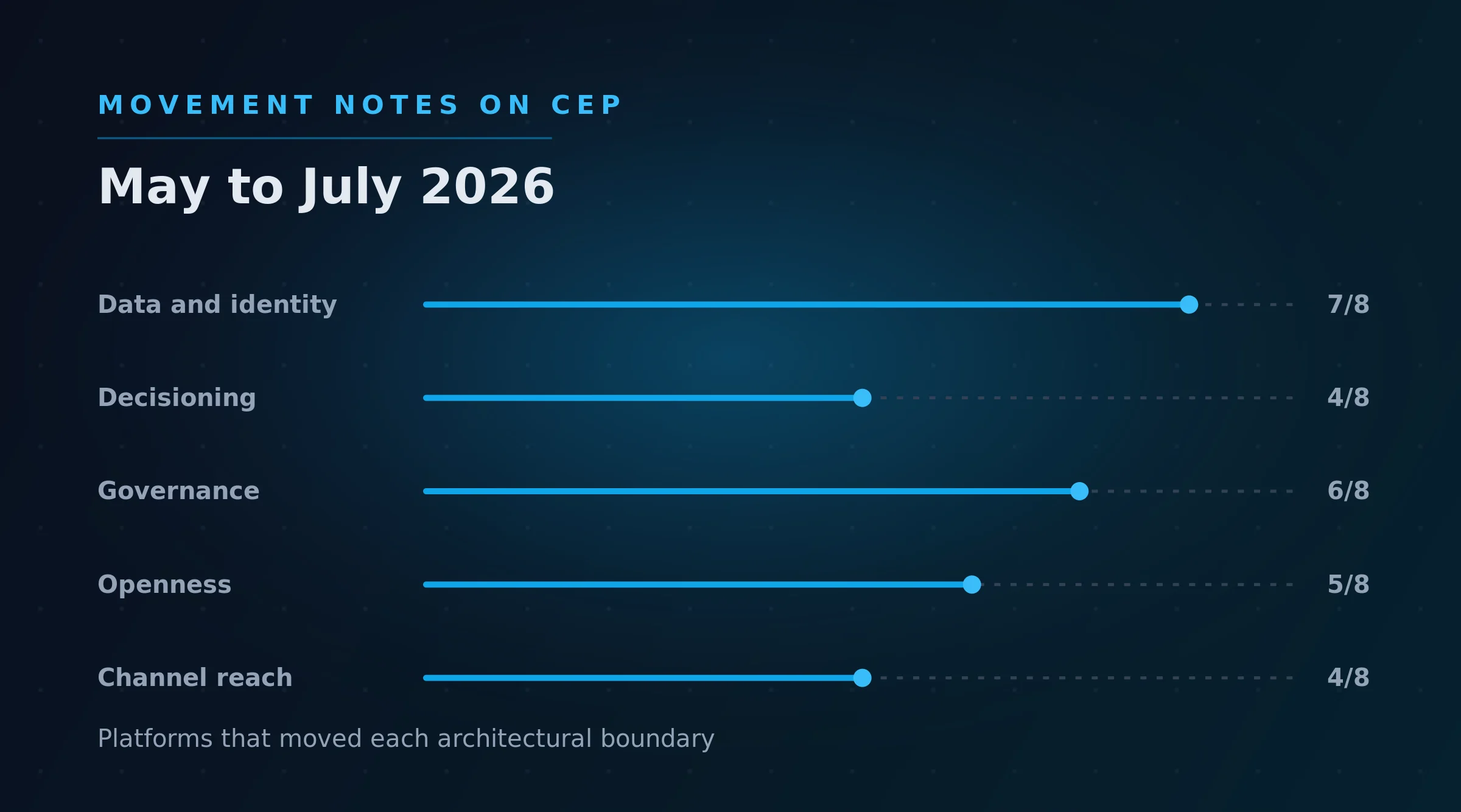 Latest issue Movement Notes on CEP: May to July 2026 Which architectural boundaries eight customer engagement platforms moved between May and July 2026, across data, decisioning, governance, openness and channel reach. Read the latest
 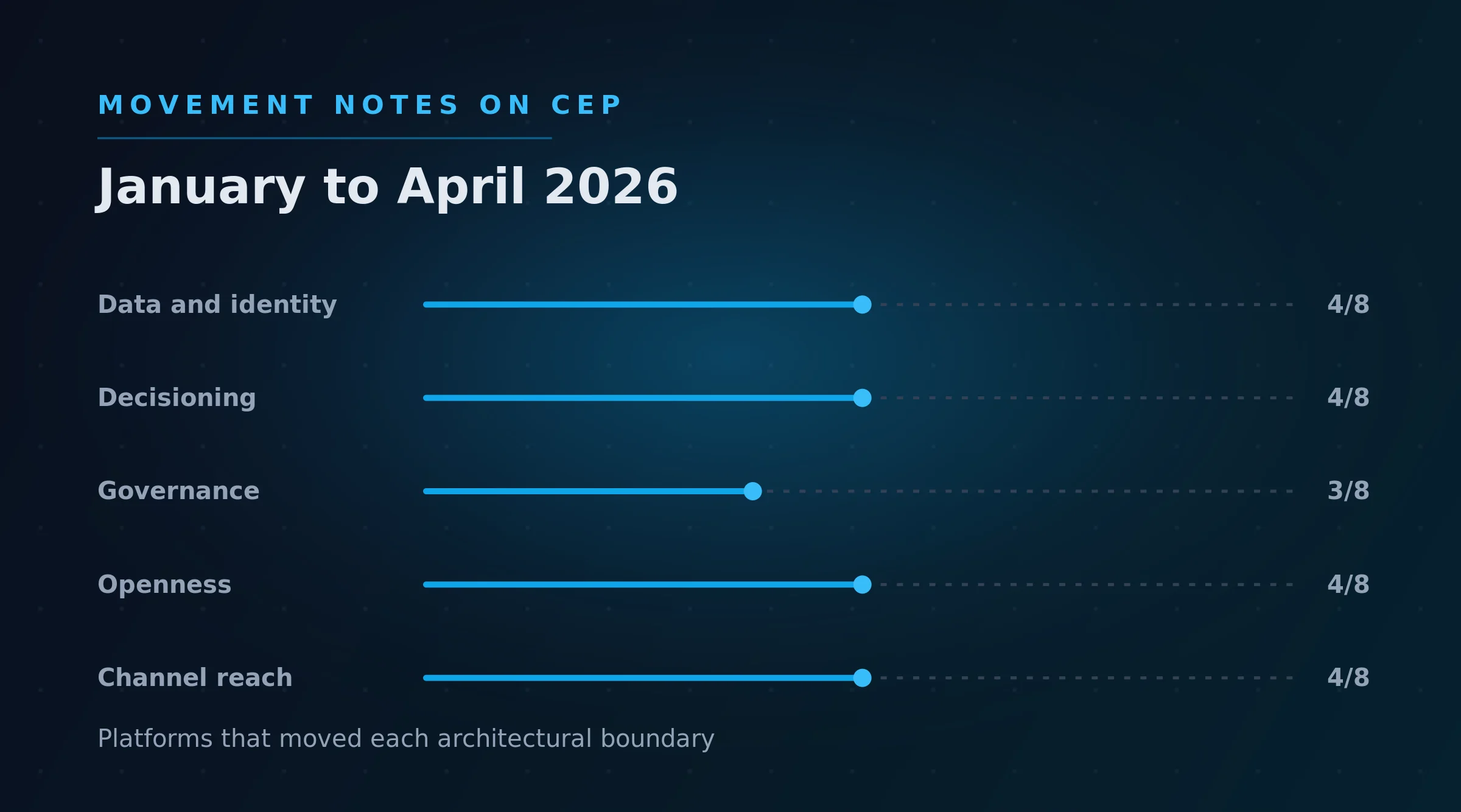 Previous issue Movement Notes on CEP: January to April 2026 Which architectural boundaries eight customer engagement platforms moved between January and April 2026, across data, decisioning, governance, openness and channel reach. Read this issue
 Both issues so far are reconstructions, written after their windows had closed (or after three months and not foure). The forward record, with dated predictions resolved in the following issue, starts with the next one.
The method
The unit is the boundary, not the vendor
There are no points, no totals and no grades here, and the reason is not diplomacy. A number cannot carry a reason, and the reason is the only part worth reading. An architect draws a small number of lines: identity resolves here and not there, this data stays in the warehouse and that data is replicated, approval happens inside the platform or outside it. Those lines are the real deliverable, and they are expensive to move once a programme runs on them.
So each issue asks whether anything a platform shipped would make you redraw one of them. If yes, the map names what moved. If no, the cell is empty and the article says what shipped into that empty cell and why it left the line where it was. The judgement ends up as a sentence you can argue with rather than a mark you can only resent.
The five boundaries
Drawn from the failure modes that recurred across eight Field Notes and their synthesis, not from a procurement checklist.
- 01 Data foundation and identity The line between a system of record and a system of action. It moves when customer truth is allowed to live somewhere new.
- 02 Decisioning autonomy The line between rules you author and processes that learn. An assistant that drafts copy sits on one side of it.
- 03 Governance and guardrails The line between what the platform enforces and what your organisation has to enforce around it.
- 04 Openness and exit cost The line around the platform. It moves only when the platform becomes cheaper to leave.
- 05 Channel and surface reach The line around what the platform may act on. A new surface counts only when it changes the architecture.
How to read an empty cell
An empty cell means nothing in the public record moved that line during the window, which is not the same as nothing having shipped. Not published means the vendor did not make enough public to tell either way, recorded per boundary rather than per company, because a vendor can be entirely legible about what it bought and entirely opaque about how the result will be controlled. Every issue carries a plain table of which vendors published a dated change record for the window, because which of these companies will tell you what changed is worth knowing before you sign anything.
Announced but unclosed transactions never appear on the map, since a signature has not moved anything yet. Availability is recorded alongside every entry, distinguishing generally available from public beta, private beta or early access, announced without a date, and acquired but not yet integrated.
Cadence, predictions and corrections
Four-month windows, three issues a year, published about two weeks after each window closes: August to November in mid-December, December to March in mid-April, April to July in mid-August. Every issue closes with dated, binary predictions and opens by resolving the previous issue's. Some will be wrong, and the resolved score is there so you can decide how much weight the rest of the judgements deserve.
Each issue also audits the weekly record it draws on, naming what the MarTech Watch missed and why, since a source process that claims to be complete is one nobody can check. Corrections change both the prose and the relevant cell in the next issue: if something here is wrong, send the dated evidence and it will be corrected in public.
Where to go next
- Field Notes on CEP What each platform fundamentally is. Start here if a name on the map is new to you.
- MarTech Watch The weekly dated record every issue is built from.
- Weekly MarTech Signals What a given week of that record adds up to, read every Monday.
New issues are announced in the weekly signals email. The signup is at the foot of this page.