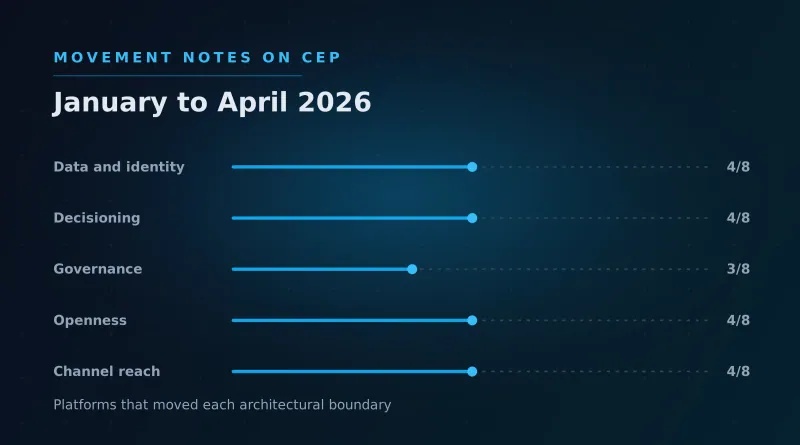
Two acquisitions closed and two were signed between May and July, and between them they explain more about where customer engagement platforms are going than every product launch of the period combined.
Insider One completed its purchase of Bluecore on 13 May and took ownership of a retail identity network. MoEngage completed its purchase of Aampe on 24 June and took ownership of a decisioning process that runs per customer. Salesforce signed agreements for Contentful and for Fin, reaching toward structured content and service resolution without yet owning either. The platforms that did not buy a layer tried to reach it another way, by changing how agents access configuration, how current data enters a decision, or which adjacent surface becomes part of orchestration.
Between May and July, these platforms moved most at the junction between knowing the customer and acting on them.
This is the second and final catch-up issue of Movement Notes on CEP, and the first with a forward record attached. The window runs from 1 May to 31 July 2026, matching the MarTech Watch through week 31. The method is unchanged from the baseline: the unit is the boundary rather than the vendor, an entry names a line that moved, an empty cell means nothing in the public record moved that line, and the sections below say what shipped into every empty cell and why it left the line where it was.
The May to July boundary map
| Platform | Data and identity | Decisioning | Governance | Openness | Channel reach |
|---|---|---|---|---|---|
| Adobe Journey Optimizer | profile assembled at write time | journeys testable before they run | certificate auth, PII-driven permissions | loyalty motivation layer taken, ledger left outside | |
| Bloomreach Engagement | Databricks, catalog state operational | agent with execution rights at GA | agent inherits project policy | Databricks connectivity | catalog changes as native journey events |
| Braze | bidirectional Databricks integration | Operator builds campaigns | profile PII excluded from MCP, regional split | bounded, documented remote MCP | |
| Insider One | acquired the Bluecore identity network | not published | not published | zero-copy Snowflake segmentation | Google RCS and paid-media feedback |
| Iterable | live data read at decision time (beta) | retrieval without replication | |||
| Klaviyo | service and social write to the profile | recipient-level tracking control | custom objects API | social as an owned surface, GA | |
| MoEngage | not published | acquired per-customer decisioning | custom agent guardrails and step visibility | not published | not published |
| Salesforce Marketing Cloud | live CRM objects in Marketing Cloud Next | staged consent mapping |
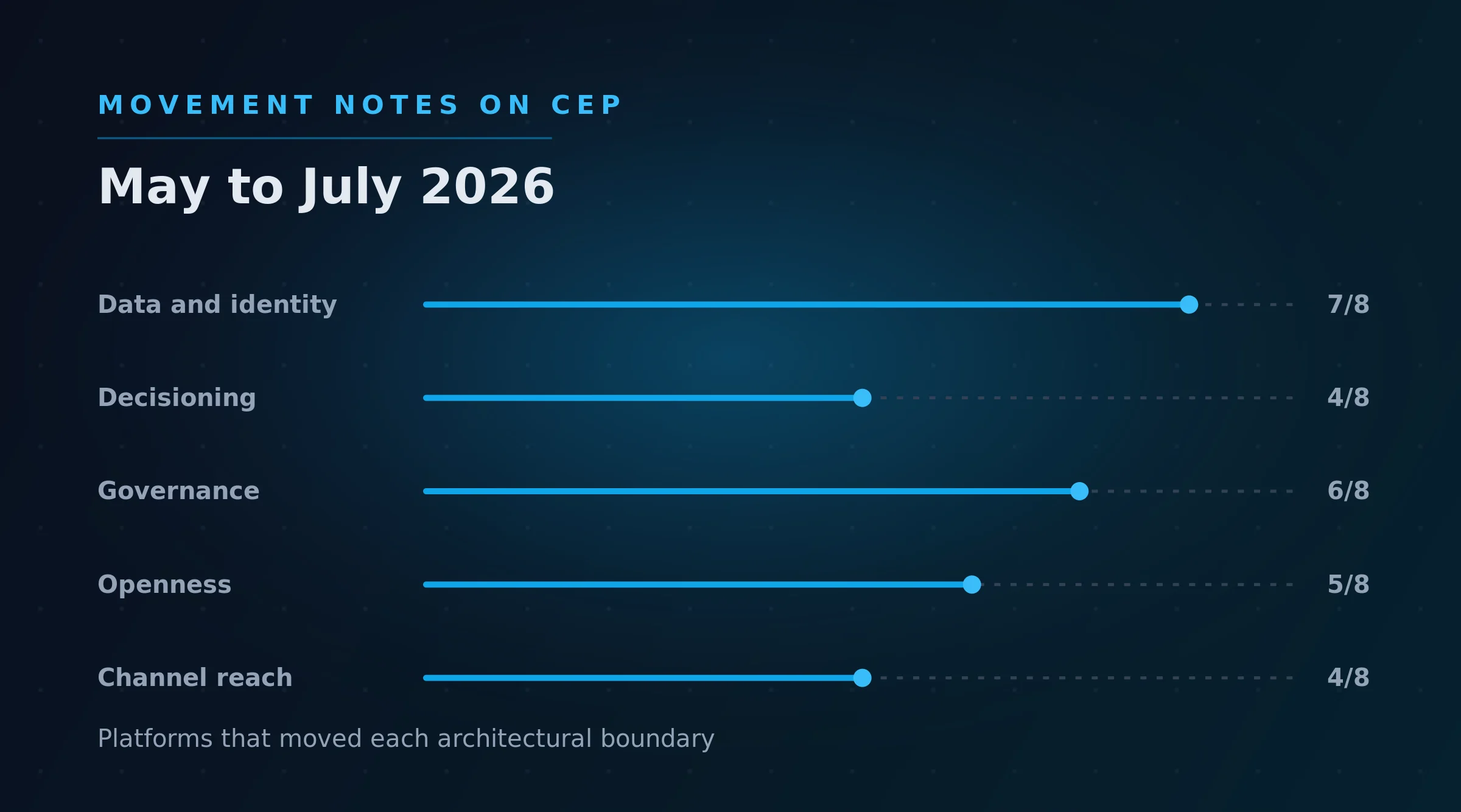
Read the data column first, because seven of eight platforms moved that line and no other column comes close. Read the governance column second, because six of eight moved it, and this is the first window in which governance appeared across almost the whole set rather than in two or three places.
One clarification about the Adobe row, since a reader following the weekly record will have seen more Adobe activity than this map shows. The platform on the map is Adobe Journey Optimizer, not Adobe. Marketo Engage put an MCP server exposing more than a hundred operations into open beta, which is a far larger external surface than anything AJO shipped, and it belongs to a different product with a different buyer. The same scoping applies throughout: this series tracks the eight platforms assessed in Field Notes, and suite siblings do not lend their movement to them.
Two acquisitions are set in bold, not as praise but as magnitude. Buying a layer is a different kind of movement from building one, and both entries record the acquisition of a layer while claiming nothing whatever about integration.
Where the boundaries have been moving since January
With two windows recorded, some trajectory is visible, and it is worth stating in prose rather than in a running tally, since a tally would turn eight platforms into a league table and that is not what any of this is for.
Bloomreach is the only platform to have moved a line on every column in both windows, which no product launch of either period would have told you and which is the sort of thing this format exists to surface. Braze and Adobe have both moved lines steadily without ever moving more than one at a time in any single direction. Iterable front-loaded, changing five lines in the first window and two in the second, which is the usual shape of a large consolidated release followed by a quieter quarter. Klaviyo did the reverse, moving one line early and four late as service, social and the profile converged. Insider One has moved lines only on data and openness, which is precisely the strategy it has been describing out loud. MoEngage moved nothing in the first window and two lines in the second, both of them arriving through an acquisition. Salesforce moved nothing in the first window and two in the second, both inside Marketing Cloud Next, which is consistent with a vendor spending its capacity on a platform transition rather than on architecture, and which will change quickly if either pending transaction closes.
Data and identity: seven of eight moved the same line
This was the column the period belonged to, and the near-unanimity is the finding.
Insider One’s Bluecore acquisition brought a retail identity network, relationships with more than 400 United States enterprise brands, and what Insider describes as a Transparent ID Network processing more than ten billion shopper events a day. Those are company figures, and the direction is legible whatever the numbers turn out to be, because an engagement platform bought a substantial identity and behavioural-data asset rather than another message channel. The entry records the acquisition of a foundational layer and carries no claim that Bluecore’s identity model, consent semantics or retail event definitions had become native Insider architecture by the end of July.
The reason so much moved at once is not coincidence, and it is not really about any of these vendors. On 16 June, at its Data and AI Summit, Databricks launched CustomerLake in private preview: an agentic customer data platform embedded in the lakehouse, with Profile Agents performing what it calls Agentic Identity Resolution and Campaign Agents generating audiences and campaigns through Genie. A warehouse vendor put identity resolution, audience building and activation inside the warehouse. Within roughly a week, Bloomreach announced itself a CustomerLake launch partner, Iterable was named a Databricks validated partner and launch partner, and Braze shipped a bidirectional Databricks integration. Whatever else this window contained, that is the event the data column is reacting to.
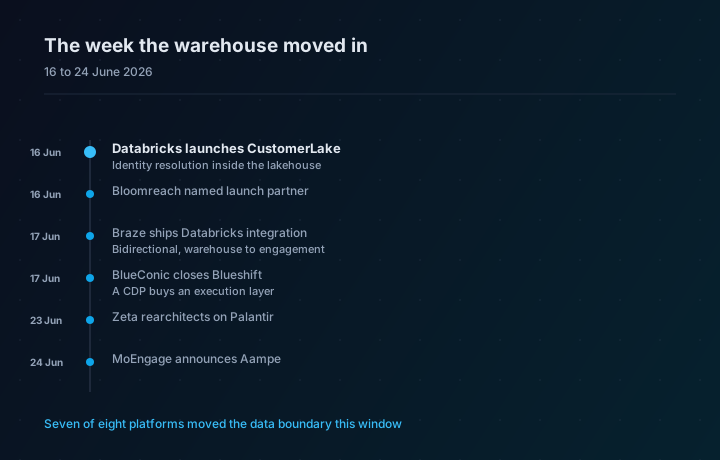
The individual moves are versions of the same decision about where truth lives. Iterable put Journey Live Data into beta, bringing current inventory, price, loyalty or eligibility information into a running journey through an external endpoint, with returned values branching the customer or personalising content and persisting only when the implementation explicitly saves them, which changes the moment at which a decision reads reality. Adobe consolidated profile attributes at write time rather than read time in the July platform release and added file-based targeting that loads audiences at execution time without persisting them as Experience Platform datasets, both of which change how the profile is assembled rather than what it contains. Braze added a bidirectional Databricks integration on 17 June, bringing warehouse data and engagement data together for activation and removing a pre-formatting step, which is a genuine change to what has to be reshaped before it can be used. Worth being accurate here, since the vendor framing invites the opposite reading: the Braze Data Platform is not new, having launched in 2024, and what happened in June was a set of enhancements to it rather than the arrival of a data layer. Klaviyo let Customer Agent write preferences and intent into the profile, turned Instagram interaction into owned customer signals and added support for multiple email addresses per profile, which together take the customer model past a single commerce-marketing identity. Bloomreach’s CustomerLake integration landed on 16 June alongside catalog state becoming operational through native journey triggers. Salesforce expanded Marketing Objects, CRM-object sources and live Salesforce data access in Marketing Cloud Next, the first item in seven months where Marketing Cloud Next changed a boundary rather than closing a parity gap.
MoEngage is the one unpublished cell. Aampe plainly requires behavioural input to learn per customer, and nothing public showed how its data model joins MoEngage by the end of July.
Decisioning: MoEngage bought the unit everyone else is approaching
Aampe is not another campaign assistant. It provisions a decisioning process for each individual customer, choosing what to say, when, how often and through which channel, then learning from the outcome through reinforcement learning and causal analysis, and the company reported having deployed millions of such agents across its customers, processing more than 200 billion decisions a week. MoEngage already had an insight-led, app-first platform and had introduced Merlin agents for marketer workflow, so what the acquisition adds is the customer-side layer rather than another marketer-side one. The unit of decision in this category has been descending for years, from the campaign to the segment to the journey branch, and Aampe is the first thing in the set that states the endpoint plainly.
The qualification is large enough to state twice. Through 31 July no public release demonstrated Aampe as a native MoEngage capability, no combined conflict model explained what happens when a per-customer agent disagrees with a marketer-authored Flow, and no permission model showed who may change the objective or the reward signal. The entry records the acquisition of a layer, which is what it says, and nothing about integration.
Bloomreach made Loomi Marketing Agent generally available in June and extended it to schedule sends and create email and SMS campaigns from configured voucher pools, which is the only agent in the set holding execution rights at general availability. Adobe moved Journey Simulation, Journey Fragments and path targeting to general availability, added natural-language expressions and decision rules and put propensity-based channel selection into limited availability, and simulation reaching general availability is the item that moves a line, because a journey you can test before it runs is a different governance object from one you cannot. Braze expanded Operator from platform assistance into campaign construction while Agent Console let agents operate inside Canvases and Catalogs.
Three cells stayed empty and none of them for want of activity. Klaviyo Composer moved from private preview to public beta on 30 June with human approval retained before launch, which is progress along a path that has not yet changed where the path ends. Iterable added Nova improvements and decisioning enhancements in the same category. Salesforce added Agentforce marketing templates, content and goals agents and new campaign workflows while negotiating to buy the service-resolution platform that would give those agents something to complete, and the agreement itself sits in the structural section rather than on the map. Insider One continued Agent One and introduced an Insight Agent without making granular availability visible, which is a second consecutive window in which this column cannot be read.
Governance: six of eight moved the line
This was the first window in which governance appeared consistently across almost the whole set, and that fact matters more than any individual entry in the column.
Bloomreach shipped the period’s most concrete constraint. Loomi may use voucher codes only from pools already configured in the project, and it inherits silent hours and frequency caps rather than operating beside them, so when no pool exists it does not invent a code. That is modest engineering with large architectural meaning, because an agent that inherits platform policy is governed by the mechanism you already audit, while an agent carrying its own policy is a second system to audit. Scenario approval and message archiving landed in the same window.
Braze’s remote MCP server used OAuth and single sign-on, separated United States and European endpoints, exposed a bounded content-write surface and stated that user-profile PII is not available through the interface, while user deletion reached general availability. One item deserves more scrutiny than it received, which is that Operator can edit settings such as quiet hours, messaging rules and approval workflows through natural language. A convenient control surface is also a control surface that can be changed quickly, and who may instruct the agent to widen its own constraints is not a question the documentation answers. Adobe added certificate-based authentication for custom actions, customer alerts and raised active-journey limits with new guardrails, and the loyalty release brought web application firewall allowlisting and permissions motivated by PII visibility. MoEngage introduced Custom Agents with marketer-defined guardrails and step visibility, then added scheduling, context files and accessible tools. Klaviyo added account and recipient-level email open-tracking controls alongside Customer Agent brand guidance, and the tracking controls are what moves the line, because per-recipient tracking consent otherwise has to be honoured outside the platform. Salesforce delivered staged consent mapping and email archiving in Marketing Cloud Next, and consent mapping is a migration-critical architectural artefact rather than a setting.
Iterable added source footnotes to Nova responses, a real and welcome provenance feature that tells a marketer where an answer came from without changing what the platform enforces on their behalf. It is worth naming plainly rather than leaving to inference: in a window when six of eight platforms attached a named control to a widening action scope, this was the contribution on that column, and Iterable’s April compliance and retention work was among the stronger material of the previous window.
Nothing in this column amounts to a foundational answer. The set shipped more constraints without establishing anything about cross-agent identity, delegated authority, or responsibility when one system reads data from another and acts in a third.
Openness: MCP arrived everywhere and the line moved in five places
MCP was the period’s most repeated interface and the clearest test of whether this column is filled honestly, because counting servers would have filled every cell and told the reader nothing.
Five platforms did something to the dependency itself. Insider One launched Zero Copy Segmentation for Snowflake at Snowflake Summit on 2 June, querying governed warehouse data and retaining audience membership for activation instead of ingesting the dataset beneath it, which is the single clearest reduction in extractable state in the window. Iterable combined its MCP work with live external data retrieval, so facts consulted at decision time never need replicating. Braze paired its remote server with a bounded, documented and regionally separated write surface and an explicit statement of what it does not expose, which is the difference between an interface and a governed one. Klaviyo expanded public APIs for Customer Agent and custom objects, and a custom-objects API is what determines whether a bespoke data model can leave at all. Bloomreach’s Databricks connectivity moves data gravity in the customer’s direction.
Adobe and Salesforce both shipped MCP surfaces that leave this line where it was, and the reasoning matters more than the empty cell. Adobe added five read-only channel-configuration tools on 9 July, letting an assistant list and inspect channel configurations, configuration resources and marketing actions, on a server that is itself in beta and read-only throughout. That makes configuration inspectable in a narrow sense and changes nothing about what it costs to leave, and a cautious read-only first step is a defensible way to start. Salesforce released an MCP server for Marketing Cloud Engagement in the same shape. MoEngage introduced an open MCP architecture around Merlin, and the public material was not detailed enough to tell what it does to dependency. If any of the three introduces documented write scopes with logging, or a warehouse-native access pattern, this column will show it immediately.
The governance layer around MCP now matters more than the protocol. Authentication, session duration, tool-level scope, PII boundary, write approval, logging and downstream retention decide whether external access becomes an enterprise property or a new source of invisible coupling, and almost none of it is documented well anywhere in the set.
Channel reach: the platform grew into loyalty, social and the catalog
Adobe introduced Journey Optimizer Loyalty Challenges in private beta, and the line it draws is why it appears here. The module leaves points, tiers and reward balances in the existing loyalty system, connects through fulfilment APIs, and takes only the motivation layer of challenge definitions, tasks, rewards, participation and the journeys that run them. Loyalty logic becomes a native orchestration surface while the ledger stays external, which is a defensible position and a rare instance of a suite vendor declining to absorb something. The same window unified SMS, MMS and RCS authoring, added WhatsApp Flow templates and expanded direct-mail decisioning.
Klaviyo made Social Marketing generally available, connecting Instagram comments, messages, mentions and user-generated content to profiles, segments and flows, while Customer Agent extended service across web chat, email, SMS and WhatsApp and RCS reached general availability. Marketing, service and social now feed the same customer and commerce context, which is the strongest evidence yet that the B2C CRM framing is a description rather than a positioning exercise. Bloomreach turned catalog changes into native journey events for price reductions, back-in-stock, new arrivals and low inventory, which removes a custom pipeline from a great many retail implementations, and added LINE and WhatsApp carousels alongside it. Insider One’s Google partnership brought RCS and paid-media feedback closer to its cross-channel system.
Iterable’s consent-aware Google Ads journey tile extends work that already moved this line in the previous window. Braze’s important movement was in data, agents and external access rather than a new surface. Salesforce shipped RCS, offer management, richer personalisation and agent templates in Marketing Cloud Next, none of which changes where this line sits, while the two transactions that would change it decisively had not closed and therefore do not appear on the map.
The platform that moved strangest: Insider One bought the data layer
Insider One moved strangest because it did not add more intelligence above the customer profile. It moved toward owning more of what makes the profile possible, and it did so in two directions that pull against each other.
Bluecore matters for three reasons: a strong United States enterprise retail presence, an identity network built on shopper behaviour, and a large stream of retail events. Insider grew from onsite personalisation into cross-channel engagement and then a native customer data platform, so Bluecore potentially strengthens the identity and retail-data substrate underneath that whole progression. Zero Copy Segmentation points the other way, accepting that an enterprise may want Snowflake rather than Insider to remain the governed home of raw customer data, with Insider storing what it needs to activate an audience rather than the dataset beneath. The Google relationship extends that argument across BigQuery, Analytics, Ads, RCS and Vertex AI.
One move says the platform needs a stronger internal understanding of the shopper, the other says enterprise customer truth belongs in the warehouse, and both can be true at once. A combined architecture faithful to both has to say where resolution happens, which identifiers travel, where audience membership persists and which system holds consent evidence. Public documentation answered none of those by the end of July, which is why the same row carries the window’s largest data entry and two columns that cannot be read at all.
That combination is the format working rather than failing. Visibility is a property of a column and not of a company, and Insider is entirely legible on what it bought and entirely illegible on how the result will be controlled. The risk is not that the strategy lacks logic. It is that the combined identity story stays clearer in a sales presentation than in an implementation diagram, and the next issue should ask for the diagram.
What these notes can and cannot see
| Platform | Dated, granular change record covering this window |
|---|---|
| Adobe Journey Optimizer | Yes |
| Bloomreach Engagement | Yes |
| Braze | Yes |
| Insider One | No, second consecutive window |
| Iterable | Yes |
| Klaviyo | Yes |
| MoEngage | No, second consecutive window |
| Salesforce Marketing Cloud | Yes, split across four product surfaces |
Acquisition integration is a second blind spot and a structural one. Announcements describe intended combinations long before a customer can inspect schemas, migration paths, entitlements, regional availability or support boundaries, so the Bluecore and Aampe entries record strategic movement and claim nothing about whether either works yet.
The third gap is price, and it is the one that most limits the openness column. Separate licences, consumption models, agent invocation charges, data-processing fees and required suite entitlements can turn architectural openness into commercial dependency, and none of that appears in a release note. Until it is public or observable in real evaluations, that column is a technical reading rather than a full measure of exit cost.
Structural moves: the whole layer went up for sale
Corporate movement never appears on the map, and this window it was too large to leave in a footnote.
Six transactions touched the layer between knowing a customer and acting on one. Insider One bought identity through Bluecore on 13 May, in cash and equity, at a valuation that kept Bluecore’s unicorn status. Publicis agreed on 17 May to take LiveRamp private for an enterprise value of about 2.17 billion dollars, moving the industry’s most widely used identity infrastructure inside an agency holding company, which prompted Hightouch on 16 June to offer between 800 million and 1.2 billion dollars for RampID and LiveRamp Connect specifically, with a response demanded by 26 June. BlueConic closed its purchase of Blueshift on 17 June, a customer data platform buying a cross-channel engagement platform to put execution underneath its own unification layer, forming a combined roughly 600-customer business. MoEngage announced Aampe on 24 June in an all-cash deal. Salesforce signed for Contentful on 1 June and for Fin, renamed from Intercom only weeks earlier, on 15 June at approximately 3.6 billion dollars.
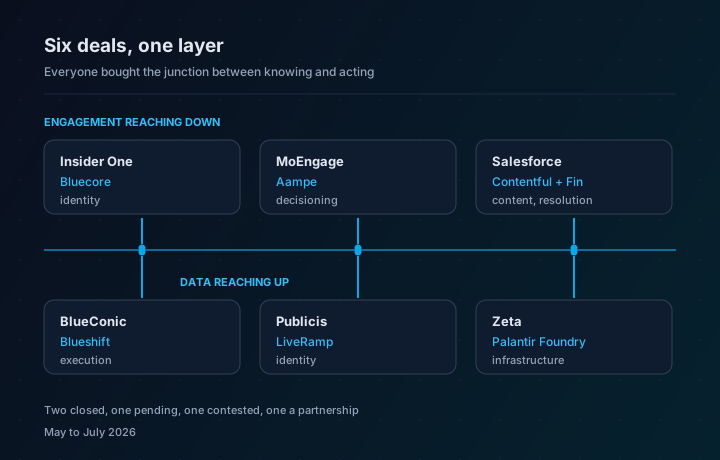
Read together those are not six separate stories. Every one of them is somebody acquiring either identity or execution in order to own both, and the direction of travel differs only in which end the buyer started from. Insider and MoEngage are engagement platforms reaching down toward data. BlueConic is a data platform reaching up toward execution. Publicis and Hightouch are fighting over the identity substrate itself. Salesforce is buying the content and resolution layers an agent needs to finish a job rather than propose one. Zeta made the same argument through partnership rather than purchase, announcing on 23 June that its Data Cloud would be rearchitected on Palantir Foundry, a deal it expects to generate more than 100 million dollars over several years.
The timing of the Salesforce transactions matters for how the next issue should treat them. Contentful is expected to close in Salesforce’s third fiscal quarter of 2027, roughly August to October 2026, and Fin in the fourth, which means both could plausibly be closed and partially documented before the next window ends.
Braze took the internal-build route with the position to support it, reporting 211 million dollars of revenue for the quarter ended 30 April, up 30.2 percent year over year, with dollar-based net retention around 110 percent and record free cash flow of 27 million, and raising full-year fiscal 2027 guidance to between 895 and 899 million dollars from the 884 to 889 million it had guided in March. Klaviyo reported first-quarter revenue of 358 million dollars, up 28 percent, posted its first positive GAAP operating margin since going public, authorised a 500 million dollar share repurchase and raised full-year guidance to between 1.514 and 1.522 billion dollars. That last figure implies about 23 percent growth against 28 percent delivered, and the guided second quarter of 359 to 363 million implies 23 to 24 percent, so the company is planning for deceleration while spending heavily on agents. Second-quarter results were released after this window closed and appear in the next issue rather than being inferred here. Bloomreach’s scale signal was product rather than financial, with Loomi Marketing Agent reaching general availability on 2 June, the Databricks relationship deepening on 16 June, and its conversational agent gaining third-party actions and a self-service insight loop on 24 June.
One structural move ran the other way and deserves recording because a category narrative that only counts acquisitions will always read as a growth story. Intuit announced cuts of roughly 3,000 roles and named Mailchimp explicitly as an area of reduced investment. Not every incumbent in this market is buying a layer.
What the weekly record missed
The MarTech Watch begins at week 20, so it cannot be the evidence base for the baseline issue, and rebuilding the vendor record for this window against primary sources was partly an audit of my own weekly process.
The first thing that audit found is that the Watch caught more than I expected. Bloomreach’s Loomi Marketing Agent reaching general availability on 2 June, its conversational-agent expansion on 24 June, Klaviyo’s Social Marketing launch, Composer entering public beta, Braze’s remote MCP server, Adobe’s loyalty release and the Aampe and Bluecore transactions were all recorded, most of them in the week they happened. The weekly scan works on what it is pointed at.
What it missed clusters into one shape, which is more useful than a list. Every gap is an event where one of the eight was a participant in somebody else’s announcement rather than the author of its own. Bloomreach announced itself a Databricks CustomerLake launch partner on 16 June and Braze shipped its bidirectional Databricks integration on 17 June, neither of which produced a platform row, because both were framed as partner news rather than as product releases. The largest omission is not about the eight at all: Publicis agreed on 17 May to acquire LiveRamp for roughly 2.17 billion dollars, which moves identity infrastructure that a great many of these platforms depend on inside an agency holding company, and it never appeared in the weekly record. Insider One’s Zero Copy Segmentation, launched at Snowflake Summit on 2 June, sat in later editions as a newsroom link without ever receiving a scored row.
The pattern is that the weekly monitoring is organised by vendor and fed mainly by changelogs, so it sees a vendor best when the vendor is talking about itself. Announcements made at somebody else’s conference, partner listings inside another company’s launch, and infrastructure transactions one layer below the eight all fall through. The process change is therefore not simply a newsroom sweep: it is a monthly pass over the platforms these eight depend on, meaning the warehouses, the identity networks and the protocol layers, because that is where the events that move all eight at once are now originating. This section stays in every issue, because a source process that claims to be complete is one nobody can check.
Watchlist
HubSpot, Optimove, Tealium, Zeta and Optimizely remain outside the map on the same terms as the baseline. Nothing this window moved any of them across the boundary, and Optimove stays the closest candidate.
What I am watching, and when it resolves
These are the first genuine predictions in the series, written before the outcome is visible. Each resolves as a yes or a no in the next issue, which covers 1 August to 30 November 2026. Some will be wrong, and the resolved score is there so you can decide how much weight the rest of the judgements deserve.
- Braze’s remote MCP server reaches general availability with documented tool-level write scopes and write logging by 30 November 2026.
- Adobe Journey Optimizer’s MCP surface gains at least one documented write scope by 30 November 2026, or Adobe states publicly that it will remain read-only.
- MoEngage publishes a documented conflict model describing what happens when an Aampe per-customer agent and a marketer-authored Flow disagree, by 30 November 2026.
- Insider One publishes a dated, granular product changelog covering at least three months of releases by 30 November 2026.
- Adobe Journey Optimizer Loyalty Challenges reaches limited or general availability by 30 November 2026.
- Klaviyo Composer reaches general availability by 30 November 2026.
- At least one of Contentful or Fin closes and Salesforce ships a named, documented integration surface into a marketing product by 30 November 2026.
The category question is simpler than any of the seven. After a window that produced more agent surfaces than any before it, does the next one deepen permissions and evidence, or announce more agents?
The verdict
The window did not produce a converged architecture. It produced a shared problem and several competing answers, which is a more useful thing to watch.
The problem is that an engagement platform cannot act autonomously from a thin profile and a folder of disconnected content. It needs current identity, governed data, structured content, a decisioning process, customer surfaces and the authority to use them. Insider, MoEngage and Salesforce bought the pieces they were missing. Adobe, Braze, Bloomreach, Iterable and Klaviyo extended what their platforms could reach or control. Both routes arrive in the same place and differ mainly in how much integration risk each vendor has taken on to get there.
The more those lines moved, the more visible governance became. Read-only tools, PII exclusions, source footnotes, existing voucher pools, human approvals, consent mapping and message archives are small signs of one recognition, which is that autonomy without a legible constraint is not an enterprise capability. That is the real change since January. Agents stopped being an interface inside the platform and started becoming actors across its boundaries, and the boundary is where the architecture lives.
The next contest is not who announces the most autonomous platform. It is who can make an autonomous decision inspectable, bounded and current enough to trust.
Method and cadence
This issue closes the catch-up. The baseline reconstructed January to April and this one reconstructed May to July, both after their windows had closed, which is why the forward record starts here.
From now Movement Notes runs on four-month windows, three issues a year, published roughly two weeks after each window closes. The next covers 1 August to 30 November 2026 and appears in mid-December, followed by 1 December to 31 March in mid-April and 1 April to 31 July in mid-August. Four months is long enough for a map to hold something other than empty cells, and short enough that a Field Note is never more than one issue out of date.
Every issue opens by resolving the previous issue’s predictions, and corrections change both the prose and the relevant cell, so the record never rests on something that quietly disappeared. If a cell here is wrong, send the dated evidence and it will be corrected in public.
Sources
Adobe
- Adobe Journey Optimizer release notes
- Adobe Journey Optimizer Loyalty Challenges
- Adobe Experience Platform release notes
Bloomreach
- Bloomreach Engagement changelog
- Bloomreach company news, 2026
- Bloomreach conversational-agent expansion
Braze
Insider One
- Insider One acquisition of Bluecore
- Insider One Zero Copy Segmentation for Snowflake
- Insider One and Google partnership
Iterable
Klaviyo
- Klaviyo Composer and Customer Agent releases
- Klaviyo product updates
- Klaviyo first-quarter 2026 results
MoEngage
Salesforce
- Salesforce Summer ‘26 Marketing Cloud Next release notes
- Salesforce agreement to acquire Contentful
- Salesforce agreement to acquire Fin
The layer underneath
- Databricks launches CustomerLake, an agentic CDP in the lakehouse, private preview from 16 June 2026
- Bloomreach deepens its Databricks partnership through CustomerLake, 16 June 2026
- BlueConic acquires Blueshift as CDPs move from data to action, closed 17 June 2026
- Publicis to acquire LiveRamp, 17 May 2026
- Hightouch offers Publicis up to 1.2 billion dollars for key LiveRamp assets, 16 June 2026
- Palantir and Zeta Global announce a strategic partnership, 23 June 2026
Internal research