13 min read
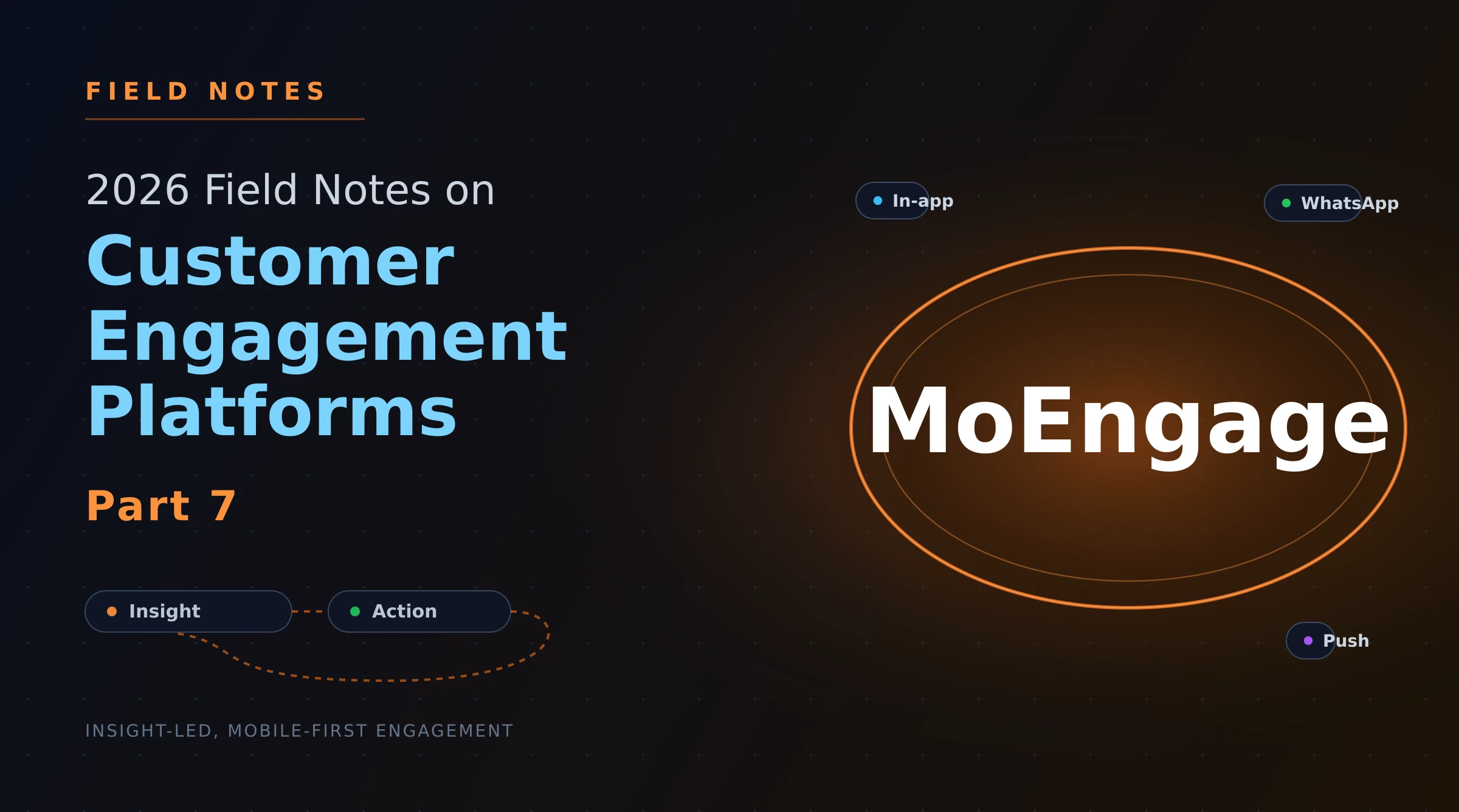
Why MoEngage is Part 7, and why insights-led is a distinct CEP physics
Most engagement platforms treat analytics as the surface you visit after the campaign has run. MoEngage inverts that, and the inversion is the whole platform. If Braze’s physics is event-driven and Insider One’s is user-centric growth, MoEngage’s physics is insights-led engagement.
That’s not a tagline I’m borrowing by accident: it’s the company’s own positioning, and it’s also the most accurate description of how the platform behaves in delivery. MoEngage starts from the assumption that the bottleneck isn’t sending, it’s understanding. So it puts analytics and predictive insight at the front of the workflow, then wires that understanding directly into orchestration across owned and messaging channels, which is why the person building the journey is meant to be the same person reading the behaviour that justifies it.
The same orientation explains where the platform keeps turning up. MoEngage appears in evaluations across EMEA, India, Southeast Asia and the Middle East more often than its size alone would predict, because those are the markets where the smartphone and the messaging channel were always the primary surface rather than a secondary one. It stays firmly in the independent CEP lane alongside Braze, Bloomreach, Insider One and Iterable.
In other words, MoEngage shows up when the enterprise brief is not “give me another journey builder,” but:
- understand customer behaviour at scale (analytics, cohorts, funnels, RFM)
- predict what’s about to happen (churn, conversion, channel affinity)
- act on it across app, web, push, email, SMS, WhatsApp, and on-site
- and do all of that fast, with a lean team
This is the seventh article in the series: one platform per chapter, same evaluation lens, no brochure tone.
A quick note on what I mean by “CEP” (and where MoEngage leans)
In my working definition, a CEP is a system of action that:
- listens to customer signals (events, attributes, behaviours)
- evaluates decision logic (rules, policies, models)
- orchestrates activation across channels
- measures outcomes and feeds learnings back into the loop
MoEngage fits this definition cleanly, but it leans harder than most peers on the “listen” and “measure” ends of the loop. The analytics layer isn’t a reporting afterthought bolted onto a campaign tool; it’s the surface marketers are meant to live in. That’s the practical meaning of “insights-led”: the platform is designed so the person building the journey is also the person reading the behaviour that justifies it.
Whether that’s a strength or a risk depends entirely on your governance, and there is more on that later.
MoEngage in one sentence
MoEngage is an insights-led, mobile-first customer engagement platform that couples native behavioural analytics with cross-channel orchestration, with standout strength in app-centric lifecycle programs and messaging-first markets (push, WhatsApp, SMS), now pushing aggressively into agentic AI through its Merlin AI suite.
Its physics: insight-led, app-first. Every platform in this series has a centre of gravity that predicts how it behaves under load, and I map all eight against each other in Part 9. MoEngage’s is insight-led and app-first: it lets a team analyse and act in the same seat, tuned for app retention and messaging reach.
A brief history: from mobile analytics to a global engagement platform
MoEngage was founded in 2014 by Raviteja Dodda (CEO) and Yashwanth Kumar, with an early conviction that mobile would reshape how consumer brands build relationships, particularly in markets where the smartphone, not the desktop, was the primary (often only) channel.
That origin matters, because platforms keep their original physics. MoEngage’s physics is mobile behaviour turned into engagement. It shows up as strengths in:
- SDK-based event capture and app lifecycle patterns
- mature push and in-app capabilities (the channels that matter most in app-first businesses)
- a predictive layer trained on high-volume behavioural data
- strong fit for banking, fintech, retail, media, e-commerce, and telco in emerging and high-growth markets
Today MoEngage is headquartered in San Francisco, with major engineering and operations centres in Bengaluru and a strong EMEA presence out of Berlin. It reports 1,350+ brands as customers, names like Flipkart, Domino’s, Nestlé, McAfee, and Deutsche Telekom, and frames its scale around the hundreds of millions of consumers reached through those programs.
If you come from a suite-heavy background, MoEngage feels engineered for teams that ship weekly, optimise continuously, and treat the mobile app as the centre of gravity rather than “one more channel.”
How MoEngage is positioned today
MoEngage positions itself as an insights-led customer engagement platform, bringing together:
- Customer analytics (behavioural analytics, cohorts, funnels, RFM, segmentation)
- a customer data / unified profile layer (CDP-like capabilities)
- cross-channel orchestration (Flows / journeys)
- native channel breadth (push, in-app, email, SMS, WhatsApp, on-site, cards)
- a predictive + generative + agentic AI stack (Sherpa and, increasingly, Merlin)
The consistent theme in MoEngage’s positioning is channel breadth in markets where messaging wins. WhatsApp, in particular, is often a decisive factor in EMEA, LATAM, India, and the Middle East, and it’s a channel that doesn’t always get first-class product love in older marketing clouds.
From a buyer’s perspective, MoEngage tends to resonate when an organisation wants:
- analytics and activation in one narrative (less stack fragmentation)
- faster execution than suite-led ecosystems
- strong coverage of app + messaging channels
- a price-to-value proposition that can work well for lean lifecycle teams, depending on scale and commercial terms
The MoEngage mental model (how I explain it internally)
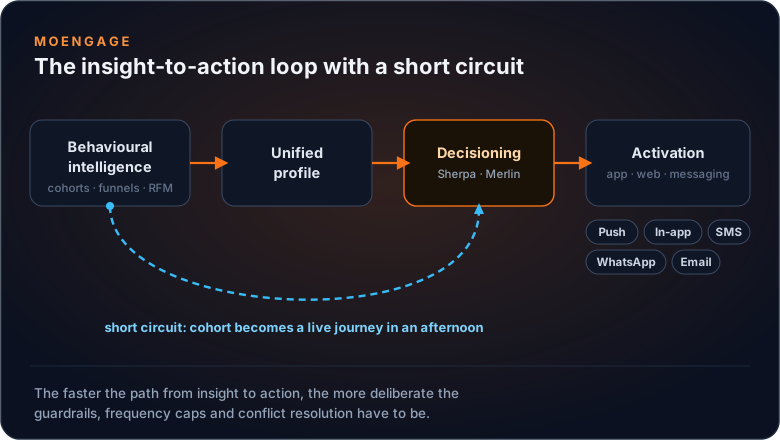
A useful way to think about MoEngage is as an insight-to-action loop with a short circuit:
- Behavioural intelligence (events, cohorts, funnels, predictive scores)
- Unified profile (identity + attributes + computed traits)
- Decisioning (segments, predictions, Sherpa optimisation, Merlin agents)
- Activation across push / in-app / email / SMS / WhatsApp / web
The “unfair advantage” of this model is the distance, or rather the lack of it, between noticing something and acting on it. When an analytics cohort can become a live segment and a journey trigger without leaving the platform, lifecycle teams move fast.
But that same short circuit is exactly where governance has to do its work. A platform that lets a marketer go from “interesting cohort” to “live always-on journey” in an afternoon is a productivity gift and a sprawl risk in the same gesture.
The faster the path from insight to action, the more deliberate your constraints have to be.
Sherpa, then Merlin: the AI direction
MoEngage’s AI story has two layers, and it is worth keeping them distinct.
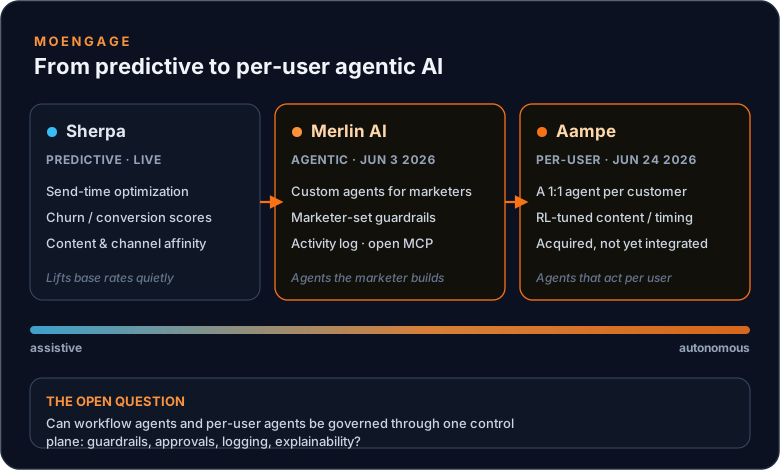
Sherpa is the predictive layer that has been in production for years. In practice it does the unglamorous, high-value things: send-time optimisation (per-user best time to engage), churn / conversion prediction (probability scores you can target proactively), and content / channel affinity (which message and which channel a given user is most likely to respond to). This is the kind of AI that quietly compounds: it improves the base rates of an existing program rather than promising a revolution.
Merlin AI is the newer, louder layer: generative and increasingly agentic. On June 3, 2026, MoEngage launched Merlin AI Custom Agents, and the design choices are the interesting part, not the demo. The pitch is explicitly built around marketer-defined guardrails, full visibility (an activity log of what data was used, which channels were touched, what content was deployed), and an open MCP architecture so external tools and agents (or your own) can operate on MoEngage data and tools within constraints. Alongside it sit assistive agents like a Flows assistant (objective in, multi-stage journey out), an in-app template generator, and campaign-insight agents.
Three weeks later, on June 24, 2026, MoEngage went a step further and acquired Aampe, the AI infrastructure company that provisions a dedicated, autonomous agent for every individual customer, with a reinforcement-learning engine that continuously optimises content, timing, channel, and frequency at the per-user level. Aampe’s founding team joins to lead MoEngage’s agentic decisioning work. The strategic intent is straightforward: MoEngage is trying to assemble both halves of the agentic story inside one platform, workflow agents for the marketer and decisioning agents that act per user. The acquisition establishes the direction, but the operational integration still needs to be proven in the product.
My practitioner read is consistent with the test I apply to every vendor in this series, which I set out in How I judge any agentic marketing claim: the label matters far less than whether the AI improves operational reality under governance, with explainability you can actually govern. MoEngage putting guardrails, logging, and MCP openness at the centre of the announcement is the right instinct. To be clear about my own vantage point: I have not yet run Merlin custom agents or the Aampe engine in a live production programme, so what follows is an architectural read of the design choices, not a delivery report. The first test is whether those guardrails hold when a federated, multi-brand team runs many agents at once. Post-Aampe, the second is whether per-user decisioning agents and marketer-built workflow agents can eventually be governed through one coherent control plane.
Recent funding and growth milestones (and what they suggest)
MoEngage is privately held, so there are no quarterly earnings calls, but the 2025 signals are unusually loud.
- 2022: Series E of $77M, led by Goldman Sachs Asset Management and B Capital.
- November 2025: roughly $100M raised to open a Series F.
- December 2025: a further $180M follow-on, led by ChrysCapital and Dragon Funds, brought the full Series F to $280M. A substantial part of the later round was secondary, so not all of it represented new operating capital. Reporting around the transaction put the valuation well over $900M, with the company tracking toward ~$100M in annualized recurring revenue and stating that it expected to turn EBITDA positive.
What I take from this (in CEP terms):
- MoEngage has crossed the scale where enterprise buyers can reasonably expect stability, security investment, and ecosystem maturity.
- Raising twice in six weeks signals strong investor conviction, while the meaningful secondary component also shows that part of the transaction was designed to provide liquidity rather than fund operations.
- The stated use of capital, Merlin AI and AI agents plus the possibility of strategic acquisitions, is consistent with where the whole category is heading: from automation to decisioning. The Aampe acquisition six months later delivered exactly that.
As always with private vendors and selective disclosure, I tell buyers to weight customer references and implementation track record more heavily than any single headline metric.
As of July 2026, the Series F and the Aampe acquisition remain the latest disclosed milestones for a company that, as a private business, discloses selectively.
Analyst signals (read them carefully)
MoEngage shows up in the analyst conversation, but it is worth being precise about which recognition, because the series tries not to inflate badges.
- The most recent, and most substantive, signal is analyst-assessed vision: MoEngage was named a Visionary in the 2026 Gartner® Magic Quadrant™ for Personalization Engines (published February 3, 2026). That is a meaningful step up from a pure customer-satisfaction badge, because it reflects Gartner’s read on completeness of vision, not only operator sentiment.
- On the customer-satisfaction side the record is unusually strong. MoEngage was the only vendor named a Customers’ Choice in the Gartner Peer Insights “Voice of the Customer” for Email Marketing, with the highest “Willingness to Recommend” score in the report, 97%, and it was also named a Customers’ Choice in the Voice of the Customer for Multichannel Marketing Hubs (most recently in the 2026 report).
- In cross-channel evaluation it was a Strong Performer in The Forrester Wave™: Cross-Channel Marketing Hubs, Q4 2024, and it had earlier debuted as a Contender in The Forrester Wave™: Real-Time Interaction Management, Q1 2024. The detailed scoring is best validated against the licensed reports rather than the vendor summaries alone.
- For historical context, MoEngage first entered the Gartner picture as a Niche Player in the 2022 Magic Quadrant™ for Multichannel Marketing Hubs.
The pattern I read here is a vendor whose operator satisfaction has been consistently high for years, now paired with analyst-assessed vision starting to catch up, which is what the Personalization Engines Visionary placement represents. I still weight the “Voice of the Customer” signals heavily because they are hard to fake, but none of these badges is definitive proof on its own: review composition, participation thresholds, report scope (Personalization Engines and Email Marketing are adjacent to, not identical with, a full CEP), and vendor review-generation activity all matter. I would treat them as strong practitioner signals, then validate through reference calls and implementation evidence.
The “physics” of MoEngage: insight-led, app-first activation
If Braze’s physics is event-driven (reacting to streams), Bloomreach’s is customer + product intelligence, and Insider One’s is user-centric growth, MoEngage’s physics is insight-to-action activation.
The platform is engineered around the lifecycle / CRM marketer who is expected to analyse and act in the same seat. Its core logic assumes that the fastest way to lift a program is to make behaviour legible (cohorts, funnels, RFM, predictions) and then collapse the distance to activation. Where some platforms ask you to build the “brain” through elaborate event mapping before you get value, MoEngage tries to hand you a usable brain early, tuned for app retention, conversion, and messaging-channel reach.
Competitive set (how it shows up in real programs)
MoEngage’s competitive set depends on what the enterprise is actually trying to fix.
1) Independent CEP competition
When the buyer wants a high-velocity, app-centric engagement platform, MoEngage frequently lands in the same room as Braze, Insider One, CleverTap, Iterable, Netcore, and similar. The differentiation usually comes down to: depth of native analytics, messaging-channel breadth (WhatsApp especially), predictive maturity, and total cost for a lean team.
2) Suite-led ecosystems
In large enterprises standardising on Adobe or Salesforce, MoEngage has to justify why a specialized independent platform is worth it. Here the real conversation isn’t features, it’s speed-to-value, operating model, and where decisioning should live.
3) “Analytics + activation” overlap
Because MoEngage leans on native analytics, it sometimes gets compared (unfairly, in both directions) to product-analytics or CDP tools. The honest framing: MoEngage is strongest when analytics exists to drive engagement, not as a standalone BI surface.
Where MoEngage is strongest (my delivery-centric view)
If I had to summarise MoEngage’s most practical advantages in enterprise delivery:
- Insights-led workflow: native behavioural analytics that feed segmentation and journeys without a tool-switch.
- App + messaging channel depth: push, in-app, and WhatsApp coverage that fits emerging-market and EMEA realities.
- Predictive that earns its keep: Sherpa’s send-time, churn, and affinity models lift base rates quietly.
- Lean-team velocity: a strong fit when a small lifecycle team has to run a large, always-on program.
- Practitioner-validated: consistent “Voice of the Customer” recognition is a meaningful, hard-to-fake signal.
When MoEngage can struggle (or require a clearer design)
The trade-offs look familiar if you’ve delivered app-centric engagement at scale:
- If identity resolution is weak across app, web, and CRM, the unified profile frays and predictions get noisy.
- If the buyer expects the CEP to also be the enterprise data foundation (complex MDM, heavy identity governance as the primary mission), that’s not MoEngage’s centre of gravity.
- If governance can’t keep pace with the short insight-to-action path, you get journey sprawl and cross-journey conflicts.
- In deeply web/desktop-first B2B contexts, the mobile-first DNA is less of an advantage.
The questions I like to ask early in a MoEngage evaluation
To get past demo aesthetics and into architectural truth:
- What is the identity strategy, and how do we resolve profiles across app, web, and CRM?
- Who owns the event taxonomy, and how do we keep it stable as the app evolves?
- How does the platform enforce consent and policy consistently across push, email, SMS, and WhatsApp?
- How do we operationalize frequency caps and conflict resolution across journeys?
- How will we govern Merlin agents: guardrails, approvals, logging, and who can deploy them?
- How does per-user agentic decisioning (post-Aampe) interact with our journeys, and who arbitrates when they conflict?
- What is our experimentation model (A/B, holdouts, incrementality), and who owns it?
Watch-outs I put in writing
- If your identity and event semantics are weak, “insights-led” quietly becomes insights-misled.
- If governance can’t keep up with the short insight-to-action path, fast becomes chaotic.
- If you treat WhatsApp (and messaging generally) as “free reach,” you’ll learn about pressure strategy the expensive way, via opt-outs and complaints.
- If you adopt agents before the underlying program is stable, AI will accelerate inconsistency, not fix it.
What’s next
Part 8 turns to Klaviyo, where commerce-data gravity pulls an ESP toward B2C CRM.
Sources
MoEngage
- Insights-led Customer Engagement Platform. Positioning.
- Customer Insights and analytics
- Merlin AI
- Series E, $77M led by Goldman Sachs Asset Management and B Capital
- Additional $180M Series F and liquidity event
- MoEngage NEXT 2025, Autumn Edition, AI direction recap
Analyst recognition
- Visionary in the 2026 Gartner Magic Quadrant for Personalization Engines, Gartner published 3 February 2026.
- Niche Player debut in the 2022 Gartner MQ for Multichannel Marketing Hubs
- Only vendor named Customers’ Choice in Gartner Peer Insights Voice of the Customer for Email Marketing
- Customers’ Choice with the highest willingness to recommend, 97%, in the 2025 Gartner Peer Insights Voice of the Customer for Email Marketing
- Customers’ Choice in the Gartner Peer Insights Voice of the Customer for Multichannel Marketing Hubs 2026
- Strong Performer in The Forrester Wave: Cross-Channel Marketing Hubs, Q4 2024
- Contender debut in The Forrester Wave: Real-Time Interaction Management, Q1 2024
Press coverage
- PRNewswire, MoEngage launches Merlin AI Custom Agents, 3 June 2026. Full visibility, marketer-defined guardrails, open MCP architecture.
- PRNewswire, MoEngage acquires Aampe, 24 June 2026. One-to-one agentic decisioning.
- TechCrunch, Weeks after raising $100M, investors pump another $180M into MoEngage, 16 December 2025.