12 min read
Why Klaviyo is Part 8 (and why “commerce-data gravity” pulls it from ESP toward B2C CRM)
Every platform in this series has a gravity. Adobe’s is suite gravity. Salesforce’s is CRM gravity. Braze’s is event gravity. Klaviyo’s is something more specific and, in its core market, just as strong: commerce-data gravity.
Klaviyo grew up inside the ecommerce stack: close to the storefront, close to the order, close to the Shopify webhook. That proximity is the whole story. Where many CEPs have to be fed customer and transaction data through integrations, Klaviyo was born sitting on top of it. Purchase history, browse and cart behaviour, product interactions, review submissions, support tickets, email and SMS engagement: Klaviyo ingests the full spectrum and unifies it into a single profile by default, because for a DTC brand that data is the business.
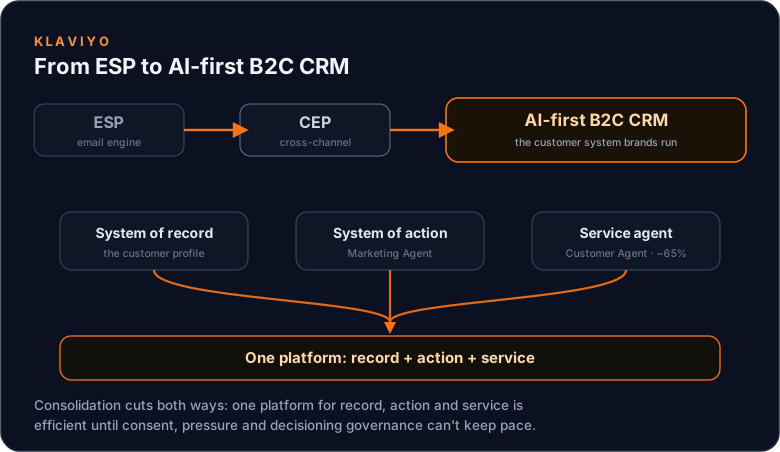
That’s why Klaviyo is one of the most interesting “category migration” stories in this series. It now positions itself not as an ESP, and not even simply as a CEP, but as an AI-first B2C CRM. The provocative question for an enterprise buyer is whether that’s a genuine architectural expansion or a marketing reframing, and, as usual, the answer depends on what you build around it.
This is the eighth article in the series: one platform per chapter, same evaluation lens, no brochure tone.
A quick note on what I mean by “CEP” (and where Klaviyo stretches it)
In my working definition, a CEP is a system of action that:
- listens to customer signals
- evaluates decision logic (rules, policies, models)
- orchestrates activation across channels
- measures outcomes and feeds learnings back into the loop
Klaviyo fits this definition through its orchestration of email, SMS, push, RCS, and WhatsApp, but it explicitly stretches the category in two directions at once. Downward into the data layer (a native CDP and unified profile that it now positions as a system of record), and upward into service and conversational AI (a Customer Agent that handles support, recommends, and converts). The ambition is to close the loop inside one platform rather than across a stack.
That’s a meaningful claim, and it’s the right lens for evaluating Klaviyo in 2026: not “is it a good email tool?”, because that is no longer the interesting question, but “do we want our B2C customer record and our activation and our service agent to live in the same place?”
Klaviyo in one sentence
Klaviyo is a commerce-native engagement platform that now positions itself as an AI-first B2C CRM, unifying customer data with cross-channel activation (email, SMS, push, RCS, WhatsApp) on top of a native CDP. It is highly established in DTC and ecommerce through deep Shopify gravity and is now moving up-market and toward agentic, autonomous execution.
Its physics: commerce-data proximity. Every platform in this series has a centre of gravity that predicts how it behaves under load, and I map all eight against each other in Part 9. Klaviyo’s is commerce-data proximity: it assumes the storefront is the primary source of behavioural and transactional truth.
A brief history: bootstrapped, Shopify-shaped, then public
Klaviyo was founded in 2013 by Andrew Bialecki (CEO) and Ed Hallen, both alumni of Applied Predictive Technologies. Two details from the origin story still explain the company today.
First, they bootstrapped for roughly three years before raising external capital, a discipline that shaped a product built around measurable, revenue-attributable outcomes rather than vanity features. Second, they tied their fortunes to the ecommerce ecosystem, becoming the default email-and-SMS engine for Shopify-era DTC brands. That bet compounded, and the deep, native commerce integration remains Klaviyo’s structural advantage.
Klaviyo went public on the NYSE on September 20, 2023 under the ticker KVYO, raising about $576M at roughly a $9.2B valuation, one of the few notable tech IPOs of that cycle, and a signal that commerce-led engagement had graduated from “SMB tool” to public-market scale.
Like every platform here, Klaviyo keeps its original physics: commerce behaviour turned into revenue-attributable messaging. It shows up as strengths in ecommerce data modelling, fast time-to-value for DTC teams, and a relentless focus on attributed revenue per send.
How Klaviyo is positioned today
Klaviyo’s current positioning is deliberately bigger than email. It frames itself as the autonomous B2C CRM, combining:
- a native customer data platform (unified profile, real-time signals) positioned as both system of record and system of action
- cross-channel activation: email, SMS, RCS, WhatsApp, mobile push
- analytics and reporting built around attributed revenue
- a growing service / conversational surface
- an agentic AI layer (K:AI) spanning marketing and customer service
The strategic intent is clear: move from “the channel tool brands add” to “the customer system brands run.” Whether a given enterprise should let it become that system is a separate, deliberate decision, but the platform is unambiguously aiming there.
The Klaviyo mental model (how I explain it internally)
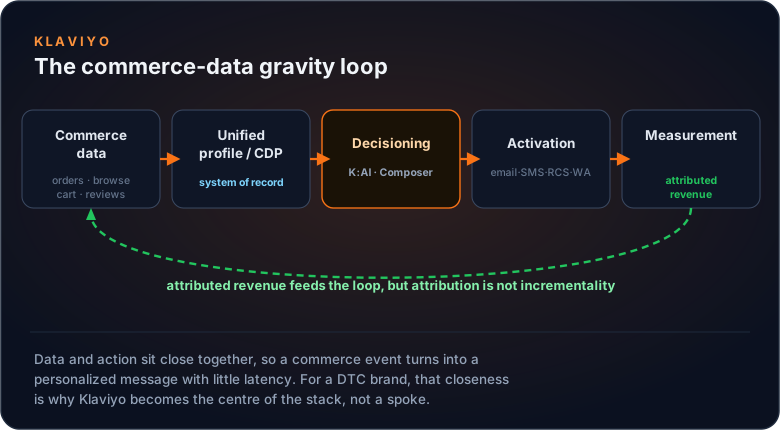
I frame Klaviyo as a short, tight commerce loop:
- Commerce + behavioural data (orders, browse, cart, products, reviews, support)
- Unified profile / CDP (which Klaviyo increasingly positions as the B2C customer system of record)
- Decisioning (segments, predictive metrics, K:AI agents, Composer)
- Activation across email / SMS / push / RCS / WhatsApp
- Measurement in attributed revenue, fed back into the loop
The “unfair advantage” is the same one Bloomreach enjoys from a different angle: the data and the action live close together, so there’s very little latency or translation loss between a commerce event and a personalised message. For a DTC brand, that closeness is why Klaviyo so often becomes the centre of the stack rather than a spoke.
The risk is the mirror image of the advantage. When the platform is the record and the action and increasingly the service agent, your governance of consent, pressure, and decisioning has to be just as consolidated, or the consolidation works against you.
K:AI, Marketing Agent, Customer Agent: the agentic turn
Klaviyo’s AI direction crystallized at its K:BOS event on September 25, 2025, with the launch of a Marketing Agent and the broad release of a Customer Agent, the moment it started describing itself as an AI-first B2C CRM.
The Marketing Agent is pitched as genuinely agentic, not assistive: point it at a URL and it can turn that into a marketing plan with ready-to-review campaigns, flows, and forms; write on-brand content; personalise each send; and keep optimising, while you set the guardrails and approval steps. The Customer Agent handles service: Klaviyo reports that it can resolve roughly 65% of questions autonomously and, because it sits on the full customer profile, recommend and convert rather than just deflect tickets. Alongside these sits Composer, an agentic experience that generates and recommends full campaigns and flows from a single prompt. In March 2026, Klaviyo expanded these agents further under an explicit “autonomous B2C CRM” narrative.
My practitioner read doesn’t change for Klaviyo, and it is the same test I apply everywhere, set out in How I judge any agentic marketing claim: the agentic framing is only as good as the guardrails, approvals, and explainability around it. I should be explicit that I have not operated K:AI’s Marketing Agent or Customer Agent in production myself, so I am assessing the design and the claims here, not reporting delivered results. The encouraging part is that Klaviyo’s pitch foregrounds marketer-set guardrails and approval processes; the part to test in delivery is whether those controls hold up for a brand running high volume across multiple regions and consent regimes, and whether “resolves 65% autonomously” holds up against your support taxonomy, not a reference dataset.
Recent financial context (why it matters for CEP decisions)
Unlike the privately held vendors in this series, Klaviyo is public, which gives us unusually clean signal.
For full-year 2025 (results reported February 2026):
- Revenue: $1.20B (+32% YoY), with Q4 revenue of $350.2M (+30% YoY)
- Total customers: 193,000+
- Net Revenue Retention: 110%
- Profitability inflection: Q4 GAAP net income of $7.0M, full-year non-GAAP operating income of $169.2M (a 13.7% margin), and free cash flow of $87M (+61% YoY)
- The >$50k ARR cohort kept outgrowing the overall customer base through the year, the clearest up-market tell
For 2026, Klaviyo guided revenue to $1.501–1.509B (implying ~21.5–22.5% growth) with non-GAAP operating income of $218–224M.
For a CEP buyer, I read these less as “finance trivia” and more as three practical signals:
- Klaviyo is crossing into mid-market and enterprise (the >$50k ARR cohort growing faster than the customer base is the tell).
- International expansion remains a real part of the story, which matters if you operate in EMEA: Klaviyo’s international business has continued to grow faster than its overall base, and that should create stronger incentives to deepen local channel, service, and compliance support, although buyers still need to validate those capabilities market by market.
- The company has the scale and investment capacity to fund the agentic roadmap it is betting on.
It’s also worth being honest about the other side: NRR at 110% is healthy but not euphoric, and a 2026 growth target in the low 20s signals a company managing the transition from hyper-growth DTC into a broader, more competitive B2C CRM arena. That transition is exactly where the enterprise-fit questions get sharper.
Update, as of July 2026: Klaviyo has since reported first-quarter 2026 results (quarter ended March 31, 2026): revenue of $358.0M, up 28% year over year, net revenue retention of 110%, and a record 16% non-GAAP operating margin, and it raised full-year 2026 guidance to $1.514B to $1.522B. The signal I read above holds: the up-market and international transition is continuing, and the profitability inflection is now clearer.
Analyst and ecosystem signals
Klaviyo’s analyst recognition skews, appropriately, toward its core constituency. It was named a Leader in the 2025 IDC MarketScape for AI-Enabled Marketing Platforms for Small Businesses, a real endorsement that also tells you something about where its centre of gravity has historically been.
In early 2026 it made its first-ever appearance in a Forrester Wave, landing as a Strong Performer in The Forrester Wave™: Email Marketing Service Providers, Q1 2026. It did not reach the Leaders’ circle, where Forrester placed Cordial and Zeta, but among the twelve vendors evaluated it earned the highest customer-satisfaction score, which fits the profile of a platform whose users tend to like it a great deal.
Read together, though, both recognitions are anchored in email and the small-to-mid-market, which is exactly the heritage Klaviyo is now trying to grow beyond. So the more telling signal for the “up-market, beyond email” story is not any single badge, but whether the >$50k ARR cohort and international growth keep translating into enterprise accounts rather than messaging volume.
The “physics” of Klaviyo: commerce-data proximity
If Braze’s physics is event-driven, Bloomreach’s is customer + product intelligence, Insider One’s is user-centric growth, and MoEngage’s is insight-led activation, Klaviyo’s physics is commerce-data proximity.
The platform assumes the storefront is the primary source of behavioural and transactional truth. That is enormously powerful in DTC and ecommerce, but it needs harder scrutiny when a brand’s reality is shaped by heavy offline activity, complex B2B2C relationships, or service-led interactions.
Competitive set (how it shows up in real programs)
Klaviyo’s competitive set depends on the brief.
1) DTC / ecommerce engagement
In its home turf, Klaviyo competes with ecommerce-focused engagement and email/SMS platforms, and with the native capabilities of commerce suites. Here it usually wins on depth of commerce integration, time-to-value, and attributed-revenue reporting.
2) Independent CEP / B2C engagement
As it moves up-market, Klaviyo increasingly meets Braze, Bloomreach, Iterable, Insider One, and MoEngage in the same room. The differentiators become channel orchestration depth, multi-brand governance, identity beyond commerce, and enterprise operating-model fit, areas where the suite-adjacent and mobile-first players have longer track records.
3) Suite-led ecosystems
In enterprises standardising on Adobe or Salesforce, Klaviyo has to argue why a commerce-native specialist beats the orchestration layer of a suite the company already owns. The honest framing: Klaviyo wins when commerce is the business and speed is the priority; it has more to prove when the enterprise wants one governed control plane across marketing, sales, service, and commerce.
Where Klaviyo is strongest (my delivery-centric view)
- Commerce-native data: a unified profile fed by storefront reality with minimal integration tax.
- Time-to-value: DTC teams get to attributed revenue fast; the bootstrapped DNA still shows.
- Attributed-revenue discipline: measurement framed around money, not opens.
- Channel consolidation: email, SMS, push, RCS, WhatsApp in one place, increasingly with service.
- Agentic momentum: a genuine, funded bet on autonomous marketing and service execution.
When Klaviyo can struggle (or require a clearer design)
- When the business is not primarily storefront-transactional, the native commerce advantage thins and Klaviyo competes more on equal terms.
- Multi-brand, multi-region governance at enterprise scale is younger territory than for the suite-adjacent players; design it explicitly.
- Identity beyond commerce (offline, CRM, service, partner data) needs deliberate architecture; don’t assume the storefront profile is the whole customer.
- Letting Klaviyo be record + action + service agent simultaneously concentrates a lot of risk; consent, pressure, and decisioning governance must be just as consolidated.
The questions I like to ask early in a Klaviyo evaluation
- Is the business commerce-transactional enough that Klaviyo’s native data model is a genuine advantage, or are we forcing a fit?
- What is the identity strategy beyond the storefront: how do offline, CRM, and service data reconcile into the profile?
- How do we enforce consent, preferences, and frequency across email, SMS, RCS, and WhatsApp consistently?
- How will we govern K:AI agents: guardrails, approvals, logging, and the support taxonomy the Customer Agent actually has to handle?
- What is our measurement model beyond attributed-revenue dashboards: do we have holdouts and an incrementality mindset?
- If Klaviyo becomes our system of record, what’s our exit and interoperability posture?
Watch-outs I put in writing
- Attributed revenue is not incrementality. Klaviyo’s reporting is excellent at attribution; don’t let it substitute for holdouts and true lift.
- If you treat the storefront profile as the whole customer, you’ll under-serve everyone whose value isn’t expressed in transactions.
- Consolidation cuts both ways: one platform for record, action, and service is efficient until governance can’t keep pace with it.
- Agentic ≠ autopilot. “Resolves 65% autonomously” and “plans campaigns in minutes” are starting points to validate against your data and constraints, not guarantees.
What’s next
Part 9 steps back for an interim synthesis, eight platforms and one pattern, before the series continues.
Sources
Klaviyo
- AI Email Marketing and SMS, B2C CRM. Positioning.
- K:AI for workflow automation in marketing and service
- Klaviyo advances AI-first B2C CRM with Marketing Agent and Customer Agent, 25 September 2025.
- Introducing K:AI Marketing Agent
- Best Shopify integration for email marketing. Commerce gravity.
- Named a 2025 Leader in the IDC MarketScape for AI-Enabled Marketing Platforms for Small Businesses
- Named a Strong Performer in The Forrester Wave: Email Marketing Service Providers, Q1 2026. First participation; highest customer-satisfaction score.
Investor releases and SEC filings
- Klaviyo expands AI Agents to power the Autonomous B2C CRM, March 2026.
- Q3 2025 results, 32% revenue growth and raised full-year guidance, 5 November 2025.
- Strong Q1 2026 results and raised full-year outlook, May 2026.
- SEC Form 8-K, fiscal Q3 2025
- SEC Form 8-K, full-year and Q4 2025 results, reported February 2026.
- SEC Form S-1 registration statement. Founding, business history and IPO context.
Company history
- Summit Partners, Klaviyo: From Bootstrapped Beginnings to IPO