8 min read
Why an interim synthesis now (and why it isn’t a ranking)
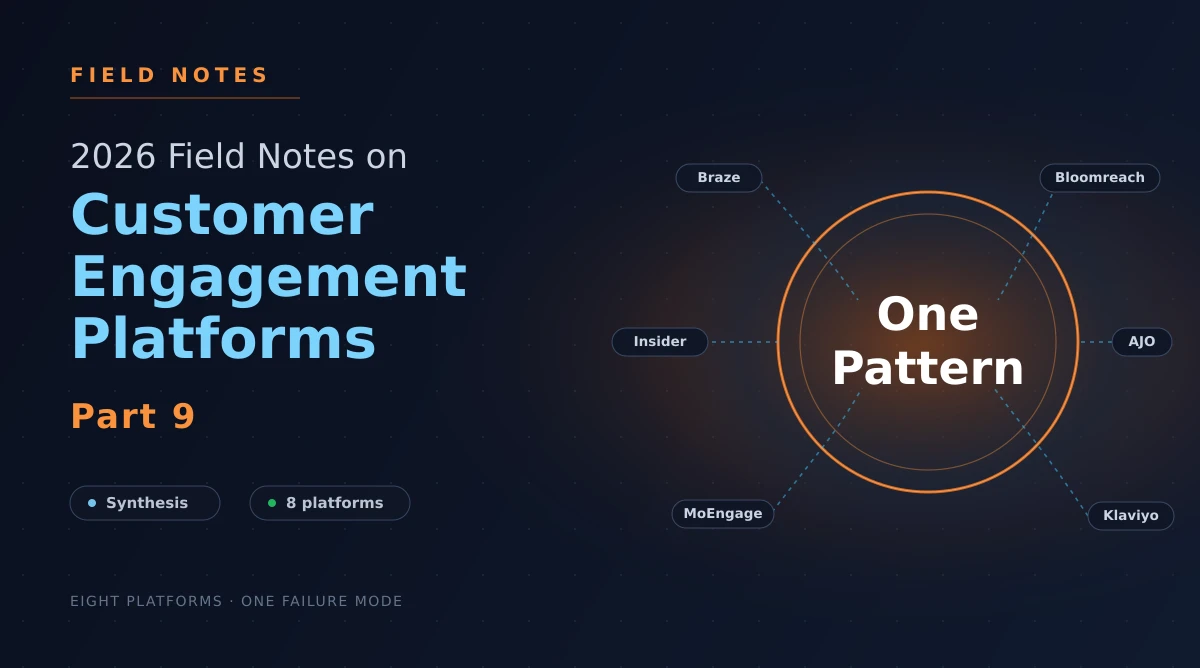
Eight platforms in, I have written eight separate assessments and no single place that reads across them. That is the gap this article closes. It is not the last word on the series, because more platforms are still coming, so treat it as an interim synthesis: a pause to name the pattern that has been forming underneath the individual write-ups.
The series opened, back in Part 0, with one question: what system are we actually building, and who owns it? The wager was that platforms do not succeed or fail on feature checklists but on the operating system you build around them, identity, consent, governance, semantics, and the discipline to run engagement as a repeatable practice. Eight deep assessments later, I can say something stronger than “the architecture matters.” I can say what the architecture keeps failing on, and it is remarkably consistent.
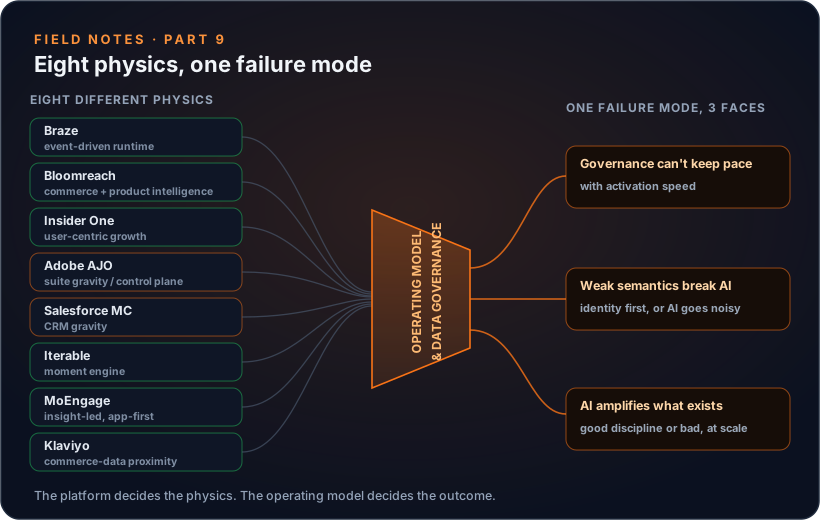
The eight platforms have eight genuinely different physics. Their failure modes converge on one.
That sentence is the whole article. Everything below either shows the divergence or explains the convergence.
Eight different physics (why comparison has to start here)
One of the through-lines of the series is that each platform has a centre of gravity, a “physics” that explains how it behaves under load and what it assumes about the world before you configure anything. These are not marketing taglines. They are the thing that decides whether a platform fits your reality or fights it.
| Part | Platform | Physics (its centre of gravity) |
|---|---|---|
| 1 | Braze | Event-driven: reacts to streams, engagement as a product runtime |
| 2 | Bloomreach | Customer + product intelligence: commerce data as the brain |
| 3 | Insider One | User-centric growth: the brain pre-installed, web-to-message |
| 4 | Adobe Journey Optimizer | Suite gravity: a control plane over the Adobe foundation |
| 5 | Salesforce Marketing Cloud | CRM gravity: operational customer context as the anchor |
| 6 | Iterable | Moment engine: signal-to-moment velocity for lifecycle teams |
| 7 | MoEngage | Insight-led, app-first: analyse and act in the same seat |
| 8 | Klaviyo | Commerce-data proximity: the storefront as the source of truth |
Read that column on its own and the practical lesson is already there. These platforms are not interchangeable, and no honest two-by-two can rank them, because they are optimising for different definitions of the customer. Braze assumes the customer is a stream of events. Klaviyo assumes the customer is a buyer whose truth lives in the storefront. Adobe assumes the customer is a governed profile inside a larger experience foundation. Choosing well means matching a platform’s physics to how your business actually generates and reads customer reality, which is a very different exercise from counting features.
That is the divergence. Now the part that surprised me by how cleanly it repeated.
One convergent failure mode (the pattern worth naming)
When I lined up the “watch-outs I put in writing” from all eight assessments, they were, underneath the platform-specific wording, almost the same three sentences. Different physics, identical way of breaking.
The first recurring failure is that governance cannot keep pace with activation speed. I wrote a version of this line for almost every platform without noticing I was repeating myself. Bloomreach: if you treat AI as a feature rather than a decision system, governance will lag behind activation speed. Insider One: if governance cannot keep up with activation speed, you will create cross-journey conflicts. MoEngage: if governance cannot keep pace with the short insight-to-action path, fast becomes chaotic. Klaviyo: consolidation cuts both ways, one platform for record, action and service is efficient until governance cannot keep pace with it. The faster a platform can turn a signal into a send, the more the binding constraint moves away from the tool and toward the operating model wrapped around it. This is why the strongest platforms in the series are often the ones that expose the governance gap fastest.
The second recurring failure is that data semantics and identity are the real foundation, and no AI layer compensates for a weak one. The series is full of the same warning in local dialect. Braze: invest early in data contracts, events, identities, semantics, because this is where most long-term value is won or lost. AJO: if the AEP foundations are weak, AJO behaves like a Ferrari stuck in city traffic. Insider One: if identity resolution is weak, AI-native becomes AI-noisy. MoEngage: if your identity and event semantics are weak, insights-led quietly becomes insights-misled. The wording changes, the failure does not. Meaning has to exist in the data before any activation or optimisation layer can do anything trustworthy with it.
The third recurring failure is that AI amplifies whatever is already there, good discipline or bad. This is the point where the whole category is moving at once, and it is also where the acquisition activity of the last eighteen months belongs. Braze bought OfferFit to move from branching logic to per-user decisioning. Adobe shipped the Journey Agent and the AEP Agent Orchestrator. Salesforce made Agentforce the corporate growth narrative, not a side feature. Iterable introduced Nova Agent as execution infrastructure. Bloomreach leaned into Loomi. Klaviyo launched a Marketing Agent and a Customer Agent and started calling itself an AI-first B2C CRM. MoEngage launched Merlin AI custom agents and then, three weeks later, acquired Aampe to get a per-user decisioning engine, assembling both halves of the agentic story inside one platform. Everyone is buying or building the same thing: a decisioning layer that acts, not just assists. My read did not change across any of these. The label, assistant or agent, matters less than whether the AI improves operational reality, fewer manual errors, better conflict detection, safer optimisation, and explainability you can actually govern. Point an agent at a stable, well-instrumented program and it compounds the returns. Point it at an unstable one and, as I put it for MoEngage, it accelerates inconsistency rather than fixing it. Or, in the Klaviyo formulation, agentic is not autopilot.
Two secondary patterns show up often enough to name. One is the confusion between system of record and system of action: the recurring temptation to let the CEP quietly become the enterprise data foundation, which Braze, MoEngage and Klaviyo all warn against in their own contexts. The other is the gap between attribution and incrementality: AJO warns that under-designed measurement turns optimisation into opinion, Salesforce flags measurement fragmentation across dashboards, and Klaviyo says it most sharply, attributed revenue is not incrementality. When the decisioning layer starts optimising, the measurement question stops being cosmetic and becomes the thing that tells you whether the optimisation is real.
Different physics, one failure mode: the operating model and the data semantics cannot keep pace with how fast the platform can act.
The market data says the same thing louder
This is not only a practitioner’s pattern-matching. The analyst numbers for 2026 describe exactly the same gap between activation speed and the governance to control it. Gartner predicts that 60% of brands will use agentic AI to deliver streamlined one-to-one interactions by 2028, which is the activation-speed half of the story arriving on schedule. In the same breath, Gartner also predicts that more than 40% of agentic AI projects will be cancelled by 2027 because of escalating costs, unclear business value, or inadequate risk controls, which is the governance half failing on schedule. Forrester puts a number on the downside, estimating that B2B companies will collectively lose more than ten billion dollars in 2026 to ungoverned use of generative AI.
The distance between “60% will adopt” and “40% will be cancelled” is not a contradiction. It is the series thesis expressed as a forecast. The platforms are ready to act faster than most operating models are ready to govern, and the organisations that close that gap first are the ones whose agentic bets will survive contact with production.
The positioning map, updated for all eight
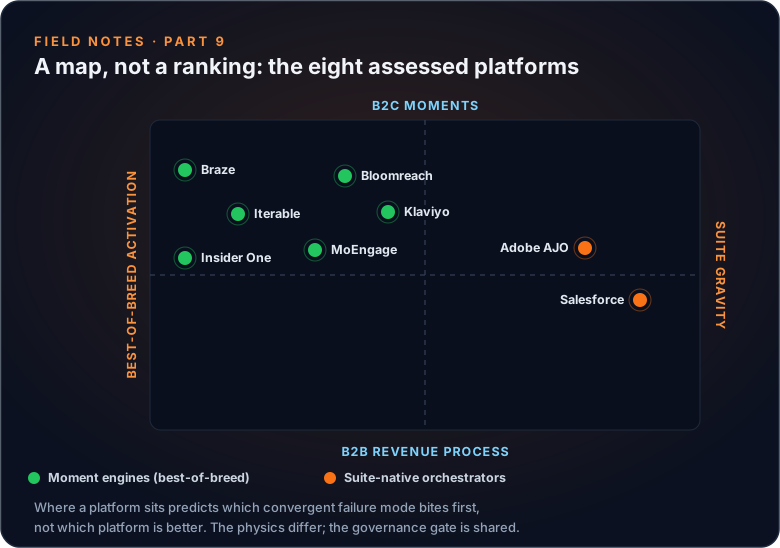
The two-by-two from Part 0 was drawn before MoEngage and Klaviyo had been assessed, so this is the version that now carries all eight. The point of the refreshed map is not to crown a winner. It is that where a platform sits predicts which of the convergent failure modes will bite you first. Sit on the high-velocity best-of-breed side and governance-versus-speed is your early risk. Sit on the suite-gravity side and the foundation-maturity tax, the Ferrari-in-traffic problem, is what you pay before you see value. Lean on commerce-data proximity and identity-beyond-the-storefront is the architecture you have to design deliberately.
The questions that recur in every evaluation
Because the failure modes converge, so do the questions worth asking on day one, whatever platform is in front of you. Across the eight assessments the same short list kept surfacing, and it travels well from vendor to vendor. What is the identity strategy, and how do we resolve profiles across app, web, CRM, and, where relevant, the storefront? How does the platform enforce consent and policy consistently across every channel? How do we operationalise frequency caps and conflict resolution across journeys, especially once decisioning agents start acting per user? What is the measurement model, and do we have holdouts and an incrementality mindset rather than attribution dashboards alone? And underneath all of them, which system is the system of record, which is the system of action, and have we decided that on purpose rather than by accident?
None of these are platform questions. They are operating-model questions, which is the point. The vendor you choose sets the physics. Your answers to these five decide the outcome.
What’s next
The series continues, and each new platform will get the same lens: history, position today, scale signals, competitors, architecture fit, operating-model implications, AI direction, and the watch-outs I put in writing. But the pattern is now on the table, and I expect the platforms still to come to confirm it rather than overturn it. If a future platform genuinely breaks this convergence, that will be the most interesting article in the series. Until then, the takeaway holds across all eight.
The platform decides the physics. The operating model decides the outcome. The architecture always wins.
Sources
Gartner
- Predicts 60% of Brands Will Use Agentic AI to Deliver Streamlined One-to-One Interactions by 2028, press release, 15 January 2026.
- Marketing Trends 2026. Data foundations, governance, agentic readiness.
- CMOs: Ensure Marketing Decisions Are Ready for Agentic AI
- Magic Quadrant for Multichannel Marketing Hubs, 2025. Category framing.
Forrester
- 2026 Predictions. Ungoverned generative AI loss estimate.
BCG
Related work on this site