4 min read
The label is noise
Every platform has AI now, and every platform has a word for it. Assistant, copilot, agent, agentic, autonomous. The vocabulary moves faster than the capability, and most of it is positioning rather than description. I stopped trying to keep up with the labels a while ago, because the label has almost no predictive power. What predicts whether an AI feature earns its place in a real program is not what it is called, but how it behaves under operating conditions: real data, real consent rules, real frequency pressure, multiple teams, and a governance function that will eventually ask what happened and why.
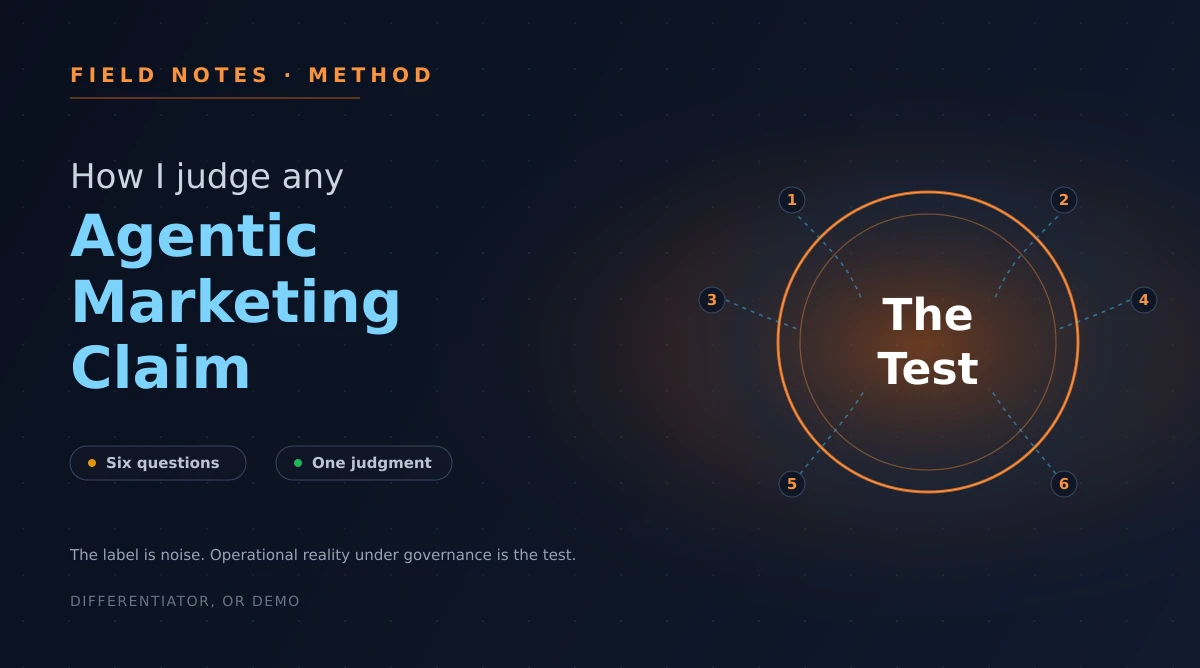
So I use one test, and I use the same test regardless of vendor, because the failure modes are the same regardless of vendor. I wrote it down here because I found myself repeating it in almost every platform assessment I publish, which is usually a sign that something wants to be a reference rather than a paragraph.
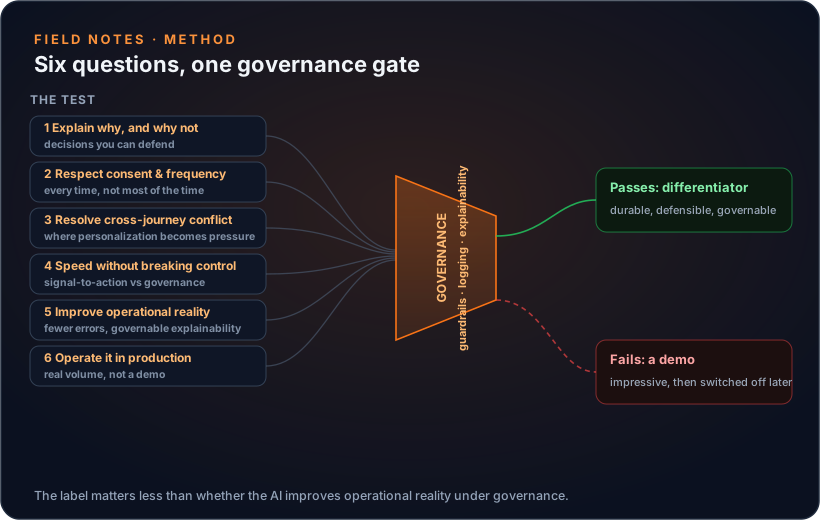
The label matters less than whether the AI improves operational reality under governance. Everything else is a demo.
The test, in six questions
These are the questions I put to any agentic claim, on any platform, before I care about the interface or the announcement.
- Can it explain why a given customer received something, and just as importantly, why not? Explainability is not a nice-to-have once a system starts making decisions on your behalf. It is the difference between an optimisation you can defend and one you have to apologize for.
- Does it respect consent, eligibility, and frequency constraints every time, not most of the time? An agent that is right 95% of the time is still wrong at a scale you will hear about.
- Can it detect and resolve conflict across journeys when several things want to fire at once? This is where “personalisation” quietly becomes pressure, and where most real programs break first.
- Can it improve speed without breaking governance? The whole promise of agentic marketing is compressing the distance from signal to action. The whole risk is compressing it faster than your controls can keep up.
- Does it improve operational reality: fewer manual errors, better conflict detection, safer optimisation, and explainability you can actually govern? If the honest answer is “it makes nicer content faster,” that is useful, but it is not decisioning, and it should not be priced or trusted as if it were.
- Can you operate it in production, at real volume across regions and consent regimes, or does it only hold up in a demo? A capability I have run in a live program and a capability I have seen in a keynote are two very different kinds of evidence, and I try never to confuse them.
If a system cannot answer these, the agentic layer stays a demo. If it can, it becomes a durable differentiator. And there is a rule I have watched play out more than once: if an AI feature cannot work within governance constraints, it gets switched off sooner or later, no matter how impressive it looked when it was bought.
Why these questions, and not a feature list
Because AI amplifies what is already there. Point an agent at a stable, well-instrumented program with clean identity and honest event semantics, and it compounds the returns. Point it at an unstable one, and it accelerates the inconsistency instead of fixing it. The model does not repair a weak foundation, it scales whatever the foundation already produces, good discipline or bad.
That is why the questions are about governance, semantics, and explainability rather than about capabilities. The binding constraint in agentic marketing is almost never what the AI can do. It is whether your operating model can keep pace with how fast the AI is now able to act. The gap between those two, adoption racing ahead of control, is the single most reliable predictor of whether an agentic bet survives contact with production. The market data says the same thing: analysts expect the majority of brands to adopt agentic AI for one-to-one interactions within a couple of years, and they expect a large share of agentic projects to be cancelled in roughly the same window over cost, unclear value, and inadequate risk controls. Both forecasts are true at once, and the distance between them is exactly the governance gap these questions are trying to expose.
How to use it in an evaluation
Put the six questions in front of the vendor directly, and treat the quality of the answers as data. Vendors who work with serious enterprise programs will recognise them and answer specifically. Vendors who do not will reach for the demo. Ask for production evidence rather than staged examples, ask how the system behaves with holdouts and an incrementality mindset rather than attribution dashboards alone, and ask who owns the guardrails, the approvals, and the audit log once the agent is live. In an RFP, these belong in the same section as security and data governance, not in the innovation appendix, because that is where they will actually be tested.
The series behind this test
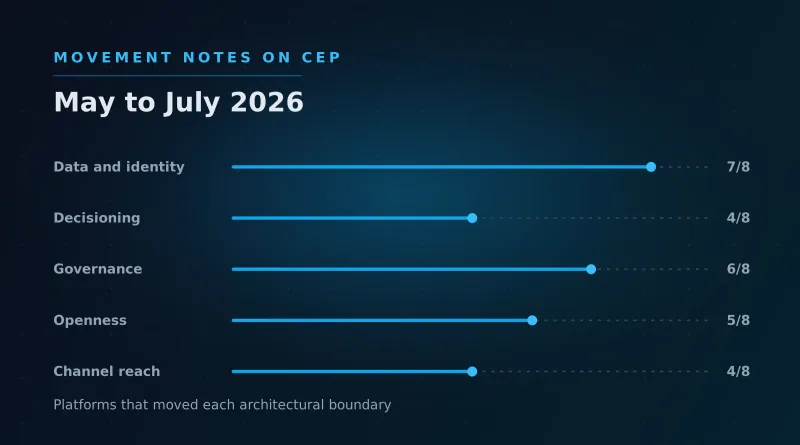
This is the lens I bring to every platform in my Field Notes on CEP series, and the reason the individual assessments end up converging: the platforms differ enormously in their physics, but they fail in the same handful of ways, and this test is how I catch it early. I set out that convergence in full in Part 9. Keep this page as the short version: six questions, one judgment. The platform decides the physics. The operating model decides whether the AI is a differentiator or a liability.
Sources
Gartner
- Predicts 60% of Brands Will Use Agentic AI to Deliver Streamlined One-to-One Interactions by 2028, 15 January 2026.
- CMOs: Ensure Marketing Decisions Are Ready for Agentic AI
Forrester
- 2026 Predictions. Ungoverned generative AI loss estimate.
Related work on this site