11 min read
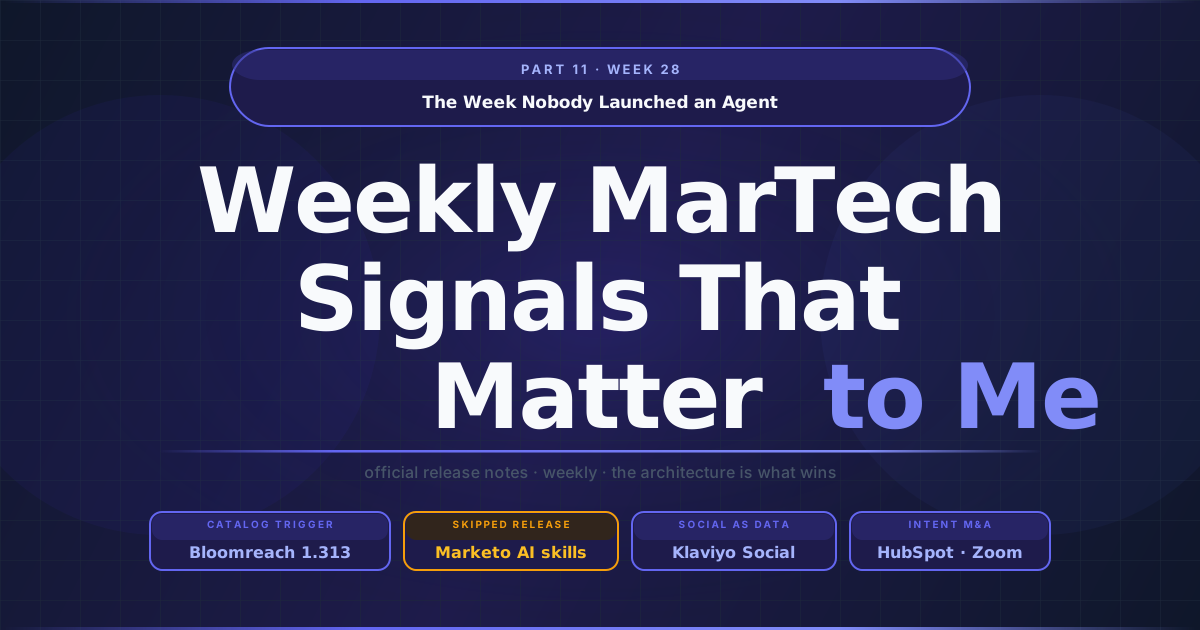
The Week Nobody Launched an Agent
Week 28 had a US holiday in the middle of it, the weekly roundup services skipped their editions, and for the first time in months not a single monitored vendor launched a new agent. If you measure a week by its headlines, this one barely happened. If you measure it by what changed in the architecture underneath, it was one of the more instructive weeks of the quarter, because with the agent noise switched off you could finally hear the other things moving: a catalog wired directly into journey entry, a channel map extending east, a release calendar quietly skipping a month, and two acquisitions that tell you where the next consolidation wave is pointed.
TL;DR
- Bloomreach made product-catalog changes a native journey-entry mechanism, removing a familiar integration junction while moving its logic and failure modes inside the platform.
- Adobe Marketo Engage skipped the expected June release and moved into a two-part July cycle led by its first packaged AI skills, including record-level diagnostics for explaining why a lead missed a milestone.
- Klaviyo turned social interactions and support conversations into profile data while exposing Customer Agent through public APIs. The agent is becoming a programmable platform surface rather than a self-contained feature.
- HubSpot and Zoom both moved to acquire person-level buyer intelligence, reinforcing the pattern of signal layers being pulled inside larger platforms rather than remaining neutral components.
Operational deadline: Salesforce materials cited in the digest place the first Marketing Cloud Next consent-mapping milestone for email on July 13, followed by SMS and WhatsApp on August 17. I could not independently confirm those exact dates in the public documentation available during this review, so teams mid-migration should validate the requirement in their Salesforce environment and with their implementation contacts before treating it as a universal deadline.
When the catalog becomes a journey trigger
Bloomreach’s 1.313 is the release I keep coming back to, and not for the reasons the release notes lead with. The headline items are channels: LINE is now live for customers in Japan, Taiwan, and Thailand, with rich formats and consent handled natively through the follow and webhook lifecycle, and WhatsApp gains carousel templates with up to ten scrollable cards per message. Both are real, and I will come back to LINE in a moment. The item that changes how I would draw an architecture diagram, though, is catalog triggers.
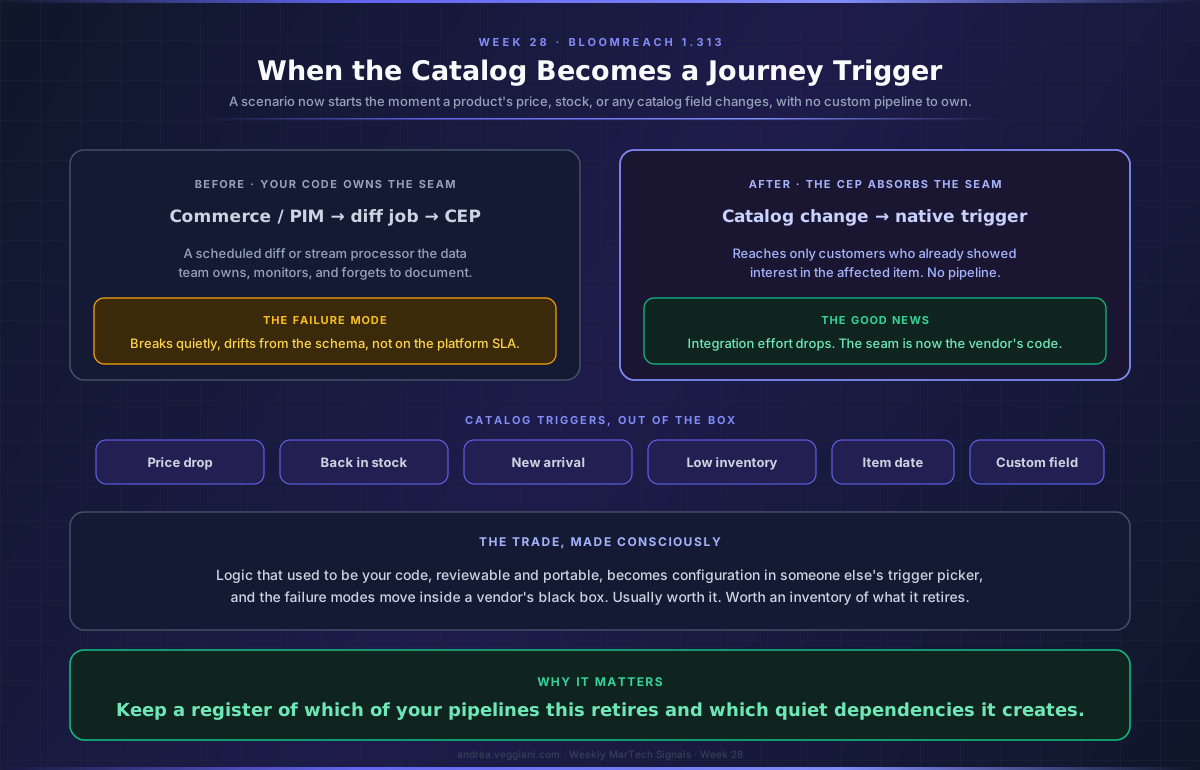
The capability sounds modest when you describe it: a scenario can now start the moment the product catalog changes, and it reaches only the customers who already showed interest in the affected item. Price drops by a threshold you define, an item comes back in stock, a new arrival matches a category someone browsed, inventory runs low, a date on the item approaches, or any custom field crosses a condition you set. Bloomreach’s own framing is telling, because it names the thing being replaced: no custom pipelines, no watchdog jobs.
Anyone who has built back-in-stock or price-drop programs at scale knows exactly which pipelines those are. Historically this pattern lives in the junction between the commerce or PIM system and the engagement platform, implemented as a scheduled diff job or a stream processor that somebody on the data team owns, monitors, and forgets to document. It breaks quietly, it drifts from the catalog schema, and it is almost never covered by the platform’s SLA because it is not the platform’s code. When the CEP absorbs that junction, the integration effort drops dramatically, which is the good news. The trade is that the failure modes move inside a vendor’s black box, and the logic that used to be your code, reviewable and portable, becomes configuration in someone else’s trigger picker. I think the trade is usually worth it. I also think you should make it consciously, with an inventory of which of your existing pipelines this retires and which quiet dependencies it creates.
The LINE launch deserves its own sentence, because it did not happen alone. The same week Bloomreach made LINE generally available, Adobe’s Journey Optimizer release page added a coming-soon entry for a substantially upgraded LINE authoring experience, with multiple message formats, grouped messages, and device previews. Two major CEPs advancing the same regional channel in the same week is a useful market signal. It suggests that APAC channel coverage is becoming a more visible part of the enterprise engagement roadmap. If your brand operates in Japan, Taiwan, or Thailand, the channel map your platform selection assumed twelve months ago is already out of date.
What a skipped release tells you about a platform
Last week I reported, carefully and without editorializing, that Marketo’s own release schedule showed a June 26 release date that had passed with no June release notes published. This week the question resolved itself in a way I did not have on my list of likely outcomes: there will be no June ‘26 release. The current release notes page now carries the title “Release Notes: July 2026 #1 of 2,” with standard-cycle features rolling out from July 10 and, implicitly, a second July release to come, presumably at the scheduled July 31 date. That second date is worth circling in red for a different reason: it is the same day the SOAP API reaches end of life and the access_token parameter stops working, two deprecations that have been standing in the announcements section since April. A release landing on the same day as two breaking API changes is the kind of calendar collision that integration teams should plan around now rather than discover in August.
The content of July #1 is Marketo’s first packaged set of AI skills, and one of them is more interesting than its modest open-beta framing suggests. Product knowledge is documentation Q&A inside the platform, useful but familiar. Investigate leads is different in kind: you ask why a specific person did not reach a milestone, an MQL threshold, a program qualification, a campaign, and the system explains in plain language what happened. That is diagnostic explainability at the level of an individual record, and it points at the most chronically underserved need in marketing automation operations, which has never been generating more content but understanding why the machine did what it did. If the skill works as described, it is a small step toward auditable automation, and I would like to see every platform copy it.
The same scan surfaced something more uncomfortable: Adobe Journey Optimizer B2B shipped a full 2026.5 release on May 22, with landing pages and forms graduating out of beta, next-best-path journey nodes, event-history filtering, and an updated Audience Agent. My weekly scans missed it for six weeks because the rendered release page buried the new section. The correction is recorded in this week’s digest with the true date, and the method now diffs the underlying source rather than trusting the page. I mention it here for the same reason I mention vendor gaps factually: a tracker that hides its own misses is not a tracker you should trust.
Substantively, the release matters too. With native landing pages and forms, AJO B2B can now support more of the inbound-capture layer itself, changing the long-run division of labour between AJO B2B and Marketo that Adobe B2B customers will eventually need to plan around.
Social engagement becomes a data channel, and the agent gets an API
Klaviyo gave me a small, satisfying moment of process vindication this week. Last week a secondary source claimed a July 7 general-availability date for Klaviyo Social Marketing, and with no primary source to confirm it I flagged the claim as unverified rather than reporting it. On July 7, exactly as the unverifiable source said, Klaviyo formally launched Social Marketing, with general availability confirmed as of June 30. Sometimes the rumor is simply early.
The launch itself is worth taking seriously as an architecture move rather than a feature. What Klaviyo has built is a pipe that turns Instagram comments, direct messages, mentions, and user-generated content into structured, consented first-party data: social interactions become profile properties, segment conditions, and flow triggers, and the content customers create becomes a reusable library. Social engagement has always been rich signal trapped in a rented platform; the interesting part is not the auto-replies but the fact that a CRM vendor now treats a social network the way it treats a website or a point-of-sale system, as an ingestion source for the unified profile. That is the same story as Bloomreach’s catalog triggers told from the demand side: another external system wired directly into the profile and the journey, another integration you no longer build yourself, another dependency you now govern instead of code.
The quieter Klaviyo items from late June complete the thought. Customer Agent gained public APIs to configure, monitor, and run it programmatically, profile context tools that ground its answers in order history and predictive analytics, and profile enrichment that writes what it learns in conversations back to the profile. Add Marketo’s packaged skills and Bloomreach giving its campaign agent plain-language send scheduling, and the shape of the week becomes clear: nobody launched an agent, but three vendors made their existing agents more programmable, more grounded, and more governed. After two quarters of demos, the agents are becoming infrastructure, with the interfaces, contracts, and failure modes that word implies.
Intent is the next layer being bought
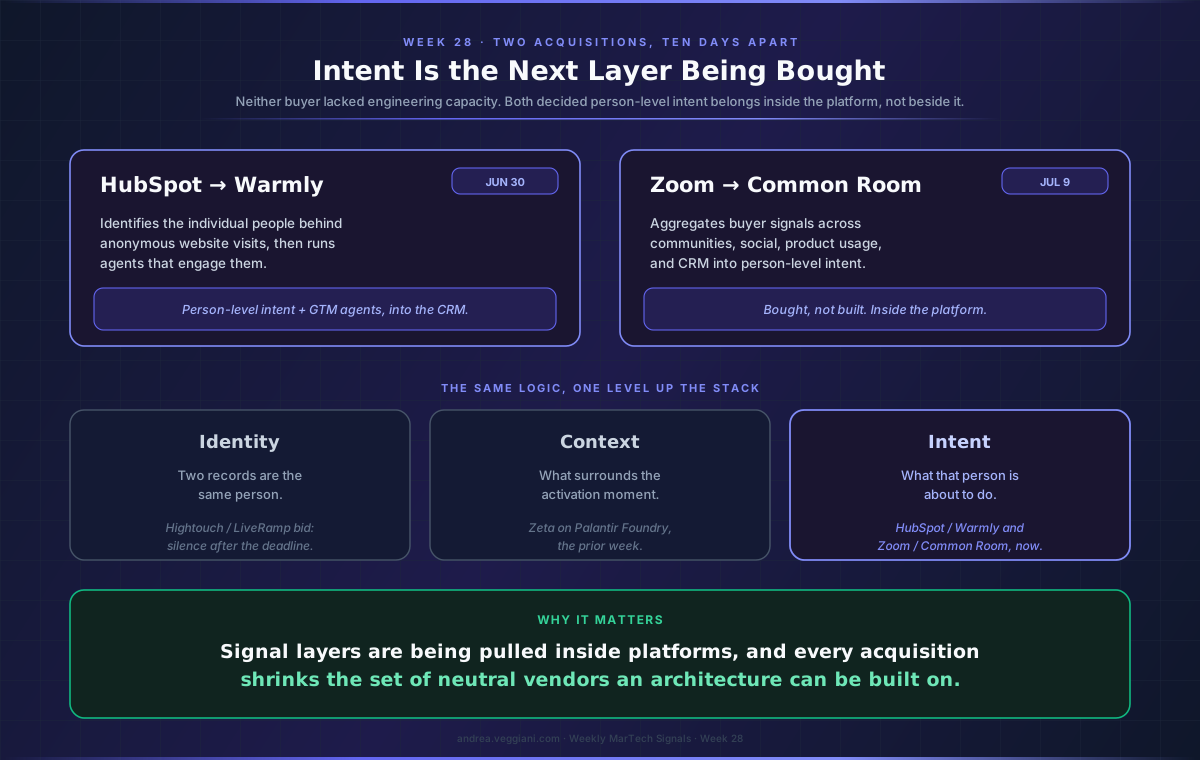
The two acquisition announcements that surfaced in this week’s scan look small next to the quarter’s headline deals, and that is exactly why they are worth reading together. HubSpot agreed to acquire Warmly, whose product combines person-level website intent with agents that engage and follow up with buyers. Zoom entered a definitive agreement to acquire Common Room, which unifies signals from CRM, product usage, marketing, engagement systems, and external buying activity into person-level buyer intelligence. Both buyers chose acquisition as the fastest route to mature person-level buyer intelligence rather than waiting to assemble the data, workflows, partnerships, and market presence organically. In both cases, the signal layer is being pulled inside the platform rather than left beside it.
This is the same consolidation logic that has been running through the identity layer all quarter, one level up the stack. Identity resolution tells you that two records are the same person; intent intelligence tells you what that person is about to do. Hightouch tried to buy the first with its bid for LiveRamp’s RampID assets, and on that front the week delivered only silence: the June 26 deadline Hightouch set for a Publicis response has passed with no publicly reported answer, acceptance, or withdrawal. The proposal may have stalled or moved into private discussion; publicly, the identity question remains unresolved. What is no longer open is the direction of travel. Signal layers, whether identity, context, or intent, are being pulled inside platforms, and every acquisition reduces the likelihood that those layers will remain independently available and neutral over time.
The boundary of the platform is moving
Put the week’s pieces side by side and they describe one movement from different angles. Bloomreach absorbed the catalog pipeline. Klaviyo absorbed the social pipeline. HubSpot and Zoom are absorbing the intent layer. Marketo is packaging operational intelligence as platform skills. In every case, something that used to live at the edge of the platform, in your code, your pipelines, your point-solution contracts, moved inside it.
For integration effort and speed to market, that movement is almost pure gain, and I will happily retire a watchdog job I no longer have to maintain. The cost is subtler and accrues later: every absorbed junction is logic you can no longer read, port, or independently monitor, and every acquired signal layer is one fewer neutral vendor when you next need to change platforms. The evaluation discipline that follows is not to resist the absorption but to document it: which pipelines the platform has replaced, which signals now arrive only through it, which logic can still be independently monitored, and what an exit would actually require while it is still cheap to know the answer.
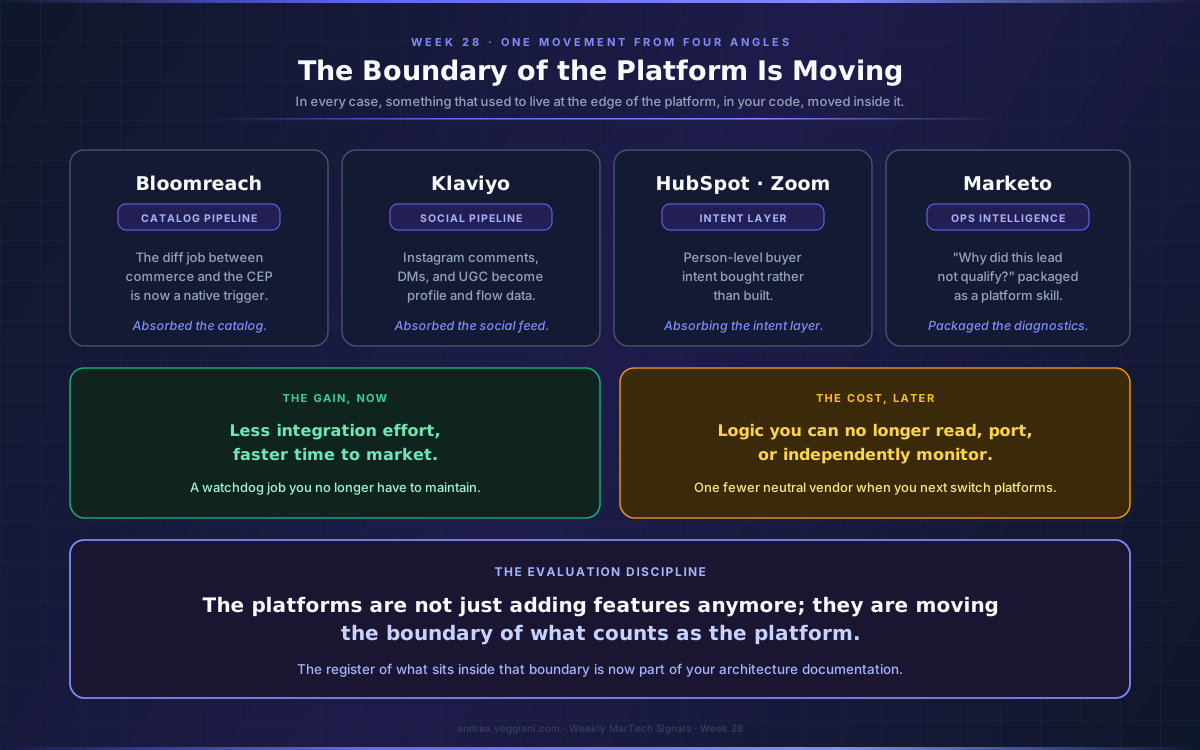
The platforms are not just adding features anymore; they are moving the boundary of what counts as the platform, and the register of what sits inside that boundary is now part of your architecture documentation.
Sources
Bloomreach 1.313
- Bloomreach Changelog 1.313. LINE channel, WhatsApp carousels, catalog triggers, Loomi send triggers, SDK updates; July 8.
Adobe: Marketo and AJO B2B
- Marketo Engage: Current Release Notes, July 2026 #1 of 2. Marketo AI skills, July 10 rollout, standing deprecations.
- Marketo Engage: Release Schedule. Planned June 26 and July 31 dates.
- AJO B2B Release Notes: 2026.5. Landing pages, forms, next-best-path nodes; deployed May 22, captured late.
- AJO Release Notes. Late-June additions and the coming-soon LINE authoring upgrade.
Klaviyo
- Klaviyo What’s New. Official dated feed for Social Marketing integrations, Customer Agent public APIs, profile context tools, and profile enrichment.
- StreetInsider: Klaviyo launches social media marketing product. Secondary confirmation of the July 7 launch and June 30 general availability.
- Mi3: Klaviyo unveils social marketing tool. Additional launch coverage, July 8.
Intent and identity
- Warmly: Warmly is joining HubSpot. Acquisition announcement, June 30.
- MarTech.org: HubSpot’s Warmly deal points to the next generation of CRM. Analysis, July 1.
- Zoom Newsroom: Zoom to Acquire Common Room. Definitive agreement announced July 2; description of Common Room’s person-level buyer intelligence.
- MarTech.org: latest AI-powered martech news and releases. Weekly coverage that surfaced the Zoom/Common Room item in the July 9 scan.
- Axios: Hightouch offers Publicis up to $1.2B for LiveRamp assets. Original bid and June 26 deadline; no public update since.
Governance
- Salesforce: Summer ‘26 product release announcement. General Summer ‘26 release context. The specific July 13 and August 17 consent-mapping dates should be confirmed against customer-specific Salesforce guidance before publication.
The digest behind each weekly article is produced through a structured AI-assisted scan of official release notes and product update sources. I review the output, verify the relevant signals and write the architectural interpretation.
This article draws from the Martech Weekly Digest scans run on July 9, 2026, covering release notes and product updates across several CEP platforms and vendors.
If you find errors or gaps in coverage, I want to know. The process improves when the output is challenged.