
Concept
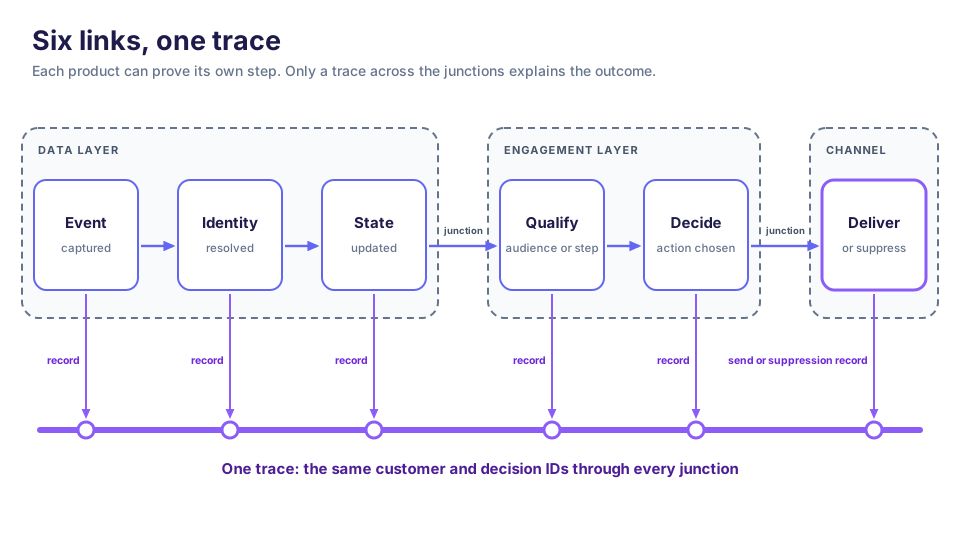
Traceability is the ability to answer one question for one customer: why did this message reach her, or why did it not? The answer is a chain of six links. An event was captured, the identity behind it was resolved, the profile or state changed, the customer qualified for an audience or a journey step, a decision selected an action, and a channel delivered it or a rule suppressed it. Each link usually belongs to a different component and often to a different product, and each keeps its own logs. Traceability is the responsibility of joining those records into one account of what happened, fast enough to be useful to the person asking.
Why it matters
Sooner or later someone asks. A customer complains about a discount that arrived the day after a full-price purchase, a data protection officer asks why a person who withdrew consent was still contacted, or a marketer wants to know why a journey that tested perfectly converts nobody. Without a trace, each of those becomes an investigation across four teams, each of whom can prove that their own component behaved correctly. Suppressions are the hard half of the problem, because a message that was never sent leaves no delivery record, and the question “why did she not receive the offer” has to be answered from decisions that are rarely logged at all. Automation raises the bar further. When an agent chooses the action instead of a rule someone wrote, the only honest way to judge the claim that it chose well is to see what it saw and what it decided, and Agents in Production, Part 2 shows how quietly agentic systems fail when nothing checks what they actually did.
A simple example
A customer buys a sofa in store on Monday afternoon and on Tuesday morning receives “We miss you: 20% off your next order”. The trace shows that the purchase reached the platform through the point-of-sale load at two on Tuesday morning, but under the loyalty number, which had not yet been linked to her email identity. Her profile therefore still showed no purchase in fourteen months, the win-back audience evaluated at seven and included her, and the email went at eight. With a trace this takes ten minutes to read and points at one fix, the identity link for loyalty numbers. Without it, the email team shows a correct send, the data team shows a correct load and the case closes as a timing issue that will happen again.
The architecture view
Each product can prove its own step. Only a trace that crosses the junctions can explain the outcome.
Placement follows how many junctions the chain crosses. In a suite or a CEP that carries its own data, most links sit inside one vendor and the question becomes whether its profile history and journey logs expose decisions and suppressions as well as sends. In a composable stack the chain crosses several systems, and Part 1 of the patterns lists the questions a failed trigger raises in that case: was the event captured, was the identity resolved, did the audience update, did the sync run. What makes those answerable is a shared identifier for the customer and the decision, carried through every junction, and an owner for the joined view.
The mistake I often see
The recurring error is treating traceability as engineering’s logging. Each team keeps excellent logs for its own component, the delivery platform reports opens and bounces, and nobody owns the view that connects them, so every investigation starts from zero. The related error is accepting aggregates as evidence. A dashboard can show that a journey sent forty thousand messages at a healthy rate and still cannot say why one particular customer was included, and it is the individual case that a complaint, an audit or a failing test actually needs. I would put the ability to trace one customer end to end, suppressions included, into the acceptance criteria of any implementation and test it before go-live.
Go deeper
Traceability depends on everything upstream being inspectable, so read what identity resolution is, what a customer attribute is and event, state and transition alongside this node, and who can change the logic for the governance half of the same theme. The wider pattern, activation outrunning governance across eight platforms, is the thread of Field Notes on CEP, Part 9.