
Concept
A Customer Engagement Platform is the layer that orchestrates and delivers interactions across channels. It decides, given a profile it can read, which message goes out, in what order, through which channel, and it executes that across email, push, in-app, SMS and web. What it owns is orchestration and delivery. Resolving who the customer is across every source is a different responsibility, and one a platform does not discharge simply by belonging to this category. Whether the product you buy ends up carrying both is a separate question, and it is answered by your data rather than by the category name.
Why it matters
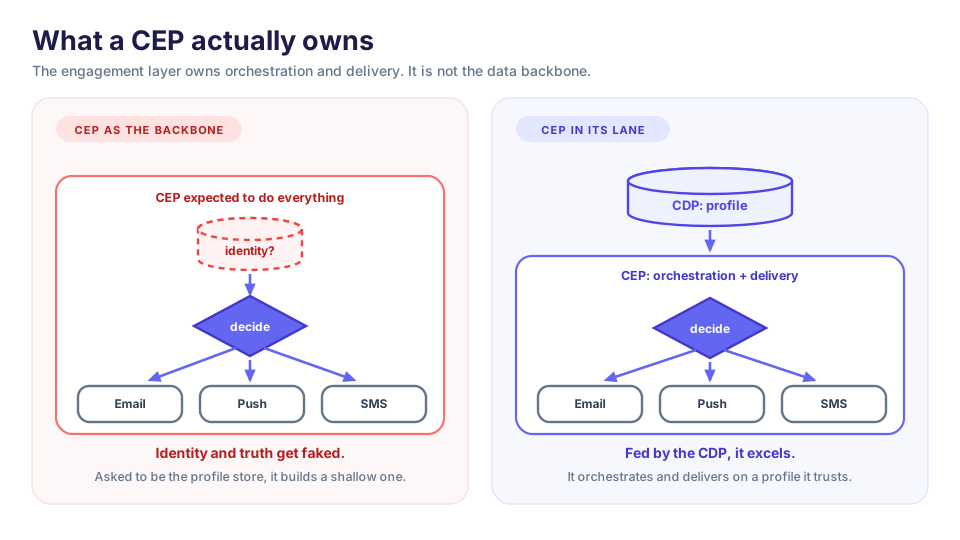
The category name won so completely that it now stands in for the whole modern stack, which is exactly why its boundary gets blurred. Because a CEP touches every channel and holds the journey canvas, teams assume it is also the system of record, and start pushing identity, consent and profile ownership into it. That overreach is where stacks quietly break. A CEP asked to resolve identities it only ever meets as they pass through its own channels builds a shallow, channel-shaped version of the customer, good enough to send against and wrong enough to contradict every other system. What decides the outcome is whether the platform can see the sources the profile needs. A business where marketing owns the customer data and people arrive through owned channels can hold that profile inside the engagement platform quite legitimately, while one with stores, a call centre and a loyalty scheme is asking it to resolve people it will never observe, and that is when the CDP responsibility has to live somewhere the engagement platform is not.
A simple example
A brand runs email, push and SMS through one engagement platform, and it works beautifully as long as it is deciding sequence and channel. Then someone asks it to also be the single source of customer truth. Now the CEP is trying to reconcile identities it only sees when they pass through a channel, so a customer who bought in store but never opened an email is thin or invisible inside it. The platform is excellent at the orchestration it owns and quietly poor at an identity it never sees. The fix is a profile that reaches the in-store purchase, and whether that profile is a separate product or a data layer inside this same platform is the second question, settled by how many other systems need to read it.
The architecture view
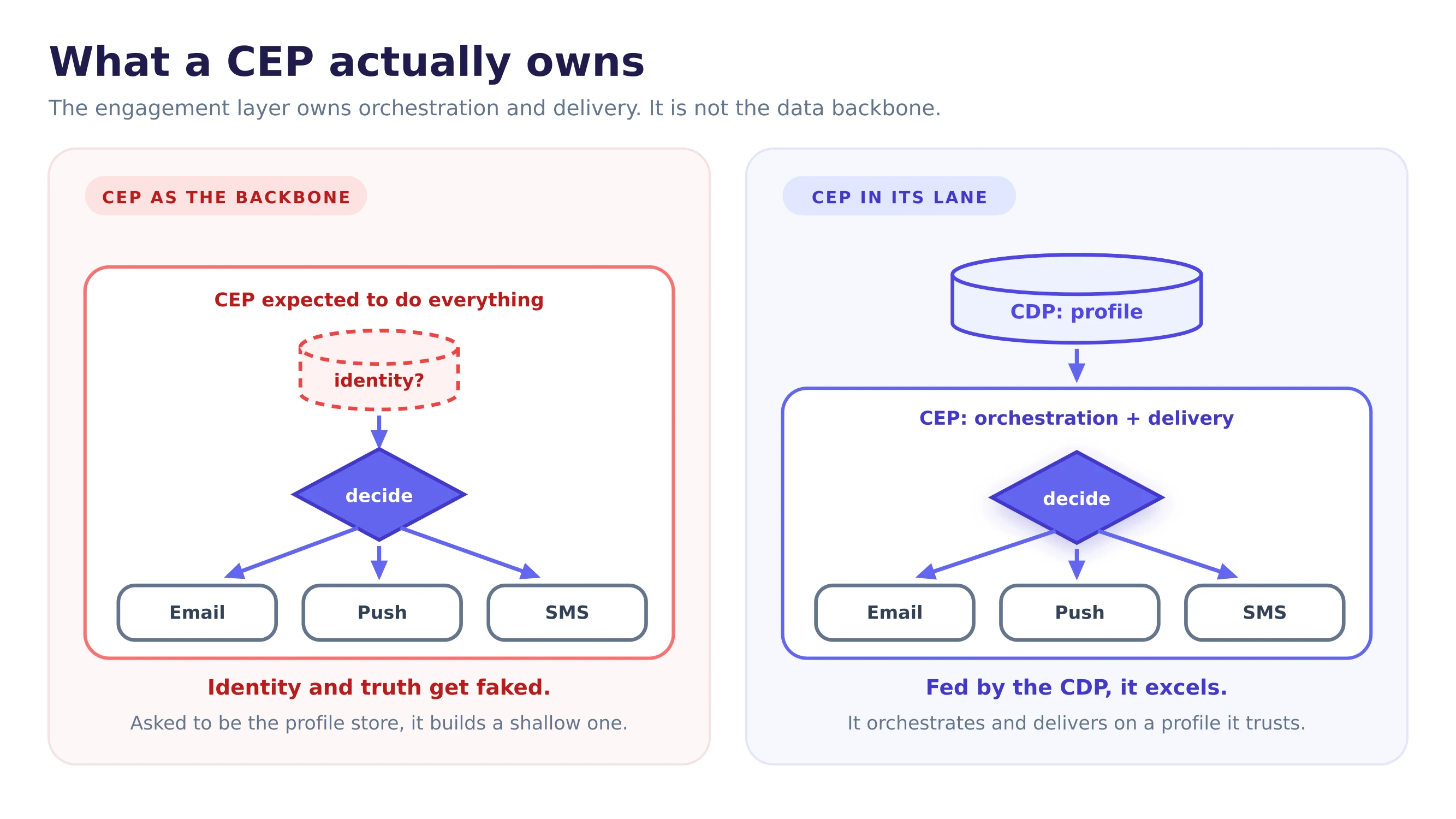
What a CEP actually owns. Orchestration and delivery on the right, resting on a data backbone it does not try to be.
This is why Braze pairs with a CDP rather than trying to replace one, and why Adobe places Experience Platform beneath Journey Optimizer instead of folding identity into the journey layer. Bloomreach, which carries more of its own data layer, is the interesting middle case, and even there the question stays the same: how deep is the profile it resolves versus the profile it merely receives. The strongest engagement layers are the ones that are explicit about which of the two jobs they are doing, and how far the profile they hold actually reaches.
The mistake I often see
The recurring error is buying a CEP as if it were the whole stack. Because the category named the stack, the purchase feels complete, so identity and data strategy get deferred with a vague sense that the CEP covers them. A year later the team is manually syncing customer data into the CEP from three places, the profile is only as current as the last sync, and every channel inherits the same partial picture. The CEP did nothing wrong. It was handed a responsibility nobody had explicitly assigned, on the assumption that the category came with it, a division of labour I traced across eight platforms in the Field Notes synthesis.
Go deeper
For the full origin of how the engagement layer ended up naming the category, read the acronym piece on the CEP. To place it against the suite, CRM and data pulls that decide where it should sit, Four Gravities maps the forces.
This node sits beside what a CDP is, the responsibility it reads from, and what decisioning is, the choice it orchestrates. For when a CEP’s own data capabilities are sufficient, the architecture decision works through the six criteria that settle it.