
Concept
Consent architecture answers four questions that are usually answered by accident. Where is consent captured: the sign-up form, the cookie banner, the app prompt, the store till, the call-centre script? Where is the evidence recorded, meaning who agreed to what purpose, when, through which channel and against which version of the wording? Where is the current state held, the resolved answer to whether this person may be contacted for this purpose on this channel today? And where is that state enforced, at every point where customer data is used, including journeys, paid media audiences, the service desk and any agent acting on the customer’s behalf? Preferences sit in the same layer with different rules, because consent is a legal basis for using data for a purpose while preferences record what the customer wants, such as topics, frequency and channel, and both have to reach the same enforcement points.
Why it matters
Two lines in Article 7 of the GDPR shape the architecture more than any vendor feature. The controller has to be able to demonstrate that consent was given, which makes the evidence record a system requirement, and withdrawal has to be as easy as giving consent, which in a multi-channel stack means that a withdrawal in any one place has to reach every place that uses the data. That second requirement is where channel-level storage breaks. An unsubscribe recorded only in the email platform is honoured by email and invisible to the SMS journey, the push campaign and the paid media audience that was synced to an ad platform last week. Consent also attaches to a person, so it inherits every identity error: in the identity resolution node, a shared tablet that merges a mother and her son lets his opt-out suppress her order updates, and the reverse error lets her consent cover him. Some packaged platforms now enforce part of this at the point of activation. Adobe Experience Platform, for example, blocks an audience activation when the data usage labels it carries conflict with the destination’s marketing purpose and, where consent policies are licensed, removes the profiles that lack the required consent from what it sends.
A simple example
A customer follows the unsubscribe link in a marketing email and opts out of all marketing. The email platform suppresses her immediately, as it should. The engagement platform that runs SMS and push keeps its own profile, fed nightly from the CDP, and the CDP never hears about the opt-out because nobody built that route, so she receives a promotional SMS two days later. Her address is also still in a customer-match audience refreshed weekly in an ad platform, so she keeps seeing the brand’s retargeting ads for another five days. Each tool behaved correctly by its own records. The fix is to make the preference centre, or a consent service behind it, the single place where every capture point writes, with the profile carrying the resulting state and every channel and destination reading that state before it acts. The email platform’s own suppression list stays as a safety net, not as the source of truth.
The architecture view
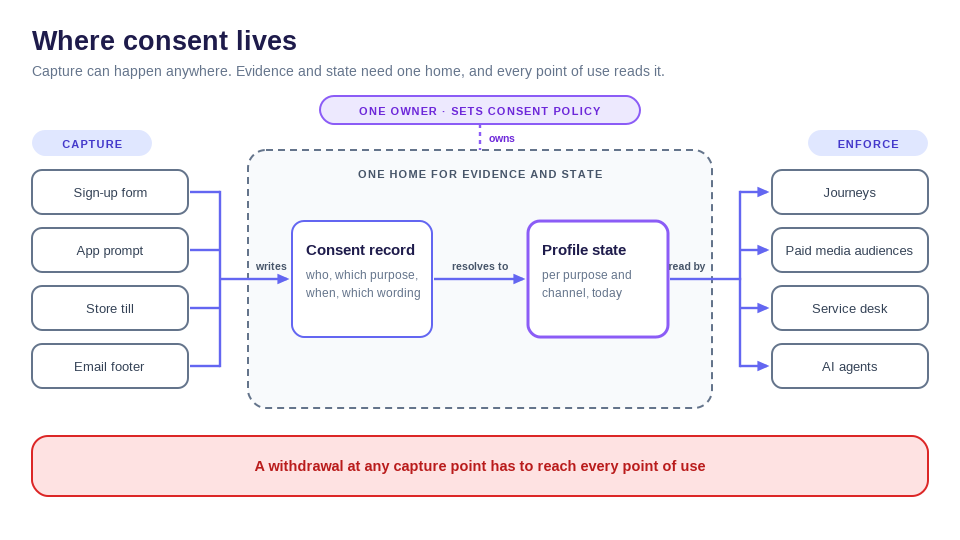
Capture can happen anywhere. Evidence and state need one home, and every point of use has to read it.
The placement follows ownership, as it does for the golden profile. Part 2 of the CDP and CEP patterns makes the governance point directly: across multiple brands, geographies or regulated sectors, consent cannot be managed only as suppression logic inside each execution tool, and a CEP carrying its own data has a lower governance ceiling than a pattern where governance sits at the data layer. Whether that home is a dedicated consent platform, the CDP profile or a governed table in the warehouse is a packaging choice. The architecture needs one home with a named owner, read by every enforcement point.
The mistake I often see
The recurring error is storing consent in the tool where it was first captured, usually the email platform, and adding a sync for each new channel as it arrives. That works while the stack has one channel and fails quietly with every addition, because each sync has its own schedule and its own gaps. A related error is treating the cookie banner as the consent architecture. A consent management platform on the website governs tracking and advertising consent for that site, and marketing consent collected in stores, apps and call centres still needs somewhere to live. The error that surfaces last is destination latency: the state is right in the profile, but an audience already synced to an ad platform keeps the customer until its next refresh, so the refresh schedule of every destination belongs in the design.
Go deeper
Consent depends on identity resolution and on who owns the golden profile, and a consent failure is exactly what explaining why a customer got a message has to be able to reconstruct. For how governance requirements shape the choice of pattern, read CDP and CEP patterns, Part 2, and for why keeping data in the warehouse leaves consent where it was, zero-copy activation.
Sources
Regulation
- GDPR, Article 7, Conditions for consent. Paragraph 1 on demonstrating consent, paragraph 3 on withdrawal being as easy as giving consent.
Platform documentation
- Adobe Experience League, Automatic Policy Enforcement. Activation is blocked when data usage labels conflict with the destination’s marketing action, and profiles without the required consent are excluded, with consent policies available only with Adobe Healthcare Shield or Privacy & Security Shield.
- Adobe Experience League, Consent Processing in Adobe Experience Platform. How consent and preference data is ingested into profile-enabled datasets and stored on the profile.