
Concept
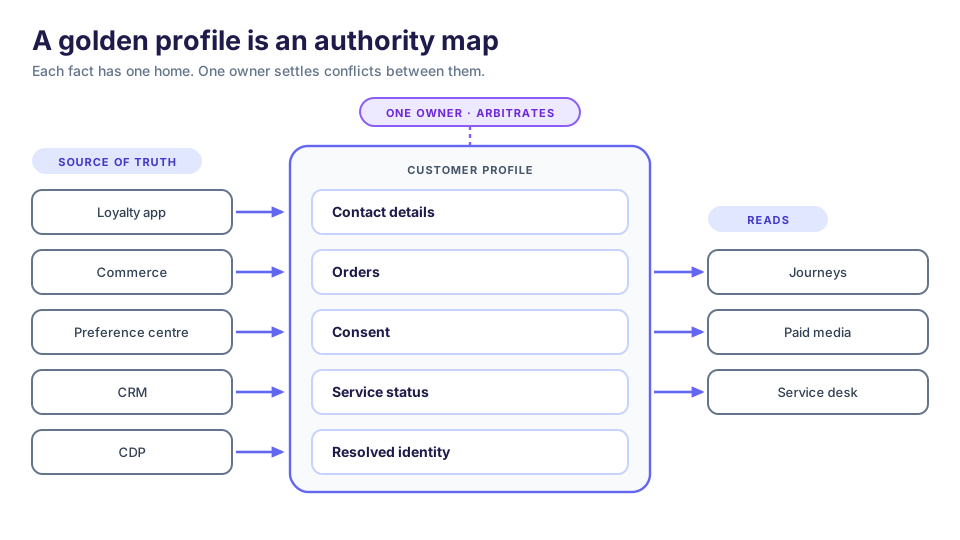
A golden profile is the version of a customer that every system agrees to treat as authoritative. The phrase suggests a single record in a single database, and that is rarely what works. What works is an authority map: for each kind of fact, one system is the source of truth, so contact details come from the app where customers edit them, orders from commerce, consent from the preference centre, contract and service status from the CRM, and the resolved identity with its behavioural attributes from the CDP or the warehouse model. The golden profile is the assembled result of that map, and it only holds together if someone owns the map itself and can settle a conflict when two systems disagree.
Why it matters
Ownership of the profile decides the architecture before any platform is chosen. Part 2 of the CDP and CEP patterns makes the point through the three patterns: when a data or IT organisation runs a governed warehouse as the customer truth, a standalone or composable CDP on top of it is natural; when marketing owns the customer data and is accountable for activation, a CEP carrying its own data layer can be coherent; when data, IT and marketing are aligned around one platform, a suite fits. When nobody owns the profile, organisations drift towards whatever the engagement platform can hold, and the governance problem is deferred rather than solved. The same gap shows up in selection. Melanys Figueredo Toledano put it well in a recent essay: when marketing wants autonomy, engineering wants control and procurement wants consolidation, platform selection becomes a proxy for priorities nobody has agreed. The RFP then picks a winner in an argument that was never held, and the argument returns after go-live as duplicate profiles.
A simple example
A fashion retailer has three systems that each believe they hold the golden profile: the e-commerce platform, the loyalty app and the engagement platform. A customer changes her email address in the loyalty app. E-commerce still has the old address and keeps using it for order confirmations. The engagement platform receives the new address from a loyalty sync, matches on email, finds nobody and creates a second profile, which starts her welcome journey from the beginning while her original profile keeps receiving win-back offers. None of the systems malfunctioned. The fix is an authority map that names the loyalty app as the source of truth for contact details and e-commerce for orders, with the CDP resolving identity across both, and an owner who can decide that a new email is an update to an existing customer. In the identity resolution node, survivorship rules are how that map is enforced field by field.
The architecture view
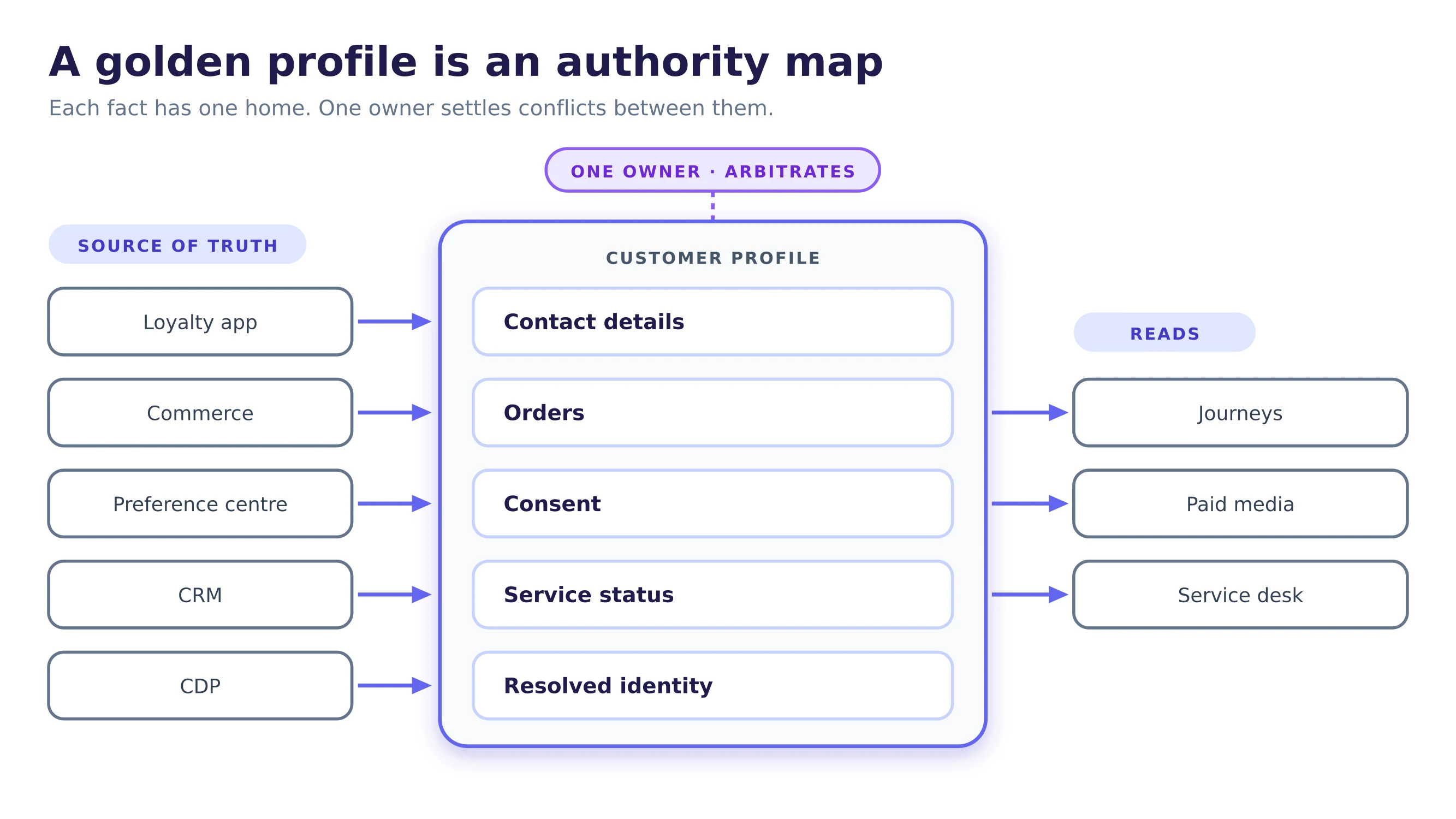
A golden profile is an authority map with an owner. Each fact has one home, and one person settles disputes.
The map says nothing about which product holds the assembled profile, which is the layer or product question again. A suite, a standalone CDP, a warehouse model or an engagement platform can each serve the assembled view, provided it respects the map and does not quietly become the source of truth for facts it only receives.
The mistake I often see
The recurring error is using a platform purchase to settle an ownership argument that nobody has had out loud. Marketing, IT and procurement each back the option that serves their priority, the selection becomes the battleground, and the losing side keeps its own profile after implementation because nothing in the new architecture removed its reasons for having one. The related error is equating golden with complete, copying every field from every system into one store and calling the result authoritative, when all it has done is make one more copy that nobody is accountable for. I would settle who owns the authority map, and who arbitrates between systems, before the first vendor demo, because the answer narrows the choice of pattern more than any feature comparison can.
Go deeper
The ownership criteria behind the three patterns are in CDP and CEP patterns, Part 2, and the record-layer history of who may change the truth about a customer is in the acronym piece on the CRM. For the rules that enforce the map, read identity resolution and customer attributes, and for the operating side of ownership, who can change the logic.
Sources
Practitioner writing
- Melanys Figueredo Toledano, Reflections on the importance of Customer Data Platforms in data-driven organizations, LinkedIn, 22 September 2026. Source of the “platform selection as a proxy” framing.