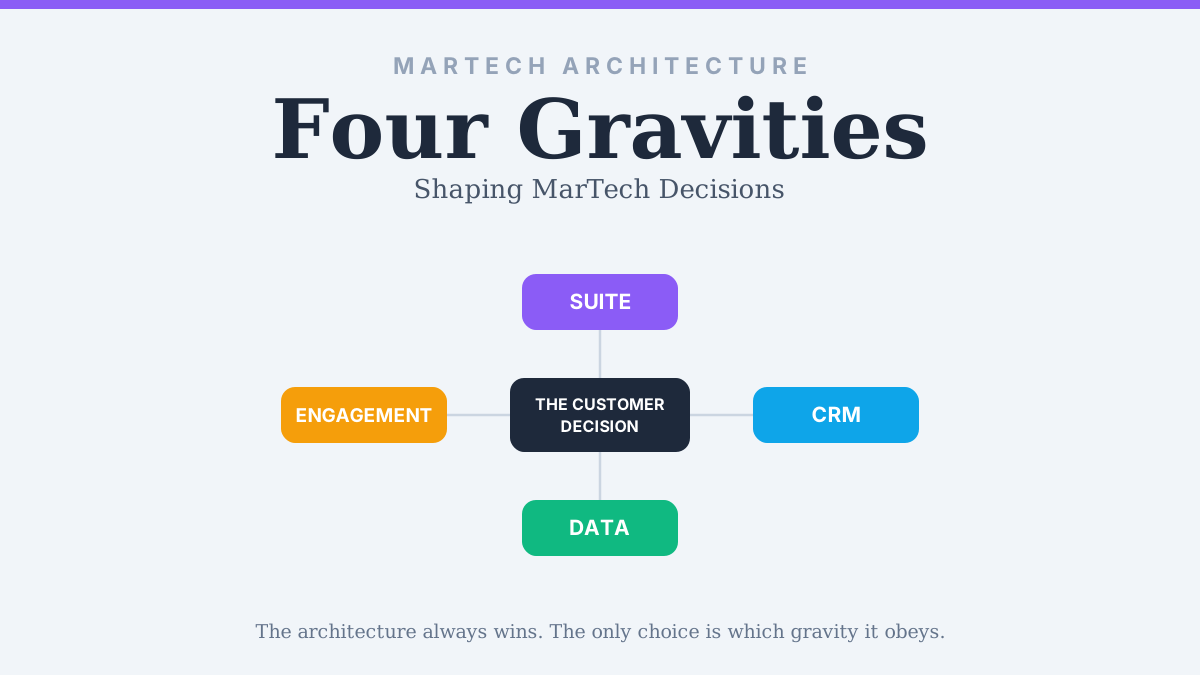
First of a new arc, one layer below everything covered so far. The ESP to MAP to CEP lineage decides what to say, the CMS to DAM to DXP lineage decides what to show, and the CDP decides who is listening. This arc is about who owns the record underneath all three.
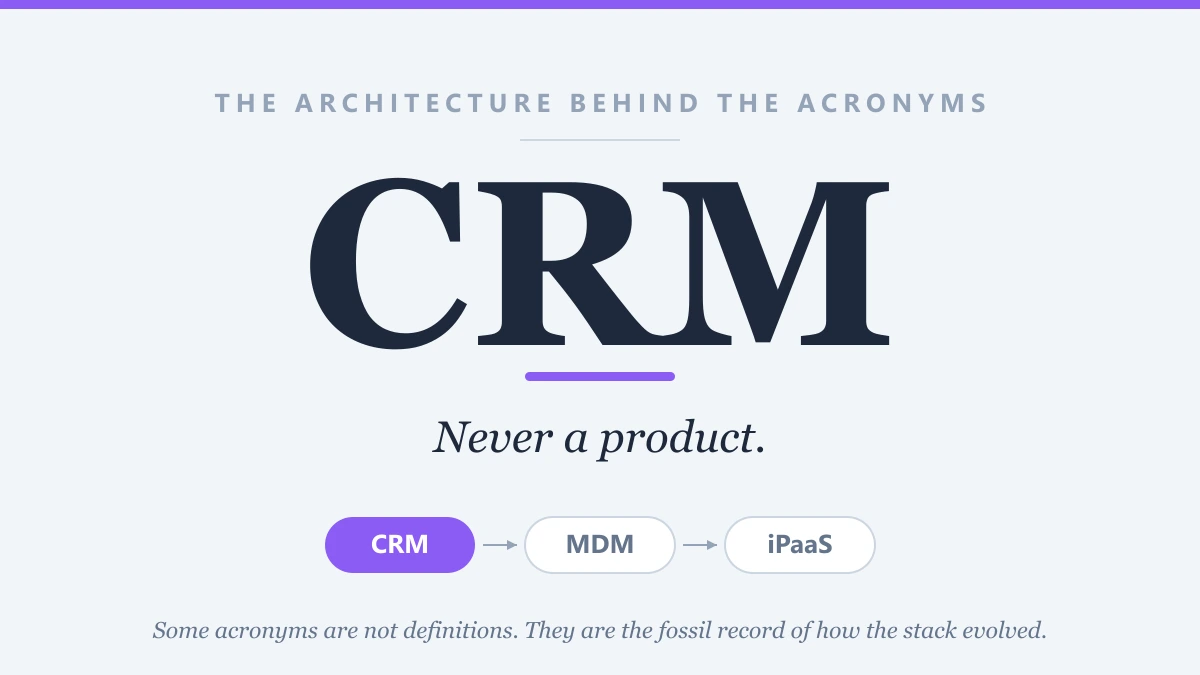
Every acronym in this series so far has been a product category pretending to be a definition. CRM is the opposite problem. It is a definition that the industry turned into a product category, and the evidence sits in the least likely place, which is Gartner’s own glossary. Gartner defines customer relationship management as a business strategy designed to optimise profitability, revenue and customer satisfaction, adding that to realise it, organisations must foster behaviours and implement processes and technologies that support coordinated customer interactions across all channels. Read that again and notice what is missing. There is no software in it. There is no data model, no schema, no system. The most widely deployed three letters in enterprise technology are formally defined as a way of running a company.
Meanwhile CRM accounts for the largest single share of the enterprise software market, and by Gartner’s 2024 market share work it accounted for 51.4 per cent of an enterprise application SaaS market that grew 16.7 per cent to 218.5 billion dollars. So the analysts describe a strategy, buyers describe a system, sales teams describe a place to log calls, marketing teams describe a list of email addresses, and finance describes the second largest line item after the ERP. Those five descriptions point at five different systems wearing the same three letters, and the confusion between them is the direct result of how the category was built.
What the CRM acronym actually solved
The original problem was smaller and much more concrete than anything the acronym now implies. Before CRM existed as a term, the relationship with a customer lived in a salesperson’s head, in a Rolodex, in a notebook, and in the pattern of who called whom and when. It was real, it was valuable, and it belonged to the individual rather than to the company, so when the salesperson left, the relationship left with them. Contact management software in the late 1980s attacked the first half of that problem by making the list portable and shared, and sales force automation in the early 1990s attacked the second half by adding the process around the list, meaning pipeline stages, forecasts, activity tracking and the discipline of recording what happened.
Tom Siebel founded Siebel Systems in 1993 after failing to persuade Larry Ellison that Oracle should package and sell its own internal sales application as a product, and Siebel became the dominant provider of that category, holding it through the rest of the decade and peaking at around 45 per cent of the CRM market in 2002. The name arrived afterwards, which is telling. By the mid 1990s the software existed and worked, but the industry had not settled on what to call it, and candidates including enterprise customer management and customer information system circulated before customer relationship management won out around 1995. Even the parentage is disputed, with more than one vendor claiming to have coined it. An acronym whose product predates its name by two years is an acronym that was applied to something already built, rather than one that described a design intent.
What it solved, then, was ownership. CRM turned the customer relationship from a personal asset into a corporate one, and everything that followed, including everything that went wrong, descends from that single move. Once the relationship is a corporate asset, it needs a record. Once it has a record, someone has to decide what belongs in it. And once several departments want different things in it, the record becomes political.
The market that shaped it: from Siebel to free
The commercial history of CRM is best read as a thirty year argument over who gets to own the record, conducted through pricing rather than architecture. Oracle ended the first phase by announcing on 12 September 2005 that it would acquire Siebel Systems for 10.66 dollars per share, valuing the company at roughly 5.85 billion dollars on a fully diluted basis, or about 3.61 billion net of the 2.24 billion in cash Siebel held. Ellison’s line at the time was that in a single step Oracle became the number one CRM applications company in the world, which is a fair description of what buying the category leader does, and the deal closed in early 2006.
By then the second phase was already underway. Salesforce had been founded in March 1999 and had gone public in June 2004, and its entire positioning was an attack not on Siebel’s functionality but on Siebel’s delivery model, which is what the No Software campaign was actually saying. The pitch was that the record should live somewhere you did not have to install, maintain or upgrade, and that argument was won so completely that it is now difficult to explain to anyone who started working after 2010 why it was ever controversial.
The third phase is the one that matters most for anyone doing architecture today, and it is the phase where the record stopped being the thing you paid for. HubSpot announced a free CRM at INBOUND in 2014, in public beta to begin with and generally available the following year, offering contacts, companies, deals and tasks at no licence cost. The strategic logic is worth stating plainly, because it explains a great deal of subsequent vendor behaviour: whoever holds the customer record has privileged access to sell everything that reads from it, so the record itself is worth giving away. Once one vendor establishes that, the record drifts toward becoming free infrastructure, and the margin moves upward into marketing, service, analytics and now agents. That is a pricing decision with an architectural consequence, because a layer that vendors compete to give away is a layer they also compete to define, and the definition gets stretched to whatever makes the paid layer above it more attractive.
The analyst gap: one acronym, three Magic Quadrants
This is where CRM diverges most sharply from every other acronym in this series. With CEP the finding was that no analyst uses the term at all. With MAP it was that Gartner has to prefix the category with B2B to make it precise. With CRM the finding is stranger, because the analysts use the term constantly and still cannot evaluate it as one market.
Gartner does not publish a single Magic Quadrant called CRM. It publishes three that between them cover the three letters. The sales side is evaluated on its own. The service side is evaluated as the Magic Quadrant for the CRM Customer Engagement Center, itself renamed in 2013 from customer service contact centres to reflect the move beyond the phone, with the most recent edition published in November 2025. The marketing side ended up in the Magic Quadrant for B2B Marketing Automation Platforms. Three quadrants, three buying centres, three vendor sets that only partially overlap, and one word that buyers use as though it referred to a single system.
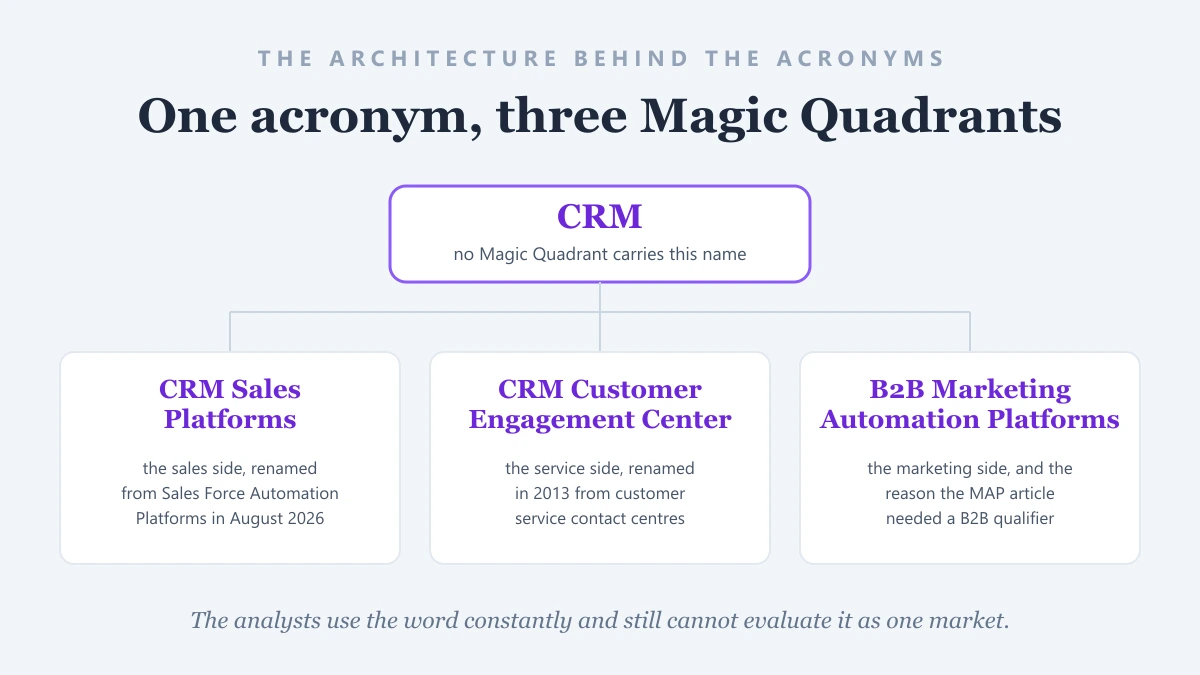
The sales quadrant is the one worth watching, because it changed its name in August 2026 and the direction of the change runs opposite to everything else in this series. What had been the Magic Quadrant for Sales Force Automation Platforms was published on 6 August 2026 as the Magic Quadrant for CRM Sales Platforms, with Salesforce and Microsoft named Leaders and Microsoft appearing in the leader quadrant for a sixteenth consecutive year. Every other article here has documented analysts moving away from the popular acronym, inventing MMH and RTIM rather than writing CEP, adding a B2B qualifier rather than saying marketing automation. This is the first case of the traffic running the other way, with Gartner dropping the functional description, the automation of a sales force, and adopting the buyer’s word instead.
The rename tracks a change in what is actually being evaluated. Sales force automation described making an existing human process faster and more visible, whereas Gartner’s framing of the 2026 edition puts the weight on predictive, generative and agentic AI inside sales workflows together with the governance and observability around them, which is a different question and a much closer relative of the one this article is about, namely who governs the record and what is permitted to write to it.
Forrester has arrived at the same fragmentation from a different direction, having run a CRM Suites Wave in 2022 and then split its CRM coverage into multiple evaluations, including a Customer Relationship Management Software Wave in the first quarter of 2025 and separate industry-specific versions such as financial services. Forrester’s own commentary on that 2025 Wave is more useful than the rankings, because the analysts described a market at a moment of reckoning in which CRMs have become overengineered to the point where their complexity erodes their value, and where adding AI features risks adding another layer of that complexity rather than removing it.
Put the two together and the picture is consistent. Analyst coverage still sizes CRM as a market, and publishes the share numbers to prove it, while evaluating it as a family of adjacent markets that share a data lineage rather than as one homogeneous product market. The only place the unified category still exists is in the way buyers talk and the way vendors sell. When the people whose job is to define categories have to break yours into three to say anything precise, the three letters have stopped marking a system boundary and started marking a history.
How marketing kept borrowing the CRM
The pattern I see most often in client architectures is a CRM doing four jobs, three of which it was never designed for, because it happened to be where the email addresses were. Very little of it is bad implementation. Almost all of it is a boundary nobody drew.
The mechanism is always the same. The CRM holds the consented contact, the account structure, the opt-in state, the service history and the commercial relationship, which makes it the most trusted list in the building. Marketing needs a list. Marketing therefore builds segmentation on top of the CRM, then personalisation on top of the segmentation, then journey logic on top of that, and each step is individually reasonable while the cumulative result is a system of record being used as a behavioural engine. The strain shows up in predictable places, including custom fields multiplying to hold campaign state, nightly batch jobs standing in for real-time signals, and eventually a performance conversation about query load on the object that also runs the sales forecast.
The underlying issue is that the CRM and the CDP hold two different kinds of truth. The CRM holds relationship state, meaning the durable, mostly human-authored, commercially meaningful facts about who this customer is to us, which change slowly and are expected to be correct. The CDP holds behavioural state, meaning the high-volume, machine-authored, mostly recent facts about what this customer just did, which change constantly and are expected to be timely rather than authoritative. Both are legitimate. They are optimised for opposite properties, and the failure mode of confusing them runs in both directions, because CRM-driven personalisation tends to be stale while CDP-driven commercial decisions tend to be ungoverned. I have written before about how the acronyms in this part of the stack fight each other for the same territory, and the CRM is usually the incumbent in that fight rather than the challenger, which is precisely why it keeps being asked to do work that belongs elsewhere.
The practical test I use in architecture reviews is a single question: if this field is wrong, who gets called? If the answer is a sales manager, a service lead or a compliance officer, the field belongs in the CRM. If the answer is nobody, because the field will be recomputed tomorrow from source events, it does not.
What the CRM gets confused with
The confusion set for CRM is unusually large because the acronym is older than most of the categories it now sits beside. The CDP boundary is the one that has genuinely moved, since CRM vendors have added customer data platforms of their own and warehouse-native approaches have made the storage question less decisive than the governance one, but the division of truth described above still holds. The MAP boundary is the one that gets ignored on purpose, because the B2B version of marketing automation is so tightly coupled to the CRM that the two are frequently bought together and run as one system, which works right up until the lead object and the contact object start disagreeing about the same person. The CEP boundary is the clearest of the three, since orchestration decides what interaction should happen next across channels while the CRM records what the relationship currently is, and a CRM asked to orchestrate in real time will do it slowly and expensively. The warehouse boundary is the newest, and a growing number of organisations now treat the warehouse as the analytical truth and the CRM as one operational system among several that feeds it, which is a reasonable position and a significant demotion from where the CRM sat in 2005.
The cleanest way to hold all four distinctions is by asking what each system is authoritative about. The CRM is authoritative about the commercial relationship. The CDP is authoritative about observed behaviour. The MAP or CEP is authoritative about what was sent and what happened next. The warehouse is authoritative about the reconciled historical view. Most architectures I review have never written those four sentences down, and most of their integration problems are downstream of that omission.
Does the CRM still matter, and what agents change
CRM still matters, and it matters more than the deflating category language suggests, but the reason has shifted. For thirty years the CRM mattered because it was where the relationship was written down. It now matters because it is where the relationship is authorised, meaning it is the system that decides what is permitted, what is consented, what is contracted and what is owed, and those are exactly the facts that cannot be inferred from behaviour no matter how much of it you collect.
The agentic turn makes this sharper rather than softer, and in a way that I do not think the market has fully priced in. Salesforce’s positioning around Agentforce and Data Cloud, now presented as Data 360, describes agents that reason over unified structured and unstructured data and then execute actions inside the CRM, which includes resolving cases, qualifying leads and progressing opportunities. Read architecturally, that is an inversion of the entire history of the category. For three decades the consequential writes to a CRM were made or reviewed by people, even where integrations, batch jobs and workflow rules also touched the records, and the governance was built around controlling that human input through page layouts, validation rules, required fields and approval processes. An agent reverses the flow. The system becomes the writer, at machine speed, across many records at once, and every control designed to slow down a human typing into a form is the wrong shape for that.
None of the hard questions this raises are model questions. They are architecture questions, and they are old ones. Which system is authoritative when an agent and a human disagree about the same field. Whether an agent’s write carries the same audit weight as a human’s. What happens when the agent operating from the service side and the agent operating from the marketing side both believe they own the next contact with a customer. Whether consent state is a fact the agent can read or a boundary the agent cannot cross. An organisation that never decided who owns the customer record when the writers were people is not going to discover the answer now that the writers are agents. It is going to discover the cost of not having decided.
That is the real state of the acronym in 2026. Whatever the market did with the three letters, what they named was a decision about ownership, made once, usually early, usually implicitly, and then lived with for a decade. The technology around it has been rebuilt three times, from client-server to SaaS to agentic, and the decision underneath has not changed at all. The analysts have now started renaming their categories after it.
CRM stopped being a product category long ago and became the name for a governance decision every organisation makes at least once and rarely revisits, which is who is allowed to change the truth about a customer, and all the agentic era changes is how quickly you find out you got it wrong.
Sources
Gartner
- Definition of Customer Relationship Management (CRM) (CRM defined as a business strategy rather than a product category.) · Customer Relationship Management Reviews and Ratings (The Peer Insights market view of CRM.)
- Magic Quadrant for Sales Force Automation Platforms (The sales half of the acronym, evaluated as its own market.) · Sales Force Automation Platforms, transitioning to CRM Sales Platforms (Peer Insights carrying the August 2026 category rename.)
- Magic Quadrant for the CRM Customer Engagement Center (The service side of the acronym as a separate market.) · Magic Quadrant for B2B Marketing Automation Platforms (The marketing half, and the B2B qualifier discussed in the MAP article.)
- Market Share Alert: Enterprise Application SaaS Market Reaches $218B in 2024, Worldwide (CRM as the majority share of enterprise application SaaS revenue.) · Market Share Analysis: CRM Sales, Worldwide, 2024 (Vendor-level share within the CRM sales segment.)
Forrester
- A Market On The Cusp Of Change, Decoding The Forrester Wave: Customer Relationship Management Software (The Q1 2025 evaluation, and the argument that CRMs have become overengineered.)
- Announcing The CRM Forrester Wave Evaluations And How To Use Them (Why Forrester splits CRM into several evaluations rather than one.) · The Forrester Wave: CRM Suites, Q3 2022 (The earlier single-suite framing, for comparison.)
Trade press
- Gartner Magic Quadrant for CRM Sales Platforms 2026: The Rundown (The August 2026 rename from Sales Force Automation Platforms, and the leader placement.)
- Gartner Magic Quadrant for CRM Customer Engagement Center (CEC) 2025: The Rundown (The service side of CRM as a separate quadrant, and the 2013 renaming from customer service contact centres.)
- The Forrester Wave for CRM Software 2025: Top Takeaways (Vendor-level summary of the Q1 2025 CRM Wave.)
Company filings and announcements
- Siebel Systems Form 8-K, September 2005 (The Oracle acquisition terms: $10.66 per share, $5.85 billion fully diluted, $3.61 billion net of cash.)
- Microsoft named a Leader in the 2026 Gartner Magic Quadrant for CRM Sales Platforms for the sixteenth consecutive year (The 6 August 2026 publication date and the sixteen year run.)
- HubSpot Launches Free CRM and Sidekick Sales Acceleration at INBOUND14 (The 2014 decision to give the customer record away.)
- The History of Salesforce (Founded March 1999, IPO June 2004, and the No Software positioning against installed CRM.)
- The Force Behind Agentforce: How Data Cloud Fuels Agent-First Enterprises (Agents reasoning over unified data and executing actions inside the CRM.)
Category history
- Siebel Systems (Founding in 1993 and the sales force automation lineage.) · A Brief History of Customer Relationship Management (The mid-1990s naming of the category and the competing candidate terms.)