13 min read
Second of a trilogy on the content layer, and the operational half. Read it after the CMS, which governs structured content, and before the DXP, which tries to assemble content, assets, data and experience delivery into one platform.
Digital Asset Management is one of those categories that is usually understood through its least interesting feature. Ask what a DAM does and the answer is some version of “it is a central place to store images and videos so people can find them.” That is true, and it is also the equivalent of describing a CDP as a database or a CEP as a message scheduler. The repository is only the visible part. The real purpose of a DAM is to make digital assets usable at scale, which means knowing what an asset is, who owns it, which version is approved, where it may be used, when its rights expire, what transformations exist, which markets can access it and how downstream systems should retrieve it. A shared folder can store files. A DAM creates a governance model around them.
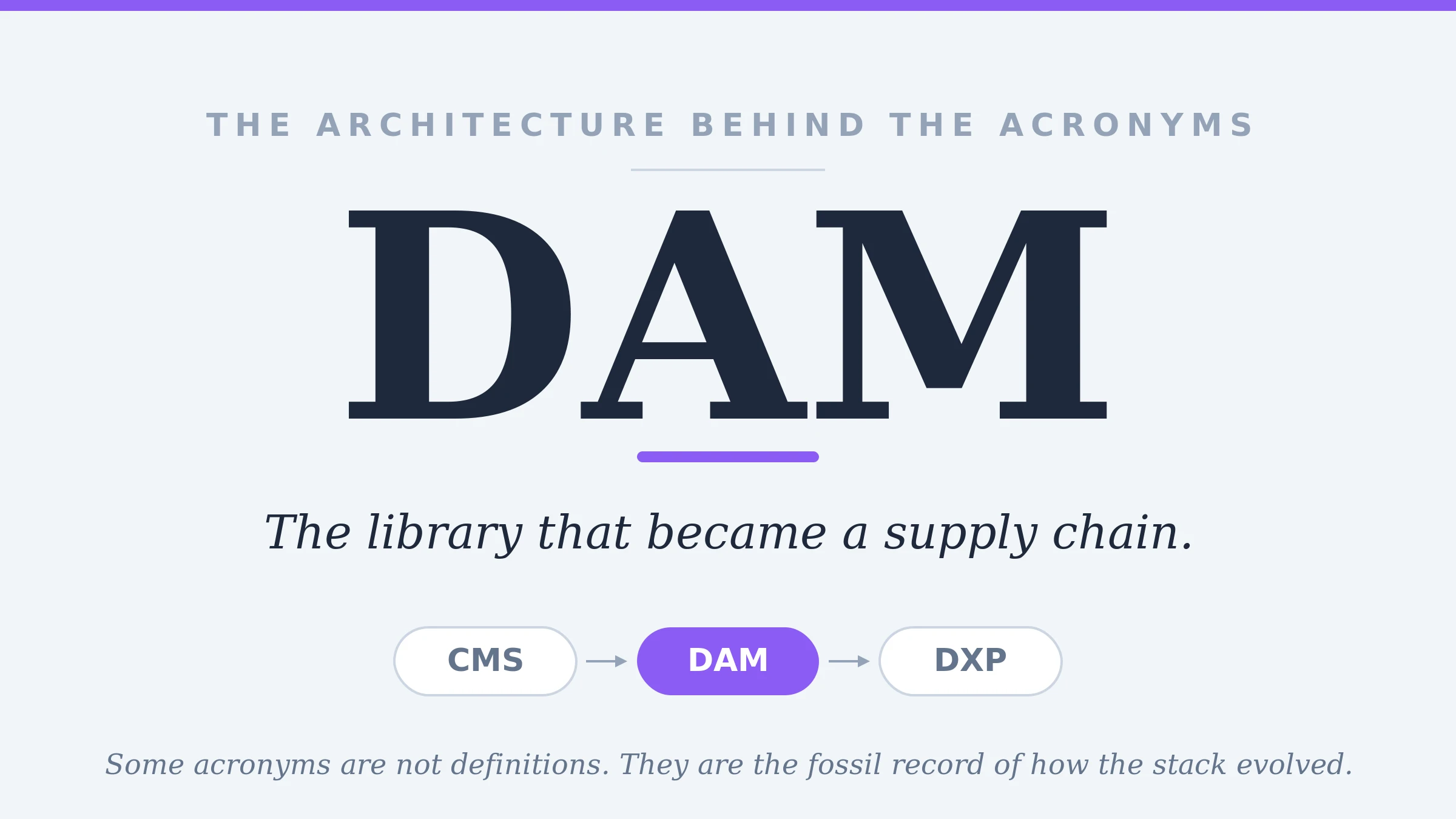
For years that governance sat mostly around finished creative work. The campaign was produced, the final assets were approved, and the DAM became the place where teams stored and distributed them. That model is changing, because assets are now created continuously, adapted for multiple formats, localised across markets, personalised for audiences and delivered dynamically to websites, commerce platforms, social channels, applications, email and advertising systems. Generative AI adds another order of magnitude, since a single master asset can now produce dozens or hundreds of variations, some generated automatically and some assembled at runtime. In that environment the DAM is no longer merely the library at the end of the creative process, it is becoming part of the process itself. The library became a workflow, and the workflow became a supply chain.
What it actually solved
The original DAM problem was file proliferation, and creative, publishing and media organisations were among the first to experience it at scale. Digital photography, desktop publishing, audio, video and design files multiplied quickly while the methods used to organise them remained based on folders, filenames and individual memory. That works until it does not, and the failure mode is universal: a folder called Final becomes Final_v2, then Final_Approved, then Final_Approved_NewLogo, then Final_Approved_NewLogo_USE_THIS. The joke is familiar because file systems know where a file is stored but not what the file means.
A DAM added a layer of descriptive and operational information around the binary asset. It attached metadata describing subject, creator, brand, campaign, market and usage, generated previews and thumbnails so users could identify assets without opening source files, and provided search and taxonomy that went beyond the folder structure. It introduced version control and explicit relationships between masters and derivatives, permissions determining who could view, download or modify an asset, and approval states separating work in progress from publishable material. It also carried rights and expiry information controlling where and for how long an asset could be used, along with renditions for different formats, sizes and delivery contexts. The architectural shift underneath all of this was subtle but important: the file stopped being self-describing, and its business meaning moved into metadata and workflow.
That is why metadata standards became central to DAM. Adobe introduced the Extensible Metadata Platform, XMP, in 2001 to provide a common way to embed and exchange metadata across digital assets and creative applications, and the goal was not simply better search but continuity of meaning as files moved between tools and teams. The early DAM category created a system of record for digital media. Not a record of the campaign plan, not a record of the customer, but a record of the asset and the conditions under which it could be used.
The market that shaped it
DAM was shaped by industries where the cost of using the wrong asset was high. Publishers needed to manage large image archives and reuse material across editions, broadcasters needed to catalogue video and audio, agencies needed to control work across clients and production teams, and global brands needed to distribute approved logos, photography and campaign materials without losing brand consistency. The market therefore developed around four persistent requirements. Findability meant users could locate the right asset without knowing where it had been stored or who had created it. Control meant the system could distinguish approved material from drafts, restrict sensitive content and prevent outdated or unlicensed assets from remaining in circulation. Reuse meant a valuable asset could be used more than once, which required visibility across teams and markets as well as enough metadata to understand whether reuse was appropriate. Distribution meant the asset could move from the central repository into websites, print workflows, partner portals, commerce systems and later a growing range of digital channels.
For a long time DAM remained a specialist category. It was important to creative operations, brand teams and publishers, but often peripheral to the rest of the MarTech architecture. The CMS might reference an image from the DAM, an agency might upload campaign files, and regional users might download approved materials from a brand portal, but the DAM was connected without usually being treated as a runtime system. That changed as digital experience became more visual and more fragmented, because every channel introduced its own formats, dimensions, compression requirements and delivery constraints. Commerce needed product imagery at scale, mobile demanded responsive assets, social platforms multiplied aspect ratios, video became central, and personalisation increased the number of variants required for the same campaign idea. The cost of producing the asset was no longer the only issue. The cost of transforming, governing and delivering it became equally important, and the market moved from managing a collection to managing a lifecycle.
How vendors changed the meaning
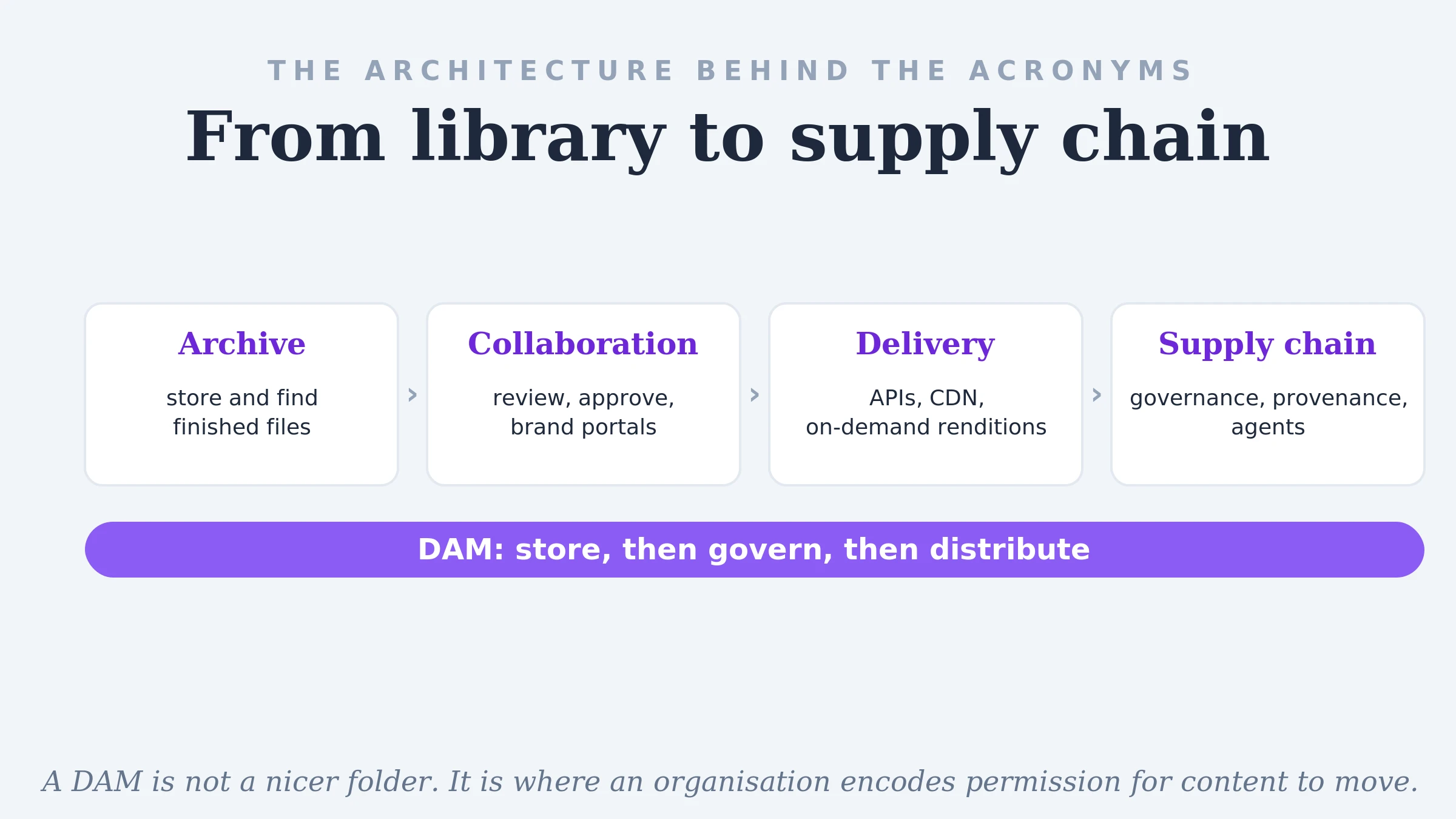
The first expansion was from archive to collaboration. DAM vendors added review, annotation, approval, sharing, brand portals and integrations with creative applications, and the platform moved earlier into the production process, helping teams manage work before the asset was final. The second expansion was from library to delivery infrastructure, as cloud-based DAM and dynamic media platforms introduced APIs, content delivery networks and on-demand transformations. You can see the split in the market itself: platforms like Cloudinary grew up developer-first, as an API-and-CDN media pipeline, while incumbents like Adobe with AEM Assets and specialists like Bynder, Canto and Aprimo came at the same problem from the brand-and-workflow side. The two heritages still shape how each product behaves. Instead of creating every rendition manually, systems could resize, crop, optimise or convert an asset for a specific channel at delivery time, which changed the relationship between master and derivative. In the traditional model each required output might exist as a separate file. In a dynamic model the master remains governed while many delivery variants are generated through rules and URLs, so the DAM begins to participate directly in experience performance, page speed and channel adaptation.
The third expansion was into content operations. Vendors began positioning DAM as one component of a broader content supply chain, with planning, briefs, creative production, approvals, work management, asset governance, delivery and performance measurement appearing in the same product story. This was partly a real response to organisational fragmentation, because most content operations are full of hand-offs: a campaign is planned in one tool, briefed in another, produced by an agency, reviewed through email, stored in a DAM, assembled in a CMS and activated through a CEP or advertising platform. Each boundary creates delay, duplication and lost context. A more connected supply chain can reduce that friction. It can also turn DAM into another category that tries to absorb everything around it.
The fourth expansion is happening now, through AI-assisted and agentic content operations. DAM platforms increasingly offer automatic tagging, visual search, duplicate detection, smart cropping, background removal, variant generation and natural-language discovery, and some are beginning to position agents as participants in the asset lifecycle, finding approved material, generating adaptations, checking compliance and routing work through approval. This makes the old description of DAM as a searchable library even less adequate, but it also makes governance more important than the AI feature itself, because when content generation becomes cheap the number of assets stops being the constraint and trust becomes the constraint. Which version came from the approved master, whether the asset was generated, edited or captured, which model or tool changed it, whether the licence allows this use, whether a person approved the result, and whether the organisation can prove what was shown to the customer all become live questions. Standards such as C2PA Content Credentials are emerging to address part of this by attaching verifiable provenance information to digital content, and a DAM is a natural place to preserve and operationalise that provenance. Storing a credential and enforcing a policy are not the same thing. The category is moving from managing assets to managing confidence in assets.
What it means architecturally today
A modern DAM is best understood as a governed asset lifecycle and distribution layer. Its core responsibilities usually run across preserving canonical master assets, managing metadata, taxonomy and relationships, controlling versions, approval states and permissions, and recording ownership, licences, rights and expiry dates. They extend to creating or orchestrating renditions and transformations, exposing assets through APIs, portals and delivery services, tracking where assets are used and increasingly how they perform, and preserving provenance across human-created, edited and AI-generated content. The architecture depends less on whether the DAM has the longest feature list and more on whether the asset lifecycle is coherent around it, which turns into a handful of concrete questions.
Where an asset enters the system matters. If final files are uploaded only after the creative process is complete, the DAM remains a downstream archive, which may be enough for some organisations, but it cannot become the operational backbone of content production if the work happens elsewhere without integration. What counts as the source of truth matters too, and the answer should not vary by team. If the agency drive, the local market folder and the DAM all contain slightly different masters, the organisation has not created a central asset layer, it has created another copy. How metadata is created is a related question, since automatic tagging can reduce manual work but does not replace a business taxonomy. AI can recognise a beach, a car or a person, but it cannot infer the organisation’s exact campaign rights, market restrictions or approved claims unless those rules are modelled and connected. Where transformations are performed is a boundary decision, because a CMS, commerce platform, email system and advertising tool may all create their own image variants. That can be practical, but it can also produce duplicated processing and inconsistent quality, so the line between DAM-managed renditions and channel-specific adaptation should be deliberate. How assets connect to structured content and product data is the last of these. A DAM knows the asset, a CMS knows the editorial structure and a PIM knows the product, and the experience often needs all three, so stable identifiers and explicit relationships matter more than copying information between repositories.
There is also a permission dimension that the agentic shift makes sharper. An AI agent that can search the DAM is useful, an agent that can create a new variant is more powerful, and an agent that can publish that variant into a live experience is performing a materially different action. The permission model should recognise those stages as distinct. The most common DAM failure I have watched happen, though, is not technical but behavioural. The platform is implemented as the official repository, but teams keep using local drives, messaging applications and agency portals because the DAM is slower, poorly structured or disconnected from their actual workflow. A system of record only works when the organisation has a reason to trust and use it, because a library nobody trusts is not a system of record, it is an expensive archive.
What it gets confused with
DAM sits close to several other content technologies, but the confusions are not equally expensive, and it is worth being honest about which ones actually cost money. The most expensive is mistaking a DAM for cloud storage. Storage platforms synchronise and share files perfectly well, which is exactly why so many organisations quietly run their asset operation on a shared drive and then wonder why brand consistency keeps slipping. What they are missing is not capacity, it is the metadata, rights management, rendition control, brand governance and downstream delivery integration that make an asset governable rather than merely stored. The second costly confusion runs the other way, treating a DAM as a DXP. A DAM can be a critical component of a digital experience platform, particularly where visual content is central, but it does not manage customer context, personalisation and the full experience lifecycle, and buying one while expecting the other ends badly.
The remaining boundaries are real but cheaper to get wrong. A DAM is not a CMS, because the CMS manages structured editorial content and the composition of experiences, and a page referencing an asset does not pull that asset into the CMS’s governance model. It is not a PIM, which owns product attributes, classifications and commercial data while the DAM owns the images, videos and manuals attached to them, so commerce needs both. It is not work management, where briefs, tasks and timelines live, even when a DAM suite bundles those features. And it is not a CDN, although modern DAM often includes delivery, because a CDN optimises distribution while the DAM decides which asset, version and transformation is even allowed to be distributed. The simplest way to hold all of it is that the CMS governs what the content says, the DAM governs which asset is allowed to move, and the DXP, at least in theory, assembles those components into a coherent experience.
Does it still matter
DAM matters more now than when the category was created, and the reason is not that organisations have more files, although they do. The reason is that every asset now has more states, more derivatives, more destinations and more potential risks. A single photograph may exist as a raw master, a retouched version, several regional crops, a web-optimised rendition, a commerce thumbnail, a social format, an email adaptation and multiple AI-generated variants, with rights that differ by country, channel and time period and brand approval that applies to one version and not another. Without a governed asset layer, that complexity becomes distributed across people and platforms: the CMS stores one copy, the agency stores another, the commerce platform creates its own derivative, the social team downloads and edits a local version, and the AI tool generates a new asset with no reliable connection to the source. The organisation still has content. It no longer has lineage. That is the real reason DAM remains relevant.
In the next phase of content operations, the valuable platform will not be the one that can generate the most variants, because generation will become broadly available. The valuable platform, and the one I would actually spend budget defending, will be the one that can answer where an asset came from, who changed it, which version is approved, what it can be used for, where it has already been used, when it must stop being used, and whether a human, channel or agent can retrieve it without bypassing those rules. The DAM began as the place where digital assets were stored, then became the place where assets were governed, and now it is becoming the place where the organisation encodes permission for content to move. The library did not disappear. It became the infrastructure for the supply chain around it.
A DAM is not a nicer folder, it is where an organisation encodes permission for content to move, so in an era of infinite AI variants judge it on lineage and governance, not on how many assets it can generate.
Sources
Canto
- Digital asset management (DAM) platform overview (Repository, search, sharing, brand and workflow capabilities associated with modern DAM.)
Adobe
- XMP metadata (XMP as a standard for processing and storing metadata in digital assets.) · Extensible Metadata Platform (The framework for preserving metadata across files and creative workflows.) · Content supply chain (The connection between planning, creation, workflow, asset management, delivery and performance.)
Cloudinary
- Digital Asset Management overview (The asset lifecycle from upload to deployment.) · Dynamic Asset Transformation (On-demand conversion, optimisation and adaptation for different delivery contexts.) · Digital Asset Management API (Application access to governed assets through APIs.)
Forrester
- Announcing The DAM Forrester Wave, Q1 2024 (The growing requirement to make rich-media assets available across more geographies and digital touchpoints.)
C2PA
- Content Credentials (The open standard for communicating the origin and edit history of digital content.) · C2PA Technical Specification (The technical model for binding verifiable provenance information to digital assets.)