
Concept
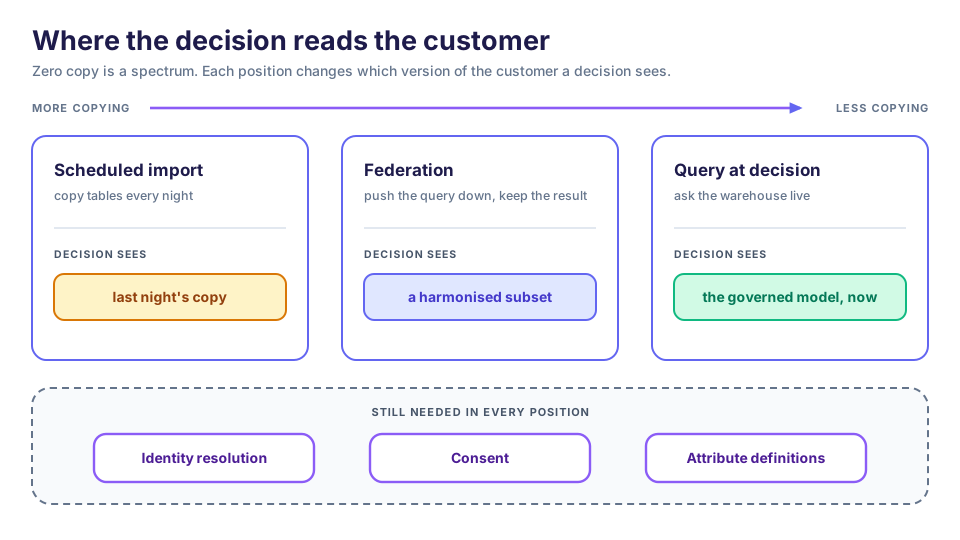
Zero-copy activation means that the platform acting on customer data does not need to keep its own full duplicate of that data before it can act. The warehouse or lakehouse, Snowflake, BigQuery, Databricks or Redshift, remains the place where the customer model lives, and the engagement platform queries it, references it or receives just what a decision needs. In practice it is a spectrum rather than a feature. At one end sits a scheduled import that copies tables every night, in the middle sits federation that pushes a query down to the warehouse and materialises the result, and at the far end sits a live query at the moment of decision. What moves along that spectrum is the answer to a single question, which version of the customer the decision is using.
Why it matters
Every copy of the customer is a second truth that starts drifting the moment it is made. A loyalty tier recalculated in the warehouse at noon and copied into the engagement platform at midnight is wrong for twelve hours, and when the copy is partial, the platform, its segments and any agent reading from it reason about a customer who is missing most of her history. Zero copy removes that class of debt, which is why the packaged vendors have moved towards it: Adobe builds audiences directly against warehouse data with Federated Audience Composition, and Braze now triggers Canvases from warehouse data through zero-copy Cloud Data Ingestion. The difficulty is that three goals travel together in the same conversations and get blurred. Zero copy reduces duplication. Zero-party data is about learning directly from customers. Governance is about using data responsibly. A stack can achieve the first and neither of the others, because a badly modelled customer queried in place is still a badly modelled customer, a fragmented identity graph stays fragmented when it lives in Snowflake, and ambiguous consent does not become clear because the platform reads it live.
A simple example
A fashion retailer keeps its loyalty programme in the warehouse, where tier upgrades are calculated as soon as an order posts. The old architecture copied the tier into the engagement platform every night, so a customer who crossed into the top tier at ten in the morning spent the rest of the day receiving offers meant for the tier below. Moving the upgrade audience to a zero-copy pattern fixes that, because the platform now asks the warehouse at decision time. The same retailer still keeps journey state inside the engagement platform, meaning which step each customer has reached, when she last received a message and whether she clicked, because that state changes by the second and belongs where the journey runs. Copying it out to the warehouse and querying it back would add latency for no gain. The architecture uses zero copy where freshness of shared truth matters and keeps local state where speed of reaction matters.
The architecture view
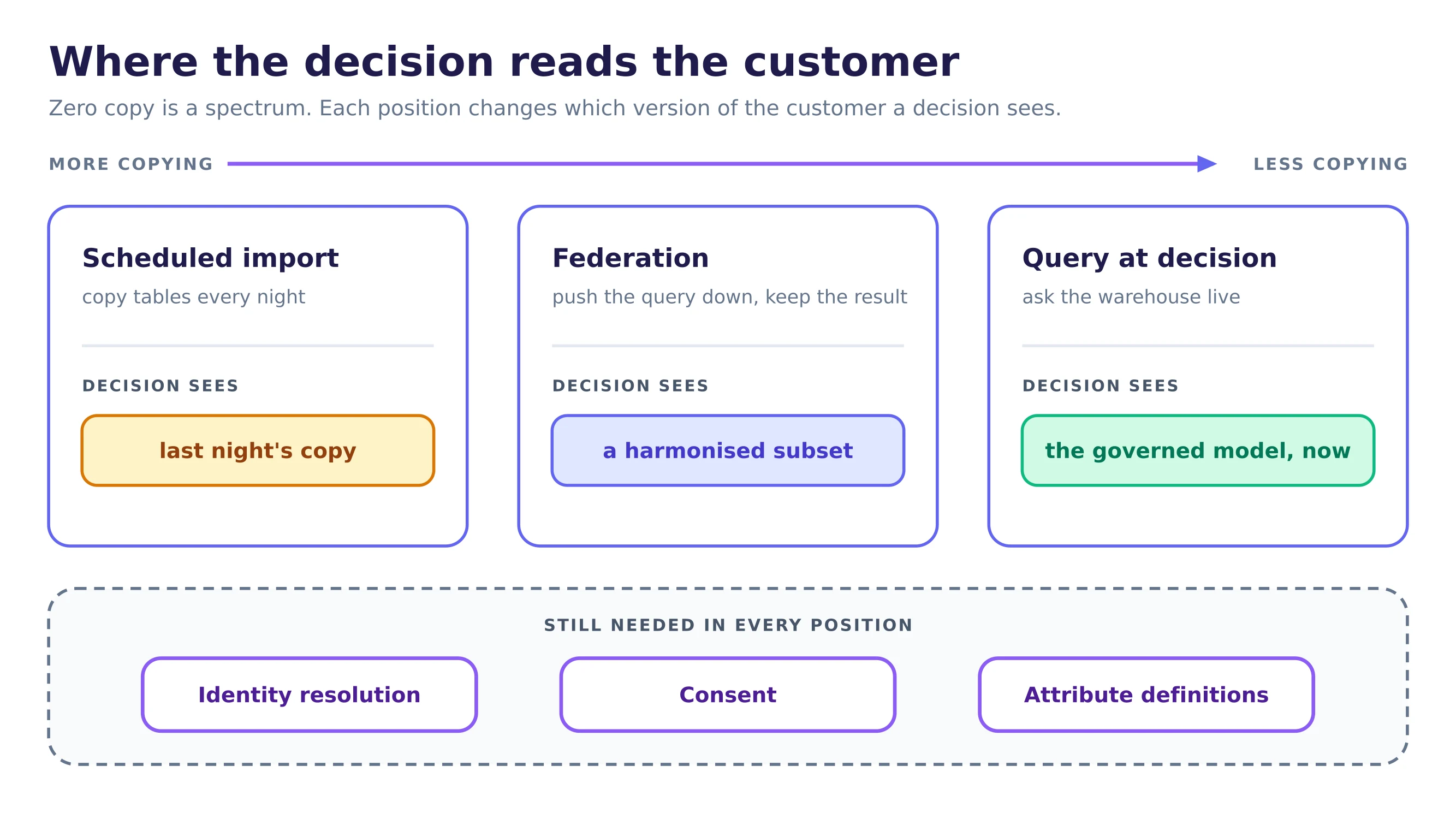
Zero copy changes which version of the customer a decision sees. Identity, consent and definitions still need an owner in every position.
This is the composable variant of Pattern C in the CDP and CEP patterns, and it assumes what that pattern assumes: a governed warehouse and a data team able to run it as the customer model for marketing. Where those exist, zero copy moves marketing closer to the enterprise truth. Where they do not, it moves marketing closer to an ungoverned one, faster.
The mistake I often see
The recurring error is treating zero copy as the goal, when the goal is to make every copy intentional. Teams set out to eliminate copies altogether, discover that journey state, low-latency attributes and some regulated data are better replicated deliberately, and either abandon the programme or force live queries where they do not belong, which raises warehouse costs and slows the journeys they were meant to speed up. The second error is assuming that once the data stays in place the decisioning question has been answered. Querying the warehouse tells a platform what is true about the customer, and it says nothing about which of several qualifying actions should win, which remains where decisioning lives to decide.
Go deeper
The full vendor spectrum, from Hightouch to the suites, is in Zero-Copy Engagement: When the Warehouse Becomes the Campaign Brain, and the acronym piece on the CDP explains how the warehouse argument reshaped the category. Zero copy does not settle identity resolution or who owns an attribute’s meaning, and it changes the timing picture described in event, state and transition.
Sources
Platform documentation
- Adobe Experience League, Engage with Audiences Using Federated Audience Composition. Audiences built against the warehouse without copying the underlying data into Experience Platform.
- Adobe Experience League, Federated Audience Composition: prerequisites and guardrails. Supported warehouses include Amazon Redshift, Google BigQuery, Databricks and Snowflake.
- Braze, April 30, 2026 Release Notes: Zero-copy CDI syncs for Canvas triggers. Canvases triggered from warehouse or S3 data.