8 min read
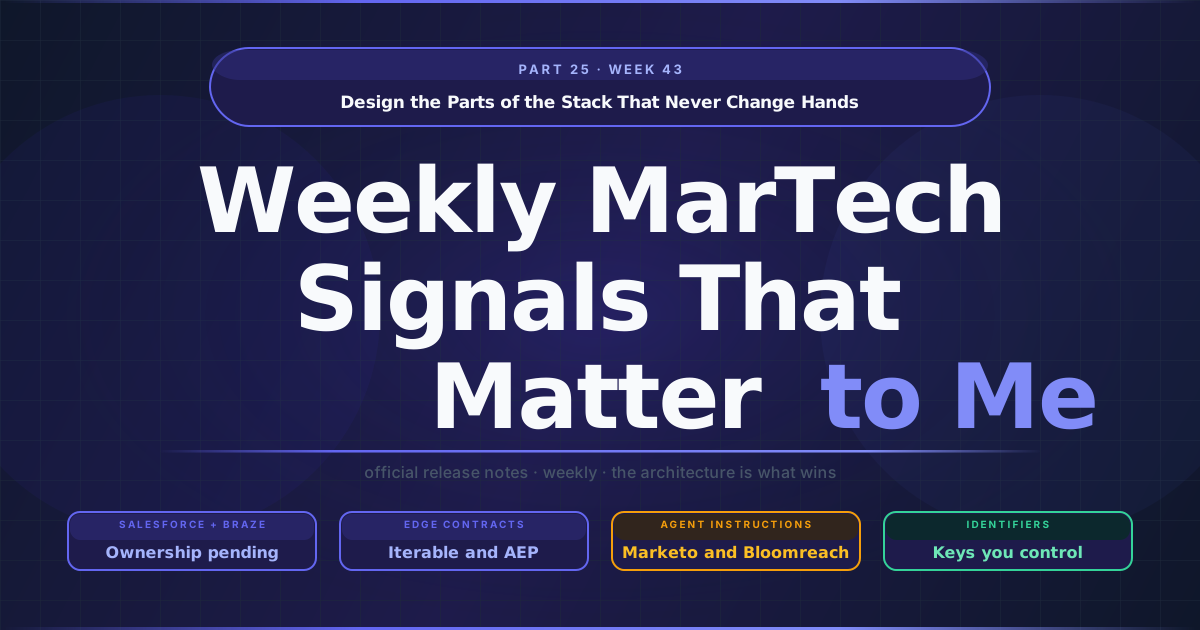
Design the Parts of the Stack That Never Change Hands
Most platform decisions I have been part of were made against a roadmap: what the vendor will ship next year, how it fits the rest of the stack, how long the contract runs. This week one of those inputs became uncertain for a large number of teams at once. Salesforce has agreed to acquire Braze, and both are among the platforms I use in production. The Week 43 MarTech Watch records the facts, and a separate article reads what Salesforce actually bought. This essay is about a narrower question that I think matters more for the people designing stacks today: while ownership is pending, which parts of the architecture stay yours whatever happens?
TL;DR
- The deal is signed, the endpoint is open. Salesforce agreed to acquire Braze for about $5.66 billion in enterprise value, with the close expected in its fiscal year 2028; no combined roadmap or positioning against Marketing Cloud Engagement has been published.
- Edge contracts stay yours. Iterable now syncs opt-in and opt-out changes back to Salesforce records, and Adobe Experience Platform lets each streaming dataflow choose which changes trigger an export. Written down outside the platform, those contracts survive any change of ownership.
- Identifiers you control travel. Insider matches a plain email with its SHA-256 and MD5 hashes and can decrypt identifiers sent with a customer-held key, which points to an identity strategy built on keys the company owns.
- Agent instructions are business rules. Marketo’s Callable Agents act on plain-language instructions and Bloomreach’s Loomi Connect exposes more than 180 tools to agents; the text that steers them should be versioned outside the platform.
What the Salesforce and Braze agreement says, and what it leaves open
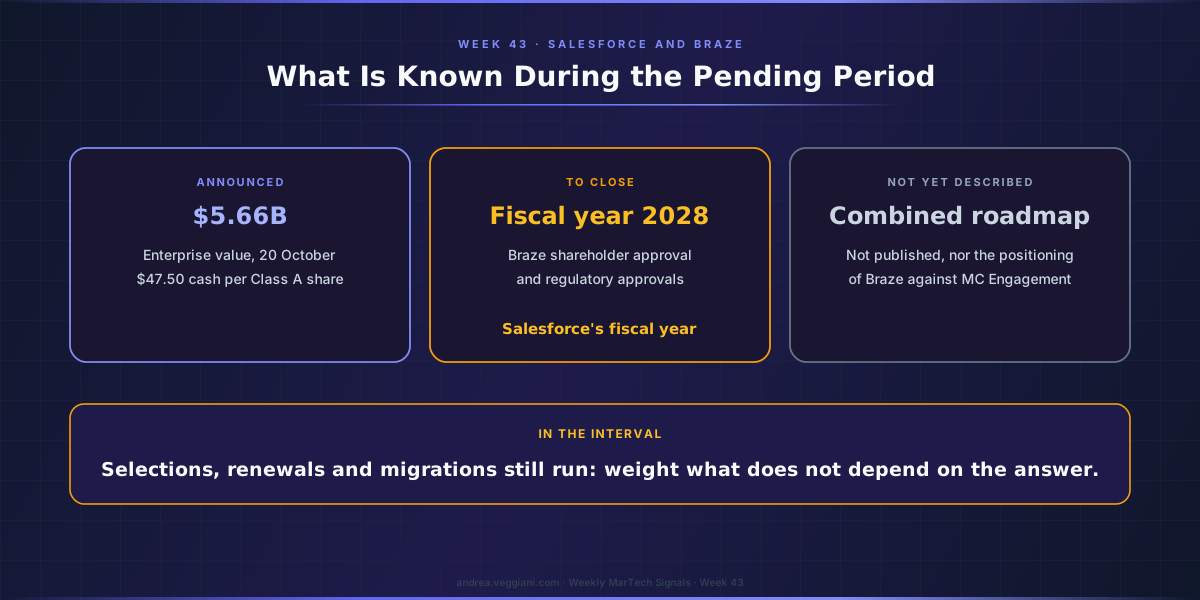
The facts are in Salesforce’s announcement. Salesforce has signed a definitive agreement to acquire Braze for approximately $5.66 billion in enterprise value, paying $47.50 in cash for each Braze Class A share. The transaction is expected to close in Salesforce’s fiscal year 2028, subject to approval by Braze’s shareholders and to regulatory approvals. Salesforce expects Braze’s real-time engagement and AI decisioning to complement Data 360, Customer 360, Agentforce and SIForce, and, within Customer 360, to “strengthen Marketing Cloud’s cross-channel personalization”. Braze’s CEO, Bill Magnuson, adds that “we’ll continue building as Braze and investing in the Braze community of customers and partners who built this company with us.” The release also describes a shared commitment to “an open, composable approach”.
What the announcement does not describe is a combined product roadmap, or how Braze and Marketing Cloud Engagement will be positioned against each other after the close. That is normal for an announcement at this stage, and I would not read anything into it. It does mean that, for a while, teams outside the two companies have no published answer to plan against.
In my reading, that interval is the part that deserves design attention. A selection that is decided in the coming months, a renewal that falls before the close, or a migration that was already scoped between the two platforms will all run while the endpoint is unknown. Reading what both companies have filed is a sensible habit here: the facts that will matter most during the pending period, the conditions to close and the timeline, are in the documents they publish, and commentary can only repeat them.
The practical consequence is to keep deciding, while putting more weight on the parts of the design that do not depend on the answer. Three of them showed up in this week’s releases elsewhere in the record.
Contracts at the edges of the CEP stay yours
Every engagement platform sits between systems: data comes in from a warehouse, a CDP or an event stream, and audiences, consent changes and results go out to a CRM, an ad platform or an analytics store. The definitions of what crosses those edges, which events, which fields, which direction, belong to the team that owns the stack, not to the platform in the middle.
Iterable’s October release is a good example of how much of a stack’s behaviour lives at those edges. Its new Salesforce data out integration is described as “syncing email opt-in and opt-out updates from Iterable back to Salesforce Contact and Lead records”. Consent used to travel one way in many of the setups I have seen, into the engagement platform. Here it travels back to the CRM, and someone has to decide which system wins when the same person changes their preference in both.
Adobe Experience Platform’s October pre-release notes move a similar control to general availability on the outbound side. “When to activate” lets each streaming dataflow choose whether attribute changes, segmentation changes or identity changes trigger an export, with all three enabled by default. That is an edge contract made explicit, as a setting per dataflow.
To me, the lesson for the pending period is simple. If those contracts are written down outside the platform, as a list of events and fields with an owner and a direction, they survive any change of ownership in the middle. If they exist only as configuration inside one tool, the next platform decision starts with an archaeology project.
Identifiers that travel between platforms
The second thing that stays yours is the key you use to recognise a person. On most migrations I have worked on, campaigns could always be rebuilt; the hardest part was matching people across systems that each kept their own internal IDs.
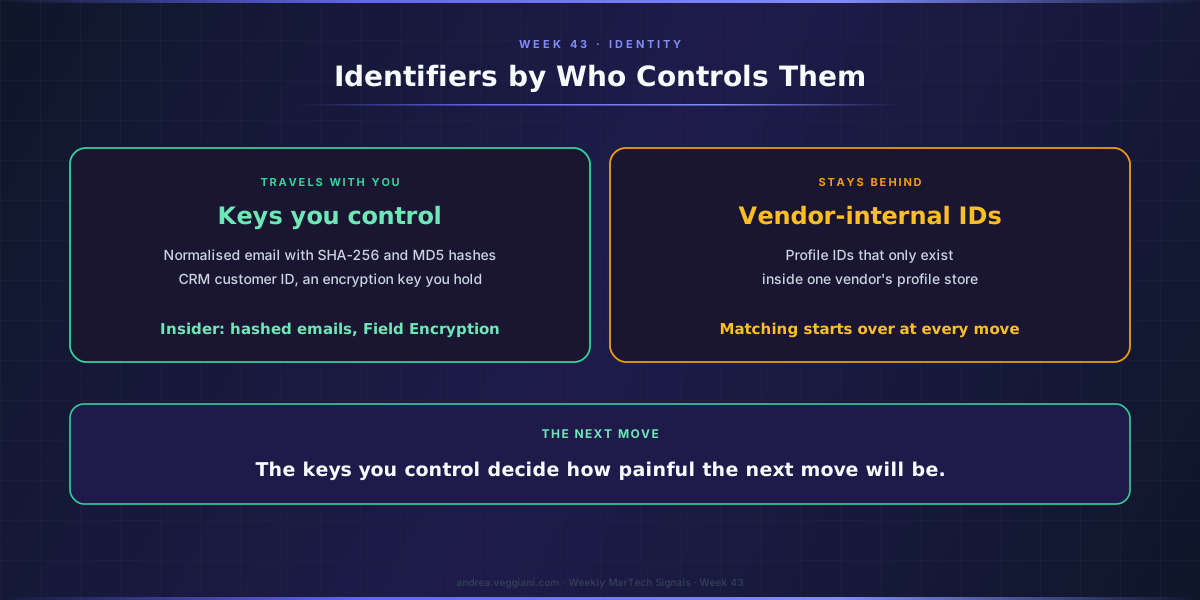
Insider documented two features this week that point in a useful direction. With hashed email identifiers, “Insider One treats a plain email address and its SHA-256 and MD5 hashes as the same person”: when a plain email arrives, the platform stores both hashes on the profile, and data that later arrives with only a hash lands in the right place. With Field Encryption, in early access, a company registers its own encryption key once and sends identifiers encrypted with it, and the platform decrypts and matches them on ingestion.
The general point reaches well beyond Insider. An identity strategy built on keys the company controls, a normalised email and its standard hashes, a customer ID from the CRM, an encryption key the company holds itself, is easier to carry from one platform to another than one built on identifiers that only exist inside a vendor’s profile store. I wrote about a different identity question, whose identity an agent acts under, in Part 22; this one is older and more basic, and it decides how painful any future move will be.
Agent instructions are artefacts you own
The third part is newer. Teams are starting to write instructions for agents that work inside their platforms, and those instructions are becoming part of the stack.
Marketo Engage’s November release lists Callable Agents, which “run as a flow step in your smart campaigns and act on a lead record based on instructions you write in plain language”, for example to normalise a lead’s data or flag likely bots, with the result written back to fields on the lead. It is marked as coming soon, with the release scheduled from 6 November. Bloomreach made Loomi Connect generally available, with more than 180 tools that compatible agents can call to analyse performance, build segments and launch campaigns as approved actions.
How far such agents should be allowed to act is a separate question, which I covered in Part 23. The point here is ownership of the text. An instruction that says how a lead should be cleaned, or which tools an agent may call for a campaign, encodes business rules in the same way a smart list or a journey does. If it lives only inside the platform, it is lost or rewritten at the next change. If it is versioned outside, with an owner, it moves with the team.
A checklist for the pending period
None of this requires a view on how the acquisition will turn out. On public documentation as of publication, the outcome is not described, and the useful work does not depend on it. For any stack that includes Braze or Salesforce Marketing Cloud, or that is choosing between them, I would write down three things now: the contracts at every edge of the engagement platform, with direction and owner; the identifiers used to match people across systems, and which of them the company controls; and every instruction and tool list written for an agent, stored and versioned outside the platform.
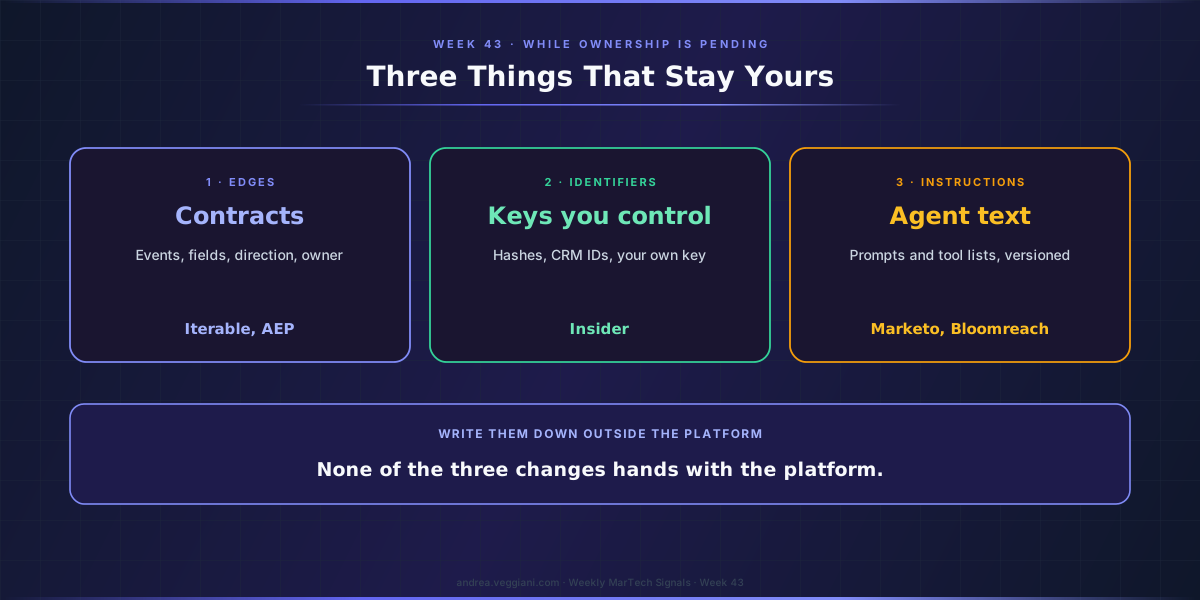
While ownership is pending, design the parts of the stack that never change hands: the edges, the identifiers and the instructions.
Sources
Salesforce and Braze
- Salesforce Signs Definitive Agreement to Acquire Braze. Source for the enterprise value, the price per share, the expected close and its conditions, the four layers, the Marketing Cloud quote, the CEO quote and the composable approach.
- Braze investor news. Braze’s listing of the same announcement.
Iterable
- 2026 Release Notes. Source for Salesforce data out and the consent sync back to Contact and Lead records.
Adobe Experience Platform
- Pre-release notes, October 2026. Source for When to activate, its three triggers and their defaults.
Insider
- Hashed Email Identifiers. Source for SHA-256 and MD5 matching.
- Field Encryption Key. Source for customer-held keys and early access status.
Adobe Marketo Engage
- Release notes, November 2026 and release schedule. Source for Callable Agents, their coming-soon status and the 6 November date.
Bloomreach
- Loomi Connect general availability. Source for the number of tools and the approved actions.
The record
- MarTech Watch, Week 43. Every date and status referenced in this essay.
- Part 22, Week 40 and Part 23, Week 41. Earlier essays on whose identity an agent uses and on autonomy as a setting.
- Weekly AI Tools That Matter to Me: Part 13, Week 43. The same week on the agentic tools beat, where the question was who maintains a written procedure once the format is shared.
The digest behind each weekly article is produced through a structured AI-assisted scan of official release notes and product update sources. I review the output, verify the relevant signals and write the architectural interpretation.
This article draws from the Martech Weekly Digest scans run on October 22, 2026, covering 16 to 22 October across several CEP platforms and vendors. The dated record behind it is in MarTech Watch, Week 43.
If you find errors or gaps in coverage, I want to know. The process improves when the output is challenged.