8 min read
The Way Out Deserves as Much Design as the Way In
When I review a journey design, the entry criteria usually fill a page and the exit gets one line. The same is true of segments, audience syncs and integrations: a lot of thought goes into how something starts, and very little into how it stops. The releases in the Week 42 MarTech Watch are unusual because several of them are about stopping, and together they make a case that the way out is now a design object in its own right.
TL;DR
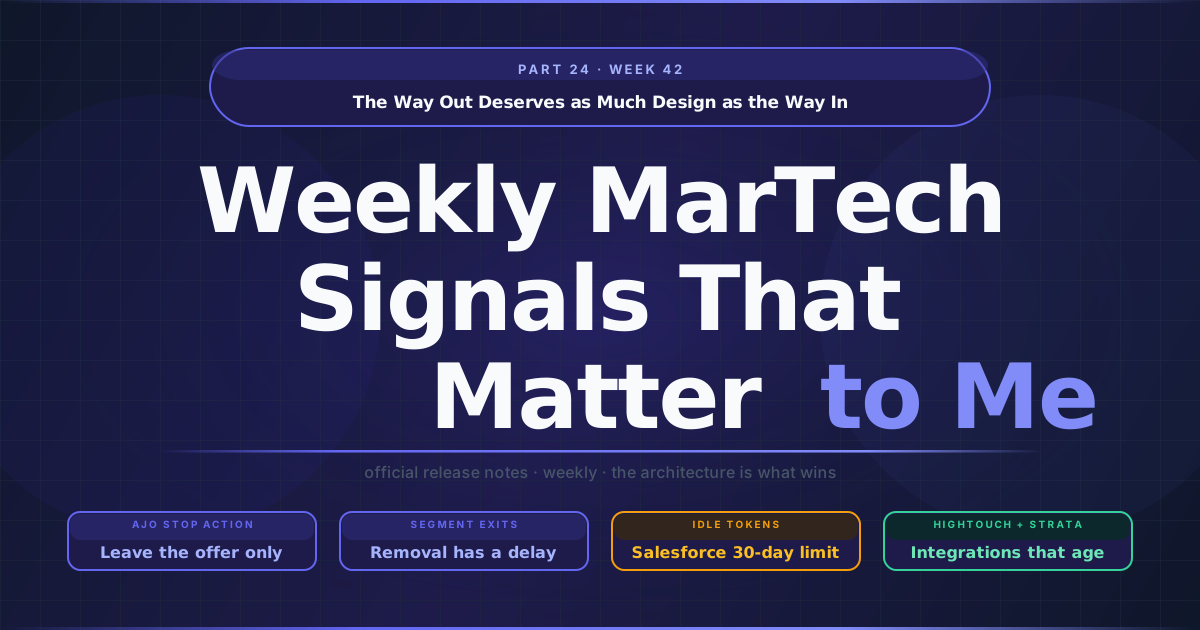
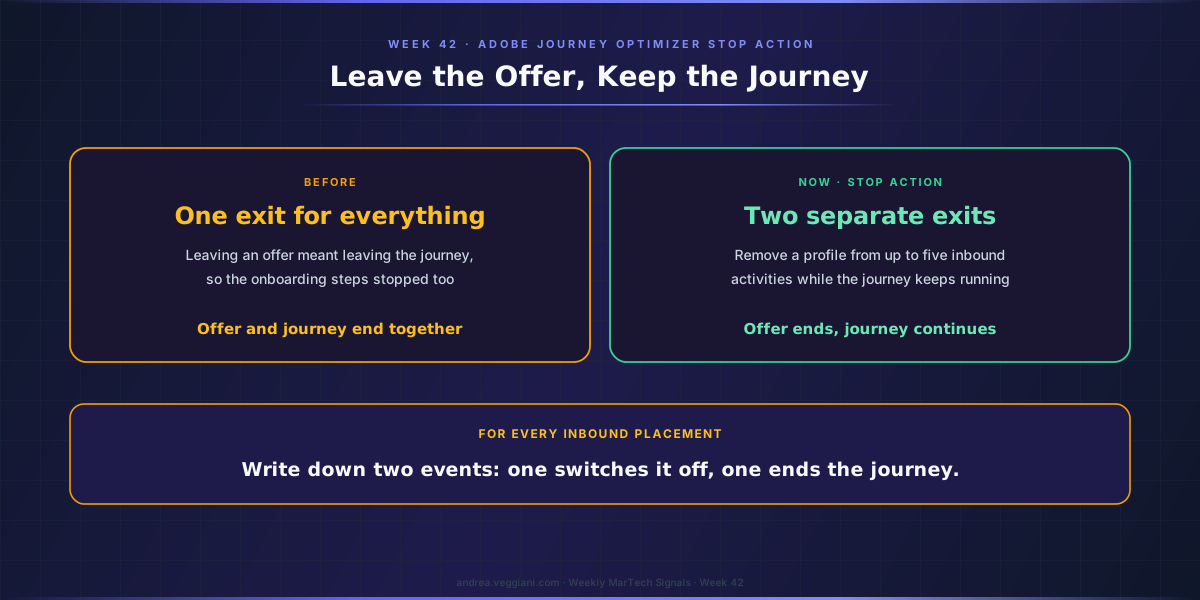
- Leaving an offer no longer means leaving the journey. Adobe Journey Optimizer’s new Stop action removes a profile from up to five inbound activities or experiences while the journey keeps running, so every inbound placement now needs its own switch-off event.
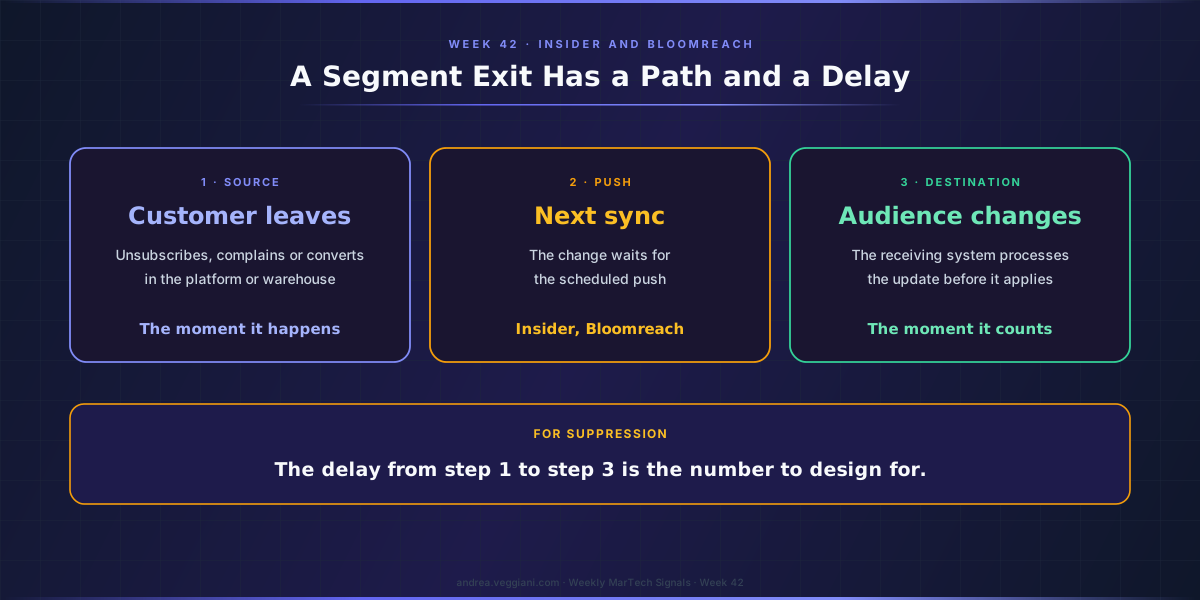
- A segment exit has a path and a delay. Insider’s ChatGPT Ads sync removes people who leave a segment, and Bloomreach 1.320 imports external segments from a warehouse; in both, removal arrives after a push and the destination’s own processing.
- Integrations age and expire. Salesforce will revoke refresh tokens idle for more than thirty days, and Hightouch bought Strata, whose agent keeps custom integrations running as systems change.
- Withdrawal has to be as easy as the yes. The Garante’s 29 October term asks for consent that can be withdrawn simply and selectively, and the withdrawal has to reach every system that reads it.
A way out that is not the end of the journey
Adobe Journey Optimizer added a Stop action activity to the journey canvas. Adobe’s description is precise: it lets you “remove a profile from up to five inbound activities or experiences directly from a journey, decoupling inbound disqualification from journey exit for more advanced cross-channel orchestration.”
The interesting word is decoupling, because in the setups I have worked on the two things were tied together. Inbound placements, an in-app message, a content card, a code-based experience, stayed visible for as long as the profile sat in the journey that placed them. If a customer converts on day two of a five-day onboarding journey, the promotional card that was meant to push the conversion keeps showing, because the only clean way to remove it was to remove the person from the journey. That also removed everything else the journey was meant to do next, the welcome sequence, the setup reminders, the first-use tips, which the customer still needs.
Teams have worked around this for years. Some split one journey into two, so that exiting the first ends the offer while the second carries on. Others add conditions to every inbound placement that check a profile attribute updated by another process. Both work, and both spread one decision across places that drift apart over time. With a Stop action, the decision lives where it belongs: at the point in the journey where the reason to stop becomes true, with the journey still running underneath it.
In my reading, this changes how the design document should look. For every inbound placement, there are now two separate questions. What event should switch this placement off? And what event should end the journey? They are often different, and writing them down separately is the first step to getting both right. The same release added an on-demand Validate button, which runs configuration and message checks when the designer is ready to test or publish. On a canvas that now carries its own exit logic, that check is a useful place to confirm that every placement has a way out.
Leaving a segment has to travel too
Segments have the same imbalance. Entry rules get attention, and removal is assumed to happen on its own. That assumption gets weaker every time a segment leaves the platform where it was built.
Insider documented a ChatGPT Ads Remarketing Segment that sends a Dynamic Segment to ChatGPT Ads as a custom audience and keeps it in sync: “Users who entered the segment are added, and users who left the segment are removed.” Only email address and phone number are sent, formatted and hashed with SHA-256, and Insider states that “No other identifiers or attributes are sent.” It also notes that ChatGPT Ads processes each update before the audience changes, so the effect of a sync is not immediate. I wrote about the assistant as an advertising channel in Part 20; the point here is the removal.
Bloomreach approached the same mechanics from the other side. Release 1.320 adds external segments: segments defined in a source system such as a data warehouse are registered in Bloomreach, membership updates are pushed from that source, and the segments are then targeted as customer properties. Where that state should live is a question I covered in Part 15.
What both releases make visible is that a removal has a path and a delay. A customer who unsubscribes, complains or converts leaves the source segment at one moment, and leaves the paid audience or the engagement platform at a later one, after a scheduled push and the destination’s own processing. For suppression use cases that delay is the whole question, and it deserves a number in the design, not an assumption.
Integrations have a lifecycle too
Integrations are the least visible thing in a marketing stack, and they also leave quietly. Salesforce told administrators that refresh tokens unused for more than thirty days will be revoked for connected apps and external client apps, in sandboxes first and then in production, with the dates in this week’s Watch. The notice names the likely cases itself: batch jobs, seasonal integrations, rarely used clients.
In marketing stacks, that list describes a specific kind of connector: the one that wakes up for a holiday campaign, a yearly loyalty reload or a quarterly data sync, and sleeps in between. When the token behind it has been revoked, the connector fails on the day it is needed, and a person has to log in again or reauthorise it. The fix is not technical. It is an owner and a calendar entry for every connector that does not run every month.
Hightouch, a vendor I follow on my watchlist but do not run in production, acquired Strata, which it describes as “an agent-driven platform for building and maintaining custom API integrations without code.” The agent maps fields and events, generates the integration and, in Hightouch’s words, “keeps it running as systems change.” Strata’s founders met as early employees at Iterable, which is a good sign that the problem they are solving comes from practice.
Read side by side, the two items describe the same truth from opposite ends. Integrations need care long after they are built: they age, credentials expire and the systems at either end change, and whether a person or an agent does the maintenance, someone has to know which integrations exist and when each one last worked.
Withdrawal has to be as easy as the yes
The regulatory version of the same idea arrives on 29 October in Italy. The Garante restated that by that date companies, platforms and newsletters must align notices, consents and withdrawal for email tracking pixels with its April guidelines, and it listed verification among its inspection activities for the second half of 2026. The Garante’s note says users must be able to withdraw consent simply, “anche selettivamente”, also selectively. I’m not a lawyer, and the regulator’s own page is the reference; the mechanics of consent as a profile field are in Part 21.
What strikes me is where the effort usually goes. Klaviyo, also on my watchlist, added email tracking consent to its sign-up forms, and capture is the part most stacks design carefully. The off switch, and where it propagates, is the part that gets less attention. A withdrawal that updates the profile but not the export to the ad platform, or not the field that the sending platform reads, is not a withdrawal anyone can demonstrate.
An exit inventory
Each of these releases gives teams a better tool for leaving, and none of them decides when to leave or how fast. On public documentation as of publication, that decision still belongs to the team that runs the stack. I would add one page to every CEP design: for each entry point, a journey, an inbound placement, a segment, an audience sync, an integration credential, a consent, the event that removes someone, every system the removal has to reach, and how long it takes to get there.
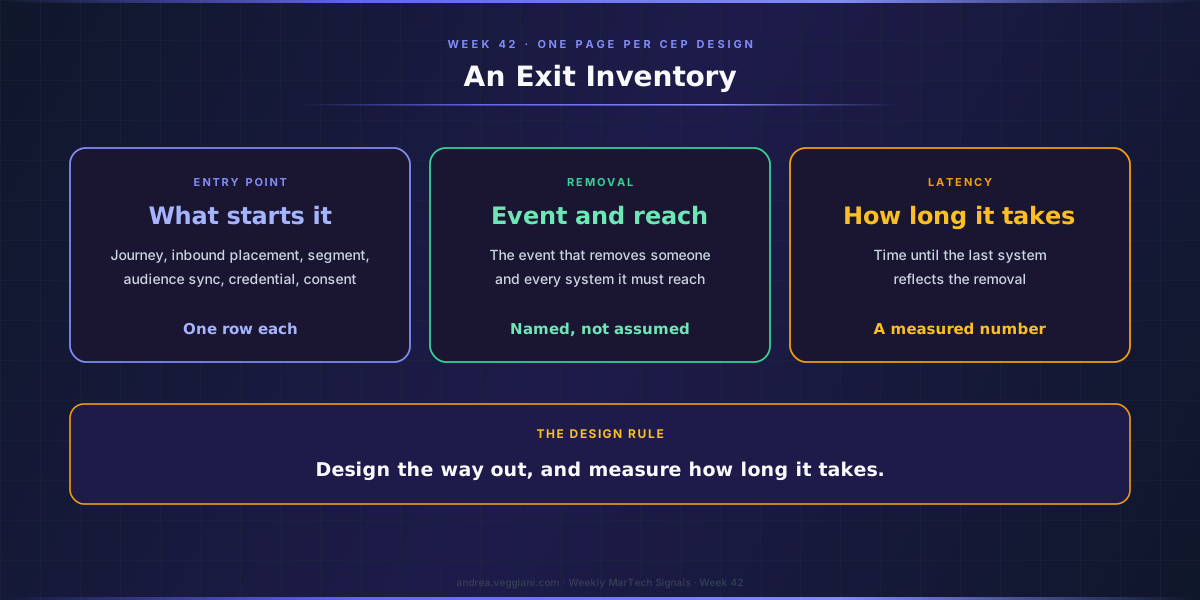
The way out of a journey, a segment or an integration is now something you can design, so design it, and measure how long it takes.
Sources
Adobe Journey Optimizer
- Release notes. Source for the Stop action description, the five inbound activities limit and the on-demand Validate button.
Insider
- ChatGPT Ads Remarketing Segment. Source for the sync behaviour, the identifiers sent and hashed, and the processing delay in ChatGPT Ads.
Bloomreach
- Release 1.320. Source for external segments, membership updates pushed from the source system and targeting as customer properties.
Salesforce
- MarTech Watch, Week 42. Source for the refresh token idle limit, its enforcement dates and the cases Salesforce names, from Salesforce’s administrator notification.
Hightouch
- Hightouch acquires Strata. Source for the acquisition, the description of Strata and its founders’ background.
Regulation
- Garante per la protezione dei dati personali, E-mail marketing: le linee guida sui tracking pixel. Source for the 29 October term, selective withdrawal and the inspection plan.
Klaviyo
- What’s New. Source for email tracking consent in sign-up forms.
The record
- MarTech Watch, Week 42. Every date and status referenced in this essay.
- Part 15, Week 32, Part 20, Week 38 and Part 21, Week 39. Earlier essays on where state lives, the assistant as an ad channel, and consent as a profile field.
The digest behind each weekly article is produced through a structured AI-assisted scan of official release notes and product update sources. I review the output, verify the relevant signals and write the architectural interpretation.
This article draws from the Martech Weekly Digest scans run on October 15, 2026, covering 9 to 15 October across several CEP platforms and vendors. The dated record behind it is in MarTech Watch, Week 42.
If you find errors or gaps in coverage, I want to know. The process improves when the output is challenged.