12 min read
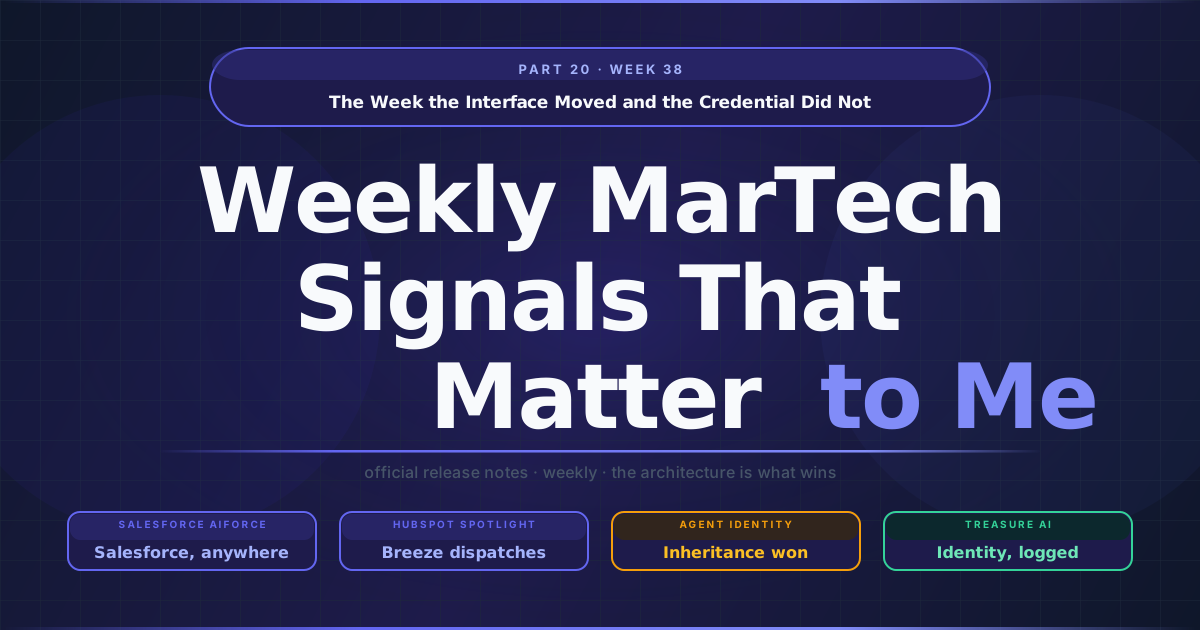
The Week the Interface Moved and the Credential Did Not
For two years the question I have been asked most often in platform selection has been some version of “which of these will still be the system of record in three years”. This week two vendors answered a different question, one nobody in the room had asked out loud: what if the system of record stops being a place you go to at all. Salesforce said it at Dreamforce, HubSpot said it at UNBOUND, and OpenAI said the consumer-facing half of it on the same day. None of them framed it as an architecture change. All three of them shipped one.
TL;DR
- Salesforce and HubSpot both announced that their own screen is no longer where you use them. AIforce takes a Salesforce tenant’s data, logic and permissions to Claude, Slack and Lightning; HubSpot’s new Breeze Assistant dispatches agents and its ChatGPT connector runs campaigns from outside HubSpot. In both cases the data stays put and the surface moves.
- Salesforce answered the agent identity question, and answered it as a feature. Every agent sees only what the person asking can see, with no new permissions model and no migration, which is the commercial argument for inheritance rather than the security one.
- Marketing is not in the Salesforce in Claude beta. The 37 prebuilt skills are sales skills, with analytics, service, marketing, commerce and industries stated as arriving “in the near future”, and the tool inventory and write scope are not documented the way Braze documented its own.
- Treasure AI published the first identity log on my watchlist. Two queryable tables record the key and value pairs excluded from stitching and the identifiers evicted at a profile’s two-hundred-association ceiling, on for every instance with no opt-in.
The screen stopped being the product
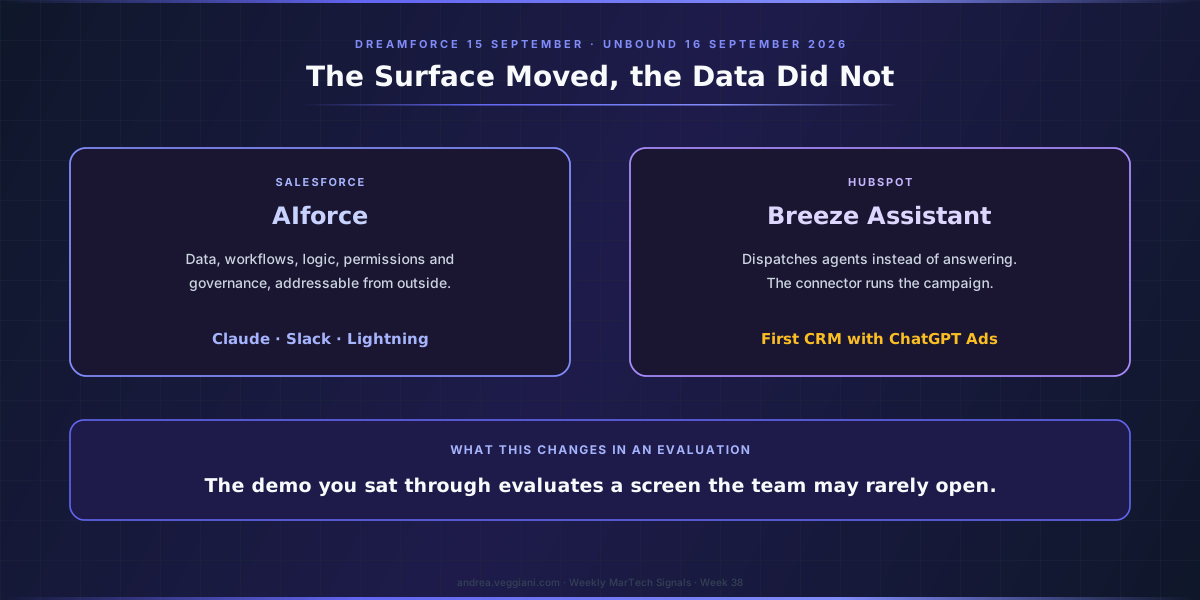
Salesforce unveiled AIforce on 15 September, and the sentence that matters is not in the product description, it is in the framing: “With AIforce, people don’t have to come to Salesforce to get work done. Salesforce comes to them, in Claude, Slack, Lightning, or wherever they want to work.” The layer takes the data, workflows, business logic, semantics, permissions and governance that already sit inside a Salesforce tenant and makes them addressable from outside it. It launches with three surfaces, Claudeforce, Slackforce and Agentforce Coworker, and it names the Headless Toolkit as the open architecture underneath.
A day later HubSpot’s Fall 2026 Spotlight did the same thing from the other end. The headline product is an all-new Breeze Assistant that no longer answers questions but dispatches them, in HubSpot’s own words it “assigns the right agents to get it done”. Underneath it sits a self-updating Smart CRM and Context Home, a screen whose entire job is to score how complete your context is and show you where the gaps are. And on the same day HubSpot became the first CRM to integrate ChatGPT Ads, with a connector that now runs email campaigns and builds landing pages from inside ChatGPT rather than inside HubSpot.
These are not the same product and the two companies do not compete for the same buyer, but they are making the same architectural bet, and it is a bet about where the interface lives rather than where the data lives. Both are explicit that the data is not moving. What is moving is the surface, and with it the place where a marketer forms an intention and the place where that intention becomes a write.
For anyone selecting platforms, that changes the shape of the evaluation. I have spent most of a career comparing user interfaces as a proxy for how a team will actually work in a system, and that proxy is now weaker than it was a month ago. If the real surface is Claude or Slack or ChatGPT, then the demo you sat through evaluates something the team may rarely open, and what changes on that surface becomes your problem too.
Inheritance stopped being an open question
This record has been tracking one question across every agent announcement since the summer: whose identity does the agent act under. The answers so far have been scattered. Braze publishes that agents inherit the dashboard user’s permissions and that revocation lands on the next request. Optimizely gave its Virtual Teammates identities of their own. MoEngage shipped sub-agent delegation with no identity statement attached at all.
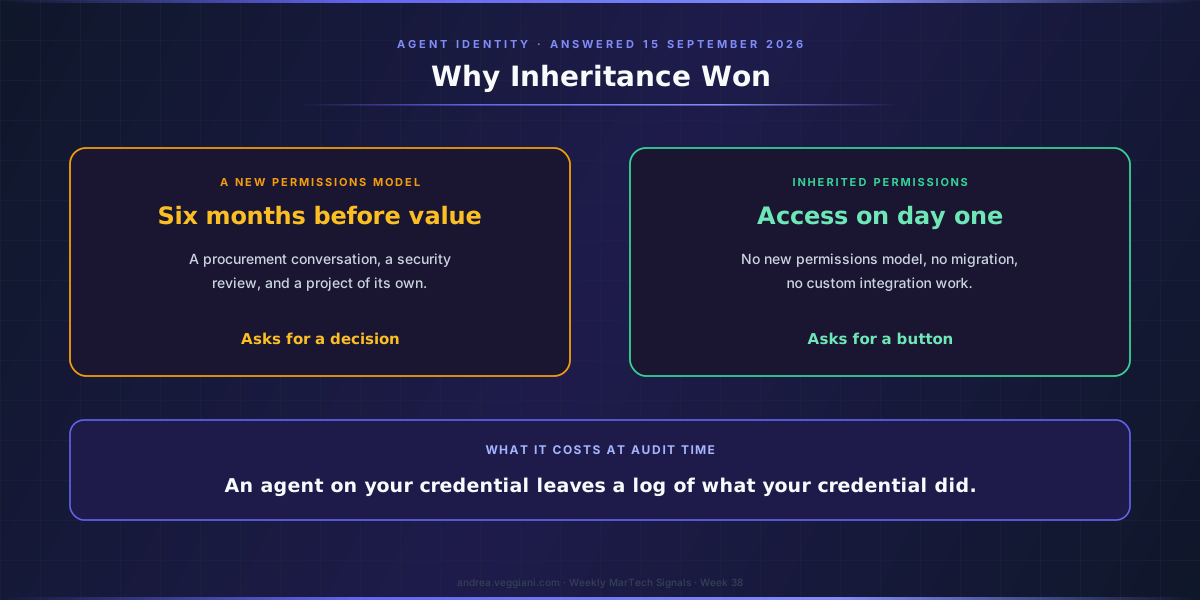
Salesforce has now answered it, twice on one page, and answered it as a feature rather than as a constraint. AIforce is described as “Secure and governed: Because every request runs on existing permissions and business rules, every agent sees only what the person asking can see, and every action routes back through Salesforce.” Agentforce Coworker gets the same treatment, “it operates entirely within your existing permissions and business rules, and nothing is retained outside your trust boundary”, and then the commercial line that explains why inheritance won: “No new permissions model, no migration, no custom integration work. Admins connect once and teams get access on day one.”
That last sentence is the whole argument. Inheritance is not winning because it is the cleanest security model. It is winning because a new permissions model is a procurement conversation, a security review and a project, and inheritance is none of those. A vendor that requires one is asking for six months before value; a vendor that inherits is asking for a button.
I think the trade is defensible at runtime and awkward at audit time, and I want to be careful about the register here, because this is my reading rather than a vendor statement. When an agent acts under a person’s credential, the log of what the agent did is a log of what that person’s credential did. If a campaign goes out wrong, the question “who approved this” resolves to a named human who may have typed one sentence into a chat window. Salesforce’s own mitigation, that every action routes back through Salesforce, helps with where the action landed. It does not by itself separate an action a person took from an action an agent took on their behalf, and I have not seen documentation from any vendor on this watchlist that does.
Marketing is not in the beta
The Claudeforce half of the announcement deserves a sentence of precision that most coverage skipped. Salesforce in Claude went into beta for all customers, and what ships is a prebuilt MCP server inside Claude carrying 37 prebuilt sales skills, from prospecting to pipeline hygiene, piloted with Deloitte, GitLab and Legora. It is a real capability with a real tool surface, and it is a sales capability.
Salesforce is straightforward about the rest: analytics with Tableau, and skills for service, marketing, commerce and industries, arrive “in the near future”. So the one vendor on my list of nine that has put its platform inside a general-purpose assistant has not yet put its marketing platform there. On public documentation as of publication, the tool inventory and write scope of that MCP server are not described the way Braze described its own, which named 71 tools and marked 34 of them as writes.
That gap is the thing to watch rather than to complain about. When the marketing skills land, the question for anyone running Marketing Cloud is narrow and answerable: which of them write, what is the smallest unit of damage one of them can do, and does the same inheritance model apply when the write is a send.
The ad became a conversation
The third announcement of the week is the one that will reach clients before either of the first two. OpenAI is testing Sponsored Agents, which turn an ad click inside ChatGPT into “a clearly labeled conversation with a business-sponsored agent”. OpenAI states that this conversation is distinct from ChatGPT’s independent answers and separate from the conversation the user started. Alongside it came an Ads Manager plugin that creates and analyses campaigns from a prompt, AI creative suggestions drawn from the landing page, and an opt-in setting that adapts existing headlines and descriptions to the context of a conversation and auto-translates ad copy into the reader’s language.
Read that last item as an architect rather than as a media buyer. The creative is no longer a fixed asset with a variant list. It is generated per conversation, in a language selected at runtime, inside an exchange the advertiser does not observe. Every measurement framework I have built for a retail or fashion client assumes that a creative is a countable thing with a stable identity, and that assumption has just been removed from one channel.
I want to state the limit of what I know here. The announcement does not describe what an advertiser is shown about what a Sponsored Agent said on its behalf, and I have read the full page rather than a summary of it. That is a question to take to an account team once the test widens, and I have no basis for saying the capability is missing.
What is certain is distribution. HubSpot is the first CRM partner and Shopify the first ecommerce partner, both live now, with the Shopify app going international from 23 September. A channel that was a pilot a month ago arrives inside two platforms that mid-market marketing teams already run.
Treasure AI wrote down what identity resolution never showed you
Away from the conference noise, the most useful release of the week came from Treasure AI, and it is the kind of thing that only looks small if you have never had to explain a merged profile to a client.
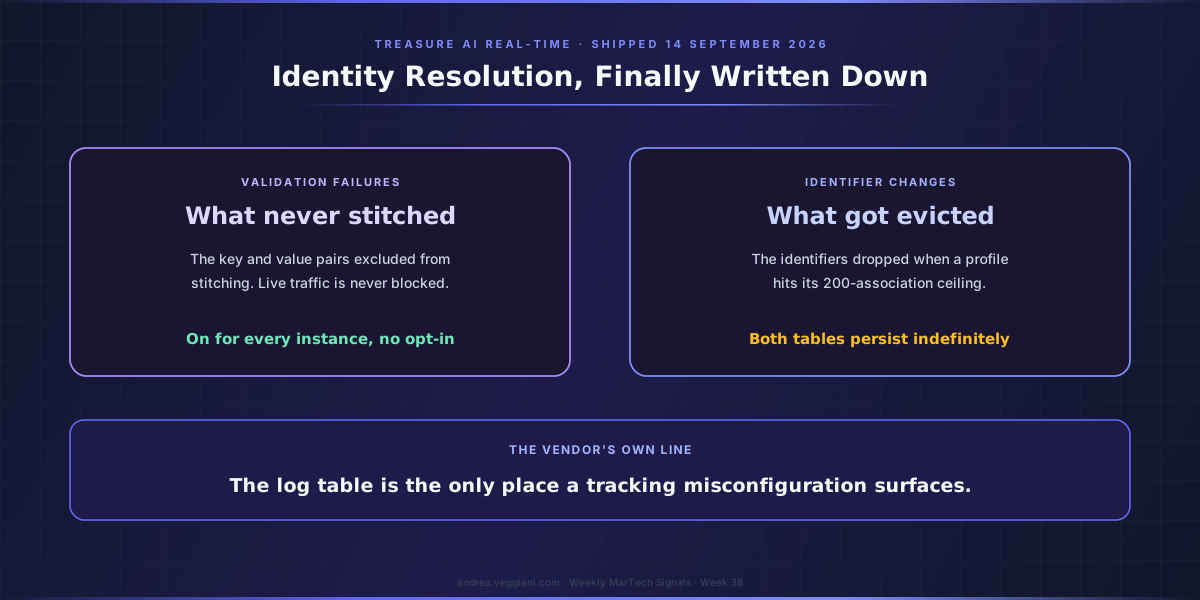
Real-Time now writes its identity decisions to two queryable tables. One records the key and value pairs on an incoming event that failed validation and were excluded from stitching. The other records identifier changes, and it now also records which identifiers were evicted when an event stitched to a profile already holding two hundred associations. Merge rows report the incoming identifiers that triggered a merge separately from the profile’s full association set, so you can see which identifier caused a merge rather than only that one happened.
Three properties make this matter more than the feature description suggests. Logging is on for every instance with no opt-in. Live traffic is never blocked, so an event carrying an invalid key is still processed. And the vendor says the consequence out loud: the log table is the only place a tracking misconfiguration surfaces.
Identity resolution has been the least observable part of a customer data platform for as long as the category has existed. A profile either merged or it did not, and the reason lived inside the vendor. An eviction ceiling at two hundred associations is exactly the kind of limit that bites a telco or a device-heavy retailer, quietly, for months, and until this release a client could not watch it happen. Both tables persist indefinitely by default, which is a storage decision someone should make deliberately rather than discover on an invoice.
The unglamorous items that will actually cost you a sprint
Bloomreach shipped release 1.318 on 16 September and used it to rename the product: Bloomreach Engagement is becoming Marketing across the UI, with the vendor stating that nothing about the service, its functionality or the agreement terms changes. Underneath the rename sits a Flutter SDK 3.0.0 that raises the floor to Flutter 3.38.0, Dart 3.10.0 and iOS 15.0 for Xcode 27 compatibility, adds Stream integration with JWT authentication for the Tracking API, and adopts the iOS UIScene lifecycle. A Flutter shop below those minimums cannot take this release without a toolchain upgrade first, and that is a planning conversation rather than a patch.
Two Adobe items belong in the same category. Marketo’s current release-notes page carries an announcement that the REST API access_token query parameter stopped being available after 31 August 2026, and integrations must now authenticate with the Authorization header. That date has passed. Separately, Journey Optimizer expanded the list of reserved keywords in Profile Query Language to include general keywords, time units and boolean and logical operators, so an XDM schema field whose name collides with one must now be wrapped in backticks to be referenced in a personalization expression. Neither item was announced loudly. Both can break a running implementation.
And Twilio has told anyone running a peak-season SMS programme what November looks like: a Heightened Awareness Period from 19 November to 4 January, during which US sending rates are monitored and may be limited at account level for toll-free, short code and 10DLC numbers, with high-volume short-code and toll-free accounts liable to be moved temporarily to Market Throughput. If your Black Friday plan assumes the throughput you tested in September, test it again.
What I would actually put on a client call
Three things, in this order.
First, if you run Salesforce or HubSpot, the interface question is now a governance question, and it belongs on the desk of whoever owns identity. Inheritance means your agent’s blast radius is exactly the blast radius of the people you enable it for, so the useful exercise is to re-read the permission sets of the twenty people you would switch it on for first, before anyone sits through a demo of the agent itself.
Second, if you are inside a regulated vertical, this was a good week. Journey Optimizer Loyalty became available to Healthcare Shield and Privacy and Security Shield customers on 15 September, and Salesforce updated its Account Engagement release note on disabling email open and click tracking, which now offers per-business-unit control over opens, links and advanced metrics. That makes three platforms on this watchlist with a documented tracking switch framed as regulatory compliance, after Adobe Campaign’s Web UI toggle and Klaviyo’s consent-conditional click tracking. With the Italian Garante’s term falling on 29 October, that is no longer a roadmap conversation.
Third, and this is the one I would lead with: ask your CDP vendor to show you the identity log. Treasure AI has now published one. The others have not, and the request is reasonable enough that the answer will tell you something either way.
The vendors spent this week explaining that you no longer have to come to them. The architecture question underneath is the same one it has always been, only harder to see now that the interface has moved: when something goes out that should not have, whose name is on it.
Sources
Salesforce and Dreamforce 2026
- Salesforce Unveils AIforce, Bringing the Full Power of Its Platform to Any Interface. Source for AIforce, Salesforce in Claude and its 37 prebuilt sales skills, Agentforce Coworker, and every quoted governance property.
- Salesforce Winter ‘27 Release Note Changes. Source for the week of 14 September additions, including Salesforce in Claude and the OAuth flow blocking in new orgs.
- Marketing Cloud Account Engagement Winter ‘27 release notes. Source for Disable Email Open and Click Tracking and its per-business-unit scope.
HubSpot and OpenAI
- Fall 2026 Spotlight. Source for Breeze Assistant, Smart CRM, Context Home and Marketing Studio.
- HubSpot and OpenAI deepen partnership. Source for the first CRM integration with ChatGPT Ads and the updated connector.
- Reimagining advertising with AI. Source for Sponsored Agents, the Ads Manager plugin, AI text customization and the Shopify international date.
Adobe
- Journey Optimizer release notes. Source for the Journey Anomaly Detected alert, Loyalty on the Shield tiers, and the expanded PQL reserved keywords.
- Marketo Engage current release notes. Source for the REST API
access_tokendeprecation.
CDP and data
- Treasure AI September 2026 release note. Source for the Real-Time identity log tables, the two-hundred-association eviction and the observability tracking ID.
- Bloomreach release 1.318. Source for the rename and the Flutter SDK 3.0.0 minimum versions.
Channels
- Twilio changelog. Source for the Heightened Awareness Period dates and throughput handling.
- Klaviyo What’s New. Source for consent-conditional click tracking and the September releases.
The full record
- MarTech Watch: Week 38, 2026, which carries every item, its date, its status and its primary source, including the ones this essay did not have room for.
The digest behind each weekly article is produced through a structured AI-assisted scan of official release notes and product update sources. I review the output, verify the relevant signals and write the architectural interpretation.
This article draws from the Martech Weekly Digest scans run on September 17, 2026, covering 11 to 17 September across several CEP platforms and vendors. The dated record behind it is in MarTech Watch, Week 38.
If you find errors or gaps in coverage, I want to know. The process improves when the output is challenged.