When I opened the 2026 Field Notes series in February, I started with Braze because it was the clearest example of an independent, event-driven engagement runtime I had worked with. Four chapters later, Part 5 described Salesforce Marketing Cloud through the pull of CRM gravity, where marketing becomes an extension of the CRM operating system and Data Cloud (now Data 360) supplies the context. I wrote those two chapters as opposite ends of the decision every CEP evaluation eventually reaches, an engine built around live behaviour on one side and a suite built around the customer record on the other, and the whole series rested on a premise I never had to write down, which was that Braze and Salesforce were two different companies with two different ideas of what an engagement platform is for.
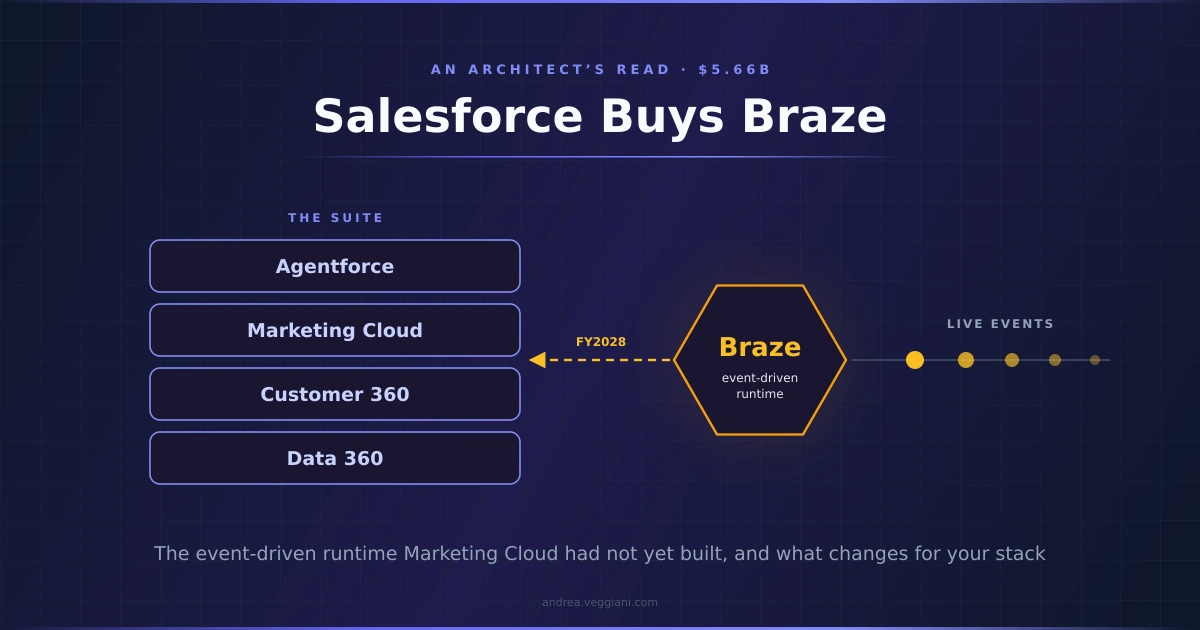
On 20 October 2026 Salesforce signed a definitive agreement to acquire Braze for $47.50 per share in cash, about $5.66 billion in enterprise value, with closing expected during Salesforce’s fiscal 2028; the dated record of that week is in the Week 43 MarTech Watch. From fiscal 2028, the two opposite ends of my Field Notes map will describe two products of the same company.
TL;DR: Salesforce is paying $5.66 billion for an event-driven engagement runtime with Braze’s decisioning layer on top, the part of the stack its native Marketing Cloud rebuild had not yet delivered for mobile-first B2C. The deal moves a Pattern C engine into the reference Pattern A suite, and the questions that matter now are architectural ones each enterprise will have to answer for itself, long before Salesforce publishes a combined roadmap.
That change rewrites the map the series drew, and it is the reason I want to read this deal as an architect would, looking at what Salesforce bought, where Braze sits in the CDP–CEP patterns and how the market around it shifts.
Salesforce is buying the runtime it had not managed to build, and every enterprise running Braze now has to decide how much of its own architecture it wants to follow that runtime into the suite.
What Salesforce Actually Bought in Braze
Braze began life as Appboy in 2011, and its design still reflects that origin. It was built SDK-first for mobile apps, it listens to a continuous stream of behavioural events, and it evaluates entry, exit and branching conditions in Canvas as those events arrive, which is the event-driven model the rest of the market has spent a decade trying to retrofit. The things practitioners rely on every day, from real-time triggers and in-app messaging to Currents streaming engagement data back into the warehouse, all follow from that starting point.
On top of the runtime, Braze added a decisioning layer. In March 2025 it agreed to acquire OfferFit for $325 million in cash and stock, and the product now ships as BrazeAI Decisioning Studio, a reinforcement learning system that tests offers, send times, channels and frequency for each customer and keeps adjusting as results come in. I called that move strategically loud at the time because it shifted the CEP conversation from who draws the best journey canvas to who runs the best optimisation loop. At Forge 2026, held from 28 to 30 September, three weeks before the Salesforce announcement, Braze pushed the same direction further with four launches: Decisioning Studio Go, an agent that picks the subject line, send time and image for each recipient of a recurring email, measured against a random control group; Agentic Standards, which checks campaigns and Canvases against brand, compliance and personalisation rules; Operator Connect, which brings BrazeAI Operator into Claude, ChatGPT and Microsoft Copilot under the user’s existing Braze permissions; and Conversational Agents for two-way conversations across WhatsApp, SMS, RCS and web. Decisioning Studio Go reached general availability in the 15 October release, five days before the deal was announced, alongside Message Prioritization, while Agentic Standards remains in beta.
The business behind the product is healthy enough to explain the price. In its fiscal second quarter of 2027, which ended on 31 July 2026, Braze reported revenue of $227.2 million, up 26.2% year over year, with 2,789 customers, 361 of them above $500,000 in annual recurring revenue, and full-year revenue guidance of $910 to $913 million. At $5.66 billion, Salesforce is paying a little over six times guided revenue for a company whose non-GAAP operating margin was just under 10% last quarter.
The comparison I keep coming back to is 2013, when Salesforce paid $2.5 billion for ExactTarget. That deal bought email at enterprise scale, and the Marketing Cloud Engagement product most practitioners still work with today grew out of it, with data extensions, SQL activities, Automation Studio and a Journey Builder that added API entry events to an engine designed around relational data and scheduled processing. Salesforce has spent the last few years rebuilding marketing natively on its core platform, with Marketing Cloud Next and Data 360 doing the heavy lifting, and Part 5 described how Engagement and Next coexist in real programmes. The pace of that rebuild shows in small details: in the week of 12 October, Marketing Cloud Next withdrew four Landing Pages and Forms release notes because, in Salesforce’s words, “these features aren’t quite ready yet”. My reading of this acquisition is that Salesforce decided the native rebuild would not reach the event-driven, mobile-first B2C runtime fast enough on its own, and that buying the category reference was quicker and less risky than continuing to simulate it.
The Fourth Piece: Contentful, Fin, Listen Labs and Braze
Looked at one at a time, Salesforce’s 2026 acquisitions read like an expensive shopping list. Looked at together, they draw a single architecture diagram.
In June, Salesforce agreed to buy Contentful for about $1.5 billion, which I read at the time as a move into the content layer that turns content into a runtime asset agents can retrieve and assemble. Also in June it agreed to pay about $3.6 billion for Fin, the customer service AI company formerly known as Intercom, a deal that closed on 10 September. At the start of October it moved to acquire Listen Labs, an AI customer research company, in a deal reported at around $2 billion. Braze is the fourth and largest piece, and together the four come to more than $12 billion of announced or reported deals in a little over four months.
Salesforce’s own framing says Braze will complement all four layers of its architecture, Data 360, Customer 360, Agentforce and SIForce, which makes the shape of the loop easy to see. Listen Labs helps the business understand why customers behave as they do, Data 360 holds the unified context, Contentful supplies governed content, Fin handles service conversations, Agentforce reasons across all of it, and Braze executes the high-frequency, last-mile interaction on mobile, in-app, web and messaging channels. Agentic marketing has an obvious bottleneck at that final step, because an agent that reasons well about a customer is of little use if the execution layer cannot react to a live in-app signal, choose between competing offers in milliseconds and suppress a promotion the moment a service case opens. That final step is what Braze was built to do.
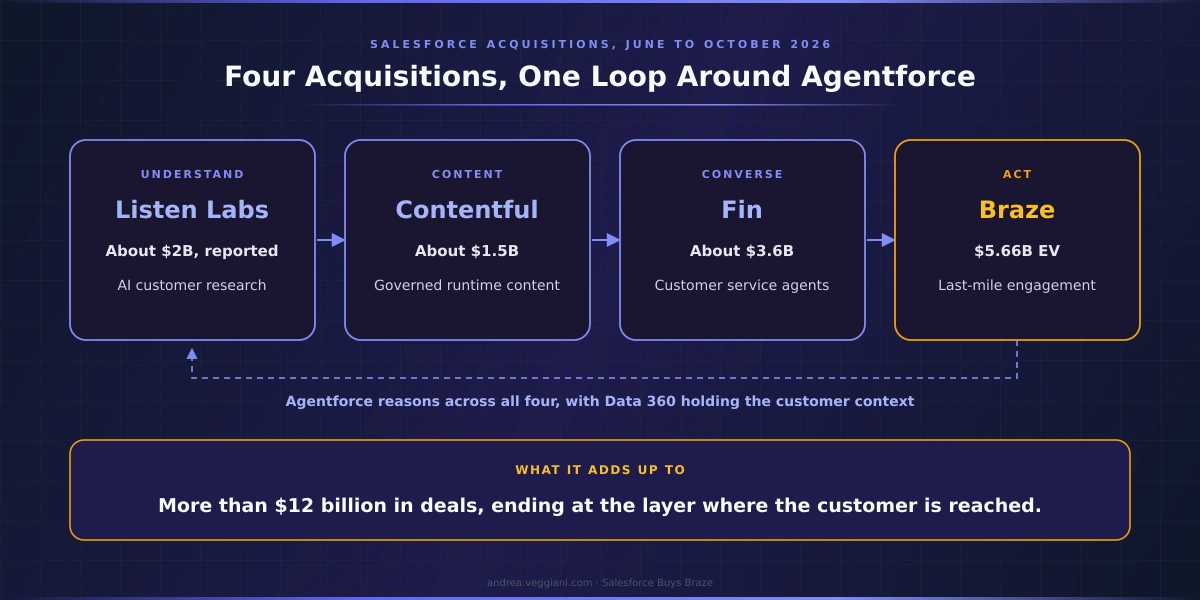
Figure 1. Read together, the four deals cover understanding, content, conversation and action, with Braze at the execution end.
It is also where Adobe has been strongest. Adobe Experience Platform with Adobe Journey Optimizer is the closest thing the market has to a suite with a native real-time runtime, and until this week Salesforce’s answer to that combination in mobile-first B2C was the weakest part of its offer. With Braze inside, the competitive bar for AJO in that segment rises, and the content-layer contest I described after the Contentful deal now extends to the execution layer as well.
A Pattern C Engine Inside a Pattern A Suite
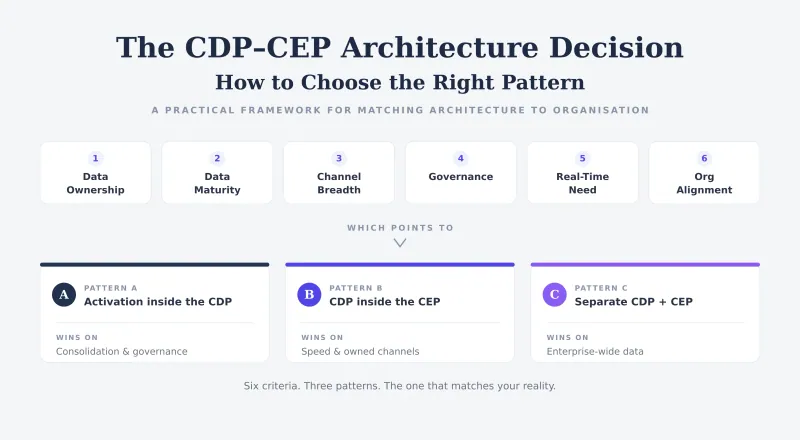
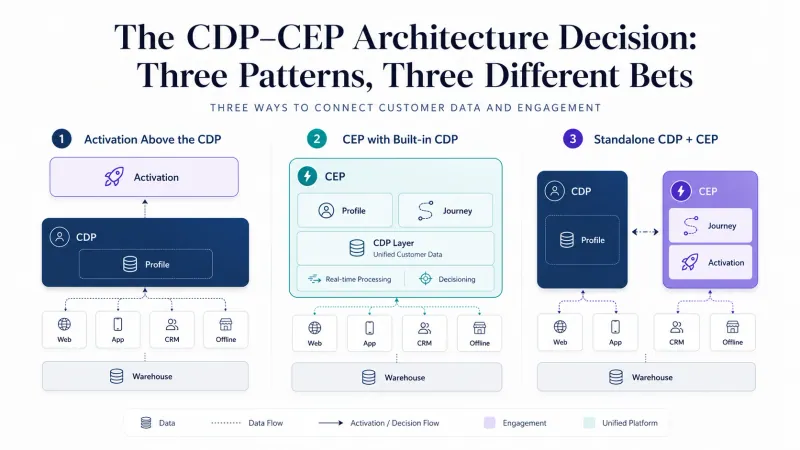
The framework I use for these decisions, set out in The CDP–CEP Architecture Decision, describes three patterns. In Pattern A, activation lives inside the CDP, because the data platform vendor expands upward into journeys and channel execution and the CDP remains the system of record. In Pattern B, the CDP lives inside the CEP, because the engagement vendor expands downward into identity, profiles, event ingestion and segmentation. Pattern C is classic best-of-breed, a standalone CDP or warehouse-based data layer connected to a separate CEP through APIs, streaming or Reverse ETL.
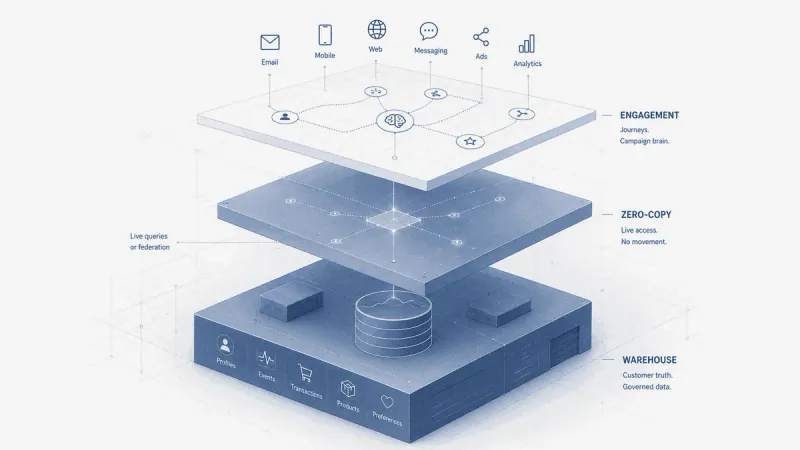
Salesforce with Data 360 and Marketing Cloud is the reference example of Pattern A, with activation built on top of the data layer and governed by the same model. Braze sits in Pattern C. It has strong behavioural event ingestion, user attributes, segmentation and real-time activation, but it does not position itself as a full enterprise CDP or as a replacement for identity resolution upstream, and its answer to the data architecture question has increasingly been direct connections to the warehouse: Snowflake Data Sharing, Cloud Data Ingestion from Snowflake, Databricks or BigQuery, and Reverse ETL tools such as Hightouch or Census. Pattern B belongs to vendors such as Bloomreach and Insider One, which position their platforms as the combined data and engagement system. A typical Pattern C arrangement around Braze has the warehouse owning the customer truth, Salesforce CRM owning the business records and Braze owning the moment of interaction, which is the shape I described in zero-copy engagement.
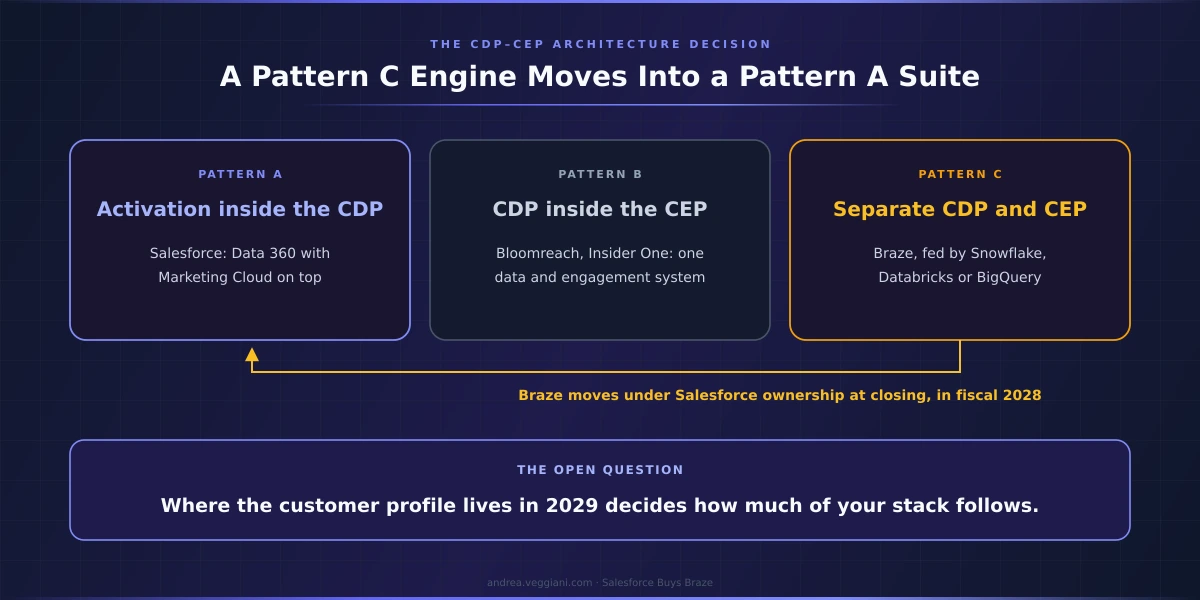
Figure 2. Braze has been a Pattern C engine, connected to the data layer its customers already own; after closing, its owner is the reference Pattern A suite.
Inside a Pattern A suite, gravity pulls toward the suite’s own data layer, and it does so through three channels that rarely appear in a press release. The first is commercial, when new capabilities are priced or packaged around Data 360 consumption. The second is product, when the most interesting AI features need the context that only the suite’s data layer holds. The third is organisational, when the account team, the partner ecosystem and the reference architectures all start drawing Data 360 in the middle of the diagram. Salesforce says Braze will complement Data 360, and Bill Magnuson has said “We’ll continue building as Braze,” and I take both statements at face value. Neither of them tells you where the customer profile will live in 2029.
That question matters because two profiles of the same customer is the drift problem Pattern A was designed to remove. In Pattern A the activation logic sits next to the governed profile, while a Braze customer on Pattern C maintains an audience definition in the warehouse and a corresponding segment or entry condition in Braze. If Braze becomes the execution engine of Salesforce’s Pattern A, customers running it in Pattern C may face a slow re-platforming of identity and context even if they never change CEP. The same tension applies to where decisioning should live, because Decisioning Studio optimises inside the CEP while Agentforce reasons across the suite, and two decisioning layers making choices about the same customer need a clear division of responsibilities.
How Many Marketing Clouds Does Salesforce Run Now
Salesforce’s marketing portfolio already needed a map before this deal. Marketing Cloud Engagement carries the ExactTarget lineage, Marketing Cloud Account Engagement (formerly Pardot) serves B2B, the Growth and Advanced editions run on the core platform, and Marketing Cloud Next is the agentic layer built around Agentforce and Data 360. Braze becomes the next entry on that list, and the announcement places it inside Marketing Cloud, with Magnuson and co-founder Jon Hyman bringing their expertise to that organisation.
What Salesforce has not published yet is just as important. There is no combined roadmap, no pricing model and no statement about how Braze will sit next to Engagement’s email, mobile and journey capabilities. My own expectation is that Braze ends up as the high-frequency B2C runtime of the portfolio, because that is the gap it fills, but an expectation is not a roadmap, and the fiscal 2028 closing date means Salesforce has every reason to keep the message vague until the deal clears its regulators.
For Engagement customers, the useful conversation starts now. It is reasonable to ask how much of Engagement’s R&D budget is committed for the next three years, whether the upgrade path towards Next still makes sense if Braze becomes the destination for real-time B2C, and who pays for a migration if one eventually becomes the recommended route. For Braze customers who already run Salesforce CRM, there is a real upside to weigh against the risks, since a native, supported connection between CRM objects and Braze events would remove integration work that today has to be designed and maintained by the customer.
What the Market Priced In
The market reaction is worth a short look because it tells architects something about timing. Braze shares rose about 51% on 20 October, which reflects the 58% premium over the previous close of $30.04, and they still traded roughly $2 below the $47.50 offer. That spread is the market pricing a long road to closing: the deal needs Braze shareholder approval, clearance under the Hart-Scott-Rodino Act and other antitrust and foreign investment approvals, with an outside date of 19 October 2027 that can be extended twice by up to 90 days. Salesforce owes Braze a $300 million termination fee if regulators block the deal or it fails to close in time, under conditions set out in the merger agreement, and Braze owes Salesforce $191.39 million in specific cases, such as accepting a superior proposal.
Salesforce shares slipped by around 1.4% on the day. Klaviyo moved the other way, rising between 8% and 10% as investors reassessed the category, since with Braze leaving the public market Klaviyo becomes the most visible independent CEP still listed, a position I looked at in Part 8. Speculation that Klaviyo could be the next target followed within hours. For the purposes of architecture, the useful number is the outside date, because it means Braze customers have up to a year, and possibly more, in which nothing changes in production and everything can change in negotiations.
Where Iterable, MoEngage, Insider One, Bloomreach and Adobe Stand
When the category reference moves into a suite, buyers who wanted independence look for it among the vendors that can still offer it. The 2026 Gartner Magic Quadrant for Multichannel Marketing Hubs, published a month before the deal, places several of them next to the Salesforce, Adobe and SAP suites: Iterable, MoEngage, Insider One, Bloomreach, Klaviyo, Optimove, Airship and CleverTap. For warehouse-native teams that chose Braze precisely to stay outside a suite, Iterable is one of the most direct independent alternatives, and I expect many of them to look at it, and at its peers, before their next renewal. Its October release added a Salesforce integration that writes opt-in and opt-out changes back to Contact and Lead records, which shows how an independent CEP can sit next to a Salesforce CRM while staying outside the suite.
MoEngage brings analytics and engagement together in one platform and is particularly strong in mobile-first markets where Braze has been its natural benchmark, so it gains a simpler story to tell those buyers. Insider One has always argued for functional density, with CDP, web and app personalisation, conversational messaging and AI inside one product, and it can now contrast a unified stack available today with a Salesforce portfolio that will take years to integrate. Bloomreach keeps the advantage I described in Part 2, where catalog, search intent and merchandising sit in the same platform as engagement and Loomi AI works across both, because owning Braze does not automatically connect Commerce Cloud’s product intelligence to messaging execution. In the same week Bloomreach made Loomi Connect generally available, exposing more than 180 tools to MCP-compatible agents, which gives it an agent-facing story of its own while Salesforce works out how Agentforce and BrazeAI fit together.
Adobe is the competitor that matters most at enterprise scale. The synthesis at the end of the Field Notes series already pointed to a market where suites and independents were converging from opposite directions, and this deal accelerates that convergence on the Salesforce side. AJO now faces a rival suite with a credible mobile runtime, which shifts the Adobe conversation in B2C towards how well AEP and AJO handle high-frequency, app-centric programmes, an area where Braze has been one of AJO’s most direct competitors.
Three Questions to Put on the Table Before the Deal Closes
Nothing breaks in production tomorrow morning, and conference keynotes will show a unified story long before the products underneath behave like one. If you run Braze, run Marketing Cloud, or are designing a three-year target state, these are the questions I would raise now.
- Will Braze stay neutral towards the warehouse? The test over the next 18 months is whether Cloud Data Ingestion, Currents and the warehouse connectors keep improving at the same pace, and whether new AI and decisioning features remain available on open schemas or start to require Data 360 to deliver their full value. Bill Magnuson has written that Braze remains “committed to an open, composable approach, so you can keep building on the data, tools, and partners you rely on today,” while Braze’s internal field Q&A says no decisions about the period after closing have been made, so the intent is on record and the implementation is still open.
- Where will the customer profile live in 2029? If the answer is Data 360, Pattern C customers need a plan for moving identity and context, and if the answer is still the warehouse, they should get that commitment in writing at renewal.
- Who arbitrates when everything can send? Fin service agents, Agentforce, Marketing Cloud journeys and Braze Canvases will all be able to reach the same person within seconds, so frequency capping, suppression, consent enforcement and decisioning priorities across engines become the architecture, and that ownership has to be designed explicitly. Braze’s Message Prioritization, generally available since 15 October, already decides which competing Braze message sends under frequency caps, and nothing yet plays that role across engines owned by the same company.
There is a fourth question, whether the organisation can actually operate what it ends up owning, and it deserves more than a bullet point. I will come back to it in a separate article, from the side of the teams that operate these platforms every day.
For what to write down while the deal is pending (the contracts at the edges of the engagement platform, the identifiers that travel and the instructions written for agents), the checklist is in Weekly MarTech Signals Part 25.
Rereading Field Notes Part 1 and Part 5
Part 1 and Part 5 still describe two different products, and until the deal closes they also describe two different companies, because nothing changes in production in the meantime and Braze’s runtime remains what the series described. What changes is how I would read the two chapters as a pair. Part 1 described an independent runtime whose value came partly from sitting outside any suite, and Part 5 described a suite whose value came from keeping marketing close to the CRM record. From fiscal 2028 the question those chapters framed as a choice between vendors becomes a choice inside one vendor’s portfolio, and the trade-offs they described move with it, from the procurement table into the design of each customer’s own stack.
That does not have to be bad news. A native, supported connection between CRM objects and Braze events could remove integration work that customers design and maintain themselves today, and the combined company has the resources to invest in decisioning at a scale Braze could not reach alone. It does mean that teams who chose Braze for its independence, and teams who chose Marketing Cloud for its CRM gravity, both have to decide, deliberately and early, which parts of their architecture they want to keep independent of the vendor that will own their runtime. When the deal closes I expect to revisit both chapters, because an honest version of the Field Notes map will have to show where the two products actually connect once the keynote slides are behind us.
The deal changes who owns Braze; who owns your architecture is still your call, and the next twelve months are the window to make it deliberately.
Sources
Investor releases and filings
- Salesforce to acquire Braze, press release (Braze Form 8-K, Exhibit 99.2). Deal price, enterprise value, expected closing and the four-layer framing (Data 360, Customer 360, Agentforce and SIForce).
- Braze Form 8-K, merger agreement summary. Termination fees, outside date and regulatory conditions.
- Braze communications filed with the SEC (DEFA14A). Bill Magnuson’s statement on an open, composable approach and the internal field Q&A on post-closing decisions.
- Braze fiscal second quarter 2027 results (Form 8-K). Revenue, customer counts and full-year guidance.
- Braze Form 8-K on the OfferFit acquisition agreement. The $325 million cash-and-stock agreement of March 2025.
Salesforce acquisitions in 2026
- What Does Salesforce’s Braze Deal Mean for Marketing Cloud Customers? (CMSWire). Braze inside Marketing Cloud, the Fin and Contentful values, and Magnuson’s “We’ll continue building as Braze.”
- Salesforce closes Fin and eyes $2bn Listen Labs (The Next Web). The Fin closing on 10 September 2026.
- Salesforce to acquire AI customer research startup Listen Labs in reported $2B deal (SiliconANGLE). The reported Listen Labs price.
Braze product announcements
- Braze Forge 2026 recap: self-service speed and autonomy require governance (CMSWire). Decisioning Studio Go, Agentic Standards, Operator Connect and Conversational Agents.
- What’s new in Braze. The 15 October release: Decisioning Studio Go and Message Prioritization generally available, Agentic Standards in beta.
Other vendors
- Gartner, Magic Quadrant for Multichannel Marketing Hubs. The 2026 edition, published 22 September 2026, and the vendors it evaluates.
- Iterable 2026 Release Notes. The Salesforce data out integration for opt-in and opt-out changes.
- Bloomreach opens its platform to the agentic era. Loomi Connect general availability.
- Salesforce Winter ‘27 Marketing release notes. Marketing Cloud Next release notes, including the withdrawn Landing Pages and Forms items.
Market reaction
- Braze rallies as Salesforce acquisition puts marketing software in focus (Yahoo Finance). Braze, Salesforce and Klaviyo share moves on 20 October 2026.
- Klaviyo shares jump 8% as Salesforce moves to acquire rival Braze for $5.7 billion (Investing.com). The Klaviyo reaction.
- After Braze, Could Klaviyo Be the Next Takeover Target? (Benzinga). Takeover speculation after the announcement.
The record
- MarTech Watch, Week 43. Dated record of the deal and the vendor releases referenced here.
- Weekly MarTech Signals That Matter to Me: Part 25, Week 43. What to write down while ownership is pending.